Showing posts with label rant. Show all posts

Sunday, April 29, 2012

The Suburbs


I was sitting out in the sun today reading this book, Clash of Eagles. It's a novel about an alternate history, if the Nazis had invaded America in 1940, Christmas Day, and the subsequent occupation and resistance. Excellent book, this is my second time reading it and it is just as good as the first. It is set in New York City, and it got me thinking. Why the hell do people want to live in suburbs?

Around here, in southwest Florida, that's what we have. Fort Myers has a sort of city center, but it's rather run down, and certainly not a place people live-- it's a business district for a small city with little actual business. Punta Gorda is nicer, with more of a "downtown" feel, but is itself much smaller than Fort Myers. Cape Coral was built from literally nothing starting in 1957, and it shows. There is no center, just long commercial strips along the main roads, then a horrifyingly unnavigable grid system of suburban sprawl amid the endless canals. The Cape is huge (considering it was intended as a retirement town/bedroom community for Fort Myers), large in area and population-wise, with more than 150,000 people, and most of it is a blight to me. I console myself with the knowledge that it will be under the waves of the Gulf in a hundred years.Who said climate change didn't come with some benefits, right?

The vast majority of the cities down here are much of the same. Even the upscale subdivisions and gated communities are rather crummy. I'm not saying there's no neighborly friendliness, but there's no life to it. Or, put another way, living here there's all the negatives of living in a city: the traffic, the noise, the air pollution, the close quarters with other people, yet also all the negatives of living in the country: namely, the long driving distances and relative (if not strictly actual) isolation. Where I lived most of my life so far, back in an older, inner-ring Detroit suburb, I used to think it a long way to Oakland Mall, a mere 4 miles from home; but I rarely had to go there, because there were places much closer that generally had what I needed. I could walk or bike to work for many years, for 3 different jobs. Down here, it's 7 miles to the first grocery store, with nothing in between but housing and undeveloped land. To the mall, double that number. There is a Walmart about 8 miles from here, but... well, fuck Walmart.

So you get all those negatives, but none of the benefits. You can't live the quiet country life, with the space and freedom to do your own thing: you're in a city (incorporated or not), and there are all the usual building codes and zoning laws. On the flip-side, cities are great because people live in close proximity, resulting in lots of interaction and mix of ideas and experience. It's a little horrifying to me how people live stacked on each other in cities like New York and Chicago, yet I always said if I were to live in a city it would have to be in the thick of it. I can see the allure, of the culture and vibrancy of it all. The excitement of never knowing who you might meet, what new idea or experience might come your way.

Part of Cape Coral. The canals make it a confusing maze.
But it often feels like we developed almost nothing in the last several decades but single family housing: the suburb, and its especially malignant form, the subdivision and the gated community. Where people huddle alone in front of their TVs and computers, with a large spatial buffer around them-- their yard-- everyone spread out and rarely interacting much. We drive everywhere because everything is so far away, and because everything is too decentralized for public transit, thus making traffic terrible. Human interaction is there reduced mainly to turn signals and road-rage middle fingers. We often don't work, shop, or publicly recreate near where we live, reducing the feeling of, the reality of, "neighborhood" and "community". We are alone out there, in the midst of thousands.

I've been told, on the way to this or that job or other trip to the nicer areas down here, like Bonita Springs, Naples, Marco Island, that "oh, that's a really nice area down there." Then I get there and see nothing but the same sprawling, broken living arrangement that you can't really call a city, because it's just a bunch of juxtaposed homes. This is more horrifying to me than living in the middle of New York City.

Mind you, I'm not really critiquing here the houses themselves, though I find them disagreeable as well. What ultimately bothers me is the lifestyle of modern Americans (yes, in the cities too, where people hide in their apartments just as much as the suburbanites do in their homes). People who live in a subdivision but work elsewhere, who's neighbors work elsewhere as well, almost never at the same place as each other, who have little relation to each other save for proximity and the general beliefs and biases that often at least somewhat unify socio-economic groups. Neighborhoods are planned and developed, and therefore there is even less mixture between the classes than before. Obviously they've always lived separately, but now, great blocks of land are built up to cater to a specific income level, and are often gated off.

It's like a massive sterilization of our culture, this move to the suburbs and the attendant car culture and television addiction. Does any great art or poetry or philosophy really come from the suburbs? Sure, you can have those things anywhere, from the idyllic pleasure gardens to the dankest gulag in frozen Siberia. Clearly, though, there are places that better encourage such endeavors. The country and the wilderness provide raw, inhuman reality, where insights and inspiration fall upon you like the sunshine. Meanwhile, cities have always been the engines and factories of art and high culture. They are where things mix together, where there is struggle and competition, influence and interaction, the great coming together from many places and many ways of life, all fermented together in the crazy alchemy of concentrated living.

But the suburb, well, it is a weak dilution of both. Things are made more interesting, true, by the internet, which connects people in unimaginable ways. Before, someone not living in a city had little access or exposure to the great thinkers, poets, artists, writers, and musicians. Now, I can interact with people from all over the world on message boards and blogs, can hear music from foreign countries, read (and contribute) poetry and stories and get critiqued on them, can post paintings and have more people view my amateur art than great artists ever did in their day, can find people with the same interests and hobbies, no matter how obscure... and all that interaction and influence is real.

Yet, one feels something vital missing. How often do you expose yourself to things you aren't interested in, aren't in agreement with? The internet is very self-centered: we search out people like ourselves, with common interests. We read the blogs and newspapers and editorials we agree with, and never see the ones we don't. I exaggerate a bit, but if you think about it, it's basically true. But if you're hanging out in some hip urban bar or cafe, you're going to hear people who aren't like you, who challenge you, who will speak things that you disagree with. You can't just change the channel, close the webpage, tune them out; they are there and demand to be dealt with. It is the unpredictable nature of the city that fascinates me; but the suburban lifestyle is made to be safe, secure, predictable, and in the end, bland and lifeless.

I'm not saying anything new here. It's been said before, to the point of it being a cliche: the suburbs are boring. But why, then, do people continue to flock to them? What is the allure of those dead-end cul-de-sacs, the confusing, windy streets and the cookie-cutter homes? I grew up in them and never understood it, always knew I'd have to get out of them, or somehow die inside. Am I really that different from everyone else? Someone tell me what the great thing is about the suburb, because I just don't get it.

Thursday, November 24, 2011

The Book of Job

Well, fml

I never understood why the Biblical story of Job is supposed to be some great source of solace in times of trouble. I saw this recently on a church pamphlet my parents had, something about finding hope in these hard economic times. I read it, and kept waiting for the reassurance, but it never came. Oh sure, they tack Jesus on to it, but, in itself, the book of Job details the ugliest of injustices! Taking the story on its own premises, Job is a totally righteous man, with no fault before God, yet God decides to throw catastrophe at him in some sort of "whose dick is longer" contest with Satan. And don't go blaming Satan for this, because the authority for what Satan did rests in God. Satan is just a sort of employee here, a lackey. God ordered it done, and just like that, there goes Job's wealth, his children, even his health.

The whole time, Job is demanding to hear why, why has this been done? He has to sit there with his boils and his pot shard while his long winded finger wagging friends tell him over and over what a sinner he must surely be. God at long last shows up, and, instead of answering his still-righteous servant, He goes on to upbraid Job, asking him sarcastically, "what, were you there when the world was made? Do you control the rains and winds, did you spread the constellations through the sky?" Job has gone through all this shit, never following his wife's apparently good advice to "curse God and die"-- and all he gets is a haughty lecture, a big know your role, bitch! from the Lord Almighty. Doesn't he at least deserve an honest answer?

And what are we readers supposed to come away with from this story? Where is the justice of God? Don't tell me that God's justice is too far beyond understanding, because he's even going against the basic stuff we do understand: you don't torture people, nor, you know, murder innocent bystanders ::cough::Job's kids::cough::. If God's justice is so much greater, it must be greater in depth; otherwise, if His justice is so incomprehensible, if it differs in substance, then all the moral striving the Bible demands is for nothing-- what's the point of even trying to be just if we can't see or comprehend the standard? To hell with all this religion stuff, we'll never get it anyways, so why bother about that?

And then there's the idea of the testing of one's faith, which to me sounds malicious and wrong. This monster of a god talks of love, but meanwhile throws famine, strife, disaster and dead babies at us. What an asshole. At best we get the notion that the universe is merely capricious, there is no intention good or bad, but that we suffer randomly. This differs not at all from the notion of a godless, purely material world-- there is no reason for our troubles, at least, no good reason-- and the best we can get is to know we're not alone as we suffer together under the finger of a god not worthy of trust, faith, respect, or love.

On that note, Happy Thanksgiving! :)

Saturday, October 8, 2011

Lawns


Lawns. What a ridiculous waste of land. It's worse than a parking lot in some ways, because, although it has the benefit of being alive and permeable to rain and runoff, it's still largely useless. I drive down the highways looking at acres, no, square miles, of mowed grass. Banks and businesses set on grounds too big for them, and thus surrounded in lawns. I see undeveloped lots everywhere being mowed. What gives?

A man's home is his castle;
in some cases, literally.
Lawns started off as cleared spaces around castles. It is a military design element, open, unwooded areas so as to provide sight lines for defenders and a lack of cover for attackers. They were kept cleared by workers, and grazing livestock. Later, after castles became militarily obsolete, they continued to surround the manor house, the local rich guy who owned everyone's land and could afford to keep up appearances; which is to say, he could hire the peasants keep his acres of non-productive grass shorn. It still served a bit of a defensive purpose, in case his tenants decided to rise up against him. They also made the house look more grand and imposing. Later still they began to be incorporated into the estate gardens as an aesthetic element.

It wasn't until the late 1800s that they began to be seen outside of the realm of the rich. Regular people had no time for, nor money to hire, the scything of great swaths of grass. They grew food or flowers. It wasn't until the invention of the lawn mower that the underclasses could finally realize their dream of aping the rich with these useless patches of boring green squares. That's all it is. It's pure pretension. And I find it interesting that they originated as martial works. Lawns are so much a symbol of the conquest of nature, you can picture a guy standing arrogantly, RoundUp in hand, flanked by his power mower, weed-whip, and other weapons, ready to force Nature to submit to his hand.

Lawns demand huge inputs of water, energy in the form of mowing, and, typically, vast amounts of chemicals in the form of fertilizer, herbicide, and pesticide, which are ruining water quality in our lakes, rivers, and oceans (about half of all such polluted runoff stems from residential lawns). They are often planted in non-native grasses, which tend to escape and become invasive species in the surrounding environment. They also absorb far less CO2 than trees, as well as having little shade value, thereby allowing the groud to heat up more, both of which contribute to global warming.

I've hated lawns for years. You can go down rural roads and see these struggling farmers (and what farmer isn't struggling these days?) who have to spend at least half a day mowing their enormous lawns, to say nothing of the cost of fuel and mower maintenance. Or here in Southwest Florida, where, in the rush to develop (going back decades) they cleared miles and miles of forest, built roads, and waited for them to be developed. The subdivision I live in is about 1/3 developed, and there are areas nearby that are far less developed than that.

How ugly. I wish I had a green square.
The scourge of rampant single-family home development is another rant altogether; but here someone has to mow all those miles of what used to be wildlife habitat or at least productive agricultural land. I don't know why they feel they have to keep it mowed, but they do. Personally I'd rather see them let it go back to pine forest, or at worst mow it once a year to keep the trees out-- but let it be a meadow in the meantime, where weeds are again wildflowers, and the grass bends beautifully in the winds that blow off the Gulf. Instead, the city or the developer has to hire mowing companies to cut these endless lawns, and have had to do so for decades. Think of the cost, the fuel usage, the pollution! What waste!

And meanwhile, the typical homeowner sits on his quarter acre or so of land, most of it is useless lawn. You can grow a lot of food on a quarter acre if you know what you're doing. You can use it as a net gain, rather than a net loss where you pour money and time into maintaining something that gives very little back to you. Alright, it's a good play surface for kids, but it might be a better idea to save the lawns for the public parks, where children and adults alike can get together to socialize. Might even have some good side effects on the greater society. I know when I lived in Texas last winter, I'd hang out at this one park sometimes, and watch the Mexican families show up and have a barbecue, which I though was pretty nice; gathering in public spaces rather than hiding in your home. But the family and social values of our Mexican immigrants is also another topic... yet you see how so many things can be related. Lawns connect to public space (and the loss of it), social isolationism, dead zones in the ocean, energy use, the distance of travel for the food one buys...

I guess the point is, as I said in this other post, is that here we have a non-functional landscape of negative benefit, as well as a situation where we can take actual steps towards benefiting ourselves, society, and the environment. Kill your lawn!

Saturday, September 24, 2011

Florida


Remember how I complained a bit on here about living in Texas last winter? Hey guess what, turns out, that's only because I forgot how evil a place Florida is. Worst state in the Union. The other day I was helping my uncle and another guy set up forms for some concrete to widen my uncle's driveway, a patio, and a walkway connecting the two. Lot of digging, lot of tossing dirt around to get the grade right, considering how high it was. We started kind of late, thanks to the inevitable Home Depot trip, so I didn't get working till around 10:30, and the sun, hereafter referred to as "scareball," was already high.

Did I mention the humidity? That saying about "it's not the heat, it's the humidity" is the truest thing you'll ever hear. I've worked and hiked in the Utah and California deserts, I'm qualified to compare. There, hard work is tolerable, because sweating is an effective temperature regulation strategy. Here-- where it's like breathing through a wet towel, a labor in itself, the air is so heavy-- sweating doesn't work. You just ruin your hydration and sodium balance, and get to keep all the heat to boot. There was hardly any wind, either, so what little evaporation you might have gotten was also nonexistent. Ask me, I'd say this is a dangerous climate to live and work in.

Within an hour I was drenched head to toe with sweat and feeling the early symptoms of heat exhaustion, my head throbbing, almost dizzy at times, and with a pervasive feeling of weakness. And it's the middle of September! Scareball is noticeably lower, but still smites you like a hammer.

I don't know why paradise is so often placed in the tropics. Nobody wants to live in this bullshit. Really, no one does. Most people who live here, don't live here; they live in air conditioning. Until that came around, no one wanted to live in the South. Not even Southerners. It's no wonder they ended up with an image of being lazy and dirty. It's too fucking hot to move! If it doesn't need to be done, it just doesn't get done; it's hard enough keeping up with the necessities. In this world of air conditioning, the slow Southern pace may be a traditional vestige, but it's obvious where it came from. Who wants to dispose of those old cars and all that garbage that's laying around when you're dying just trying to keep your crop growing under that relentless sun? Better to just sit on the porch in the shade, drink something cold, and just try to make it to evening. As James Taylor says, "way down here, you need a reason to move." And it better be a goddam good one, or I'm not getting off this porch, Yankee.

Anyways, I could pretty much do without the entire Southeast (save for Appalachia), but especially Southwest Florida. I like very little about the place. Palm trees? What an idiotic excuse for a tree; they look like a stick with a pom-pom on top. No freakin' shade value, that's for sure. I think I mentioned the heat and humidity. How about the lack of interesting terrain? Can we have a hill, please? The landfill doesn't count. Anyone my age, anywhere? No? Seasons would be nice. Beaches? Yeah, picture me voluntarily basking on a white-hot beach. Work? Mostly low wage service jobs, restaurant and tourist related; or construction. That's what I'm doing these days, for my uncle's company. I appreciate the job, the money isn't bad, and fortunately it's mostly remodelling work indoors, getting them fixed up for sale; meaning, there's air conditioning. Truly, if it was outside or the houses (all unoccupied) had no A/C, I'd pass on the job. I'm pretty much done with Florida out-of-doors.

Oh, and don't even ask me how the pour went. Besides that I had to haul the cement wheelbarrow by wheelbarrow all the way around the house, again starting towards noon, we couldn't even finish, some kind of permit issue, we were told to stop. My poor uncle had to eat half the cement he ordered, and as for me, half the work I did the day before was for nothing, and had to be filled back in. I hate gated communities, all the rules and regulations, and a bunch of power-drunk association board members playing mini-dictator.

But that's a whole other post. For now, just heed my advice: Florida may be nice for a vacation, but unless you like swimming in sweat, don't plan to live here.

Wednesday, January 5, 2011

On Fighting the System

I see what my problem is. Thank you coffee shops and caffeinated bursts of free thought. It's all about the scale of things. We watch the news, and see terrible problems. We incorporate these problems into our lives, yet we have no power in the sphere of our living to do a damn thing about them; not unless we are hardcore activists, politicians, or involved within the field of a specific reported problem. Generally we donate a bit of money, or sign a petition, to make ourselves feel better, but it's largely ineffectual.

So, there is is. It sounds defeatist: "well, it's too big for me, what can I do? Guess I'll give up." But it's true for most of us, and there's nothing wrong with being real about it. Think how much energy it takes just to get by in life. Most of our lives are on the edge chaos, we can hardly manage them (exaggeration alert). It's good to be involved, but man, to take the weight of global warming, destructive farming practices, pollitical corruption and the swing toward fascism, religious hate, ethnic hate, racial hate, strip mining, clear cuts, and all the rest upon our shoulders... well, there's a reason they call us liberals "bleeding hearts." We must revel in agony, consoling ourselves that at least we feel bad about the genocide in Darfur, though we don't and can't actually do anything about it.

It's silly. Why waste all our energy and emotion on what we can have little or no effect on? I think it's better to focus our energies right where we are, in the scale of our lives. That may include donating money to a club or organization you favor, or being involved in other ways, true; I'm not saying it can't. But I'm all about localism, of "think globally act locally," but I mean really do it. Don't think about the huge global issues then mope around despairing over it. Kick in the TV, cancel the newspaper delivery, and just live your life well. Put your energy to work where it will do the most good: right here. Live at the human scale.

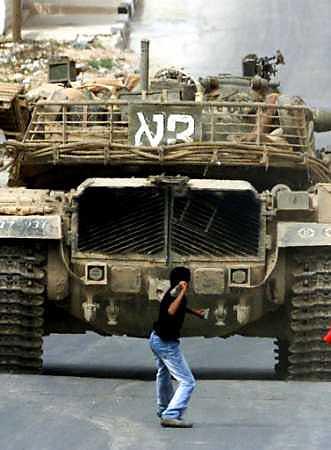
You can't fight tanks by throwing rocks at them. What you can do is take you attention elsewhere, live as if the tanks weren't there, kill them by ignoring them. Armed revolution would likely be a disaster: winning, we'd probably do no better, but we'd probably be crushed mercilessly. But what evil corporation can survive a sustained boycott? What government can survive once deemed irrelevant? The power that sustains these great systems comes from you and me, and nowhere else. And if we break from the trance of the supra-human scale, turn our backs permanantly and return to a focus on what's really here before us, and work simply to improve that, well, the whole will improve as a matter of course.

I mean that. There is no "whole," no such thing as a "nation," "state," "corporation," or "government" -- have you ever actually seen one? Of course not, they are imaginary mental constructs; over in reality, where I want to live, there are only individuals living their lives, via individual decisions. For example, there are no "vegetarians," there's just this person who isn't eating meat at this specific meal. The labels are useful shorthand, but to believe they are actually real is what has gotten us into this mess.

So alright, keep a finger on the pulse of events, but only one finger. Just live better. Starve the beast. Make choices to further your exit from the system. Bring this nightmare vision of globalism back to earth. It only exists in your mind, so stop giving it any mental attention. I believe this is the only peaceful route, and difficult; the beast will fight it like a starving lion. But eventually it will die, if we stay strong.

Eat, drink, and be merry

My other problem has been that I've been far too serious. I've lost my sense of humor about life. I must remember Death and it's great lesson: this too shall pass. Death, transience, allows us to relax in life. Not to disregard the suffering of others, but it puts things in perspective. This is, after all, a passing dream. What good does it do to live in despair the whole way through, over things beyond our control?

Our revels now are ended. These our actors,
As I foretold you, were all spirits, and
Are melted into air, into thin air:
And like the baseless fabric of this vision,
The cloud-capp'd tow'rs, the gorgeous palaces,
The solemn temples, the great globe itself,
Yea, all which it inherit, shall dissolve,
And, like this insubstantial pageant faded,
Leave not a wrack behind. We are such stuff
As dreams are made on; and our little life
Is rounded with a sleep.
The Tempest Act 4, scene 1, 148–158
And didn't someone once say laughter is the soundtrack of the revolution? Laughter is immeasureable, truly a power. Yes, it's hard to find a balance between being concerned, as we are when we hear tragic things, and having a good time, laughing and enjoying life. Keep in mind, wallowing in despair doesn't help the ones wrapped up in the tragedies; they don't need our pity and our tears. What might help is to stop feeding into the system that brings such tragedy to their distant shores. You can only act where you are. I think this guy has the right idea, showing us what can be done, at the human scale:

Wednesday, December 22, 2010

A Rant about Meditation

Another thing on meditation. Know what I hate? Every time you see a magazine or some web article about meditation, the picture is always of some woman in a tanktop and baggy pants sitting on a beach or something. Or else it's some old Tibetan monk in flowing robes sitting in some temple balanced precariously on a Himalayan crag.

News flash-- men meditate too, and not just Central Asian men. Also, you can meditate on the subway, or sitting in the gutter on skid row, or in the bedroom while the TV blares in the front room. It has nothing to do with flowing clothes, sunsets on the beach, or windy mountaintop temples.

We Americans reduce everything to image. If you wear the right clothes, and sit in these postures in peaceful places, and adopt a serene expression, you're doing it. You're wrong.

And no, I'm not really sure why this bothers me. It just does.

Wednesday, November 17, 2010

The Poverty of Wealth

I hear that most of the wealth of our nation lives in the cities. But when I look around at what we've built, all I can do is wonder why a wealthy people puts up with such an impoverished landscape. All the new buildings are bland and identical; you drive through whole developments, subdivisions, condo complexes, and everything looks the same. It's almost as bland and uniform as the old Soviet apartment highrises, except instead of gray, we might have some color splashed around. But it's a uniform color scheme, repeated on every condo, every house. Businesses like big box stores abound with blank walls facing every direction, and all the lawns sitting there as mere squares of flat green. What a waste.

Beyond that is what I call the tyranny of noise. It's appropriate that I'm reading One Square Inch Of Silence right now, because when you really stop and notice, here is no such thing as quiet space in a city. And most of the noise is just senseless. I've long had a major hatred against car alarms. I've never, ever in my life heard anyone say, upon hearing an alarm go off, "oh, someone must be breaking into that car!" Ever. I wonder if they're even effective for their intended purpose.

Yet, yesterday, with the windows open, I could hear them blaring all day. At one point, taking the trash out, one car just started going off on it's own. Nothing had touched it, nobody was around; the wind wasn't even blowing! But it honked for several minutes, filling the evening with noise and frustration. And earlier, one was going off for about a half hour before its hapless owner heard it, or the battery died. I really hope it was the latter.

I just don't know why we've all agreed to so much less than what's possible. A well-built cabin in the woods is more human than miles and miles of uniform condos. A meadow is more beautiful than a lawn. And a place where silence is at least an option is far more valuable than all the transportation systems in the world.