Like an old gull,
his life's one love long dead,
I wing far above the screaming flock,
idle on drifts and scraps
of wind,
against the sky silent and blue,
roaming the lonely hemisphere,
its mists and miles
compassed in this span of wings—
without pause,
thought, or comment, the ocean's fathoms
lose themselves behind me.
My eye swallows
the horizon's flat line
rather than the endless bump
and squabble of society.
Trading one confusion
for another.
A flash of light
from a breast clear white,
seen once and not again, I go.
Time is my possession now,
distance is what I eat, and eternity
is what I feed.
Dawn. Standing on the empty strand
eyes half closed,
with flowers of foam rolling in
as they always have,
as if remembering;
grey as the sea-fogs
giving birth to this winter sun,
I am returning
in a broken circle to you.
Thursday, February 17, 2011

Monday, February 14, 2011
Joining the Green Movement
The other day I discovered the website TED.com, a site that has tons of videos of talks and speeches by thoughtful, innovative people; I've been watching probably too many videos in my free time. I'll post links to some of my favorites at the bottom of this post. But this one I watched this morning:
Edward Burtynsky on manufactured landscapes
It's a long video for TED, but worth the time. It was interesting and in ways beautiful, but also hard for me to watch. All his images of China, and elsewhere, and the explosive growth, made me remember an article I read years ago, Humans as Cancer. Is there such a thing as explosive cancer? China would be it. But then, China is only the metastasis of Western growth models. It's a scary world we're busy making; it hurts my heart to look at it, to think about it.
I've long felt a despair of sorts, as far as environmentalism goes. For me, it has always been the major issue. I know on this blog I talk a lot about Zen and spirituality and such, but that's only so many words, probably useless to talk about. But the Green Movement, well, that's the big one. If ever there were a field I would go into, that would be it: sustainability, permaculture, deep ecology; these things thrill me, intellectually and practically. Spiritually too, I guess.
But I look at our culture and think it's a waste of time. Despair, not as an oppressive emotion (most of the time), but just as a knowing. We will never be able to transform into a sustainable culture, we are cancer. It stops me from acting, as I continually think it would be a waste of time to devote my life to these things, burnout and broken dreams the inevitable result. Better to escape to the hills, on a private off-the-grid homestead, in my own little corner of the good earth and hope the cancer doesn't follow me in. Fulfilling as that life could be in some ways, it is also apparent that this is supremely selfish.
It is the product of despair: the foolish humans cannot be helped, so fuck 'em. No use trying to fix a fundamentally flawed system, let it crash. It will crash, and what comes then will be an equilibrium-- but only because it was forced to be. We cannot engineer it, our thin layer of rationality cannot beat back the animal greed for more and more. It is a sad future I often foresee, akin to pondering the burning of the library in Alexandria centuries ago-- we will lose so many good things, advanced medical knowledge and ability, other advanced knowledge, democracy perhaps, and our one shot at having enough energy and reach to globally solve problems of hunger, poverty, and oppression through intelligent and compassionate connections and solutions. We may end up sustainable, but probably in the way that the Dark Ages were sustainable. Forced simplicity is poverty.
Growth for the sake of growth, Edward Abbey insightfully said, is the philosophy of the cancer cell. This is evil. There was potential, but it has been squandered. We grew, enriching a few people at the expense of the many, and of the wider biosphere to boot. If only we had grown compassionately, to bring a real "good life" not of material acquisition but of quality life to all. Used fossil fuel energy in moderation to piggyback us into a clean world, in tune with Nature, use resources conservatively and wisely, not, for example, to make products we use once then throw out (bottled water is an obvious example of such ridiculousness). We have been fools. Even the Green Movement, which I'd long hoped for but given up on, surprised me when it became popular... but it was quickly co-opted and ruined by consumerism, now become a cheap version of what it needed to be. Failure. Thus my despair.
A top-down goal is not what I want; those have a tendency to devolve into the totalitarian one-size-fits-all bleakness we see in evangelical religion and fascist states. The world is diverse, and needs a diversity of solutions. I know the value of and need for government and corporate action in all this, but I think the real change is going to come from the roots, organically; something that can be implemented in countless local variations. A network format, not a pyramid. Really, the model of the industrial revolution that brought us here: the individual entrepreneurial spirit, but put to something more than the profit motive. Which is really the ego motive: I want mine, and fuck all you others. But a wider goal, or shall we say vision, is needed first.
So, I watch these videos and feel inspired. I've occasionally met people doing these things, like on my AT thru-hike; in towns and on the trail, they were my first real contact with people who are doing the good things. And I still want to be involved in all that, in a hopeful future. Biomimricy amazes me, permaculture techniques and just the basic discoveries amaze me. The idea of networks, though I have little understanding of them, blows my mind. The stuff about using mushrooms and fungi, among other things, in biologically integrated technologies leaves me feeling giddy (the added thought that fungal networks may be conscious is a further thrill). Green roofs, alternative building techniques (cob, straw bale), community gardens, passive heating/cooling... all wonderful and exciting.
I just don't know how to get involved. I find myself drawn to organic farming/permaculture, through the WWOOF organization, and plan to try it out, if not this spring then next fall. Hopefully I can meet people who can point me in the ways I need to go. My problem is I have a great need to be outside, doing real work. I'm a paradox; I'm a "deep thinker" but for me, in the end abstraction is not an honest living. Too much sitting around thinking, not enough implementing. I want to be out there, in the real, doing the work. But also, I'm not an engineer, I won't be designing products or new technologies. I want to have my own land and live these ideas myself, but I think to limit myself to that is selfish and, well, lonely, futile. I want to have some impact on the world more than just improving a few acres of soil. Hope, I suppose, springs eternal, even in the face of terrible odds. I just don't know where or how to begin.
Neat videos:
Alex Steffen sees a sustainable world
Paul Stamets on 6 ways mushrooms can save the world
Janine Benysus: Biomimricy in action
Michael Pollan gives a plant's-eye-view
The Web as random acts of kindness
Christopher McDougall: are we born to run?
Edward Burtynsky on manufactured landscapes
It's a long video for TED, but worth the time. It was interesting and in ways beautiful, but also hard for me to watch. All his images of China, and elsewhere, and the explosive growth, made me remember an article I read years ago, Humans as Cancer. Is there such a thing as explosive cancer? China would be it. But then, China is only the metastasis of Western growth models. It's a scary world we're busy making; it hurts my heart to look at it, to think about it.
I've long felt a despair of sorts, as far as environmentalism goes. For me, it has always been the major issue. I know on this blog I talk a lot about Zen and spirituality and such, but that's only so many words, probably useless to talk about. But the Green Movement, well, that's the big one. If ever there were a field I would go into, that would be it: sustainability, permaculture, deep ecology; these things thrill me, intellectually and practically. Spiritually too, I guess.
But I look at our culture and think it's a waste of time. Despair, not as an oppressive emotion (most of the time), but just as a knowing. We will never be able to transform into a sustainable culture, we are cancer. It stops me from acting, as I continually think it would be a waste of time to devote my life to these things, burnout and broken dreams the inevitable result. Better to escape to the hills, on a private off-the-grid homestead, in my own little corner of the good earth and hope the cancer doesn't follow me in. Fulfilling as that life could be in some ways, it is also apparent that this is supremely selfish.
It is the product of despair: the foolish humans cannot be helped, so fuck 'em. No use trying to fix a fundamentally flawed system, let it crash. It will crash, and what comes then will be an equilibrium-- but only because it was forced to be. We cannot engineer it, our thin layer of rationality cannot beat back the animal greed for more and more. It is a sad future I often foresee, akin to pondering the burning of the library in Alexandria centuries ago-- we will lose so many good things, advanced medical knowledge and ability, other advanced knowledge, democracy perhaps, and our one shot at having enough energy and reach to globally solve problems of hunger, poverty, and oppression through intelligent and compassionate connections and solutions. We may end up sustainable, but probably in the way that the Dark Ages were sustainable. Forced simplicity is poverty.
Growth for the sake of growth, Edward Abbey insightfully said, is the philosophy of the cancer cell. This is evil. There was potential, but it has been squandered. We grew, enriching a few people at the expense of the many, and of the wider biosphere to boot. If only we had grown compassionately, to bring a real "good life" not of material acquisition but of quality life to all. Used fossil fuel energy in moderation to piggyback us into a clean world, in tune with Nature, use resources conservatively and wisely, not, for example, to make products we use once then throw out (bottled water is an obvious example of such ridiculousness). We have been fools. Even the Green Movement, which I'd long hoped for but given up on, surprised me when it became popular... but it was quickly co-opted and ruined by consumerism, now become a cheap version of what it needed to be. Failure. Thus my despair.
A top-down goal is not what I want; those have a tendency to devolve into the totalitarian one-size-fits-all bleakness we see in evangelical religion and fascist states. The world is diverse, and needs a diversity of solutions. I know the value of and need for government and corporate action in all this, but I think the real change is going to come from the roots, organically; something that can be implemented in countless local variations. A network format, not a pyramid. Really, the model of the industrial revolution that brought us here: the individual entrepreneurial spirit, but put to something more than the profit motive. Which is really the ego motive: I want mine, and fuck all you others. But a wider goal, or shall we say vision, is needed first.
So, I watch these videos and feel inspired. I've occasionally met people doing these things, like on my AT thru-hike; in towns and on the trail, they were my first real contact with people who are doing the good things. And I still want to be involved in all that, in a hopeful future. Biomimricy amazes me, permaculture techniques and just the basic discoveries amaze me. The idea of networks, though I have little understanding of them, blows my mind. The stuff about using mushrooms and fungi, among other things, in biologically integrated technologies leaves me feeling giddy (the added thought that fungal networks may be conscious is a further thrill). Green roofs, alternative building techniques (cob, straw bale), community gardens, passive heating/cooling... all wonderful and exciting.
I just don't know how to get involved. I find myself drawn to organic farming/permaculture, through the WWOOF organization, and plan to try it out, if not this spring then next fall. Hopefully I can meet people who can point me in the ways I need to go. My problem is I have a great need to be outside, doing real work. I'm a paradox; I'm a "deep thinker" but for me, in the end abstraction is not an honest living. Too much sitting around thinking, not enough implementing. I want to be out there, in the real, doing the work. But also, I'm not an engineer, I won't be designing products or new technologies. I want to have my own land and live these ideas myself, but I think to limit myself to that is selfish and, well, lonely, futile. I want to have some impact on the world more than just improving a few acres of soil. Hope, I suppose, springs eternal, even in the face of terrible odds. I just don't know where or how to begin.
Neat videos:
Alex Steffen sees a sustainable world
Paul Stamets on 6 ways mushrooms can save the world
Janine Benysus: Biomimricy in action
Michael Pollan gives a plant's-eye-view
The Web as random acts of kindness
Christopher McDougall: are we born to run?
Friday, February 11, 2011
Freedom

Stop to think on freedom but a moment, and the limits loom into view. It is, we say, a free country, but just how free really? Boundaries always lurk in the shadows of the mind, the hidden recesses of a culture. Cultures are defined by these; definitions, edges, these are boundaries, seperating us from them. No society is truly free.
But, free in many ways we are. Free to be different, in a non-threatening way. Free to think, but not to alter consciousness. Free to choose between a million worthless products. Free and encouraged to be distracted. Freedom of the open road, but if you walk, expect the police, the mirrored sunglasses and pointed questions. Don't be caught without any money, or you will be free to go to jail for vagrancy. Free to think but not to act; that is, free to go along in a thousand different ways, but not to protest: expect handcuffs, billy clubs, tear gas. Or else free to be ignored. Free to live anywhere, save on the street, where the cops rouse the sleeping bums. Free, however, and very free, to be poor. Free to change your social position, if you can afford it. Free to sink in free fall to utter loneliness, isolation, poverty, despair, sickness and insanity, but not free to put an end to it all. You are free, you are required, to live. But not free are the basics of life: water, food, housing. Free to breathe dirty air, drink dirty water, and to leave the lights on always.
I guess what I mean is, I no longer understand this word the politicians use. I guess what I really want to know, is what does liberty mean to you? What does it mean to be free?
Wednesday, February 9, 2011
Caffeine

Been feeling a little down in general lately, thinking it could be caffeine withdrawals: they take four or five days, and I'm on day three. Weird, all this from just one cup of coffee, I guess I'm sensitive to it. Right now I'm trying to decide if I really mind being addicted to caffeine. I generally abhor the thought of being addicted to anything, but caffeine suits me. I like the lift, really appreciate it, as I tend towards low energy. Also it helps me write and think, get's the juices flowing, and that feels good too. But if I'm going to be this sensitive to one cup of joe, I either need to dive into a full on habit, or go decaf for good. These withdrawals suck. I admit I'm leaning towards accepting this addiction.
 Really, though, it's kind of an interesting thing to experiement with it; you never notice these effects (for me, very low energy at the 48 hour mark, and generally depressive feelings for a few days) when you're having caffeine daily. I wonder if everyone gets this way and just never notices, either because they never have a long enough break from the stuff or because they just attribute it to other causes, sleeping poorly or feeling sad about other things.
 I was thinking today at work that perhaps caffeine is the most defining drug of our Western culture. Tea for the British was (and is?) a critical thing, and let's face it, we in America are just the bastard stepchildren of the Brits. We, however, upped the ante to coffee. It fuels our 24-7 culture of workaholism and constant motion. It is often said that western man doesn't know how to slow down and really relax, to rest and reflect. Perhaps the fact that from early childhood we are dosed daily with caffeine: pop, tea, coffee, and now energy drinks and caffeine pills. I personally graduated to coffee in middle school, never having been big on pop, besides root beer. I think I was imitating my father, too.


It is, of course, hard to know if we are go go go because of caffeine, or if we find caffeine fits into a pre-existing (hyper)active cultural trait. And of course there is a fatal flaw: green tea (and tea in general?) was first used by Buddhist monks, a pretty relaxed bunch. They used it to stay awake in long meditation sessions. And the Muslims with their coffee (it is definitely the cultural drug of the Arabs), I don't know enough to say if they are a hyperactive lot. They always seem pretty literate, though, and thoughtful, deep; perhaps they channeled their buzz into religious thought, art, writing, poetry, and the like, not to mention street protests. And generally caffeine is the most used psychoactive substance on Earth. So it's not like it's unique to us.
Maybe this is all a little silly, this whole idea. Maybe I'm taking this to absurd lengths. But If you all have thoughts, I'd like to hear them. Meanwhile I think I'm gonna go make up some green tea...
Monday, February 7, 2011
Nirvana For All! 2
I suppose my previous post may have been misleading, as it was simply a thought experiment, hoping to illustrate some of the ridiculous aspects present even in great wisdom traditions. It is not my position of things. The spiritual progression I was referring to was our increasingly clear understanding of things, not the actual advancement of souls through "better and better" forms of life.
I don't think I believe in a spiritual evolution, or any hierarchy of plant vs animal vs human. Not to say I don't believe in biological evolution. But, well, biological evolution is not linear, for one thing. The bacteria in my colon is just as modern as I am, and they are not trying to evolve towards humanity. And spiritually, they are as much one with the Tao as am I. I don't think the trees, birds, and bacteria are the souls of humans that have fucked up and gotten all this karma stuck to them, nor do I think humans are higher spiritually than anything else.
My original question was, how could a tree devolve at all? It can't fight against its upward growth, can't stop its roots from searching downwards, can't stop its leaves falling in autumn. And how can it progress? It is already perfectly at one with its nature, and has no way to be otherwise. As for acting instinctually: I don't think instinct means unconsciousness. Animals are directly aware of the world, but they aren't self-aware, aren't actively choosing, aren't questioning their motives.
But, wouldn't some ability to choose or change be required to spiritually evolve? What other mechanism is there for spiritual growth? It seems to depend on awareness, self-consciousness, reflection, self-discipline and/or increasing understanding. We should be careful about judging other beings by human standards. A bird doesn't have self-knowledge or the ability to reflect on its actions. I don't consider this ignorance. Humans have these abilities, and I don't consider them as better or higher for it. It is just a different "inner nature," a different way to be.
(Now, gradations do exist. Apes, dolphins, elephants, and such do have some level of self-awareness, and the ability to reason. That itself is a fascinating question and perhaps useful for understanding the “human question,” but is a topic for another post.)
Often we say, we are not in harmony with the Tao. But this is not true. In reality, we are one with it, and could never be otherwise so long as we exist; there is no escaping it. Just as when we think about the past or future, totally wrapped up in it, those thoughts occur in the present moment. Somehow, the discord is part of the harmony. Seeing through the illusion that we are anything other than our nature, that is enlightenment.
This is why I don't think spiritual evolution is a helpful idea. All that is, is at one with the Tao. All this about progressing towards something is actually a hindrance. We're already there, it's just a matter of seeing it. This is why the Buddha was right: there's no need to be born into the Brahmin class, and this is why I don't think animals and plants or anything has to wait to be a human. Tao is always right there, waiting to be seen. The only “problem” anywhere, is that we humans are living in illusion. Animals (and plants and bacteria) aren't in illusion, because they are directly confronting reality as it is, not as they pretend it to be; so there is no need to "evolve" towards any spiritual state. They're there.
At most I'm willing to grant a sort of spiritual evolution that has nothing to do with progress or higher or lower states. One where the universe is toying with novelty, in finding new (not better) ways of looking at itself. Maybe a sort of ratcheting up into more complexity, as per Teilhard de Chardin's Omega Universe or Robert Pirsig's Metaphysic of Quality. So novelty arises. For us that means self-consciousness and reflection. But that doesn't mean all living things are going that way. It just means the universe ratcheted "up," and it stuck in humanity. From here it may ratchet some more. And who knows, maybe in some animal out there, it will ratchet in a still different direction, unknown to us.
Disclaimer: it's amazing how easy it is to sound like you know what you're talking about with these things, isn't it? Truth is, the "human question" continues to baffle me. We do seem unique, and I don't know what to think about it. At the same time, no one knows what it's like to be a tree or a bird, so it's all speculation in the end. For that matter, I don't understand what living in tune with the Tao while still having self-consciousness and reflection means, what that would look like. How to be human without this inner conflict and tension. I don't really even know what consciousness is, though I consider it the ground of being. This blog is just a way for me to work on hammering all these questions out, and is to be taken provisionally. Your comments often spur me on, forcing me to think deeper, or see different angles, so I appreciate that.
I don't think I believe in a spiritual evolution, or any hierarchy of plant vs animal vs human. Not to say I don't believe in biological evolution. But, well, biological evolution is not linear, for one thing. The bacteria in my colon is just as modern as I am, and they are not trying to evolve towards humanity. And spiritually, they are as much one with the Tao as am I. I don't think the trees, birds, and bacteria are the souls of humans that have fucked up and gotten all this karma stuck to them, nor do I think humans are higher spiritually than anything else.
My original question was, how could a tree devolve at all? It can't fight against its upward growth, can't stop its roots from searching downwards, can't stop its leaves falling in autumn. And how can it progress? It is already perfectly at one with its nature, and has no way to be otherwise. As for acting instinctually: I don't think instinct means unconsciousness. Animals are directly aware of the world, but they aren't self-aware, aren't actively choosing, aren't questioning their motives.
But, wouldn't some ability to choose or change be required to spiritually evolve? What other mechanism is there for spiritual growth? It seems to depend on awareness, self-consciousness, reflection, self-discipline and/or increasing understanding. We should be careful about judging other beings by human standards. A bird doesn't have self-knowledge or the ability to reflect on its actions. I don't consider this ignorance. Humans have these abilities, and I don't consider them as better or higher for it. It is just a different "inner nature," a different way to be.
(Now, gradations do exist. Apes, dolphins, elephants, and such do have some level of self-awareness, and the ability to reason. That itself is a fascinating question and perhaps useful for understanding the “human question,” but is a topic for another post.)
Often we say, we are not in harmony with the Tao. But this is not true. In reality, we are one with it, and could never be otherwise so long as we exist; there is no escaping it. Just as when we think about the past or future, totally wrapped up in it, those thoughts occur in the present moment. Somehow, the discord is part of the harmony. Seeing through the illusion that we are anything other than our nature, that is enlightenment.
This is why I don't think spiritual evolution is a helpful idea. All that is, is at one with the Tao. All this about progressing towards something is actually a hindrance. We're already there, it's just a matter of seeing it. This is why the Buddha was right: there's no need to be born into the Brahmin class, and this is why I don't think animals and plants or anything has to wait to be a human. Tao is always right there, waiting to be seen. The only “problem” anywhere, is that we humans are living in illusion. Animals (and plants and bacteria) aren't in illusion, because they are directly confronting reality as it is, not as they pretend it to be; so there is no need to "evolve" towards any spiritual state. They're there.
At most I'm willing to grant a sort of spiritual evolution that has nothing to do with progress or higher or lower states. One where the universe is toying with novelty, in finding new (not better) ways of looking at itself. Maybe a sort of ratcheting up into more complexity, as per Teilhard de Chardin's Omega Universe or Robert Pirsig's Metaphysic of Quality. So novelty arises. For us that means self-consciousness and reflection. But that doesn't mean all living things are going that way. It just means the universe ratcheted "up," and it stuck in humanity. From here it may ratchet some more. And who knows, maybe in some animal out there, it will ratchet in a still different direction, unknown to us.
Disclaimer: it's amazing how easy it is to sound like you know what you're talking about with these things, isn't it? Truth is, the "human question" continues to baffle me. We do seem unique, and I don't know what to think about it. At the same time, no one knows what it's like to be a tree or a bird, so it's all speculation in the end. For that matter, I don't understand what living in tune with the Tao while still having self-consciousness and reflection means, what that would look like. How to be human without this inner conflict and tension. I don't really even know what consciousness is, though I consider it the ground of being. This blog is just a way for me to work on hammering all these questions out, and is to be taken provisionally. Your comments often spur me on, forcing me to think deeper, or see different angles, so I appreciate that.
Saturday, February 5, 2011
Nirvana For All!
Not yet become a Buddha,
this ancient pine tree,
dreaming --Issa
Issa was a great poet, my favorite haiku master, he's very "human." But while the image here is beautiful, I don't like the philosophy underneath it. Okay, so: the Hindus believed that one must be born in the Brahmin caste in order to attain Moksha, enlightenment. Buddhism arose out of that milleau, asked, "why wait?" and said Nirvana is there for all, always. But it was said that all other beings, from gods to demons, angels to the grasses and insects, were stuck in the wheel of Samsara, waiting to be human; for only humans could attain Nirvana. Now, this seems pleasant, for a moment-- even the gods envy our auspicious position; good for us, we're in the right sphere of life. But there are implications (aren't there always?).
I look out my window at the oak growing up through the lawn, and wonder what this tree could ever do to produce the karma, good or bad, that is required to keep it in this wheel of samsara, the round of suffering. It's just a tree! It grows exactly as it does, perfectly. No ulterior motives, no nothing. Likewise the birds in its branches; they are simply themselves. Even if they do have glimmers of recognizable consciousness, they act on instinct, they live in the moment, as the Buddhas instruct. Karma is translated as "action," understood as acting with expectation; trees and birds don't act that way. Crossing into Taoism, the central idea is to attain a state of wu-wei, or "non-doing," in the sense of just going with the flow of the situations, of the Tao; it is the mark of a sage. And yet this is exactly what the tree is doing out there.
So one must wonder: if a tree or a bird or any other living thing dies, after its life of pure existence, is it reborn as a human again? It there, between one human life and another, a one-life interlude as some other creature or plant? It leads to a ridiculous chain of logic: imagine how many insects die every day, how many rodents, or any of the smaller creatures. A seed, an acorn, is alive, it is a baby tree; but most do not live to adulthood, most don't make it out of the seed. What about individual cells? In my body, untold numbers of cells die every day, both my own cells and the bacteria. They didn't ring up any karma, surely. Point is, there aren't enough humans to be born to offset the supposed progression from plant to animal to human.
And on the other hand, if a man is bad in this life, accumulates much karma, he is often imagined to be reborn as a worm or a bean plant or whatever. This is seen as bad. I say, hey, great! To live as anything other than a human is to live in peace. Ever seen an irritated tree? Or a spiteful worm? A bird miserable about his lot in life? Animals, and of course plants, don't worry, don't plot, don't stress, don't agonize over decisions, don't act out of hatred (or out of compassion for that matter). They simply do their thing, purely. Wu-wei.
The difference is the difference between pain and suffering. The former is physical, but the latter is purely mental. It's the build-up of all suffering into one moment, through memory and the miserable, self-centered "why me?" thoughts. Animals feel pain as pain, but they don't worry about hurting; they simply hurt. Only humans suffer. We're the ones out of sync; the trees are doing just fine. And if bitter old grandpa was reborn as a dung beetle, good for him! He's escaped the wheel.
All kidding aside, it's kind of a natural progression of thought, I think. From class oriented salvation, to human oriented salvation, to Buddhahood for all that lives, and for the rocks as well. Ever farther from the heirarchies we go. To leave behind the human centered concepts has been a theme of the past few centuries, thanks to telescopes and microscopes and science. It's good; it lets us shed such confusions and contradictons, it leads to a more honest spiritual system, a more reasonable philosophy.
this ancient pine tree,
dreaming --Issa
Issa was a great poet, my favorite haiku master, he's very "human." But while the image here is beautiful, I don't like the philosophy underneath it. Okay, so: the Hindus believed that one must be born in the Brahmin caste in order to attain Moksha, enlightenment. Buddhism arose out of that milleau, asked, "why wait?" and said Nirvana is there for all, always. But it was said that all other beings, from gods to demons, angels to the grasses and insects, were stuck in the wheel of Samsara, waiting to be human; for only humans could attain Nirvana. Now, this seems pleasant, for a moment-- even the gods envy our auspicious position; good for us, we're in the right sphere of life. But there are implications (aren't there always?).
I look out my window at the oak growing up through the lawn, and wonder what this tree could ever do to produce the karma, good or bad, that is required to keep it in this wheel of samsara, the round of suffering. It's just a tree! It grows exactly as it does, perfectly. No ulterior motives, no nothing. Likewise the birds in its branches; they are simply themselves. Even if they do have glimmers of recognizable consciousness, they act on instinct, they live in the moment, as the Buddhas instruct. Karma is translated as "action," understood as acting with expectation; trees and birds don't act that way. Crossing into Taoism, the central idea is to attain a state of wu-wei, or "non-doing," in the sense of just going with the flow of the situations, of the Tao; it is the mark of a sage. And yet this is exactly what the tree is doing out there.
So one must wonder: if a tree or a bird or any other living thing dies, after its life of pure existence, is it reborn as a human again? It there, between one human life and another, a one-life interlude as some other creature or plant? It leads to a ridiculous chain of logic: imagine how many insects die every day, how many rodents, or any of the smaller creatures. A seed, an acorn, is alive, it is a baby tree; but most do not live to adulthood, most don't make it out of the seed. What about individual cells? In my body, untold numbers of cells die every day, both my own cells and the bacteria. They didn't ring up any karma, surely. Point is, there aren't enough humans to be born to offset the supposed progression from plant to animal to human.
And on the other hand, if a man is bad in this life, accumulates much karma, he is often imagined to be reborn as a worm or a bean plant or whatever. This is seen as bad. I say, hey, great! To live as anything other than a human is to live in peace. Ever seen an irritated tree? Or a spiteful worm? A bird miserable about his lot in life? Animals, and of course plants, don't worry, don't plot, don't stress, don't agonize over decisions, don't act out of hatred (or out of compassion for that matter). They simply do their thing, purely. Wu-wei.
The difference is the difference between pain and suffering. The former is physical, but the latter is purely mental. It's the build-up of all suffering into one moment, through memory and the miserable, self-centered "why me?" thoughts. Animals feel pain as pain, but they don't worry about hurting; they simply hurt. Only humans suffer. We're the ones out of sync; the trees are doing just fine. And if bitter old grandpa was reborn as a dung beetle, good for him! He's escaped the wheel.
All kidding aside, it's kind of a natural progression of thought, I think. From class oriented salvation, to human oriented salvation, to Buddhahood for all that lives, and for the rocks as well. Ever farther from the heirarchies we go. To leave behind the human centered concepts has been a theme of the past few centuries, thanks to telescopes and microscopes and science. It's good; it lets us shed such confusions and contradictons, it leads to a more honest spiritual system, a more reasonable philosophy.
Tuesday, February 1, 2011
Snow Storm Post
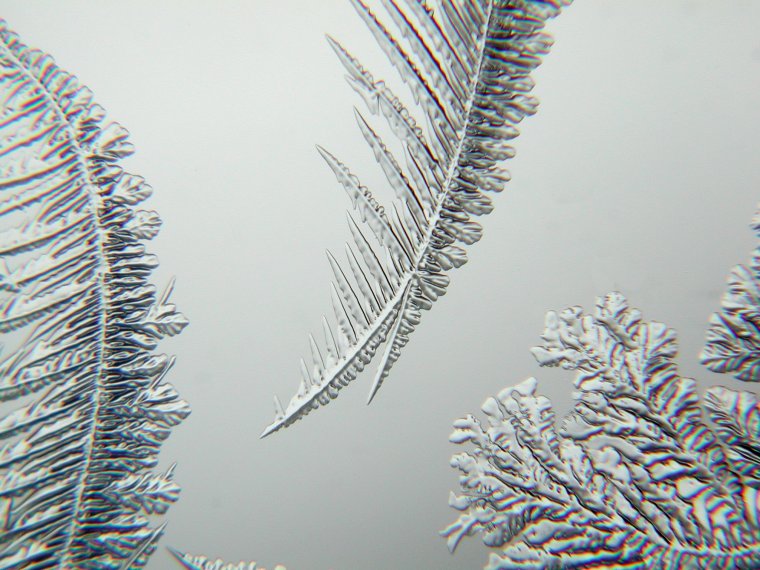
the man's grunt
on seeing his windshield—
dawn-lit frost
So the news is the big winter storm hitting the country. It even brought some arctic weather to us here in Dallas-Fort Worth, temperatures around 20, and enough snow and ice (about an inch) to close all schools and work. Not that anyone told me, I was up at 5:30 for the slow and dangerous drive in over a solid sheet of ice, sat in the parking lot for an hour waiting for someone, anyone, to show up. Bastards. But it's all good, nice to have a day off, though I know in Michigan I never once had a "snow day" from work... Texans are pussies.
I love snowstorms. It's good to have the bustle of the city world forced to slow down. Though here there's none of the shared cameraderie like when a city is buried in feet of snow and everyone's outside shoveling, pretending to complain but always with the hint of a smile and a glimmer in their eyes... still, while I was at the coffee shop treating myself to too much coffee, there was still the requisite good-natured grumbling between us patrons and the staff.
Meanwhile, outside Winter was smiling her great white toothy smile, laughing in the little "dust devils" of powdery snow busy drifting everywhere in a thousand intricate patterns, glittering in a million places as the ice throws back broken scraps of sunlight. The people complain but Winter is glorified in their very breath, the angry words transformed into a praise of things frozen immediately upon leaving their mouths.
Though I don't miss frigid temperatures of Detroit all that bad, it's nice to get a taste of winter. I'm a northerner at heart, and it's still surreal to me to see old men out mowing their dust-billowing lawns in January. So here's a few winter-themed haiku in honor of this probably equally brief moment of winter, at least for us here in north Texas.
frosted glass...
the silver moon seen
through winter-bare trees
silent as the snowfall...
the crow,
flying away.
the puppy's cocked head
in her first snowfall--
how interesting this life is!
deep snow
and paper birch—
the silence of white light
the starling's
speckled breast--
flying through the flurries
winter fog
off the sea...
one crow calling
Subscribe to:
Posts (Atom)