Showing posts with label books. Show all posts

Sunday, December 16, 2012

What We Leave Behind

I picked up Derrick Jensen's book What We Leave Behind the other day. As always, I find him hard to read. I respect him for what he's saying, and I know he's just being honest and unrelenting in his condemnation of our ravaging civilization, but it's still very gloomy reading. He's definitely a glass-half-empty type of guy:
Back to this morning. I step outside, napkins in hand. I hear the birds singing back and forth, and I'm reminded of the ongoing destruction of the planet.
There's Derrick, being his usual cheerful self. Like I said, hard to read, though he's right on target and has a lot of good info. Especially the first part of the book, much of it about waste, garbage, feces, and so forth. The historical perspective was interesting, about how people viewed garbage (really, they didn't, since garbage was not waste, but a resource, and was utilized). Made me think about my own.

For starters, human waste. The napkins he's holding were for toilet paper, as he now prefers to poop outside in the forest. As I pondered, I remembered something I wrote long ago as a teenager:

I feel so cut off from the jump and flow of life. I am totally disconnected from almost every part of my life. I have never seen the plants or animals that produce my food; I don't usually even know what country they come from, let alone what specific farm or farmer produces them. I do not know where my water comes from, where it has been, or where it goes. I don't know the people who made my tools, furniture, clothes, or electronics, I don't know the trees, plants, and mineral deposits where the materials came from. They show our leaders on the television, but I've never met them. I do not know where my urine or feces goes, or what is done with it. And the heat for my house comes from fossil fuels I've never seen burned in plants I've never seen.  

I wrote that when I lived in Michigan, and it still applies today, in Florida. I've looked into some of these things, for this post, and learned about a few of them. For example, I know the water here comes from reverse osmosis plants pumping water from the aquifer under my feet. I could go see the plants if I wanted to, all three are in this very city. My garbage ends up in an incinerator -- pleasantly called "waste to energy" or, even better, "resource recovery" plants --  from which [some of] my electricity also comes. The sewage, hard to figure out, it seems that after treatment, the dried sludge used to go to a landfill, then Cape Coral started turning it into humanure, but something changed this year and I can't find out if they still do that or now send it to a landfill; all the newspaper links are inaccessible, and this article is ambiguous. 

So it's not that I can't find these things out, though some are rather more difficult to find than they should be. No, the real problem is that I have to ask at all. Shouldn't it be painfully obvious to an organism where it's shit goes? I mean, it's my shit, I put it where I put it; but we've built a system in which the shit doesn't stay where it's put, it goes somewhere, is acted upon by others. That's weird. Of course, it always was acted on by others, but those others used to be merely soil organisms, or maybe a hungry dog. And to not know where my water comes from? Or my food? This is a matter of grave concern, all of it. 

Because (I skipped ahead in the book) Jensen talks about fighting back. But I think he's deluded. On the other hand, this may be why he's so sad. Of course in the end people know the Earth supports them. But our experience (and Jensen even says this himself) is that water comes from a faucet, food from the supermarket, shit goes somewhere else. Everything is abstract. And when it comes down to that, one will fight to the death to defend it; not to overthrow it. No one is going to work to destroy that which supports them. Which is weird to say because that is what modern civilization is actually doing, but it's removed from experience, a mere abstraction. Our immediate reality tells us that to fight back is to fight against getting food, water, sanitation, and all the rest. 

Jensen quotes someone saying something like "do not have a revolution until you are prepared to eat rats." And this is the crux. One might fight back against a regime, or even a type of economic system, as they have done for all of history. But even the communists didn't want to destroy civilization, not even industrial civilization. This is a whole other order of problem which we are being asked to fight against. Something right down to the core of our lives. No one knows how to live without civilization, except a few pockets of indigenous peoples around the world. In fact, to overthrow civilization would be to doom billions to starvation and death, because you can't support that many without it. 

Which is tragic, because of course this is what the Earth needs most, an overthrow of, at the very least, modern civilization as it works now. I don't know if civilization in any form is sustainable, let alone if a high tech one is, as the techno-futurists fantasize. But we're going to hit limits eventually, probably soon, or maybe already. And that's going to hurt, and things will change as a matter of course. I've read that Native American civilizations like Cahokia, when they got overpopulated and teetered over the unsustainable cliff, just went back to hunting and gathering and small farming, having never lost the skills totally. They were never so many, or so estranged, that this was impossible; this is not true for us. 

The other tragedy is, of course, that of human dignity and self-determination. A man used to be his own sanitation engineer, by moving his outhouse now and then (actually, this isn't sustainable either, read this). He didn't have to delegate his power out to specialists and technicians. He grew or hunted his own food, drank from a local stream, which didn't need reverse osmosis plants, made his own clothes, tools and furniture, or knew the men and women who did. His garbage decayed and enriched the soil, and so was not garbage. His body would eventually do the same. 

I have to admit, I was especially irritated to not be able to find out where the sludge solids go around here. Here we are, mining the worlds soils of nutrients with our agricultural model, never adding anything back but poisonous fertilizers, converting it into feces, and then, where do those nutrients go? I hate the thought of them being stuck in a landfill, or incinerated (the ashes to go to a landfill), to mix with heavy metals and toxic chemicals (which they've already done in the sewers and incinerators). It's like taking the world's fertility, mixing it with poison, and burying it far from the access or use of any living thing save some extremophile anaerobic bacteria. Same goes for human bodies, for that matter. We're running 200 species extinct daily, stealing the Earth's productivity to make human flesh, then, when they die, soaking them in embalming chemicals for burial in hermetic concrete vaults. 

Madness. Madness. How can this go on?

Sunday, November 25, 2012

Was It Worth It?


I'm reading Alan Watts' book The Supreme Identity again. It's one of his older works, and one of the best books I've read on metaphysics, because it is a very reasoned argument he makes, building up on some pretty solid premises. It's a pretty hard read, therefore, for both that reason, and the fact that he takes a lot of time explaining things, to try to make clear a subject that is inherently hard to talk about. I will also note that he wrote this while still an Anglican priest, and he admits in the intro that, because he was still "in the system" as it were, trying to match Vedanta and Christian theology, it is, perhaps, "somewhat torturous." Still I find it illuminating. Not a good intro to his writing, though. 

I'm on the part where he's discussing the Problem of Evil. I won't get into the arguments here, I haven't the time and it'd be better if you just read it (the whole book, that is), for I'm sure to ruin the argument in trying to simplify it here. But briefly, he argues for a God that, rather than being absolutely good, is the source of both good and evil (in the finite, relative realm), while Himself transcending both. Towards the end of the chapter he says something like how, from our limited perspective, evil seems absolutely terrible, yet, from the standpoint of the infinite, it is an integral part of the finite duality, and even the most atrocious acts are worth it, for the overall beauty of the whole Creation. He likens it to standing with your face pressed to a painting; stepping back, you suddenly see that those ugly shadows are what give shape, form, balance, and identity to the light and color.

Now, I talk a good deal on here about civilization and it's pitfalls. I've long sympathized with the Daniel Quinn/Ishmael position that civilization has been the cause of many of the negatives we see in the world today: war, poverty, starvation, disease, environmental degradation. These may exist at a basic level in all humanity, true, but civilization grows them to a scale unimaginable at that level.


So, has it been worth it? Much as we hate war and genocide, crushing poverty and tyrannical rulers, plagues and pollution and extinction...do things like high art, advanced medicine, the internet and global communications, justify it? I have a hard time here. Human history has been a bumpy road, full of inhumanity and horrors that we in the West can hardly imagine, given our plush lifestyles. No living American has had a war happen in their own backyard, we really have no idea. Though there are systemic problems, the vast majority of us don't know true poverty, true starvation. These things are everywhere in poorer places, a vast suffering of masses of people. They would still be living at peace if it weren't for civilization, close to the Earth, in communities where no one is left behind. If it weren't for agricultural surplus, expanding populations, and urbanization, there could never be slums and shantytowns.

But I must admit it hurts my very heart to imagine a world without Ode To Joy. Whenever it plays, I feel like I want to burst with happiness, and tears often come to my eyes. Or Starry Night, by Van Gogh; my favorite painting. A perfect case in point, actually; the man, like civilization, was tortured and half-insane, yet look what came of it! Or, appropriate to today's topic, Edvard Munch's The Scream; a creepy painting, yet it stirs the soul. What about all the poetry, the great novels and plays, the elegance of higher mathematics? What about telescopes revealing the heavens, microscopes showing us worlds within? What about the rush of foreign money and help when a disaster strikes a place like Haiti? Before such a thing would be impossible, if ever we learned about the disaster in the first place.

One can narrow it down to religion, as they did in one of the Intelligence Squared debates. We all know of the bigotry, the crusades and jihads, the suicide bombers on buses, the gay-bashing and abortion clinic bombings, the strife in South Asia, the Troubles in Ireland. They are terrible. But religion has also brought us the stained glass at St Denis Cathedral, in fact all of the great cathedrals, mosques, temples, and shrines. Most of the art down the long centuries has been religiously inspired, if not overt iconography. And what about the joy and giving at Christmas, the pillar of Islam that requires charity, the ideals of love and brotherhood, compassion and kindness? It hasn't been all bad, you know?

Tribal equality is a wonderful thing, and clearly mankind evolved to fit that lifestyle. We certainly have problems squaring a tribal mind to a globalized world. Yet, we have grown, stumbling, into something more. Tribes are isolated, closed within themselves, extremely conservative and narrow. Today, we have ideals of universal brotherly love, individual freedom and innovation. Such things would never occur to a hunter-gatherer, because it is born out of the long march of history, which has slowly built upon our awareness.

Is this all we've become?
I'm also reading Lord of the Rings (I usually have several books going at once), and think of the elves in this case. Immortal, they watched as evil first came down into the world, and watched as many great and lovely things died or faded. At one point, Merry, a hobbit, states that he has never until this quest been outside his country, and, had he known the perils that awaited, he should not have had the courage to do so. Haldir, an elf, says in his reply, "The world is indeed full of peril and in it there are many dark places. But still there is much that is fair, and though in all lands love is now mingled with grief, it grows perhaps the greater."

It grows perhaps the greater. The play of duality in the world is inevitable, and is what gives us joy and love, even if it also requires we know sorrow and hate. And of course, civilization is, and all this discussion is rendered moot by that fact. We are here, and there's no going back. Even if we had the deepest, darkest collapse from modern society, we would have the memory of civilization, would still almost surely continue agriculture, metallurgy, the use of animal labor, and other such advanced things. I doubt we could ever slide all the way back to the sort of natural tribal state that the Cro Magnon lived within.

I'm not sure we should want to, either. I've never been too sure about "spiritual evolution" but in some sense, we have in fact matured as a species. Many things have been discovered within ourselves that likely would not have been under the simple tribal conditions. We needed a more complex substrate, that of civilization, to bring it out of us. Emergent properties. We often do a lousy job exhibiting these higher things, of course. But they are there, waiting for each one of us.

To those of you who have read this far, I beg you to reply. This is one post I'd be very interested to have a discussion on, to hear your opinions and thoughts on the topic: Has it been worth the pain, to walk this road of civilization? Would we have been better off remaining stone age adepts, wise in a simple way, in tune with Nature? Or is it a good thing, in spite of all the hurt and horror, to have come this way, and to have found the more refined aspects of heart and mind?

Wednesday, August 29, 2012

Pressure Valve

I was sitting at the library reading The Story of B by Daniel Quinn, a second reading for me on that particular book. There is one lecture given by the character B, where he goes through the doubling of population through the ages. He details how the problems facing complex societies, from the instituting of kings and rulers as war chiefs, to crime, corruption, plague, famine, and the like, get worse as populations grow more crowded. Reading the section, now I forget the exact years, but it was something like 1500-1700, as he's talking about how as the population has doubled yet again the issues have gotten worse, he mentions in passing something about the New World.

It occurred to me that the New World was sort of a pressure valve for the Old World, Europe especially. Just as Europe was starting to really rub up against its geographical limits, and therefore whatever limits the land's carrying capacity entails, just as any possible agricultural land had been put to the plow, just as the rivers and nearby seas were about fished out, just as the socio-political pressures were building to really dangerous levels, an avenue of release was found.

Now Europe could continue expansion without the dangerous conflagrations of peasant revolts and uprisings, or at least with somewhat less of them. They could grab the riches of the new lands, the timber, furs, gold, and silver, and thus have the material with which to continue the project of civilization. They could reap the fish, the new crop-foods, could colonize and farm the new lands, and so feed their hungry masses. They could shunt off the agitating lower classes and religious sects to the New World, far from the political power, thus weakening their complaints further. They could ship criminals off, could sell the street urchins, beggars, and poor into indentured servitude, a fate often worse than actual slavery.

Just as Europe was reaching a crisis point, it almost seems, it found a backdoor for a brief respite. Much like the development of the North Sea Oil Field put off Peak Oil for a couple decades. Because this backdoor into the Americas was only a prolonging of things. Now the Americas are in many ways filled up and used up. Most agricultural land is in service (there are exceptions, like land the government pays to keep fallow, for price controls, for example). Most of the old forests are gone, most of the major gold deposits have been mined. We were again saved by the Green Revolution, which increased crop yields, but in a way it was a Trojan Horse: we grew the population while destroying the soil's ability to produce, and created superweeds and superpests, each with a growing resistance to our pesticides. Sometimes the soil just washed or blew clean away.

We're living on the dregs, just as Europe was around the time the New World was discovered. They were certainly growing close, at least. And so are we. We're tearing down the Amazon to grow beef and soy, but each acre only lasts in this way for a few years, before it is an exhausted wasteland. We are tearing apart Alberta for the last dregs of any sort of petroleum, like a junkie selling off the furniture and appliances for just a little more smack. We've pushed things longer with our technology, but that only means we'll have even less left when all is said and done than otherwise might have been.

The collapse that is 4 centuries in the making is looming again, and this time there's no escape. 

Saturday, July 28, 2012

System Disruption and The World Without Us


I recently read a book called The World Without Us. There was a TV series a couple years ago of the same name, perhaps based on or inspired by this book. Basically, it is about how things would fare if, in one sudden instant, all humans simply died or disappeared in a sort of Rapture or human-specific disease (think biological weapons), or whatever. A thought experiment.

I think I enjoyed the TV show better, because the visuals help, but the book was interesting. Both go into how long buildings (and everything else human-made) would last. Surprisingly not very long for most things. Concrete dissolves in acidic rain, and if there's rebar in it, it goes even faster, since concrete is permeable and when the iron rusts, it expands, crumbling the human-made stone. True stone (granite, marble) lasts millenia, but concrete, steel and glass is cheaper, so our empire's buildings will not inspire people two or three hundred years from now. Besides stainless steel and plastics, very little trace of us will be lasting.

Water turns out to be the major force of destruction. A quote in the book goes, "if you want to tear down a barn, cut an 18 inch hole in the roof and stand back" or something like that. The rot sets in, comes through where roof nails rust, or the plywood glues decay or dissolve, or when the window caulk crumbles, or animals chew holes in. It doesn't take long after that.

There are places in Detroit, abandoned schools, homes, hotels, factories, and so on, where urban explorers like to haunt. I never went myself but I've seen blogs and photos and such about it, plus the afore mentioned TV show which talked about Gary, Indiana, in a similar state of abandonment and decay. Trees growing under broken roofs, pigeon guano and windblown leaves and dirt creating new soils and hastening the rot and rust, root-swell and the freeze-thaw cycle breaking down what was built. Of course, looters, explorers, and vandals hasten this process, but either way it goes quick. There are whole city blocks in Detroit that could be better named prairie than urban. The houses are all gone, burned by vandals or demolished by the city. Feral dogs roam in packs, deer move in, the game-bird population swells during hunting season, there in the new refuge, where the center is hollowing out in this late stage of our modern urban development cycle. Post-worthy all on itself, really.

The thing that really got me thinking, though, was the chapter late in the book about Houston. With all its refineries, chemical plants, and heavy industrialization, and the talk about nuclear plants in general. This is important to consider not merely for the fun of wondering what the world would look like if humans disappeared, how Nature would fare. No, this is important because of what could result from "system disruption." We live in frightening times. Climate is changing, the West is burning, the seas will be rising, cities flooded by the rising tide and destroyed by storms, Peak Oil is here, the Hollow State is here, confidence in the future is looking pretty bad. Who knows what could happen in the next decade or two? The collapse of our modern system is not as far fetched as it was ten, fifteen years ago.

So what about all these highly technical, delicate, and unfathomably dangerous and toxic systems we have. When the power goes out, when the oil and the money stops flowing, who is going to man the power stations, the chemical plant safety systems. It's not terrorism I worry about, and maybe not even World War Three, but systemic failure of these just-so systems and long supply lines is possible and terrifying.

Complex systems WILL fail. I read in the book Deep Survival about this, it's an aspect of Chaos Theory. The example was a pile of sand in a kitchen timer. Flip it over and watch. The sand piles up, up, up. There are little collapses of grains cascading down, but once in a while, the big slip happens, and the whole mound collapses. That may not seem a complex system, but it is, in a way: thousands of irregular-shaped grains piled up randomly and with stress (weight of more sand) being continually added. This model applies to survival disasters, like mountain climbing (all those many factors: snow conditions, sunlight and temperature, the ropes, knots, and anchors, human choice, etc); how much more so must it apply to what goes into creating and maintaining a working nuclear power plant?

I recently saw a show about nuclear weapons, the arms race, and disarmament, and one segment talked about near-accidents. A bomber carrying nukes accidentally drops one in South Carolina, and 14 of 15 redundant safety systems failed. One switch was all that stood between us and a nuclear explosion in a populous region. That was one example in a long list given: nuclear subs sinking with numerous warheads never recovered, false alarms at command posts (on both sides of the Iron Curtain), mid-flight collisions of bombers carrying nukes, the list went on.

And then look at Japan's recent tsunami, and the nuclear disaster. The earth can shift, the weather can turn, and suddenly we're swamped in toxins. I worry every time a hurricane looks like it might hit Houston. And how many chemical and nuclear plants and storage facilities are located in the area of the lower Ohio River and on down the Mississippi? The New Madrid Fault could slip at any time, and who knows what could happen then. Last time it did, in 1812, the Mississippi jumped out of it's bed, flowed backwards for a time, and finally took a new course. Chimneys toppled in Maine, sidewalks cracked in Washington, DC. Back then, the immediate area of the quake was almost unpopulated, save for a few white settlements and of course the Native American villages. Now, we have heavy industry, major cities, and a lot at stake.

So. If humans disappeared, Nature would suffer in the short run. The chemicals and radioactivity would be hard on selected regions for a good while. But left alone, Nature clenses itself rather well. Even if we remained, things could be alright if we'd stop piling on the hurt to the environment and let the healing procede. Truly, the main problem with the human effect on the world is what it does to humans. Yes, extinction is tragic, and the individuals that are dying would surely like to live. But on the whole, the Earth doesn't care, and Nature will fill the niches, or it will have simpler ecosystems. Whether there are lawns, or prairies winking at the sky with a million wildflowers, doesn't matter except in the minds of humans. If things went back to bacterial sludge, so be it. Evolution would start out again, perhaps. And of course, eventually the sun will expand and boil the oceans away and that will be the end of it. Nature, evolution, the Earth, none of them care about any of that. Humans do, or, at least they can.

Environmentalism is about people. Keeping people healthy and well, physically, aesthetically, spiritually, economically, et cetera. Naturally, all is One, so this means that the highest good for humanity is also that for the natural systems; biodiversity is resilience. So it does tie back in to saving the forest for the forest's own sake, because it's sake and ours are the same in the end. But my worry about system disruption in terms of chemical spills and nuclear disasters is more about the horrors it will cause for society, for people. Chernobyl is already basically a nature preserve, though too radioactive for humans thus far. 

And that's sort of the point, right? We could be walking into a world-wide Chernobyl. Humans aren't about to be erased from the world, so we need to be asking ourselves, just what kind of future do we want for ourselves? With so much hanging by a thread, we should be acting far more cautiously than we are, with our cavalier attitude, building cities on fault lines, toxic industry in the path of hurricanes and on the shores of rising seas, arming ourselves to the teeth and powering our cities with things we have no way of disposing of safely, simply waiting for some panicking fool in a bunker to push the big red button or for the safety systems to fail. Yeah, Nature will get by, and even some level of society will get by, but is this sort of progress worth the suffering?

Sad thing is, we will do nothing to change. We know we're warming the planet, but nothing is done. There's even a big new coal rush happening in Africa. We know how bad it is, but we keep making it worse. We build one Sword of Damocles after another. Why more people aren't lost in despair is beyond me.

Saturday, June 16, 2012

Book: A Canticle For Leibowitz; and the Nuclear Question


I just finished reading A Canticle For Leibowitz, by Walter M. Miller Jr. It is a remarkable book, a classic in science fiction writing (though it really doesn't strike me as too sci-fi). Though it was first published in 1960, the style of it seems like something that could have been written today; the storytelling is superb, somewhat satirical, and there's an almost absurd sense to it, verging on comical, but not in a ridiculous way. Maybe more in an existential way, but don't take that to mean it's some dense philosophical novel. It's very readable and accessible, despite the oft-used Latin, which is usually explained, or otherwise just there for atmosphere. The novel does, though, have important underlying themes-- namely, the cyclical course of history, the conflict between the church and secular society, and of course the nuclear threat. For, this book is about a post apocalyptic world slowly rebuilding itself after near annihilation in the mid-20th century. The book is in three parts (Fiat Homo, Fiat Lux, and Fiat Voluntas Tua), each set roughly 600 years apart. 

Thus, Fiat Homo (Let There Be Man) begins in the 25th century. The country (we hear nothing of the other continents until part three), or what little is left of it, is nearly totally illiterate-- immediately after "the Flame Deluge" the people rampaged against learning, proudly calling themselves Simpletons and burning books, as well as killing scientists, and later, anyone who could read. Only the the surviving Roman Catholic Church, centered in New Rome (somewhere, seemingly, roundabout St Louis) maintains learning of any kind. 

The Church preserves scraps and remnants of books in a monastery in the Southwest Desert, run by the Albertian Order of Leibowitz, set up by Leibowitz (an electrical engineer of the 20th century) for just such a purpose during the book burnings. Compare to what the Irish monks did in the dark age after Rome fell. The monks copy the now largely incomprehensible but highly venerated, almost worshipped works of science in the 20th century, things like circuit diagrams and other texts and literature. They do this in the hopes that someday, someone will understand them and be able to rebuild to pre-Deluge science, technology and culture. 

The section focuses on Francis Gerard, a novice monk who finds, during a Lenten fast, an old bomb shelter containing a box that holds within it scraps that appear to be the property of Leibowitz himself, which eventually end up contributing to Leibowits being canonized as a saint. It's a hard life for Francis in the monastery, but the world outside is worse, full of monsters (genetic mutants) and roving bands of highwaymen and tribal folk. 

Fiat Lux (Let There Be Light) is set in 3174, in a time of building war between growing city-states of south-central "America" and the nomadic herders on the Central Plains, as well as a time of renewed abilities in science, including the rediscovery of electricity; rather like the European Renaissance. In the microcosm of the same monastery, we see the split growing between secular science and Church-run science growing, really the basic split between science and faith/morals. 

Finally, Fiat Voluntas Tua (Let Thy Will Be Done) is set in 3781. The world has progressed beyond even what the 20th century had, complete with space travel and even extra-solar colonies. That same monestary lives on, despite its duty to preserve the old knowledge being now unnecessary. There is a new cold war between the Atlantic Confederacy and the Asian Coalition. There are nuclear incidents, and the book culminates in ruminations on free will, good and evil, euthanasia, and again the cyclical nature of history, whether it is inherent. 

I have avoided giving many details so as not to spoil this jewel of a book for any of you who may wish to read it (highly recommended). I wish they'd had us read this in school, though of course, the Church vs Science/State issue would have been too risque for a public high school. But the discussions would have been enjoyable, I always liked classroom discussions like that. And the themes are important, and worth thinking about. That's probably why I've long been a fan of the dystopian and post-apocalyptic genres in books and movies. 

I have often though of nuclear weapons as humanity's greatest test. Well, not a test so much, as tests are administered from outside; more a situation that will really allow us to find out what we're made of. We either get a handle on our animal rage and control our apelike tribalism and hate, or else we die. Nuclear holocaust is not probably something we could survive, certainly civilization would not. And the idea that we'd eventually build up to this level, even if it took thousands of years, seems to me unlikely. 

For so many things to fall back into place, cultural, philosophical, technological, governmental, religious... sometimes it seems to me that high-tech civilization may have been a lucky accident. Like the evolution of humans itself-- the rise of such intelligent creatures depended on a lot of historical luck. If the climate in Africa hadn't changed from forests to grassland, we might still be howling in the trees. Or even if it had, but we hadn't adapted just as we did, we'd be extinct, or maybe just living like baboons, who also live in grasslands, quadrupedal and not all that bright. If (some of) the Greeks hadn't ditched the myths for that little window of philosophy they gave us, our society might never have been. Study the history of science, and you will see that this is so; the Chinese, Indian, and Islamic civilizations had science, yes, but never a Renaissance, never a truly secular, empirical culture. Until Imperial Europeans imposed it. There's no guarantee they'd have ever gotten there, though of course we'll never know. 


There is much to feel despair about in the world today. I find myself, when I allow myself to think long on it, almost totally stopped, knocked into inaction by thoughts of mass extinction, climate change, ecological rape, resource extraction run amok, chemical pollution, overfishing, dead rivers, the loss of the Amazon's forests, the slide in America and elsewhere towards fascism, overpopulation, famine and disease in the Third World, the widening wealth gap, even just the horrible environments we set up for ourselves to live in. But behind it all, and almost undiscussed, is the nuclear threat.


Oh I know there's the very public Iran debacle, and North Korea. Definitely both are a concern, and the fewer countries that have such weapons, the better. But North Korea having a few nukes with short range and pretty bad engineering, and Iran trying to attain them, worry me far less than the thousands upon thousands owned by the USA, Russia, and China, and to a lesser extent, the UK and France. Also quite worrisome are the Pakistani and Indian nukes, two countries that hate each other, and of course, little ol' war hawk Israel which almost certainly has them. With nuclear India and Pakistan on one side, and Israel on the other, you can see why Iran would want such weapons, though they deny it. 

I remember being taught in English class back in high school about foreshadowing: if the author, even in passing, mentions, say, a gun, chances are good that someone's going to use it eventually. This is my concern with nuclear weapons. Sure, the Cold War is more or less over (though Putin's Russia and quasi-Fascist America seem almost eager to resume it), and while it's been over 65 years since a full scale nuclear bomb has been used in war, the potential remains. The likelihood almost seems to increase, the longer we hold these missiles of death, hold them by the thousands. To say nothing of dirty bombs used by terrorists or rogue nations. 

Everything is on the line with this issue. I heard a quote not too long ago, something like "there is no ecological justice without social justice" meaning that social justice is more important. Makes sense in its way. You know, get the Third World, everyone really, educated, healthy, and stable; birth rates will fall, people won't have to denude their environment for sheer survival, etc. With the nuclear issue, it is made very clear: if we save all the forests and oceans, keep the whales and tigers and pandas alive, if we switch to clean energy and save the Appalachian hills, if we get Clean Air and Clean Rivers and more roadless areas and stop soil erosion... but go ahead and have a nuclear war, what the fuck does it matter? It's one thing for civilization to collapse from Peak Oil or Global Climate Change, but it's quite another to nuke ourselves into annihilation. 

Lastly, here's something weird I found out on Wikipedia. The USA's first nuclear test was named Trinity, and India's first was named Smiling Buddha. That these names would be chosen for the ugliest weapons the world has ever seen does not give me much hope. 

Friday, June 1, 2012

Religion, Stories, and the Spoken Word

You know, I've long heard modern consumerism compared to or likened to a religion, our national religion. I never took this seriously, thought it was more of a clever turn of phrase or a nice metaphor, but clearly not actually a religion. I'm no longer quite so sure. I was reading this essay, "Only the Poets Can Save Us Now," by Richard Reese, and came across thses paragraphs:
Spoken stories, poems, and songs create trances. Stories are utterly irresistible. Television is a story machine. People cannot turn it off, no matter how incredibly stupid the programs are. Advertisements are also stories. They create evil trances that strip away your self-esteem. ...

An advertising executive once nicely summed up the purpose of his business. He said, "Our job is to make women unhappy." Advertising is an evil trance. And it works! People are entranced by the commercials, and then they buy the products. If you ever go to a mall or supermarket, pay attention to the consumers. They roam up and down the aisles in a glassy-eyed, zombie-like state. They are searching for the product that will remove the curse on them. They are religious pilgrims seeking salvation.
And when you think about it, how is this any different from "the Fall" and the endless quest for redemption? We are fallen, our souls tarnished and broken, the priests tell us, and we may find healing only in the love of God, through the death and the Resurrection of our Lord Jesus Christ. Very convenient, to be told how evil and hopeless we are, then offered just the right solution. Provided we play by their rules. And really, it's the same as being told by the commercials on the TV that we are uncool, ugly, somehow deficient, and the only way to be whole human beings is to buy this product, the message all neatly tucked into a 20 second spot. It's a depraved, parasitic form of religion that follows the same pattern as the corrupt remnants of the Old Religion, itself long thin on real spirituality.

The only shift at all, really, is the one away from a spiritual basis to the story, to one of materialism. If we can understand religion to be not necessarily anything to do with some spirit world, that any idea of a spirit world is simply one perspective and one solution-- but instead see that religion is more fundamentally about making us feel whole, to tie us back together (religion comes from the Latin, literally "re-tie"), I think we get a better understanding. I'd say it's more a psychological thing in reality, if I didn't know that psychology is also just a perspective. A way of talking, a way of seeing.

But the essay's author also talks about the power of the spoken word. His whole thesis is, "Our world is sick and crazy, because it's under the spell of bad stories. We suffer from black magic, a voodoo curse." His point is that the stories we tell are whack, and we need better ones. He gives some great examples along the way, but I like this part, where he says, "Writing was invented to allow the accurate transmission of messages. ... Writing conveys information, but it has little power to enchant or entrance-- compared to the sung or spoken word." And as I think about it, I realize that this is true.

When I hear a poem spoken aloud, I find it easy to lose track of the meanings of the words, and simply flow with the rhythms and sounds. It becomes then like music, a song sung in a foreign language, which can still take you places you never thought to go. Sure, the meaning is an added layer, and not unimportant, and I sometimes struggle to understand on that level, those times when my mind is slipping away from meanings and into pure sound. And, reading a book can defintely blow your mind, but it usually stays on an intellectual level, it's dry, not alive.

There is a great energy associated with the spoken word that is absent in writing. Writing depends on the brilliant argument, but speaking is to the heart as well as the mind. They say the Devil can quote scripture, and can use it towards his own perverse aims. Note that he isn't writing his own scripture. It's the quoting, the speaking, that matters.

I am reminded again of that book, Orality and Literacy, which I spoke of here once. That bit about sound and hearing being that sense that is most closely allied with a sense of power, life, and being; the part about the reverence held for words among primitive cultures. We all know the start of the Gospel of John, "In the beginning was the Word..." And here, quoted from the same essay, is this quote from Jakob Grimm, of fairy tale renown. "A yet stronger power than that of herb or stone lies in the spoken word, and all nations use it for both blessing and cursing. But these, to be effective, must be choice, well knit, rhythmic words, must have lilt and tune; hence all that is strong in the speech wielded by priest, physician, and magician, is allied to the forms of poetry."

I don't know how far to take that. Do I believe in the chanted spell? Hard to say, hard in this world to rule anything out, especially not in a knee-jerk fashion. Surely the great speakers and persuaders, those with the magnetic charisma, have been able to talk people into some pretty crazy things. Hitler is the easy example, but think of the cultists who thought the spaceship of salvation was coming in the comet, and they all drank the Kool-aid. Think of all the politicians and advertisers, singers and poets, teachers and pundits. I don't know if there are spells that can unlock doors or change the weather, but to have effects like that on someone's consciousness, that's pretty powerful, and pretty real.

I'm pretty well in agreement that we need new stories, new songs, a new teaching. But, it's not going to work if we occasionally talk to our kids about recycling, the need to reduce our carbon footprint, while not just some of the time but all of the time we are humming the song of Growth and of Progress. We can't expect to have any change if we keep taking the kids to church, to hear how humans above all other living things are special and that the world was made for us, then park them in front of the TV to hear a similar message of egotism and narcissism. They may learn otherwise in science class, but the vast weight of the cultural stories we have now are against that. And as true as this is for the kids, the coming generation, it is true for us adults as well. What stories do we tell ourselves?

Saturday, May 5, 2012

Review (of sorts): A New Earth by Eckhart Tolle

I picked up Eckhart Tolle's book A New Earth the other day at the library. I didn't find it to be anything too surprising, but I wanted to read it, if only because Tolle's book The Power of Now was extremely surprising; it was what opened my mind up to all the spiritual stuff I write about on this blog. For pop spirituality, it had quite an impact; maybe in the way a little falling rock can start an avalanche.

The thing is, when I was in my late teens, I was 1) a strict atheist, and 2) had a very shallow view on religion-- two things that I find tend to go together. Atheists act like because they've exposed all these contradictions and ridiculous notions from the Bible, that they've not only disproved God, but all spirituality; I don't see that they've necessarily done either. All they've done is shown how unsatisfactory a few specific positions on one specific sort of God and spirituality are; they usually have about as much depth to their opinions as the fundamentalists they so abhor. They are too literal, ignoring the poetry and metaphor inherent to spirituality.

So of course, I was reluctant to read The Power of Now-- thought it was just more religious B.S. my dad was pushing on me; but he was pretty jazzed up about it, and I guess the timing was right for me. Not far into the book, my mind was officially blown. I saw that my atheist viewpoint had no depth. To someone already versed in spirituality, especially Eastern religions, it would probably seem simplistic and wouldn't have much impact; but for me it was a totally new way to look at spirituality. I knew from my minimal knowledge that Buddhism was where to look for more on this, and from there a whole world opened up to me.

One thing that struck me from his new book was when he talked about when he observed a woman on the subway talking angrily to herself about some perceived slight. It's funny to me that the only difference between a raving derelict and us sane people is that we keep our mouths shut when we rave while she doesn't. If, instead of silently thinking it, we actually spoke aloud our running internal monologue, we'd all have to be committed. He pretty much nailed that observation. Identification with the ego is literally a form of insanity.

I also liked some of his instruction, all of which boils down to "be Present." One method is to "feel the life within your body," an energy, almost a tingling, immediately available to be apprehended, similar to a heartbeat meditation. I've always liked heartbeat meditations, feeling the heart from within, and/or feeling the pulse (from within) in specific parts of the body, for its own sake, as well as to increase vitality and even to heal. He also talks about listening without comment to your surroundings, which I later learned is a common eastern form of meditation. In the end, this includes listening detachedly (is that a word?) to your thoughts.

On the other hand, I think he takes his notion of the "pain body" a bit too seriously, making it almost into some sort of demon possession. At one point he even says that people under the influence of the pain body aren't responsible for their actions. His example, believe it or not, was murder. That's a lot of bullshit. Seems to me that the pain body is just another manifestation of ego, on a more emotional level. And however unconscious one is, however wrapped up in ego, one is always responsible for one's actions.

I also don't agree with his concept of spiritual evolution, as I've written about previously (see here). I'm not convinced that this is some special time in human history that's allowing more people to be receptive to all these ideas. Awareness is always there, and always has been. Which isn't to negate historical movements that bring certain notions to the forefront: sure, we're getting away from dogmatism more these days, Buddhism, especially Zen, has arrived in the West, and it and the hippie spirituality have caused some changes, at some level (what that level is is debatable). But the Evangelical movements here in the US, plus the fundamentalist Islam that's spreading in many places, seems to discount that it's a magic moment. Tolle says that the new rabid fundamentalism is the collective ego's reaction to the new rise in consciousness, but it just seems too convenient an interpretation. I think, as always, it comes down to the individual. We all get glimpses of our insanity, and we're always free to break out of it. Usually, we run away from the cracks of light coming through the chinks in the ego's shell, fleeing into new shadows, new illusions. But awareness is always there.

Saturday, November 19, 2011

Scarcity, Abundance, and Food


Well, I just finished reading the Grapes of Wrath. That book always hits me so hard, no matter how many time I read it, infuriating me, tearing at my heart. The Joads may be characters in a book, but they stand for a reality, archetypes, so to speak.

Got me thinking, as you'd expect, about the Depression, the banks, debt, and our economic system. Seems the depression's travails were largely brought about by overproduction, as well as the environmental catastrophe of the Dust Bowl, and rampant speculation. It really boggles the mind to consider that in a time of overproduction, people were starving. And it's because we have an economy based on scarcity. We had so much food back then, so much fruit in the vinyards and orchards, too many cattle and pigs, that prices fell so much that they couldn't sell it. It cost more to pick the fruit then you could get for it, cost more to raise the beef than you could sell it for. So they let the fruit rot on the vine, or piled it in heaps and poured gasoline on it so it would be inedible; they slaughtered 6 million pigs and wasted them.

This, to stabilize prices. We are so insane in our abstraction that we forget reality. Money is a symbol for wealth. Who the fuck cares about dollars? The point is the food you can get with it. And we are so insane as to let the big owners to let people starve rather than forego their symbolic wealth. A moral people would have distributed the food, to save those starving masses. Only, then the system of scarcity (that is, scarcity for the masses, not the owners) would fall: the masses would get used to having enough to eat, they might get cocky, and surely won't go back to buying it, will they?

Starvation in a time of plenty. It is literally a mark of craziness on our society. And it goes back thousands of years, since the first guy had a silo and kept everyone's grain in it. He sure had 'em by the short and curlies then. Like when there was a famine and all the Hebrews went to Egypt to buy food, often indenturing themselves for it. It took a Moses and ten plagues to liberate them. Ever stop to think what plagues might be coming our way? Climate change is a giant monkey wrench coming down the line, and the roiling and growing poverty is going to work great changes on our society. Given that the Depression was a man created thing, and moreso a bank-and-owner created thing, I have to wonder who's orchestrating our Great Recession now, and what tricks they're using. I'm not educated or informed enough to know, but I do know the boom and bust cycle is part of our planned economy, to a much greater extent than it is a natural thing.

How few  and consolidated ownership is getting. Monsanto and Conagra control vast swaths of the food production. Five corporations own almost all of the major media sources, so even truth in news and information, food for the mind, is scarce (thank God for the internet! For now, at least). What happened to abundance? I once read this comic book series called Testament. It's a weird story mixing a fascistic near-future with biblical narrative and pagan gods of long ago, the storylines mixing and eventually merging. Anyways, at the end the human protagonists figure out a way to screw the meddling gods that live beyond the panels; the people exit the worldview of scarcity in favor of one of abundance. This is what we need to be doing.

I recently read a book called the Voice of the Planet, a compelling if strange book, where an environmentalist professor is contacted via computer by the planet itself, and is taught many lessons about the wrong path we're going down as a species, and some things that need correcting. Has some pretty amazing sequences in it, though it's a bit tedious getting to the point. Anyways, it makes the point, when talking about famine in Bangladesh, that most people there work land owned by absentee owners, who deal in money, not crops. Ownership is concentrated in relatively few hands, and thus are grown fewer and less nutritional or non-food crops (like cotton) for export to the global market. Sound familiar? This is as true for Bangladesh as it was for America in the 30s and today, for food production as well as everything else.

Beyond the giant ownership problem, which cannot be overstated, is the way we think about food. Firstly that we call it a commodity, rather than the foundation of life. That says a lot about us, and relates to the aforementioned poverty and famine. Second, we eat very little of what the Earth has to offer. Who would think to eat an insect? Ants are supposed to be delicious roasted, and most insects are edible and nutritious. In the Grapes of Wrath, the family is half-starved, but when they run over a snake, no one stops to pick it up, even though that's good meat. You can go out and eat cattail roots, very high in starch, as are day-lily tubers, right there in your own garden. Pine sap can be chewed like gum and has some sugars, acorns can be eaten if blanched of the tannins, dandelions are extremely high in vitamins and minerals and medicinal to boot-- there's food everywhere!

Yet we limit ourselves to a few key crops (wheat, corn, soy, rice, the few popular vegetables and fruits) and a few animals (cow, pig, chicken, a few fish); and being limited, these are all the more at the mercy of market fluctuations. Native cultures don't do this, not the hunter gatherers. Even though today the few remaining hunter gatherers often live in more barren areas, like the Bushmen in the Kalahari, since the good land was long ago stolen by agriculturalists, they still have a hugely more diverse diet than us, even with our supermarkets and global exchange. If one food gets scarce, they have many others. Native Americans, even the agricultural tribes, even those that developed civilization, the Moundbuilders, especially the Mississippian culture at Cahokia, even they maintained, if only as a back-up should the crops fail, a diet founded in the diversity of the natural world. They could always melt back into the forests and prairies, and often did. Diversity was their way, they didn't put all their eggs in one basket.

Homes for people, but what about
the rest of the biosphere?
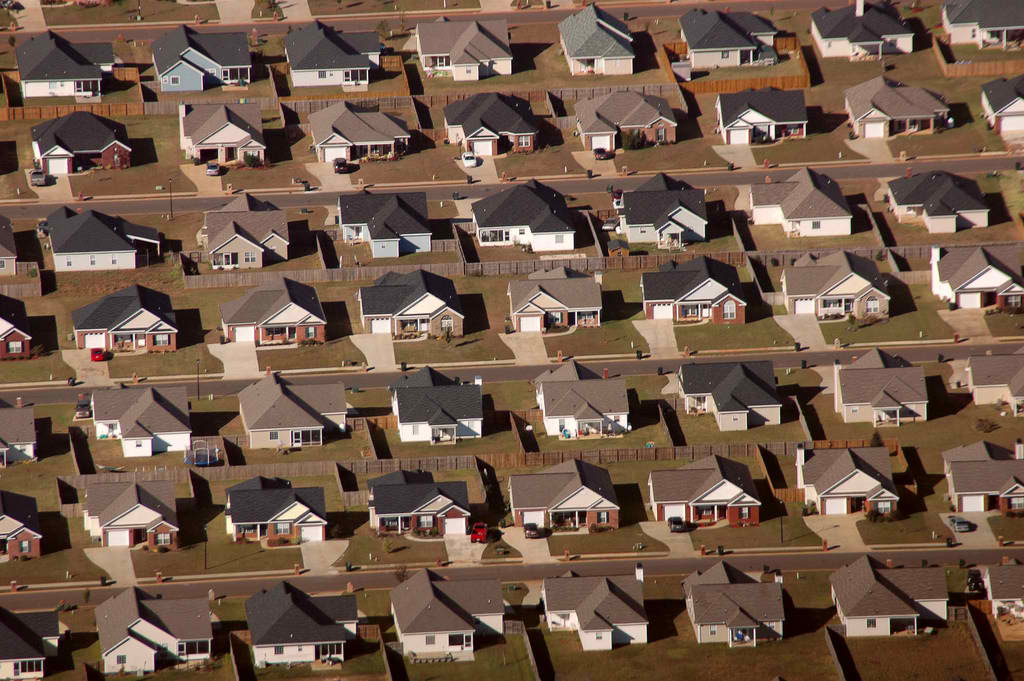
How does this apply to us? Well, I forget the statistic, but something like between 70% and 90% of our processed food contains corn in some form, it was something staggeringly high like that. Meanwhile, the dwindling numbers of homeowners grow wasteful gardens of ornamentals, rather than food, thereby ceding power they might realistically and easily keep. The sprawling development here in Florida is displacing the crackers, the traditional cattlemen this state once was filled with. All across the Midwest, in California's and Pennsylvania's valleys, and in the Southeast, like around Atlanta, we put the new suburbs and strip malls on excellent farmland, erasing productive land from use, and then grow lawns or asphalt on it. We're losing our topsoil because we care about profits, not fertility; because we live in a mindset of scarcity (not enough dollars!) rather than one of abundance. We need more CVS stores, more Walmarts, more 2000 or 3000 sqft single-family dwellings! Even though a 12x16 cabin used to do for a family of 8.

Even without submitting to eating beetles, we could do better. As Aldo Leopold wrote, "Nothing could be more salutory at this stage than a little healthy contempt for a plethora of material things." The simple life, to be brief. That is, to step back from the relentless rat race (it takes a rat to win a rat race) and reevaluate. I'm not talking about simplicity as scarcity. I mean it as clarity. If people had done that in the 30's, those cattle wouldn't have been wasted, the fruits wouldn't have had to rot while thousands starved. Possession is nine-tenths of ownership-- squatter's rights. We might have took charge of that model of scarcity that exploits the many for the comfortable few, and realized that this world is seething with food and the stuff of life, if only we could see it, and if only we could share.

And that is the hope Steinbeck gives us in Grapes of Wrath. Yes, we're left hanging, wondering about the fate of the Joads; yes, it's a sad and bleak ending, but not entirely. The people have found each other and forged a community of the road; the migrants share what they have, poor as they all are. Community over ownership. If you have a little and he has none, you get together and you both have a little. This is the power of the people, this is resilience. No one has a right to starve another, but we're right back where we were in the Depression, lesson not learned. But when the 99% finally get together to realize that they are the majority and strong when they stand together, we're unstoppable. I don't know if I'm advocating localism or socialism or communism or what; can't label it like that, and don't know what the change is going to look like. But change is in the air, and the elites are getting scared.

And they should be.

Saturday, October 29, 2011

Orality and Literacy

I briefly mentioned in my previous post the differences between the desert religions that came out of the Middle East and the religions of lush, fertile India. Thanks to a book I'm reading currently, Orality And Literacy: The Technologizing of the Word, by Walter J Ong, here's another instance of such a split. This split in cosmologies depends on writing, which is what the book is about: how moving from oral culture to a culture that uses and progressively interiorizes writing has also progressively changed how we experience the world.

A major idea in the book is that sound, unlike other senses, exists only as it is going out of existence. His example is, as I say the word existence, by the time I get to "-tence" the "exist-" is gone-- sound is an event. Writing turns a word into an object, visible and immobile on the page, while the original spoken word is a happening, a movement of air, uniquely ephemeral. You can see a violin, touch it, smell it, taste it (weird), and it will always be there for you to do so; but to hear it, it has to be played, and you can't play all the notes at once. Sound is not static, ever; it is always linked to movement and change.

The author gives another example, about how primitives consider that words have power; they are magical in that way. This makes sense since sound, being an event, requires power: you can look at a buffalo, dead or alive, but if you hear a buffalo, you know it's alive and you'd better look out. Sound is sounding, he says, requires energy to occur: power. So far he hasn't talked much about religious views and how they have been affected by this shift, but they would seemingly run quite deep. It's hard for us who are deep in a writing culture to understand the world as a nonliterate oral culture sees it. You'd really need to read the book, he gives so many instances and areas that are different; I really should be taking notes. But when you consider the differences between animist, shamanistic "religions" and your text-based religions (which includes the Judeo-Christain-Islamic, as well as Hindu-Buddhist, and to a degree Chinese religions), and apply some of the points Ong is making in this book, it's mind blowing.

Language is central to humanity. It is probably the most important basis for our lives, personally and socially, it's how we understand the world, and possibly the thing that most separates us from the animals. Obviously sight is a vital sense, but words (and thus thoughts) are sound-based originally. Even today, we speak years before we read and write. So think of how sound places you in your universe. Sound comes from all directions, sight only in front, and a bit from the sides, fuzzily. As Ong says, vision is divisive, in its ultimate it is clear and distinct. Sound, however, in its ultimate is harmony, unifying. Ong writes that sound was thus centering, and oral man knew himself as the center of the world, umbilicus mundi, and only after we became used to visual representations of language, and came to think of the world not as all around us but as laid out before us, as on a map, did we begin to become divorced from the world.

I posit that this is the basis of the salvation-orientation in our text based religions, be it salvation from evil, the Devil, Hell, samsara, or disharmony. Animistic religions are not concerned with that and often don't seem understand the friendly missionaries' concern.
A sound-dominated verbal economy is consonant with aggregative (harmonizing) tendencies rather than with analytic, dissective tendencies (which would come with the inscribed, visualized world: vision is a dissecting sense). It is consonant also with the conservative holism (the homeostatic present that must be kept intact), with situational thinking (again holistic, with human action at the center), rather than abstract thinking, with a certain humanistic organization of knowledge around the actions of human and anthromorphic beings, interiorized persons, rather than around impersonal things. (p. 73-4)
If there is no division away from the whole, from the "spirits," then there is no need for salvation, for religion, a word with means basically "to retie" in the sense of reunion. An animist lives in the center of a world that is fundamentally alive. It's also interesting to think about how shamans and animist societies use drumming and chanting to inspire trances or soul flights, and even in the Bible, where it says "in the beginning was the word, and the word was with God and the word was God... Read from the perspective of a still largely oral culture, only superficially influenced by writing, that can take on a new meaning (actually, reading the Gospel of John from a mystical or Eastern, rather than literal, perspective gives huge depth to it). You see this even in the major meditation techniques; one is "watching" the breath, but another huge one is sound, simply hearing without comment or analysis of what is heard. Chanting, gongs and bells still remain, and liturgical music in many religions is vital.

In a way, this book is sort of the flip-side to One Square Inch Of Silence, in that it is giving me a whole new way of thinking about the world, again through sound, in this case not the pure lack of it, but the way it was pushed into a sort of second-class citizenship compared to vision. I'm only half done with this book but can't recommend it enough; it's very scholarly and almost text-book like, with lots of citations and references and scholastic phrasing, and it starts a bit slow;but stick with it, it's worth it, at least if you are into widening your perspectives and understanding. It's a lot of fun to ponder the implications, what life would be like if writing wasn't in the picture.

Friday, October 7, 2011

Poker Without Cards: Book Review

I read this book about a month ago, Poker Without Cards by Ben Mack. It's another e-book, but the site I downloaded it from, secondattention.org, isn't working, and I'm having a hard time finding it at other supposed download sites (EDIT: I think this one works, it's probably easier to read if you download it); fortunately for me I have it saved; finally, it is available on Amazon in paperback. I was going to write a review on it, but I wasn't sure how to, and then I got busy with work and other things. But I found it fascinating, read it twice.

Like the last book I reviewed, God's Debris, Poker Without Cards is more about the ideas than any plot, though it too is nominally fiction. The book takes the form of a transcript of a series of supposed interviews between a psychiatrist, Dr. William Fink, and the interviewee, Howard Campbell. Dr. Fink has contacted Campbell over a patient he has in his mental hospital, Richard "Bucky" Wilson, a catatonic who was found with a note on him saying, "My dearest friend Howard, please explain."

From there, the book delves into such wide ranging topics as memes, psychology, advertising, sanity and insanity, mind control, religion, corporations, pirates, government, capitalism, left brain/right brain, history, and other such things, much of it revolving around Bucky's eventual mental breakdown several years before when he and Campbell attended Bennington College. Most of the discussion seems to be based on ideas from Buckminster Fuller and Aliester Crowley, mostly the former, though there are many other references. There are a ton of books mentioned which I intend to look into. (Two that are mentioned that I have read and also recommend are Robert Pirsig's Zen and the Art of Motorcycle Maintenance and its sequel Lila, both of which are well worth reading).

I don't really know how to review it, though. To comment on the ideas discussed would take a long time, and you'd be better off just reading the book rather than my summary of it. As for the storyline, well, it's hard to imagine such a conversation actually happening, it seems rather contrived but does build into a rather unexpected finale. So, instead of a real review, I'll simply recommend reading it if you're interested in any of the above topics, and will leave you with a few quotes.

one of the reasons I find the Bible incredulous is that when god speaks to people, nobody ever really freaks out and questions their sanity. I find that awfully convenient. Or, when these preachers on TV say god spoke to them, what the fuck. Shouldn't this be front-page news? Either god is speaking to them and we have a modern day prophet and the newfound words of God should be published everywhere, or they are insane.

Look at the way capitalism is set up: Fuller cautioned that year after year, less and less "money" is available to the average person. The rich are getting richer. At a certain point, this system will fall apart. You don't hear politicians discussing this.

Foucault asked if the legal ramifications of insanity was just a device that a society could use to discredit and invalidate minds that didn't think according to the society's ordained patterns. Is there much of a difference between a jail and a hospital if they won't let you leave?


Psychoanalysis is the disease it purports to cure

Centuries ago, Christian Huygen noticed how separate entities will fall into rhythm with one another. Specifically two pendulum clocks placed in close proximity that began to keep the same time. In 1665, he coined the word "entrainment" to describe this phenomenon

Most people entrain with the masses. This binds the illusion of free will.

Thursday, August 18, 2011

Review: God's Debris

Download "Gods Debris" for free here

I wanted to do a book review for this book I recently read, God's Debris, by Scott Adams. That's the same Scott Adams who writes "Dilbert," though this book has nothing to do with the comic strip. This short book's plot is basically this: a delivery man shows up at a house with a package to deliver, and finds this old man inside, who starts asking strange questions. Thereafter, it is basically a philosophical exchange, in a more or less Socratic form. The book touches on many areas of thought, including probability, gravity, time, evolution, the basis of existence, light, even social skills.

Adams says in the introduction that the old man knows literally everything, and thus he had to try and make the man's facts and explanations sound true; he does this by writing such that the old man gives simple answers, according to the skeptic's premise that the simplest explanation is usually the correct one (a premise that Adams himself tends to doubt, given the complexity of the world we see around us). He says in the introduction that the book is intended to be a thought experiment, namely to "try to figure out what's wrong with the simple explanations," some of which are true and some which aren't.

Frankly, there are definitely plenty of places where I found the facts to be either misguided or misleading, or flat out wrong. Especially in the parts where he talks about evolution, which I have a pretty firm understanding of. Also, the part where he says that, thanks to the immutable law of probability, if we did a redo of the Big Bang, things would happen exactly the same way; chaos theory and modern physics show that to be false. But many other sections seem credible, given my above-typical (though by no means exceptional) grasp of those aspects of science. Some, of course, is pure conjecture, though often a quite compelling sort of conjecture.

And that's what I mostly feel this book is: compelling. There are some truly fresh ideas in here, and the presentation is engaging enough to accept the occasionally contrived-sounding exchanges. The trick is to focus more on the ideas than the plot, which, as I mentioned, is extremely threadbare. The majority of the text is pure discussion, as the book is mainly a vehicle for the expounding of the ideas.

As Adams mentions in his introduction, part of the fun of this book is just to have your head spun around. For me, the most fascinating part were the sections about time and movement. I'd heard similar ideas, about existence pulsing on and off, but I'd never heard it put so clearly and rationally, never seen it given a whole explanation like this, set within a framework other than that of some New Age notion of the universe as the beating heart of God, or something. And what he had to say about light was entirely new to me, enough to qualify as a real mind fuck, a whole new way of looking at things, and I always appreciate that.

I hope you'll read this. It's pretty short, you can read it in a couple hours, depending on how often you stop to think about things; and hell, it's free. And, if you do read it and end up wanting to discuss it with someone, I'd be more than happy to, just send me an email (find my address in my profile).

Friday, April 15, 2011

Night and Darkness


As a poet, I've long been an advocate for night, darkness, silence, etc. Darkness in our culture is associated with evil; an unfortunate development, and untrue. Night represents ignorance, confusion, corruption, the time of terrors, demons, death. But it is also a very spiritual time. You may lie awake in bed thinking about the things that matter most; there is time and space, few distractions, you are able to center yourself. It is the place of intuition, reflection, thought. Lovers meet, philosophers dream, and all things can rest.

Darkness, silence, emptiness, and stasis all seem negative. They ARE negative, in that, to use a phrase out of art, they are a sort of negative space to the positive space of light, sound, form, and movement. But clearly both are necessary.

Even where there is light, darkness remains. Light is a wave, and contains within it the "off" part of the pulse, the trough of the wave. Sound is the same way. I like to think of all existence as being a vibration. Matter is basically energy, in packets called quanta. Such is one theory at least. Another is, "we work with being, but non-being is what we use." (TTC 11)

Lao Tzu is always talking about the feminine (or yin) as the base, saying "know the male, but keep to the female" (TTC 28). And yin was, I read, originally associated with the north side of a hill (the darker, shaded side). It is the dark side of the Tai Chi symbol. (Yang of course being the male, and the south, sunny side of the hill.)

The fact that light contains darkness in its very form, as a necessary condition of existence reminds me of something that Jesus said in Matthew 6, as he spoke about the lilies of the field. After talking about having to serve either God or money, he goes on to say, do not worry about what you will eat, what you will wear. If you serve God above all, the rest will follow naturally.

In Taoist terms, return to the Tao, and the worldly things take care of themselves. Nothing is done, but nothing is left undone. Be at peace with the emptiness, the darkness. Because money, material things, even spiritual things, like aping the morality of a saint or sage, are all part of the busy-ness of life. They come and go, on and off. But the emptiness, the space, the Tao, exist everywhere, foundationally. The infinite surrounds and infuses the finite; darkness dwells within the light, poverty within the wealth.
Colors blind the eye.
Sounds deafen the ear.
Flavors numb the taste.
Thoughts weaken the mind.
Desires wither the heart.

The Master observes the world
but trusts his inner vision.
He allows things to come and go.
His heart is open as the sky.
(TTC 12)
So you see I'm not just trying to be iconoclastic in talking about darkness. Or maybe I'm being iconoclastic, but in a much different and bigger way. In the stillness is born the true moral stance. As I said, poverty within the wealth: one in that mode will not use wealth as a weapon, but as a blessing. If you go for the money, the light, first, and only afterwards go for God and darkness, you're too late. Light sees only light, never darkness, which sees both.

If you start from ego, everything you do is going to have failure in it. If you start from God, from Tao, from darkness and stillness, what you do and what you are will be pure. Which is why I loved the line in Kazantzakis' book The Last Temptation of Christ:

When what is clean touches what is unclean, the unclean becomes clean!

Sunday, April 10, 2011

Thoughts on Science


I like it. It appears to give good explanations of the world. But of course they seem reasonable and True to us, living in contemporary times. People always think they have the truth in current times. Once, it was known that women were irrational, emotional creatures subject to hysteria, incapable of understanding politics or business.

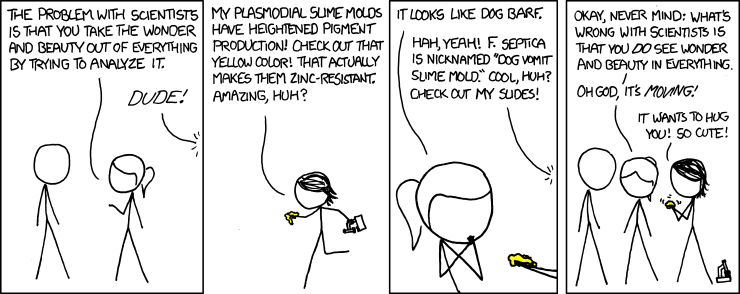
Some say science destroys wonder. I say it increaces it by many orders of magnitude. It magnifies everything, exploding our perspectives to previously unknown scales-- while at the same time massively increacing the detail and fineness of everything. We can now not only wonder at the beauty of the human form, but also know the trillions of cells living therein, with their own amazing architecture; also the ecological supports to our lives on the larger scale. We can now look at threads running everywhere, even to the stars, and temporally through natural history. An excellent book that reflects this is Annie Dillards Pilgrim At Tinker Creek, a favorite book of mine. It's deeply poetic, full of awe at the world around us, but based in science, in fact. It's close to what Richard Dawkins wanted when he wrote Unweaving the Rainbow, his answer to Keat's accusation that science destroys wonder.  

The microscope and the telescope have done more for the cause of wonder than any theology in history, for those who are paying any attention and sensitive to their implications. 

What I like most about science is that it is empirical. It looks first, then thinks. It doesn't read the dogma, then go looking for evidence to support it-- not in it's pure form. Instead it is simply open to the real. In this way science is very, dare I say it, spiritual. In a Zen way, at least. It encounters the world with attention and concentration, to see what is really there, what is actually happening. This is the prefect starting point for accurate knowledge.

Temples of the new age
The problem is that, in the end, science tears the world to pieces, so they can reassemble them; like a kid trying to fix the lamp he broke playing football in the house, to try and pass it off to us as truth, the glue running down the side, tape hanging off, and half the pieces missing.

What I mean is, science leaves us with only a model, a framework of ideas. I'm not saying there's no place for analysis, study, investigation; truly I'm all for it. But paying too much attention to mental models, be they religious or scientific, keeps us seperated from the real. They are sketches, rough estimates. They are useful, especially science which I admire in principle, but it's best not to be too attached to it.

Example: take a hundred data points and throw them on a graph; science will draw a line through them to show their average, and that average is what he holds on to. But that's not real. The reality is the hundred seperate points. The Law, the theory, the description, comes after, and is only a rough approximation of those points. There's no Law of Gravity, there's just things moving in space. We later came along and described the happenings, which, while seemingly consistent, do not actually obey our law. That is a Judeo-Christian notion with the Judeo-Christian removed; that is, the idea of laws of nature is a historical holdover from when it was thought science was discovering the laws of God. We're not discovering anything; we're just describing.

Science is provisional. Science admits this, many scientists do not; there is a reason that a scientist is far more likely to be an atheist or agnostic. Science has become their faith, though they'll call if hard truth, ignoring the many assumptions and fudge factors (such "constants" in their equations). Certainly most media reports treat science as holy dogma, absolute truth handed down by the men in white robes lab coats.

Finally, a quote: "The larger the island of knowledge, the longer the shoreline of mystery" --Mary B. Yates. Kinda sums it up, eh?

Sunday, March 13, 2011

Acceptance Part 2


I feel I must revisit my thoughts about Acceptance, as written about in that post. Mostly I stand by what I said, but I feel I glossed over the most important issue: how can you accept clearly negative things? Didn't really deal with the issue. So I'm going to hash it out here, and see what I can come up with. Your thoughts and ideas, as always, are welcome.

For me, right now the best example is silence. As I wrote in that original post, while reading One Square Inch of Silence a part of me kept feeling annoyed at all the bitching about the noise the author experienced. Like, the Zen side of me saying, hey, the air traffic is part of the landscape you're trying to get a recording of, it's not an intrusion, it just is. The problem is your preconcieved notions of what it should be. But of course, then the environmentalist, asthetic, and Wild Man sides of me come out and I'm right there with him, arguing against human created noise.

So as I sit out on the patio evenings after work, I can accept the endless jet traffic roaring over me; but will I ever really like it, will it ever sound beautiful, and will I ever be able to relax in its context? Perhaps on a deep Zen level, all existence is beautiful... but I kind of doubt this will ever happen.

But now, as I write, an idea occurs to me. I suppose, if I'm really accepting the experience, I also have to accept the thought and feeling within me that the sound is ugly. Acceptance doesn't delete all the old feelings, does it?

So I no longer fight my experience... but the experience is inherently disharmonious. Accepting that the noise is there, but also accepting that I hate it. This must be the motive for action, right? Not asthetics, but this, a more primal urge: the move towards harmony between the inner and outer experience?

Or does this disharmony mean I haven't really accepted the noise? Does working to change a thing equate to non-acceptance of a situation or condition?

Monday, March 7, 2011

Give 'Em an Inch

So, I finally finished Gordon Hempton's One Square Inch of Silence. It's a great book, and only took me so long to read because... well, I've been reading less of late, and have generally been very distractable and scattered these past few months. Too much time online as well, I think.

Anyways. He has an uphill fight ahead of him, but it's a noble cause and I support him. It's interesting to think about quiet places I have known. Having never really been as attuned to these things in the conscious way I have been since picking this book up, it's not likely to be quiet as what he would consider quiet. But I can name a few experiences, at least.

Porcupine Mountains
Top of the list is the Porcupine Mountains State Park of northwest Michigan. I remember it as being full of leaves-in-wind, and the gentle lapping of Lake Superior's unusually gentle waters on the stony shore, the almost silent night-thrum of the Big Carp River valley spread below me where I sat on the open ridge in the early morning hours, bathed in an astonishingly bright half-moon, feeling like the only man in the world save for my father, behind me sleeping in the trees.

And there are the alpine slopes of New Hampshire's Presidential Mountains, especially Jefferson after the chaotic crowds of Washington; I think it was the contrast that did it, though in actual fact just then on the side of Jefferson only an occasional fly could be heard. Also places in the southern Appalachians, and in Utah-- a few rare parts of the Wasatch Plateau, and especially Zion N.P., which despite what Mr. Hempton writes, struck me as a very quiet place, very mellow in spirit compared to Canyonlands and Arches, which felt much more hectic in spirit. I think it was because there were not private cars allowed in Zion, just the shuttle busses. Or maybe that valley really is special, and named appropriately...


Zion NP
Sadly many of these silences and quietudes are mere moments. Air planes and cars and chainsaws and all manner of other intrusions occur continually. But I'm thinking positively just now. I like Hempton's idea. Imagine if everyone picked a square inch to defend, some place they felt a connection to and meant to preserve. Not limited only to preserving quiet, but for whatever. It could be a trout fisherman protecting his favorite pool in the stream. We all have special places that we love-- maybe a place only we know, maybe a place loved in common.

It's a fascinating thought experiment. Imagine a website where people could mark an interactive map with their spot and find others nearby with whom to form coalitions. It'd be a real democratic, grassroots environmental ethic. After all, I firmly believe that for the environmental ethic, the land ethic, the green ethic, call it what you will... for it to matter, it has to be personal.

This is why organizations like the Utah Conservation Corps build trails. It doesn't seem like conservation (though keeping people on a designated path reduces impacts elsewhere), but it is, and vitally so. It helps get people out there to experience those places, to make them real. It's why there's many programs to get urban kids out in the woods for a weekend. I fully support, for example, not drilling in ANWR, but it's abstract to me. I most likely will never get there. So there's no connection. And environmentalism, ecology, is ALL about connection; building a relationship with Nature, from which we've become disconnected thanks to civilization.

Waste and Madness
in Appalachia
Example: who cares more about mountaintop removal mining? Some Sierra Clubber in Seattle, or some hillbillie back in the hollers of West Virginia? I argue the latter: it is their home being shaken by the blasting day and night and being covered in the settling stone dust, it is there land values that are plummeting, their streams and drinking water poisoned, their daily landscape being marred forever. Props to the Sierra Club and its work and empathy, but a vested interest is the prime driver for passion and action. But the people need to connect, to find one another.

I wonder if this would be feasable. I know nothing about website design, or whether this is needed or a useful idea. There's already clubs and coalitions out there, locally and nationally. I'm sure there's networks already that connect them to each other, and connect people to local clubs. Still, it's a cool thought...