Showing posts with label work. Show all posts

Sunday, November 18, 2012

It Is What It Is


It is what it is. 

Man am I sick of this phrase. I used to joke that this was the most common five words on a construction site. Probably true. But I'm starting to think it less funny. It's actually rather depressing. What is this fatalism that seems to be sweeping the nation? Everyone is saying this, or things like it. I hear it in class, on the radio, from friends, and from strangers overheard in diners and coffeeshops. Everyone seems to be throwing up their hands at the world and saying, "there's nothing I can do." 

I heard a story on NPR the other day, about teaching strategies, East and West. Here in the West, kids are taught that smart kids are the ones that do well in school. In the East, kids are taught that it's the hardworking kids that succeed. An experiment was done, some years ago, where children from Japan and from American were given a math problem far above their ability. The Americans gave up after, on average, thirty seconds, saying "we haven't had this yet." The Japanese children worked on it for over an hour. 

We deride the East, saying they are robots that learn only by rote. Somewhat true, their creativity is less pronounced. But it seems that Americans are helpless without being told exactly how to do things. We don't work for things, we give up. They said it was because failure in the West is taken as a personality flaw, not merely a lack of effort or even luck. So when confronted with an insurmountable problem, we turn away. What has happened to us?

I said to my uncle that back after WWII, there was a surge in energy, a sort of collective testosterone rush after having won the war. We were invincible, unstoppable. Just as in any contest, the victors go home, full of optimism and pride, have lots of sex (baby boom) and build lots of things (suburbia, highways, etc). The post-war boom. Things got stagnant more or less in the 70s, and now we're on a downswing it seems. Oh, there's been GDP growth, but that means little, especially to the common man, who's wages have stayed stagnant for decades. 

I think the fatalism is a defensive strategy for this decline. Things are failing, and people are stepping back from it in a sense, as a way of insulating themselves from it. That's the way things go, they seem to say, and as it falls, they try to remain separate. When things slip downwards, there is no collective energy for doing things. It is a period of waiting, to see which way things are going. But to wait too long is to fail entirely. And anyways, insulating yourself from the failure of the world is to cause the failure of the world: if no one does anything to sustain, to build, to keep alive, then, it will not be sustained, built or kept alive! It's a positive feedback loop, also known as a vicious cycle. 

Not that it's all bad, this accepting of reality; in a way it is a good thing. In remodeling homes, a specific case, you see that there's nothing you can do about the shoddy work that went before, or the fact that the wall studs are warped. The baseboard is going to have gaps between it and the wall. You grab your caulk gun and go to work. But too often I see, even in myself, an unwillingness to go the extra mile, to put in the effort and time and care to make things right. Money rules the day, and working quickly in some ways trumps doing things precisely. The evil profit motive ruining things once again. Again with the baseboard: if the corner joints aren't perfect, even when the walls were, it's okay, caulk will hide it. You say things like, "good enough for paint-grade," "can't see it from my house," and "spackle caulk and paint make a carpenter what he ain't." 

True enough. In the end, we make it look good. And often, as I said, you just have to fudge things to make them work. A good carpenter is one who can hide his mistakes, they say. One must work with what is there, must be able to see clearly what is. 

Of course, for myself, very often I rage internally against the standards some people hold. They want their walls smooth and their woodwork perfect, even in an old house, every joint hidden, every nailhole covered, and so forth. The smallest defect, they freak out over. (They also want it done for next to nothing, and as fast as possible). I may not have the patience for finish carpentry. These Euclidian ideals do not square with the world, they do not follow the curves, so to speak, of the earth. Thus the old man wastes much energy picking every leaf off of is lawn, though more fall every day, and becomes bitter and obsessed. 

So in a sense, the fatalism is a positive response. We are awakening to the reality around us, seeing it clearly, and in a sense realizing that certain things cannot be altered, and do not need to be. We are tuning in a bit better to what's there to be tuned into, ditching these Platonic ideals for a more empirical reality. This shall be the birth of the new world, as the old crumbles. 

But that it is a fatalism, and not mere clarity, is what makes me think it is an example of a greater problem. We are getting soft. We have had it too good, been too insulated from real work and real things. We have fewer than ever people entering into the trades as apprentices. In 20 years, who is going to be doing the work that will so desperately needed to be done, as we recreate our society? Mexicans, I suppose; such work has always gone to the latest wave of immigrants, from the Irish, to the Italians, the Polish, and so on. Yet as goes the prosperity, so go the Mexican immigrants, I bet. I'm sure they'd rather be poor in their own land with their families nearby, than poor in a foreign place.

Even our wars, we are loathe to fight. The hoopla over the Benghazi attacks. We are fighting a global War on Terror, however misconceived, people. Do you really think there will be no casualties? Do the Taliban or al Qaeda, after a drone strike, freak out and lob investigations and controversy at their commanders and leaders? No. These are men who know what a war is. They know about suffering, they know about effort. They mourn their dead, and go right back to the fight. 

If we are going to fight wars, which I'm not saying we should, we should do it 100%. I agree with our military leaders in this. Clear goals, and support your commanders. If you can't do both, it's time to pull out. There will be mishaps, there will be pain, there will be death. If you can't handle that, don't fight a war. 

So while I'm all for recognizing reality, we need to ditch this phrase and the attitude behind it. We are not mere slaves to fate. Perhaps the government is corrupt, business self-interested and insane. Fine, but don't submit to it with fatalism. Fight! Build something new! We can't wait for the old to fall before we work to make the new, we must start now, with hope and energy. Otherwise we're going to be stuck with some dystopian future we really aren't going to like. 

Tuesday, November 6, 2012

Gardening


Not very long ago I had a bit of a personal epiphany. I was over at my uncle's house, trimming his hedges. The sun was shining, but had just rained a few hours before, so the leaves were dripping wet. And as I went down the row of bushes, manually shearing off the excess, I realized that I really love doing this. The sharp yet quiet sound of the shears, the fresh coolness of the rain against my skin, and mainly, working with the plants. There is something about gardening that really appeals to me at a deep, soul level.

Seems like most of the other jobs I've had has been somehow anti-life. Certainly the home remodeling of recent times, which is hugely energy and resource intensive, very wasteful, polluting (with toxic chemicals), etc. Even retail jobs produce a lot of waste, and encouraging consumption doesn't quite appeal to me. Generally our economy is anti-life, speaking broadly, which is why we say it's unsustainable. This of course filters down to the lowest level, where everyone contributes to it.

I don't feel like I'm contributing anything positive to Life, not even really to the human world; I'm helping some investors make their unholy profits, and managing to feed myself on their scraps. If I were merely providing housing for people, fine, that's honorable; but we can all be real about this. No matter how used to them we are, our 2000 sq ft houses are wildly out of proportion to human needs. Unless you have a very large family, who needs such a big house? The way we arrange ourselves, everyone having their own room, typically at least 10'x10', it's pretty gluttonous in terms of space and housing. Certainly it is not the only way things can or should be. Indeed, humans evolved living in tents and huts, or large but communal long houses or lodges.

I visited, on my way to Utah last spring, some of the ancient pueblos in Arizona and Colorado. It is incredible how small those things are. The buildings seem large, but the actual rooms are claustrophobic, hardly enough space to fit a man's body laying down. Yet this is how they lived, for centuries, them and their families cuddling in these small spaces. Why do we all sleep separately (save for couples)? Why do we need so large a space for a bed room, where the chief activities are sleep, sex, and general rest? Many of our basic assumptions on this and other aspects of every day life are so clouded and myopic it sickens me.

It's the same thing with most fields of work these days: everything is tainted by the profit motive, even such basic and honorable things as farming and medicine. I've never been afraid of hard work, but I do hate knowing that my work has, inseparable from it, this threading of dishonor, the sleaziness of greed, corruption, power. Nothing is pure. This is the stuff Marx and Engels talked about. How can I really love what I do if I know that, even if I'm farming and feeding the world, I'm also poisoning the soil and rivers, or keeping livestock in barely livable conditions? I've never been able to find a fit for myself, because everywhere our system is corrupted, and I'm looking for truly honorable work.

With gardening, I am able to encourage and produce life; at least if done right. For example, trimming a bush doesn't hurt it, because it will just come back twice as hard. You can grow food and also build the soil and biodiversity as you do. In this there is still some true honor. And as I stood there in the sunlight and the rain-wet leaves, I realized that I need to be doing something with plants in my life. I'm almost thirty years old and I think I've found my calling, in general at least.

So I've been brooding on this a bit. Brooding is kind of dark sounding; call it musing, pondering. Trying to figure out which way to go with it, while realizing all the more how right this epiphany is. I mean, since I can remember I've loved plants and gardens. My parents say I used to play under the bean poles as a small child, they were like teepees, and even as I grew older I preferred being outside. I loved helping my dad in our massive flower gardens as I matured still more, propogating plants, helping design new plots, turning the soil, adding truckload after truckload of compost. Never felt like work to me. We'd smile and attribute it to our Irish blood, which makes us love to have our hands in good soil.

There was this one corner of the garden, it was my spot. It was a fairly large, lush bed on our side of the fence; meanwhile, the neighbor behind us had a big hedge, like a green and living wall. The neighbor to the side had let that part of his yard grow wild, as it was out of sight out of mind, behind his garage. There was a huge Norway spruce growing there, a good sized white cedar, tons of weeds, and a thicket of some kind of bamboo sort of plant, which spilled over into the yard behind him, also a forgotten place of decaying firewood and weeds. It's pathetic, because I'm talking about a very small area, but it was the wildest part of the yard, and I was drawn to it.

I know also that I've been missing having a garden for years. Every spring I wish I had a plot to put some seeds down in, and every summer and fall I simmer in jealousy at a few of my friends' pictures they post online, of their produce. Seems like every year, I'm not situated somewhere that I can do this for myself. Part of that is, of course, me following my other loves: camping, and, later on, hiking. Wilderness has always called me, but I'm realizing that maybe half of that call was the call of plants. To simply be in places surrounded by the vegetal world. The wild-freedom-call is another thing aside, and not to be ignored here. But plants... they are strange to me, mysterious. Living beings so far removed from my human experience that they rather baffle me. Alive like me, but mostly foreign. Their body form is different. Their senses are different. Their life cycles, different. Gardening is a conversation with this mystery. Even hiking in the forest is a sort of communion with kingdom Plantae, though it goes beyond that into general ecology too.

I think even the way I get all fired up over sustainability and permaculture and all that, is largely fueled by this. There are many good things to be done in those fields, and I'm not saying I'm purely all about the growing of plants. I'm fascinated by many aspects of sustainability, the basic philosophy of it, the science and ecology of it, and specific fields, like urban design, new building materials and methods, and new energy sources and methods.

But those will have to be for other people. I want to have my hands in the dirt, somehow, some way. My part in all this, I think, must be working with plants. I titled this "Gardening" but it could be anything: farming, working in a nursery, or as an arborist, or a conservation forester. I hardly know where this could take me.

Saturday, October 13, 2012

Slavery


Is civilization possible without slavery? 

I don't know that it is. You can read online that not every civilization has had slaves, but then again, most have. Certainly the most "civilized" have kept humans as chattel. In the West, our origins are tainted by this fact, as Athens and all of Greece was a slave society, and Rome, the West's Classical model, was very much dependent on the slave class. I'm not even getting into the Arab slave trade, nor what was going on in the East, which were monumental in their own ways. 

There was less slavery at other times. It declined in the Dark Ages and on into Medieval Europe. Not to the point of being absent, and it differed country to country, but it was largely replaced by serfdom. Which is still basically forced labor, though not as explicit and carrying somewhat more freedom. But then the Renaissance hits, the great "rebirth" of Western civilization, and what does it bring? The horrors of the African slave trade, the enslavement of whole nations of Native Americans, plus indentured servitude, which was in some ways worse, as far as how the people were treated (an African slave was an investment for life, so was somewhat less abused than someone only "owned" for 4-7 years. They worked the latter to death, more often than you'd think, to get their money's worth). 

I've heard that if people had been civil and patient, slavery in the Old South would have died out on its own, without the national bloodletting of the Civil War. Much the way Canada waited patiently to themselves eventually split from England by a gentlemen's agreement, no Canadian Revolution required. Canadians like to use these examples to prove how violent we Americans are. They are only partially right, because things aren't black and white or simple like that. There were principles at stake, and institutional human suffering, and these are worth fighting for and against, respectively.

Thoreau had something to say about this:
When the majority shall at length vote for the abolition of slavery, it will be because they are indifferent to slavery, or because there is but little slavery left to be abolished by their vote. (1)
It's true, it would have ended of itself, the way things were going. But only because we replaced human slaves with machine slaves. Be certain that I am not saying that it is immoral to use machines to do our work. I am simply saying that slavery has not been abolished, only mutated and changed. Of course, there is still wage slavery, as machines have not replaced all human labor, and actual human slavery still persists in pockets all around the world, even here in the US. But that is not my overall point here. The point here is that high civilization is not possible without free labor, and that the degree of civilization is based on how much free labor (energy) is available.

Hell, take animal domestication, the final nail in the slavery case. No civilization has existed that did not have domesticated animals, that is, enslaved animals. Perhaps the American civilizations like Cahokia, the Aztecs and Maya did (the Inca had llamas), but they practiced human slavery, were not as stable or long lasting, and not as developed (at least in the case of Cahokia) as, say, Greece, Rome, China, India, or the Arab world. That is, they were not as far removed from the hunter-gatherer and simple horticultural models they grew out of, and that is why they so easily disappeared back into those models when their civilizations dissolved (in the case of Cahokia and the Mayans). 

Animal slavery is where higher civilization began. It's one thing to keep a herd of sheep around to eat, or even cattle for milk and cheese and meat. But when you strap a saddle on a horse, or a yoke on a pair of ox and force them to do the work for you, you free up human labor to do things like form more refined administrative techniques, writing, art, religious embellishment, war, and technological invention. 

And it all comes down to energy, no? The Age of Fossil Fuel is exactly the same as the Age of Animal Domestication, in that the vast power available in either the livestock or the oil barrel frees humans from drudgery and labor to do other things. Each is a step up of an order of magnitude from what went before. That's why higher civilization developed out of the use of animal labor, and why the Industrial Age sprung up when we tapped the energy of machine labor running on fossil fuels. 

This is the issue around which our current energy woes revolve. Naturally no labor is free, even slave labor, since the slaves need to be bought, and fed, and at least minimally maintained in good health, much as a horse or ox needs to be. Likewise the machine, which, while often cheaper than human workers, still needs maintenance and fuel. It's funny, the way the owner class comes to depend on its slaves, and the energy they represent.

So now the upshot. If it turns out to be true that Peak Oil is not resolved via new energy sources, things are going to decline in complexity. This is obvious, but one must understand what's at stake. You read books like James Kunstler's A World Made By Hand, and it seems like democracy and freedom largely survive the fall. I wonder at that. Power doesn't let go so easily, and I wonder if instead of a sort of benign localism of freeholders and townsfolk, we won't end up with something more akin to a world under a myriad of Pol Pots. Those used to living high on the hog are not going to want to climb down, and I fear that they will simply see that as the oil energy goes, they must return to human energy in the form of serfs and slaves.

(Finally, check out this link, and savor the irony)

Saturday, October 6, 2012

On Change and Being Stuck


Watched this amazingly inspiring video a week ago, and since then have been thinking a lot about making changes. Changes in my own life, changes in the greater world around me. The message isn't particularly new for me, but really had an impact, and I urge anyone coming across this page to watch it.

So I'm trying to figure out what I'm really going to do. I keep running into this problem of feeling utterly trapped. I've felt this way ever since I came of age, out of the egocentric world of the child and teenager. I guess around age 18, especially after 9-11. Started getting into politics and bigger issues, trying to understand this system in which we live, and trying to figure out my place within it, and finding very few good options before me.

I know I've talked a lot on here about living the change, saying stuff about opting out of the system as it is. But man, how? How can people operate outside of the system? If you don't play by the rules, you don't get to eat. If you don't work, then you don't get to sleep indoors. They got us by the short and curlies.

One example I know I've thrown out there was gardening. Want to grow a garden? Well, you have to own land, but homesteading is so far from what most people are capable of, it's hard to imagine it happening. I mean, for those who can afford to buy land, often they buy it in town near their job. They have a house, not property. A huge building of outsized proportions, a weight around their neck, often, because we've become accustomed to such foolishness. And to really be free of the system, you can't just grow a token garden out back, a few tomato plants and maybe some lettuce, beans, and cucumbers. You need to plant a sizable amount of land (in terms of an acre or more) and have a host of skills that few people really have anymore: food preservation, crop rotation, what to do about plant disease and pests, and maybe tending livestock, among much else. I'm talking about farming, and farming requires a lot of knowledge.

And that's just for food. What about everything else we need? Clothing, shelter, transportation, medical care, etc etc. How to opt out of all that? I mean, they own our lives, whoever "they" is, if there is a "who" besides the inhuman system itself... they own our lives because they own the means of sustaining our lives. I say again: you dont work, you don't eat, you don't sleep indoors, you don't get to go to the doctor, you lose every which way. How can you fight back against such a thing? You can put out your recycling, consume less, you can try to elect better leaders, take your money out of the banks, but in the end, youre going to go to work every day because your stomach demands it, and more importantly, your children's stomachs.

I think often of Grapes of Wrath, which I know is a novel but it's such a vivid image of the Depression, and seems accurate from what I've read. And not just the Depression, but the way the union battles went for decades back then, the brutal fight it was. Brutal not just because Power fights you on it, but because you have to sit there, watch your children cry because they're hungry, while you strike and picket. What a thing to do! Most men would work for the lowered wages, rather than strike and get nothing. The only ray of hope is that, in spite of those horrible stakes, people did it anyways. They fought back, they suffered, but they did what they had to do.

But here we're talking not about just getting more workplace rights, fairer laws and economic practices, but a whole new economic paradigm. We don't have a clear goal, like better wages, the 8 hour workday or the 5 day work week, or an end to child labor. It's hard to even know where we're trying to go.

So I just don't know. I'm constantly inspired by these sorts of videos, books, ideas, but never know how to proceed. The edges of this problem are just out of reach. I can't imagine any way to have a real impact on the sort of paradigm shift I'm referring to, and can imagine even less a mass movement in this direction. I don't want to give into despair, but I feel like I've been stuck for the last 11 years and it just plain sucks.

Sunday, April 22, 2012

Growth


Is growth necessary? I've long thought of the growth economy as a problem, summed up so succinctly by Edward Abbey: "Growth for the sake of growth is the ideology of the cancer cell." But I wonder, is there any other kind of economy? At least in a civilization? Sure, hunter-gatherers are extremely stable, but if you look at things historically, once agriculture began, and thereby this project of civilization, that is when change began. Change and growth. Earlier societies were largely changeless, in that they changed so slowly that it was imperceptible to a people with no memory storage devices besides their elders. If something took longer than a few generations to happen, it didn't happen at all, it was always so.

But with agriculture, now things start to move. Slowly at first, because there is less to build on. The wheel, domestic animals, new ways of building houses, the first villages, towns, cities, new forms of governance. But there is a definite movement of change, the civilizations, the cultures, the empires, always expanded, either into the wilderness or into neighboring tribes, and either by assimilation or by conquest. And of course recent history has shown an explosion in innovation, starting in the 1850s or so. Along with this, human populations are growing all the while. Now, I'm not saying it was a smooth increase for the last 10,000 years; obviously it was not. There were discrete civilizations all that time, which rose and fell and birthed the next.

But that's sort of my point. The rise and fall of civilizations: they form, expand, maybe plateau a while, then decline. It seems a natural pattern, and one senses that civilizations are almost living organisms themselves. Most things behave this way. Water rises and falls in waves, continents rise as mountains and fall with erosion (imagine watching that in a sort of geological time lapse, that'd be incredible!).

Certainly most life follows the growth/decline cycle, with the exception of bacteria, and maybe single-celled life, which seem to divide, grow to normal size, and divide again. Bacteria don't decline or die of old age, only from predation and environmental constraints. But higher life seems to embody this rhythm. Remember the cycles of population booms and bust in the lynx/rabbit relationship? The rabbits produce more young, and a few years later that change is embodied in a growth in the lynx population, which eventually eats up more of the rabbits, leading to their decline, then eventually the lynx decline as well... and on and on. Nature is stable, but in a dynamic way. They call it dynamic equilibrium, in that nothing ever gets an upper hand for good, but maybe for a while.

Boom and bust, the way of the world? That is my question. It seems to be an inherent feature of nature-- nature meaning the process of existence, not some "thing" apart from mankind, a usage I am more and more switching to. You can appeal to the concept of yin and yang and be done with it. So you can see my concern. I've long been interested in and read much about sustainability-- though often what is to be sustained is not specified by such speakers and writers. For myself, I'm about sustaining not the current mode of civilization, complete with superhighways and space shuttles, but some mode of life that keeps alive and well human happiness and wellbeing, meaning of course living in tune with the rest of our environment. I for one do not see "subsistence" as inherently negative, as if we always need to be in a state of progress, though again, to what we are to progress towards is never defined-- therefore we are a ship without a port to sail for, eternally lost and merely thrashing about the planet in a gluttonous, terrified rage. But I digress.

Can we have sustainability? Is stasis always to be in the backwaters, the stagnant pools far from the main flow of Life? Is it inherent in all Being to expand and contract? If one culture decides to go the sustainable route, is it then doomed to be overrun by the cultures that do not so choose? Is there a way off this treadmill? I mean, we can't simply forget the last 10,000 years' worth of knowledge. We aren't simple hunter-gatherers anymore, we know farming on vast scales, transportation at incredible speeds, mass communication all around the globe. We can't simply go back, if only for the simple fact that there's too many of us. We're stuck working within the constraints of what we know, i.e., civilization, lest we perish.

Yet to continue with civilization is to perish as well, as we seem to be on a collision course. I've long thought of nuclear weapons as an opportunity, a litmus test for humanity: either control our violent streak, or die. It is far beyond such simple concepts now, as we threaten to topple the entire biosphere. We hack at mountains for the coal, we drill deep into the crust for the creamy nougat center of oil, we burn, burn, burn everything in sight, swallowing everything in our path towards progress: forests, cultures, oceans of fish, entire rivers, and millions of lives in our wars. Extinctions are peaking at a frightening rate. Horrifying.

A lot of times you'll hear from the environmental crowd, especially some of the Deep Ecologists, that humans are a disease, a cancer. I think that is ridiculous, and am in line with Daniel Quinn and others who see that it is civilization that is the problem. And perhaps it is only our concept of being separate from the rest of the world, the ego divide, dualism of city and country. The concept of civilization itself, and its counterpart "nature." Dualism everywhere destroys a clear understanding of reality: look at the Occupy movement. I sympathize with it and I'll explain why in a moment, but clearly the evil and greed in the 1% is present in the 99% just as much. The only difference is, in the 1% it is magnified by sums of money and power far above what the 99% has access to when we try to put our schemes into effect. In the end, the world can never be saved by political action, only by everyone killing their ego and opening their eyes in an enlightened state. But, as this will never happen, I must support this movement that at least tries for evenness and fairness. Yet therefore also do I dwell in despair. A corrupted means will never attain an uncorrupted end, and we are all corrupt. This is why communism failed, and why capitalism also failed.

So we seem to be doomed, and our happy talk about sustainable civilization is a sad joke, an oxymoron gone unrecognized. Growth and expansion seem inherent, and of course that means decline and collapse. I know I harp on this a bit, but it is obvious that we have overshot certain limits and are basically in the position of the Coyote: we have run over the cliff but haven't looked down yet, floating on a fading illusion and moments away from a fall. And there's nothing we can do; like Wiley E., technology isn't going to save us, and it's actually part of what put us here. Or our misuse of it, based on our clouded worldview.

I welcome your thoughts on all this: the concept of growth vs. stasis, as well as what I consider the imminent collapse of [our] civilization. This is something I'd love a discussion over. Also, as I've changed the blog around a bit, feel free to comment and critique the design as well. Note also that I've added some links there on the right: especially relevant to this post is The Dark Mountain Project, which I will hopefully talk about in an upcoming post.

Tuesday, February 28, 2012

Stupid Homes and Waste


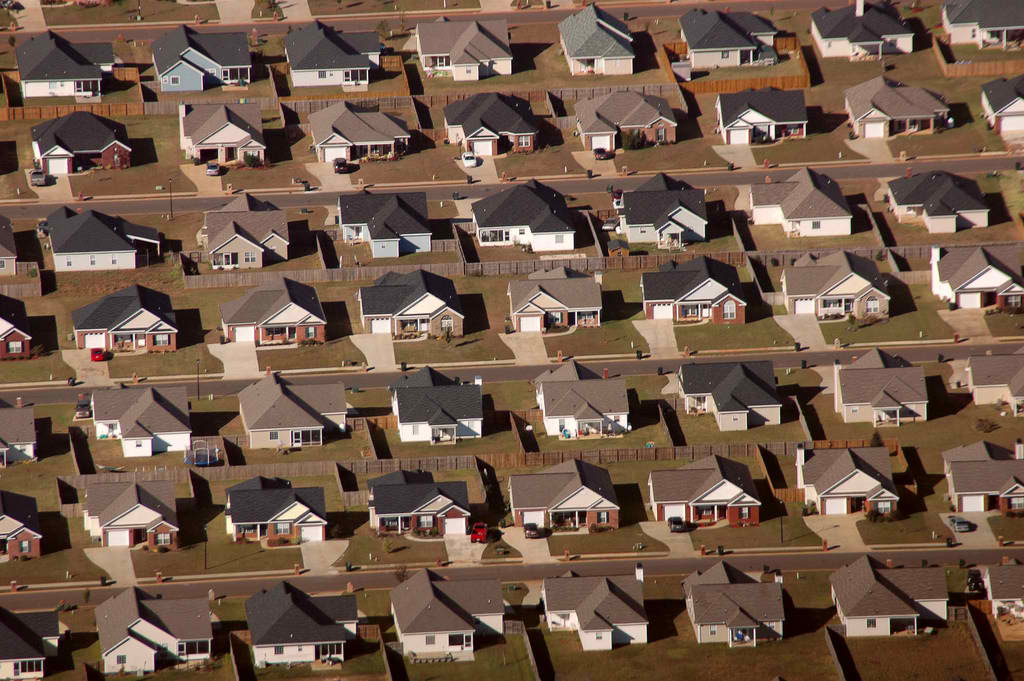
Well, my last post was sort of an indulgence. I get excited by small homes, rural living, sustainable building, and so forth. Maybe most of my readers don't care about any of that, but I put it out there anyways. I'm not sure how I'll end up living, in what sort of home; I just know that I don't want to live in anything they're building nowadays. At least here in Florida, all the houses are these squatty, bunker-like homes. I know some of it down here has to do with hurricanes, building codes require certain things and these concrete buildings sure won't blow away. But I know these sorts of homes are being built elsewhere. I remember seeing a picture of a home on a news article about foreclosures; I said to myself, ah, an article about the Florida housing market, then read the caption. The home was actually in Las Vegas. I think it may now be the predominant "style" in America; style is in quotes because these homes have no style, no character.

Even the higher end homes are still made this same cheap way. You'd expect quality in a $400,000 home, but it is not so, it's still concrete blocks, the cheap looking knock-down finish inside and out, walls not square or straight, just plain cheap. They dress them up a bit with things like crown moulding, entryway columns, and other various "adornments" but the materials these adornments are made with are cheap. Anyways, they are all variations on the same theme, and all end up looking pretty much the same.

Now, uniformity is not the worst thing in the world, and of course, as they say, there's no accounting for taste. Who am I to declare them inherently ugly? Of course I'm reminded of Pete Seeger's song "Little Boxes" every time I think about this, but I say people get what they deserve, and they can have it. They want big, grand homes for cheap, and that's what they've gotten.


But this way of building is so unsustainable. Construction waste makes up about 33% of landfill trash (in 1998, can't find anything recent, but given the boom, must be worse), and I can speak from experience. When we go into a house to renovate it, the first thing is to do a "trash out." This is largely to empty all the garbage the former occupants left behind (you'd be amazed at how much people leave), and also to tear out whatever's being removed or replaced: cabinets, doors, fences, tile, carpet, on one occasion a wall. Of course, if compressed, removing the big empty spaces in the non-optimally loaded dumpsters, there's actually less, but still, it's a lot.

In addition to the above, often enough to fill up one or two 20yd dumpsters; over the course of the job we create more waste, necessitating more dumpster space. Example: the other day we were putting new casing on the doorways throughout the house, that is, the decorative wood moulding around the door frame. I'd cut the two upright pieces from a single stick of casing, which I think was 14 ft; the leftover piece was close but still too short to use as the top piece, and was discarded. We ended up throwing 3 or 4 sticks-worth away; hard to say, I didn't lay them end to end to measure on my way to the dumpster.

What are you supposed to do with that? Surely there is a better way to use it. Perhaps as part of energy production, by buring it. Then again, as it's not real wood but medium density fiberboard, so with the binders plus the white coating, there'd probably be fumes. (I just read that it contains formaldehyde, and the dust should not be inhaled. All the dust I breathe at work has forced me to stop running, as it hurts my lungs too much; now I find out I'm upping my chance for cancer. Fuck my life). But why not make them long enough to accomodate standard door sizes? That way for most uses (not sliding doors or double doors, but most uses), there's less waste. What about recycling? We throw out lots of glass, plastic, and cardboard; and wood that can be chipped or otherwise used somehow, even if it is downcycling.

I especially hate the garage in front, showcasing blankness
The insanity of our car culture strikes again.
Much of all the other stuff we throw out is still perfectly good, often it simply doesn't match the standard design the new owner, in my remodelling work generally a realty group, prefers. Often we replace the old with new that isn't much better. Cabinets are a great example: contractor grade stuff is ubiquitous in new homes everywhere, even in nicer homes; they're all cheap as hell and won't last ten years probably. And things like fans and lights, which may not be fancy enough, or clean enough, or new enough. We do clean some of them, naturally-- no real estate group wants to waste money. But they inherently waste due to standard construction practices.

So in comes my fascination with the old log cabins and the like. My boss says they didn't build so cheaply up north, but that here in Florida everything's so shoddy. That may be true, I don't know; the big housing boom surely produced junk everywhere it struck, but Florida is the grand-daddy of all the housing boomtowns, so there you have it. Nothing built to last here, not really, not beyond the hurricane-proof concrete exterior walls. (Of course, most of the land here will probably be underwater in a century, so maybe it's moot). But the point is that building this way is so unsustainable and monstrously wasteful that it sickens me to think about it. Not only is there massive waste in the building phase, but the furnishings and the homes themselves will be garbage far sooner than is right. We might as well just throw the whole house into the landfill from the get-go and be done with it.

In addition to that, little of the material used is local or sustainable. Concrete uses lots of fuel and pollution to make, and must be transported. Native cultures built with what was around: down here they'd have wood frame huts with palm-thached roofs, probably. So a log or wood frame home, or a cob home, or a straw-bale home, or brick, or stone, these make sense. Depends on where you live. Cob wouldn't work here because the clay would have to be imported, same with stone. Wood homes are less practical in the western deserts, where adobe would be the better material. Sod homes were common on the prairies once, for obvious reasons.

I would add to this Thoreau's critique on ornaments on houses in this section from the Economy chapter of Walden (about halfway down the page). Who needs all this crown moulding and silly columns? This annotation from the linked site says:
Thoreau disagrees with the idea of making the ornaments have "a core of truth" because he sees no value in the ornaments. To him, a beautiful building is not one with a lot of fancy embellishments but one that has been designed from the foundation up to fit its purpose. True beauty comes from function rather than from ornamentation.
...and that makes a lot of sense to me. Indeed, the Economy chapter is the best of the book, in my opinion; it blew my mind so much that for a long time I never read past that, it just rocked my world. But this is how we need to be thinking about things, if we want to start moving towards a sustainable, sensible way of life.

Thursday, December 1, 2011

Moneyless Society

Here's one for you guys. I was discussing with my uncle today, and he brought up the idea of a moneyless society. I kinda dig that, and thought I'd share it here. Basically, it's simple-- there's no more money. You need something, you go to the store, get it, and walk out. Everything's free. Of course, I argued that without money as an incentive, there's a lot of jobs that would never get done. No one's gonna want to clean toilets or work in mines, for example. Not entirely sure how to resolve that, but my uncle had a great way to ensure that at least there wouldn't be any do-nothing slackers: either you do something, anything, productive for society, or you get stoned to death. I figure that with this system, we'd end up with a lot of artists, poets, musicians, and so forth, and mediocre ones at that, and still not have any janitors, miners, and so on. Maybe there could be a rotation, where the clean-up jobs get passed around, so no one's stuck doing it forever; you do so many days a year at janitorial stuff. The dangerous stuff, like mining, logging, and so forth, well, I don't know. You hate to incentivize it, or those incentives will become the new money. And anyways, I'm sure people will find a way to corrupt this, and end up with the same old ugly power/wealth hierarchies.

So I don't know, give me your ideas. I'd really like a discussion on this, hear your thoughts.

Saturday, November 26, 2011

Simplicity


Cym over at Effortless Flow recently put up a few posts about living simply and some issues she sees going along with it. I think she's pretty much right in her assessment, and just wanted to share my own thoughts on it, because after I mentioned a book Possum Living in a reply, I started musing it over some more.

Firstly, I don't see the simple life as being one of poverty. Poverty to me implies suffering and deprivation. I don't think I've made over $10,000 a year since 2007, and often quite a bit less than that, with my wandering ways keeping me unemployed for about half the year, usually. Part of the ease of me living cheaply is that I'm often either camping out on a long hike, or, in two cases, living free in government housing as part of a job (Forest Service cabins in Utah, a Fish and Wildlife bunkhouse in New Jersey). Otherwise I live in a cheap rented room, or with family, as I do currently. But I'm also able to go without a lot of stuff that others consider essential, which is key.

A big one is TV, which I've lived without for most of the last 4 years, quite happily I might add, as well as not having in-home internet most of the time. Internet is nice, but, as a bit of an aside, ever notice how you'll Google whatever random question comes into your mind? On the Appalachian Trail, we'd sometimes keep a "Google list" of stuff we'd discussed and wanted to know more about, or to settle a debate on something. Then we'd get to town and realize how irrelevant those things were, and how little we cared. Most of the time, no list, and forgetting what transient curiosities we'd wanted to look up proved their irrelevance. The internet is often a great time waster.

Anyways, the point is, I don't mind not having these things. And that's the point: simplicity has nothing to do with suffering. If you have denied yourself something, like, say, your television, and then constantly worry about missing all your shows, you haven't simplified your life at all: you still hang on to the thing, even in its absence. I think this is where the Christians got confused, with their renunciation ethic, of suffering with the poor. The point isn't to add more suffering to the world out of some sense of righteous guilt. It isn't a duty, to be taken up with regret or as a discipline. Renunciation and living simply are about realizing you don't really want or need a thing, it's about letting the extraneous stuff fall away easily like autumn leaves. It's like Diogenes, who owned only a cup until he saw someone drinking with his cupped hands, causing him to realize the cup was unnecessary, so he threw it away. This requires examination into your life, your desires, your fears, and so forth.

Diogenes with his friends
I go along with Lao Tzu: he who knows he has enough is rich. I'd add to that: he who thinks he needs more than he has is still poor; even those we call the wealthy. I also like the Bob Dylan line, What's money? A man is a success if he gets up in the morning and goes to bed at night and in between does what he wants to do. This is the essence of possum living. This possum thing I keep referring to is from the book, Possum Living, written by Dolly Freed back in the 1970s, about the life she and her father lived in their home outside of Philadelphia. Possum living is quite a lot like what Thoreau did on Walden Pond. It's leaving the world of work (save for the occasional odd job), raising your own food (gardening, chickens, rabbits) or gathering, fishing, hunting for it. It's buying clothes, when needed, at thrift stores. It's not owning a car or most of the other stuff of modern life. It's being your own boss, doing your own thing, and realizing life does not equal work, and that unemployment does not equal starvation. It's freedom.

There are a few requirements. When they started living this way, Dolly's father already owned his home and land, free and clear, just as Thoreau built his cabin on a friend's land with permission and at no cost. Living in a society that believes firmly in land ownership means that, unless you want to pay rent, the best way is to own your land. Then all you have are property taxes, not negligible but probably less, depending on where you live. You can get land cheap, even in or near cities, through police and bank auctions, and foreclosures, you just have to put in the time to find it. For myself, I'd want a decent sized chunk of land (5-10 acres) in a more rural area, but not too far out of a town (at most a small city). Then I'd build a small, simple cabin on it to fit my needs and desires, rather than buy land with a house already on it, which would surely be too big for me (thus too much work to maintain, and too expensive to buy, heat and cool).

Owning is really the main issue. It'd be hard or impossible to live this way from an apartment, though you can certainly live cheaply; but growing your food, having chickens and such sounds like a real stretch, unless your landlord is really, really cool and lets you put in a garden and chicken coop in the courtyard or something. Yeah right. It'd also be easier in a more rural area, where more wild foodstuff will be available to supplement what you grow and raise yourself; though there's always something to be found anywhere.

That's the other thing: work is still involved. Not wage work, really, but there is an element of labor. Dolly makes this point in this YouTube documentary, a point I've made in the past myself. It's work, you have to do things, but the question is whether those tasks are work or leisure. Fishing is fun, but can feed you, so is it work or play? I love gardening and even composting, which both feed my body, directly and indirectly, and my soul, because it's enjoyable, it's leisure and work at the same time. And above that is the fact that I'm my own boss, and much more free in general.

Of course, one doesn't have to go to the extreme of homesteading, though I advocate it and hope to do it someday. Even city folk can simplify their life, drastically cut their expenses, and still live well. Eating a simpler diet doesn't mean sacrificing good food; it means you buy in bulk, beans, rice, flour, and so on, and learn to prepare tasty meals for yourself. Farmers markets often cost less, and are fresher and support local economies to boot. They allow you to taste the seasons as well, since you'll only have squash in the fall, asparagus in spring. Clothes are to be had cheap at thrift stores, though this is admittedly dependant on the overconsumption of others.

As for entertainment, there's always libraries, which often also have movies and music, if you have the electronics to play them. With my laptop alone, I'm set on that. If you're athletic, there's sports that you can do for cheap or free, like pickup basketball games, cycling and running clubs, neighborhood soccer, etc. Or you can take a walk somewhere. Call your friends up and have a poker night, or, in my case, preferably euchre. Lord I love me some euchre. Nature provides much diversion: birdwatching, wildflower or butterfly hunting, learning the natural history of your area, or adding to it with amateur studies, etc. People act like the only way to have fun is to go to the bar and spend a hundred dollars on alcohol, or going out to nice restaurants. Fine if this is really what you love, but there are a million other options, often more creative and enriching options, and cheaper too.

The upshot? The less money you need, the less you have to work. Now, I'm not allergic to work, and when I do have a job, I always work hard; but I don't mean to devote my life to the accumulation of things, and I have other things to do with my time than slave away after wages. I work because I need to, and the less I need, the less I must work, and the more I can devote myself to the things I enjoy doing but haven't yet really figured out how to get paid to do. As a bonus you get to not be a hypocrite, or far less of one, when you bitch and gripe about the banks, the wealthy, the 1%, the corruption of government run by big business. You've stopped voting for those pricks by not using their dollars, and found your happiness away from their rat-race economic prison.

Saturday, November 19, 2011

Scarcity, Abundance, and Food


Well, I just finished reading the Grapes of Wrath. That book always hits me so hard, no matter how many time I read it, infuriating me, tearing at my heart. The Joads may be characters in a book, but they stand for a reality, archetypes, so to speak.

Got me thinking, as you'd expect, about the Depression, the banks, debt, and our economic system. Seems the depression's travails were largely brought about by overproduction, as well as the environmental catastrophe of the Dust Bowl, and rampant speculation. It really boggles the mind to consider that in a time of overproduction, people were starving. And it's because we have an economy based on scarcity. We had so much food back then, so much fruit in the vinyards and orchards, too many cattle and pigs, that prices fell so much that they couldn't sell it. It cost more to pick the fruit then you could get for it, cost more to raise the beef than you could sell it for. So they let the fruit rot on the vine, or piled it in heaps and poured gasoline on it so it would be inedible; they slaughtered 6 million pigs and wasted them.

This, to stabilize prices. We are so insane in our abstraction that we forget reality. Money is a symbol for wealth. Who the fuck cares about dollars? The point is the food you can get with it. And we are so insane as to let the big owners to let people starve rather than forego their symbolic wealth. A moral people would have distributed the food, to save those starving masses. Only, then the system of scarcity (that is, scarcity for the masses, not the owners) would fall: the masses would get used to having enough to eat, they might get cocky, and surely won't go back to buying it, will they?

Starvation in a time of plenty. It is literally a mark of craziness on our society. And it goes back thousands of years, since the first guy had a silo and kept everyone's grain in it. He sure had 'em by the short and curlies then. Like when there was a famine and all the Hebrews went to Egypt to buy food, often indenturing themselves for it. It took a Moses and ten plagues to liberate them. Ever stop to think what plagues might be coming our way? Climate change is a giant monkey wrench coming down the line, and the roiling and growing poverty is going to work great changes on our society. Given that the Depression was a man created thing, and moreso a bank-and-owner created thing, I have to wonder who's orchestrating our Great Recession now, and what tricks they're using. I'm not educated or informed enough to know, but I do know the boom and bust cycle is part of our planned economy, to a much greater extent than it is a natural thing.

How few  and consolidated ownership is getting. Monsanto and Conagra control vast swaths of the food production. Five corporations own almost all of the major media sources, so even truth in news and information, food for the mind, is scarce (thank God for the internet! For now, at least). What happened to abundance? I once read this comic book series called Testament. It's a weird story mixing a fascistic near-future with biblical narrative and pagan gods of long ago, the storylines mixing and eventually merging. Anyways, at the end the human protagonists figure out a way to screw the meddling gods that live beyond the panels; the people exit the worldview of scarcity in favor of one of abundance. This is what we need to be doing.

I recently read a book called the Voice of the Planet, a compelling if strange book, where an environmentalist professor is contacted via computer by the planet itself, and is taught many lessons about the wrong path we're going down as a species, and some things that need correcting. Has some pretty amazing sequences in it, though it's a bit tedious getting to the point. Anyways, it makes the point, when talking about famine in Bangladesh, that most people there work land owned by absentee owners, who deal in money, not crops. Ownership is concentrated in relatively few hands, and thus are grown fewer and less nutritional or non-food crops (like cotton) for export to the global market. Sound familiar? This is as true for Bangladesh as it was for America in the 30s and today, for food production as well as everything else.

Beyond the giant ownership problem, which cannot be overstated, is the way we think about food. Firstly that we call it a commodity, rather than the foundation of life. That says a lot about us, and relates to the aforementioned poverty and famine. Second, we eat very little of what the Earth has to offer. Who would think to eat an insect? Ants are supposed to be delicious roasted, and most insects are edible and nutritious. In the Grapes of Wrath, the family is half-starved, but when they run over a snake, no one stops to pick it up, even though that's good meat. You can go out and eat cattail roots, very high in starch, as are day-lily tubers, right there in your own garden. Pine sap can be chewed like gum and has some sugars, acorns can be eaten if blanched of the tannins, dandelions are extremely high in vitamins and minerals and medicinal to boot-- there's food everywhere!

Yet we limit ourselves to a few key crops (wheat, corn, soy, rice, the few popular vegetables and fruits) and a few animals (cow, pig, chicken, a few fish); and being limited, these are all the more at the mercy of market fluctuations. Native cultures don't do this, not the hunter gatherers. Even though today the few remaining hunter gatherers often live in more barren areas, like the Bushmen in the Kalahari, since the good land was long ago stolen by agriculturalists, they still have a hugely more diverse diet than us, even with our supermarkets and global exchange. If one food gets scarce, they have many others. Native Americans, even the agricultural tribes, even those that developed civilization, the Moundbuilders, especially the Mississippian culture at Cahokia, even they maintained, if only as a back-up should the crops fail, a diet founded in the diversity of the natural world. They could always melt back into the forests and prairies, and often did. Diversity was their way, they didn't put all their eggs in one basket.

Homes for people, but what about
the rest of the biosphere?
How does this apply to us? Well, I forget the statistic, but something like between 70% and 90% of our processed food contains corn in some form, it was something staggeringly high like that. Meanwhile, the dwindling numbers of homeowners grow wasteful gardens of ornamentals, rather than food, thereby ceding power they might realistically and easily keep. The sprawling development here in Florida is displacing the crackers, the traditional cattlemen this state once was filled with. All across the Midwest, in California's and Pennsylvania's valleys, and in the Southeast, like around Atlanta, we put the new suburbs and strip malls on excellent farmland, erasing productive land from use, and then grow lawns or asphalt on it. We're losing our topsoil because we care about profits, not fertility; because we live in a mindset of scarcity (not enough dollars!) rather than one of abundance. We need more CVS stores, more Walmarts, more 2000 or 3000 sqft single-family dwellings! Even though a 12x16 cabin used to do for a family of 8.

Even without submitting to eating beetles, we could do better. As Aldo Leopold wrote, "Nothing could be more salutory at this stage than a little healthy contempt for a plethora of material things." The simple life, to be brief. That is, to step back from the relentless rat race (it takes a rat to win a rat race) and reevaluate. I'm not talking about simplicity as scarcity. I mean it as clarity. If people had done that in the 30's, those cattle wouldn't have been wasted, the fruits wouldn't have had to rot while thousands starved. Possession is nine-tenths of ownership-- squatter's rights. We might have took charge of that model of scarcity that exploits the many for the comfortable few, and realized that this world is seething with food and the stuff of life, if only we could see it, and if only we could share.

And that is the hope Steinbeck gives us in Grapes of Wrath. Yes, we're left hanging, wondering about the fate of the Joads; yes, it's a sad and bleak ending, but not entirely. The people have found each other and forged a community of the road; the migrants share what they have, poor as they all are. Community over ownership. If you have a little and he has none, you get together and you both have a little. This is the power of the people, this is resilience. No one has a right to starve another, but we're right back where we were in the Depression, lesson not learned. But when the 99% finally get together to realize that they are the majority and strong when they stand together, we're unstoppable. I don't know if I'm advocating localism or socialism or communism or what; can't label it like that, and don't know what the change is going to look like. But change is in the air, and the elites are getting scared.

And they should be.

Friday, February 25, 2011

Union Thoughts


Been thinking lately about unions and the stuff going on in Wisconsin. So this may be a long, rambling post, a bit all over the place. Sorry, but my head is spinning. I really wish I was in Madison, part of the happenings.

The other day I started asking myself if I really felt the alienation Marx talked about that was inherent to the wage woker. Is my labor being unfairly bought, or is the valuation represented by the wages fair? For the first time, instead of just assuming they were unfair, I began to really consider how I feel, if it really feels like alienation, or if it's more of an intellectual belief.

I started to wonder just who it is that sets these values. Physical labor by and large brings less in wages than non-physical work. Why is that? Now, I'm not only talking about the work of essential services, like garbage collection, farm labor, and the like, which one could argue should be paid far far more given the value of the work; but also work such as wiring for all our fancy electronics-- labor for luxuries, so to speak. Of course, it seems to come down to skilled vs unskilled labor, the latter making the least.

But why should, say, construction laborers, who put astounding amounts of energy into their work make so much less than some guy who maybe just went to school longer, who sits easy in his office, at most exerting mental effort, which can be stressful but is not an equivalent to energy (read: life) expenditure. Yet that guy makes more money (read: energy, i.e. life). This is madness.

I don't see why skill must come into it like it does. Yes, a skilled mason should make more than a guy lugging bricks (and don't give me that bullshit apples-oranges comparison of a doctor to a janitor); but lugging bricks is fucking hard, and he should be compensated well for it, not paid a measly minimum wage which won't support a family and won't allow his work to sustain himself into old age, when his work has ruined his body and he can't continue lugging bricks.

I also don't see why someone who is sitting in a factory somewhere in China, plugging one wire into one port on a chip all fucking day makes a fifty cents an hour (yes, I made that figure up), while the laptop is sold for hundreds of dollars. The laptop is impossible without the guy plugging the wires in, and he's giving his entire life to this task, for the chance to continue eating. Those profits should be shared-- the labor is the essence of the laptop's creation.

So yes, obviously without unions, labor is devaluated continually. The "race to the bottom." They say the market sets the prices, but it's really the "owner" class. They want to make the most money with as little cost to themselves, and sadly labor is counted a cost. They will pay a worker as little as they can get away with. And when the workforce is over-large (high unemployment), they can get away with ever lower wages. It's an interesting fact that wages (and union membership, hmmm...) have declined since the 1970s, while profits have soared. It's also "interesting" to know that the boom and bust cycles of capitalist economies are in many ways created by the elites via interest rates and such, and are not accidents or strictly inherent. 

Power to the People

I consider unions the essence of (healthy) capitalism. I also think the term "collective bargaining" is redundant. Without the collective, there is no bargaining. There is only groveling before the boss, a sort of tyrant of the economic world. You can ask for a raise, but there's no negotiating. You are free to find work elsewhere, but of course all the other factories are paying the same, or less maybe, and you know, you aren't getting any younger. I actually find it amazing that a society that loves to talk about democracy is terrified of democracy in the workplace.

Well, to answer my initial question, which I've been thinking about almost nonstop for days, is yes, I do feel alienation, I do feel used. Here I am, reboxing files from their damaged boxes into new ones at a storage warehouse, helping keep Bank of America's and EMC Mortgage Company's and tons of other banks', lenders', lawyers' and businesses' files neat and clean and safe, knowing they're making millions and I'm here slaving in the dust and fluorescent lighting of a warehouse for a pittance, straining my back and tired on my feet. So, the first thought I had when I saw the seemingly endless rows of file boxes keeps coming back to me: a fire in here would be... amazing to see. Huge. Spectacular. And perhaps even just.

Now, I'm not terribly unhappy at my job. The people are cool there, I get along well with most of them, especially the guy I work closest with, another guy doing reboxing. The boss is cool, and generally stays in his office, so you don't have anyone breathing down your neck, and the work, though boring and mindless isn't terrible; it gives me time to think as I do this repetitive task. I laugh plenty, and, except for Fridays, the days pass quickly enough. It works for now. (and just to be explicit, to avoid idiotic accusations, I would NEVER set fire to the place. Not my style of bucking the system. I'd rather just live a life less ordinary)

Still, it's sad to be wishing for the day to end. I often half-jokingly refer to wage work as selling my life for money, but that's exactly what it is. I'm just waiting for 4 PM and the weekend (the 8 hr day and the weekend, of course, brought to you by unions). I'm wishing my life away. So yeah, I'm alienated. I don't share in any of Bank of America's profits, though I'm indirectly working for them. As a temp, I'm not even a real employee of the corporation I work for. And of course more than half of the employees are temps, a clever way of cutting costs; that is, for paying people less money than they should be getting. When this happens in France, the students and youth fill the streets of the cities with protests; here in America, we just bend over and say "please sir, may I have another."

So yeah, it actually terrifies me to see the unions so under threat. They were built over grueling decades by the actual blood of courageous men and women who would not be taken advantage of. They stood up to the goons and pinkertons, the police and the bosses, and won their right to a decent wage. That's all it was about. All the rhetoric about "greedy unions" is mostly bullshit. They're not being unreasonable, though I admit there is corruption in them. But the idea of unions is sound, and all they want is a proper value for the life-energy they give an employer. The unions are in a weak shape, but it's the main thing standing between us and full on fascism. It's interesting to note that the first people Hitler sent to the concentration camps were unionists. They are a direct threat to corporate control (fascism being just another word for corporatism).

This is one of the biggest issues facing the nation right now. I pray that the public union members in Wisconsin don't fold over; and if they are stripped of their rights to bargain, I hope the outrage persists and that, whether physically or in terms of "the process," they rage against this corporate machine and fight until they win.

...divided we fall

It saddens me to know that if in the end the unions fall, it will require another uphill fight someday down the line to build new ones, and that the people will probably have to suffer in tenements and degrading work in terrible conditions for terrible wages until the fury has built enough. Because that is what is at stake. Think these penny pinching CEO's won't slowly whittle down all the unions' hard fought wins? Watch for the 6 day work week to return, and longer hours, ever fewer and poorer benefits and ever lower wages, worse conditions... it's already started, folks.

What makes me wonder is, who do these corporations think is going to buy their junk when no one has enough money for food or rent or enough clothes to cover their bodies? That is, when the middle class is gone and we're all serfs again.

Of course, the fact of Peak Oil (occurred in 2006, I now read) and the coming end of growth economies may make most of this all moot, as the entire system falls, but that's a whole other post.