Showing posts with label nature. Show all posts

Saturday, April 20, 2013

Portrait of Fractal Nature


Cypress knees poke up through the swampy waters, perfectly themselves, completely of place they are. Yet they are also fractal images of other things. Here is a Zen garden of its own creation, needing no silent monks to maintain them. Here is an island chain in miniature, with moss for the vertical forest of some precipitous Pacific archipelago, or some South China mountain range. I wonder, if one looked closely enough, if a tiny temple might be perched somewhere in these craggy peaks, there in joyful worship of its own very nature, the nature of us all. For do we not all, on seeing such a place, exult in some inward place, some hidden temple of the heart?

Wednesday, April 3, 2013

Time Lapse

So, I have a little treat for you guys today. I ended up buying a time lapse camera the other day, always wanted one and finally the one I'd been watching went on sale, plus free shipping. Ended up spending $168 for this Brinno TLC200, and thanks to the sale saved maybe 50 bucks, so that's cool by me.

I got excited and had to use it right away. It helps that I had the second half of the day off work. I admit it didn't come out as well as I'd hoped, but here's a time lapse (or really, a stop-motion) video of me kayaking about in a couple canals here in Cape Coral. Next time, I'll try to remember to level the camera, as well as setting the interval to 1 second rather than 2. That's as low as I can go with it, but it would clearly make a difference, cutting the jumpiness by half and slowing it down. But I'll share it anyways, just to give you a more animated view of my neighborhood. I take you with me as I explore for the first time a couple undeveloped canals I scoped out on Google Earth.


Now, I'd like to point out, most of the canals in Cape Coral or the rest of SW Florida don't look wild like this. For some reason I ended up living in an area surrounded by relatively built out areas (say, 75% built), while my actual area is probably only 20% built out. Just born lucky, I guess (ha). So, some of the canals around here have a lot of trees. Non-native, invasive trees, mainly, but trees nonetheless. And cattails, sedges, reeds, and other vegetation. Beats paddling past stuff like this all day:


First thing they do when they build a house, it seems, is scrape the lot clean of life and build a sea-wall (though a few homes have no wall), thereby eliminating the main attraction of living in the area (in my humble opinion). I mean, if all the city's canals were lined in cement walls, devoid of the strips of riparian habitat, they'd be little more than water roads and, lets face it, open sewers, what with the murky pea-soup water filled with garbage, pesticides, fertilizer runoff, and effluent from the many old and leaking septic systems that the city has yet to deal with. [[deep breath]]

photo snagged from Google Earth
Of course, in the wealthier areas of the city, mostly the south part near the Caloosahatchee River, the homes are huge and all have pools, are nicely landscaped with palms and flowering shrubs, and don't have big piles of broken concrete in the back yard as the [vacant] home on the right does in the first picture. Most will have boat docks and, in the salt water ocean-access canals, boat lifts. Pretty nice neighborhoods, really. It reminds me of bicycling with my dad back in metro Detroit; we'd sometimes get over to the richer suburbs, and he'd always say how nice it was to bike in such upscale places. Me, I don't really want to look at stuff like that. I always preferred the farm country, open spaces with greenery, or the often-wooded rails to trails. Give me nature any day. 


Saturday, March 30, 2013

Stillness

So the other day, around 9:30 in the morning, after finishing my first and shorter job of the day, I found out that the rest of my day had suddenly been canceled, and that I was free. Taking advantage of my underemployment, I lit out for the Six Mile Cypress Slough Preserve, over in Fort Myers. I was two thirds of the way there anyway. Sadly, I did not have my camera, even my binoculars, as I had not really planned on any such trip; so I had to make do with the monocular that I found in the woods a few years ago. I hate the thing, causes eye strain, but I always have it in my truck, just in case I need it. Ah, the first world problems of the modern wildlife watcher, eh?

I will be back there, though, to take some pictures for you all to enjoy. In fact, I'm pretty sure the slough (pronounced "slew") is my favorite place in Florida so far. I walked their boardwalk trail of a bit over a mile, moving very slow. I loved the way the cypress trees actually met in a canopy, it felt a lot like being back home in the shadowy hardwoods of Michigan. What a forest should be like, in my mind. Not that I was really comparing, because, this is a subtropical cypress swamp, not a temperate forest. The point is there I was in mostly shade, with the filtered sunlight dappling its way through from a very clear sky, and this felt good to my soul, if I may put it so.

The wildlife, according to this one guy I talked to, was very sparse, with far fewer birds and such out and about than usual. It was late morning, and cold for Florida, in the 50s and windy. But I still saw three small alligators, plenty of birds and turtles, and one close encounter with a grey squirrel. He was running down the boardwalk railing toward me, and came within a few feet of me and the above-mentioned guy. He surely saw us, as he kept running towards us, then back, dithering back and forth before finally going around on the muddy ground.

And that gets me to what I wanted to write about today. This wild animal, if only a common squirrel, only came so close because we were so quiet. I mean, we were sort of tuned in to the stillness of the forest, so we didn't immediately scare him off. This is in contrast to the other people out there that morning; quite a few at that.

It is simply amazing to me how people are when they visit parks, preserves, and nature in general. They act like they're walking around in a shopping mall, they make no adjustment in their demeanor at all. Their footfalls are so loud and heavy, or else shuffling, their gestures and motions sharp and broad, their voices ring out among the trees. Some of them even walk with their heads down, going viewing station to viewing station, I presume. Meanwhile they're missing everything, mostly from scaring it away. Then they have the nerve to complain about never seeing any wildlife!

The guy I mentioned above, he was one of the exceptions; him and his wife. They had some serious looking cameras and seemed to know what they were doing out there; they walked as soundlessly and slowly as I did, stood still a lot, and spoke to me in whispers. My kind of people. For myself, I can't help but be this way. I get out there in the trees, breathing the air, and instantly start quieting down. My motions become slower, steadier. My feet find the ground softly. My mind clears of the usual mental clutter. When I must speak, I do so quietly. It feels almost a sacrilege to speak loudly in nature, where everything is so quiet. And I don't have to think about these things, it just happens, until, within a few minutes, I'm entrained with the world around me, moving into its larger rhythm.

Standing still helps immensely. I think most people who "never see anything" when they go out in the woods must believe that they simply aren't where the wildlife is, and if they could just cover more ground, they'd find it. Quite the contrary! The world is so freaking alive that it would boggle most people's minds, even my own I'm sure, if they'd only stop moving so damn much. I'm better than many, but still a city kid by birth, a civilized man, and I know I have a long way to go to that aboriginal quietude of body and mind.

Check out the book What the Robin Knows, which goes into detail about how birds sound alarms, are tuned in to the different creatures in their world, how they flee perceived threats, and basic insight into ecosystem communities. The author states that it may take up to 40 minutes for threat levels to fall back to a background level, and it may take the neighborhood residents getting to know you as well; that is, over several visits. One thing I liked best about this book, by the way, is that it reminded me that the animals I see around my yard, live there. I mean, that blue jay, that squirrel, that hawk, is the same one I see every day, they are individuals, my neighbors. They're watching me as they watch each other, and they know the area better than I do. Their lives depend on it as mine doesn't, you see.

And of course the same is true in the woods. You walk into a forest (or anywhere), and the animals there don't know you, may not really know what to make of you. You aren't one of the locals, all of whom they know. So someone calls an alarm and everyone hides until you go off somewhere else. You are a foreign element. The least you can do is to at least move in forest ways, so you at least seem to belong a little bit. Maybe they'll be a bit less frightened and a little more curious about you, or at least indifferent.

And I can vouch for that, by the way, having thru-hiked the Appalachian Trail, and only seeing, by and large, what I spooked into flight, from chipmunks and grouse to bears and moose. Hiking is great, and I highly recommend it, but the rewards of hiking lie in areas other than wildlife viewing. It's just too motion-oriented, too much hustle.

Wednesday, March 27, 2013

On The Basking Log


Making my way slowly down the canals via kayak, I spotted this basking Florida cooter ahead in the distance. I ceased paddling, and allowed myself to drift for the most part, only occasionally dipping the paddle in to keep myself straight, for the wind was coming somewhat crosswise from behind. Slowly I gained on him, taking pictures as I floated nearer. Finally, I came too close; really, it was the wind that did me in, as it was making my boat pivot. I tried to stop it with a very slow paddle, but it was too much for this turtle, and he dove at last for cover.

I'd never seen a turtle laying as he was, with his legs kicked out behind him. I am sure, however, that this is the local basking log, as there are very few other such logs in that canal; only one, actually, and for much of the day it is shaded, being mostly under the trees on the south bank.

Saturday, March 23, 2013

Cape Coral Wild

Sorry 'bout the blurriness.
I did some day tripping last weekend and this week. Not out in the depths of wild and woolly Nature, but right here in the guts of Cape Coral. See, this city, blight on the world that I think it is, is huge, and only partly built out. Much of the northern half of this sprawling town (second largest in area in FL) is quite sparsely developed, with only one or two homes per block. Some blocks have no houses at all. I could rant about the leveling of whole forests for neighborhoods that won't be built, at best, for several decades, if ever... but I'll try to contain myself.

I had discovered through the wonders of the interwebs that there are several bald eagle nests here in Cape Coral; being a threatened species, many all over Florida are documented and monitored. So I went to see one, having also learned that in Florida, bald eagles begin breeding in October or so, meaning the new crop of eaglets are about to fledge. If I wanted to see some young eagles in a nest, I'd best go soon, or I'd have to wait until next winter.

Note the homes nearby. The block this tree is on is
undeveloped and so long as the nest is there, off limits.
(I also found this website, the southwest florida eagle cam, set up in North Fort Myers on the property of, of all places, a real estate group. I watched for several hours one day while I was doing other things, and was lucky to see a parent bring back an egret it'd caught, which it and the two kids tore apart right on camera. Some would call it gruesome, but I found it engrossing).

Another day took me, again, to the northern reaches of Cape Coma, this time to see another threatened species. We have several around here, as I'm sure many places do, given the rampant habitat loss across the nation. Some I see all the time: wood storks are relatively common around here, and bald eagles too can be easy to find, in the right areas. There are burrowing owl burrows all over the place, many marked out with white stakes so they aren't mown over. I have four burrows right in my neighborhood. Unoccupied this year, unfortunately.

Hey. Yeah, you. Gimme all your cashews and no one gets hurt.
But the Florida Scrub Jay, these are found only in this state, and only on quite specific habitat, namely, Florida Scrub, a habitat that has nearly disappeared in the state thanks to development. While I was watching the eagles, I was surfing around and discovered that the Cape has a couple families of them, and with a bit more research, I located them. Apparently there is supposed to be a park created for them, but since the city has no money anymore since the only industry in SW Florida (housing) collapsed, so I think the plan is in limbo. Still, the birds remain.

What, what is it? Is there something on my face?
So I drove up there to try to get a look; before I'd even stopped my forward motion one of the blue devils was barreling through the air towards my truck. Apparently, these are the friendliest birds in the whole world, with no hesitation at all. This is probably bad, being so trusting of us duplicitous humans, yet, it worked out for me this day. I actually had some cashews with me and shared them with two of the jays, and I enjoyed that one of them would fly right up onto my hand to pick the cashews from my palm. I've never seen a wild bird up close like that.

nom nom nom
I know I shouldn't have done it, and I usually don't do such things, this feeding of wildlife, especially threatened species. Obviously, this probably goes a long way toward explaining their friendliness, it's more of a habituation really. On the other hand, though, if I can pass a few calories to birds living in a place with little resources for them to live, where the developers are just dying to make more cookie-cutter houses, once the market comes back (as if), well, so be it and good luck to them. The birds, that is.

Friday, March 15, 2013

Stealthing at Charlotte Harbor


I decided to do a little camping last weekend, spur of the moment though I'd had this spot in mind for a long time. The only issue was that there is no camping allowed there ("there" being a site along the expansive Charlotte Harbor Preserve S.P.); but I had no fears. There are only two houses anywhere near the trailhead, and a convenient piece of undeveloped forested land right there, with a helpful two track trail heading in. So I just drove my truck a couple dozen yards down the track, past a bend where it'd be concealed, grabbed my pack, and hit the trail.

I walked quickly through the pine flatwoods, more eager to get to the shore than I was interested in present surroundings. Ten minutes later, almost there, I heard voices ahead, likely fishermen, and, wanting to maintain a low profile given the laws and regulations I was breaking, I jumped off-trail into the brushy meadow and proceeded via bushwhack. Now, the forest around here isn't forest like most people are used to. It's very sparse, technically savanna  which is a wooded grassland whose canopy doesn't close. 'Round here, unlike the ones in Africa, they're often flooded with the summer rains, and fires are common in the dry spring. This all contributes to the open character.


So you'd think the hiking would be easy (indeed, such excursions are usually not problematic). But it just got worse and worse. There were no pig trails like I'm used to finding and following, and the vegetation just became a horrible tangle. There were random ditches running across my line of travel, and it seemed that on the other side a wall of brush would always rise against me, forcing me ever sideways, sort of like the Withywindle. I struggled through.

The last thirty yards were brutal. The resurrection ferns were chest high and dense, while the briars and thorns meshed together as a malicious screen. I should probably also mention that I was hiking barefoot. Just before reaching the band of mangroves, I came to the last check: brush piles from windblown mangroves, impossible to climb over or through. But you know how it is, you've come this far, and damned if you're going to swallow your pride, or let your previous efforts go to waste; you will push forward. This is why lost people die in the wilderness. This is also why we are loath to abandon our doomed 75 year project of suburbia, prating on about the non-negotiable American Dream. But I digress.

After ten minutes of aborted tries forward, I finally found a gap, not much of one but enough to squeeze through. With a sigh of relief and accomplishment, I hid my pack in the mangroves and stepped out onto the shore, picking the burrs from my clothing. The sun was still pretty high, leaving me a long afternoon of excellent bird watching. Unfortunately, I forgot I had a camera until much later, and anyways without telephoto lenses, bird photography for me is often sub-par. I have yet to invest in a high quality camera.

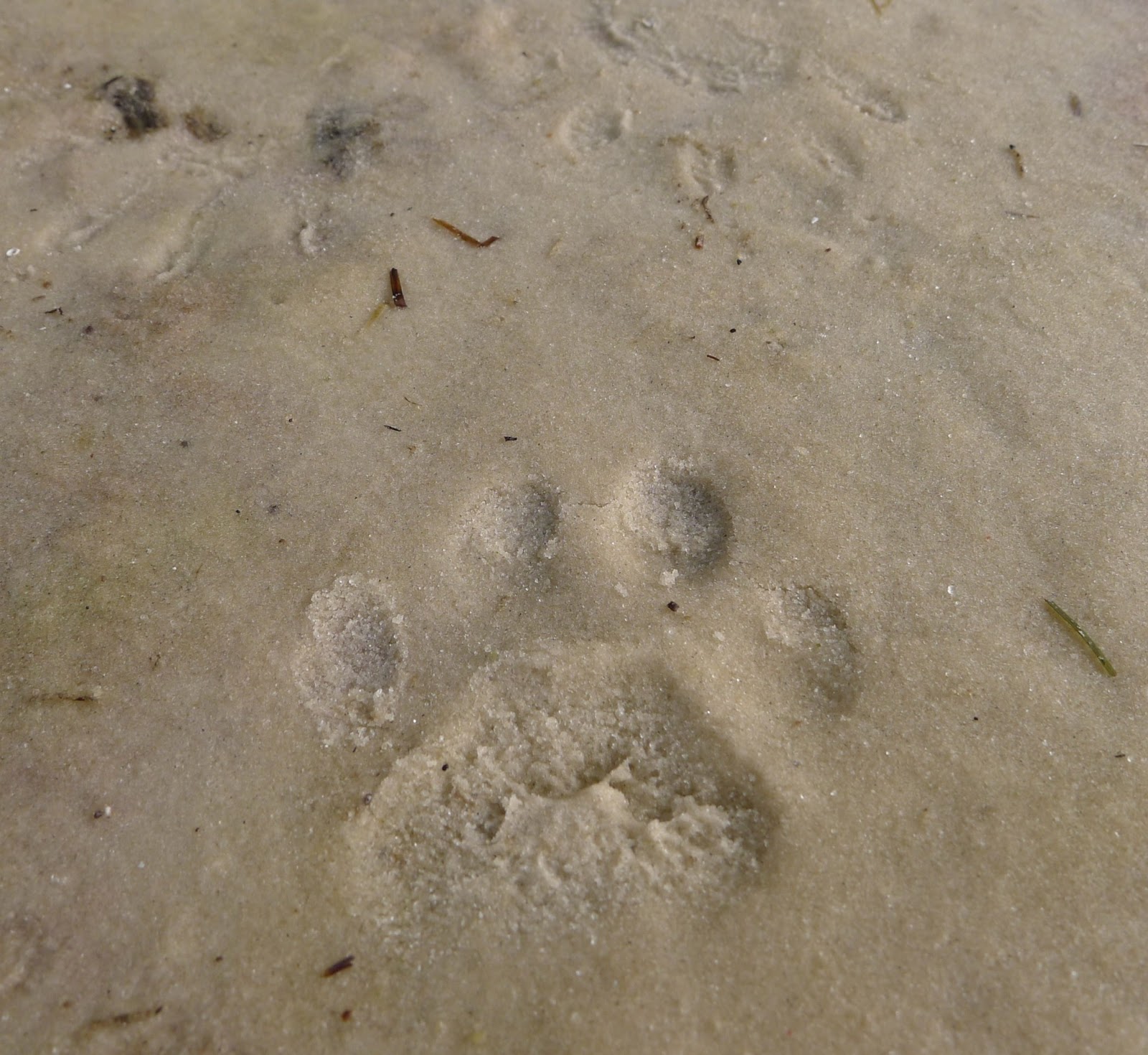
Bobcat track, with a couple raccoon tracks at the top.
This is one of the best times for bird watching here in Florida. Many winter migrants are still here, and other birds that winter in the Caribbean and South America are starting to pass through. Not to mention our resident birds. This is really a sort of birdwatching paradise, one of the things I do love about living here. In a short space I saw willets, plovers, ruddy turnstones, osprey, ibis, three species of heron, two species of egrets, brown pelicans, and a juvenile bald eagle. I even heard a loon call in the distance; apparently they winter down here. I was amazed and very happy, though, because when I think of loons I think of Michigan's UP and Maine, two places I love.

I walked back and forth, soaking in the sun, feeling the cool wet sand under my feet, enjoying the quiet (save for the occasional boaters further out on the bay). I found tons of raccoon tracks on the sand, as well as a single bobcat heading south, which I followed for a good way. I didn't catch up with her, though; maybe someday i will find her at the end of her trail, standing in her tracks.

Finally the time came to find a campsite, so I poked around up the beach, looking for a break in the mangroves with a place to lay a sleeping bag. Finding it, I settled in, and soon had a fire going. I almost never make fires when stealth camping, but I needed it to cook, having opted to go old-school on this trip, and I felt safe enough in this rather isolated spot. If I'm being truthful, though, it's not that isolated: later that night I could hear strains of rock music drifting from the resort a bit to the north, and I really wasn't very far from the main trail to this shore.

A friend said I looked sad in this picture. I was going for "contemplative"
I slept poorly, having not brought a sleeping pad, nor any bug spray, nor a tent; the mosquitoes and especially the midges ate me alive. But the dawn was beautiful, and supernaturally calm: I've never seen big water so glassy smooth in my life, and neither have you. Long Vs of ibis flocked by, heading south from their roost near the aforementioned resort. Other shorebirds also streamed past me, heading toward the oyster bars just down the way, where the feeding is rich.

The whole place is rich. I am still amazed at how alive this place is, how productive a habitat, not to mention varied: you have the mudflats of the shore at low tide, the shallow estuary with varying salinity levels all the way down to the Gulf, the mangrove fringe, the pinewoods and prairie just inland... edge habitats often host more wildlife than the interiors of a given habitat, and here are about 5 different edges all in one place, with all kinds of microhabitats mixed in.

At least 70 ibis in just this flock alone

The hike out was pleasant as well, taking my time now through the pines. I kept seeing more and more species of birds; in the end, came to 28 species in less than 24 hrs, likely a new record, though I've never before kept track so specifically. Mourning doves, an eastern wood peewee, an eastern towhee, grey catbirds, black and turkey vultures, a hairy woodpecker, mockingbirds, and more. All in all a fantastic, if short, excursion. I'd love to go back during a full moon, to maybe spot that bobcat after all.

Tuesday, November 6, 2012

Gardening


Not very long ago I had a bit of a personal epiphany. I was over at my uncle's house, trimming his hedges. The sun was shining, but had just rained a few hours before, so the leaves were dripping wet. And as I went down the row of bushes, manually shearing off the excess, I realized that I really love doing this. The sharp yet quiet sound of the shears, the fresh coolness of the rain against my skin, and mainly, working with the plants. There is something about gardening that really appeals to me at a deep, soul level.

Seems like most of the other jobs I've had has been somehow anti-life. Certainly the home remodeling of recent times, which is hugely energy and resource intensive, very wasteful, polluting (with toxic chemicals), etc. Even retail jobs produce a lot of waste, and encouraging consumption doesn't quite appeal to me. Generally our economy is anti-life, speaking broadly, which is why we say it's unsustainable. This of course filters down to the lowest level, where everyone contributes to it.

I don't feel like I'm contributing anything positive to Life, not even really to the human world; I'm helping some investors make their unholy profits, and managing to feed myself on their scraps. If I were merely providing housing for people, fine, that's honorable; but we can all be real about this. No matter how used to them we are, our 2000 sq ft houses are wildly out of proportion to human needs. Unless you have a very large family, who needs such a big house? The way we arrange ourselves, everyone having their own room, typically at least 10'x10', it's pretty gluttonous in terms of space and housing. Certainly it is not the only way things can or should be. Indeed, humans evolved living in tents and huts, or large but communal long houses or lodges.

I visited, on my way to Utah last spring, some of the ancient pueblos in Arizona and Colorado. It is incredible how small those things are. The buildings seem large, but the actual rooms are claustrophobic, hardly enough space to fit a man's body laying down. Yet this is how they lived, for centuries, them and their families cuddling in these small spaces. Why do we all sleep separately (save for couples)? Why do we need so large a space for a bed room, where the chief activities are sleep, sex, and general rest? Many of our basic assumptions on this and other aspects of every day life are so clouded and myopic it sickens me.

It's the same thing with most fields of work these days: everything is tainted by the profit motive, even such basic and honorable things as farming and medicine. I've never been afraid of hard work, but I do hate knowing that my work has, inseparable from it, this threading of dishonor, the sleaziness of greed, corruption, power. Nothing is pure. This is the stuff Marx and Engels talked about. How can I really love what I do if I know that, even if I'm farming and feeding the world, I'm also poisoning the soil and rivers, or keeping livestock in barely livable conditions? I've never been able to find a fit for myself, because everywhere our system is corrupted, and I'm looking for truly honorable work.

With gardening, I am able to encourage and produce life; at least if done right. For example, trimming a bush doesn't hurt it, because it will just come back twice as hard. You can grow food and also build the soil and biodiversity as you do. In this there is still some true honor. And as I stood there in the sunlight and the rain-wet leaves, I realized that I need to be doing something with plants in my life. I'm almost thirty years old and I think I've found my calling, in general at least.

So I've been brooding on this a bit. Brooding is kind of dark sounding; call it musing, pondering. Trying to figure out which way to go with it, while realizing all the more how right this epiphany is. I mean, since I can remember I've loved plants and gardens. My parents say I used to play under the bean poles as a small child, they were like teepees, and even as I grew older I preferred being outside. I loved helping my dad in our massive flower gardens as I matured still more, propogating plants, helping design new plots, turning the soil, adding truckload after truckload of compost. Never felt like work to me. We'd smile and attribute it to our Irish blood, which makes us love to have our hands in good soil.

There was this one corner of the garden, it was my spot. It was a fairly large, lush bed on our side of the fence; meanwhile, the neighbor behind us had a big hedge, like a green and living wall. The neighbor to the side had let that part of his yard grow wild, as it was out of sight out of mind, behind his garage. There was a huge Norway spruce growing there, a good sized white cedar, tons of weeds, and a thicket of some kind of bamboo sort of plant, which spilled over into the yard behind him, also a forgotten place of decaying firewood and weeds. It's pathetic, because I'm talking about a very small area, but it was the wildest part of the yard, and I was drawn to it.

I know also that I've been missing having a garden for years. Every spring I wish I had a plot to put some seeds down in, and every summer and fall I simmer in jealousy at a few of my friends' pictures they post online, of their produce. Seems like every year, I'm not situated somewhere that I can do this for myself. Part of that is, of course, me following my other loves: camping, and, later on, hiking. Wilderness has always called me, but I'm realizing that maybe half of that call was the call of plants. To simply be in places surrounded by the vegetal world. The wild-freedom-call is another thing aside, and not to be ignored here. But plants... they are strange to me, mysterious. Living beings so far removed from my human experience that they rather baffle me. Alive like me, but mostly foreign. Their body form is different. Their senses are different. Their life cycles, different. Gardening is a conversation with this mystery. Even hiking in the forest is a sort of communion with kingdom Plantae, though it goes beyond that into general ecology too.

I think even the way I get all fired up over sustainability and permaculture and all that, is largely fueled by this. There are many good things to be done in those fields, and I'm not saying I'm purely all about the growing of plants. I'm fascinated by many aspects of sustainability, the basic philosophy of it, the science and ecology of it, and specific fields, like urban design, new building materials and methods, and new energy sources and methods.

But those will have to be for other people. I want to have my hands in the dirt, somehow, some way. My part in all this, I think, must be working with plants. I titled this "Gardening" but it could be anything: farming, working in a nursery, or as an arborist, or a conservation forester. I hardly know where this could take me.

Friday, October 26, 2012

Great Blue Heron


I saw this Great Blue Heron, one of my favorite birds, out on my dock today when I went down to the kitchen for dinner. I think this can serve as a brief example of the sort of intelligence I was talking about in the last post. Because, typically you would expect to see herons standing in shallow water and weeds, hunting fish and frogs. Certainly it seems strange that he was standing in the open like he was, especially since I noticed him at 6 PM, and he remained there, essentially motionless, until 7:30 when I went inside. I sat on the balcony, hoping to see which way he would fly off, wondering where his nightly roost would be; but he outlasted me, as nature so often does. I grew tired of waiting and went inside. It was nearly full dark by then, and he'd been there at least an hour and a half-- who knows how long he'd been there before I spotted him.

What was he doing there? Definitely not hunting. For one thing, he was not in a good place for hunting: at least a foot and a half above the water's surface, not in the productive weed beds lining the shallows. Also, he barely moved for over an hour, hardly a twitch, aside from incrementally increasing the S-curve of his neck until his head was resting nearly on his shoulders. As dusk deepened, he did some slow wing stretches, similar to how I might stretch the muscles that lie across my shoulder blades. He also did a few knee bends, lifting one leg up, then the other. I thought he was getting ready to fly off. I think he was waiting for me to leave.

I wondered about predators. Certainly not many things prey on these the largest of herons. Possibly a bald eagle, but they prefer fish. An alligator might snap one up, but this heron was mostly safe from that, given the distance it is down to the water surface from the edge of the dock. A Great Horned Owl might take one, but probably not very often. Bobcat? Maybe. Coyote? Possibly. But this was the genius of the bird's chosen location. Not only was it far from any cover a stalking predator might use, but look at his placement. He set himself up right where the fourth tie-off post would have been, had it not been broken off. I don't think this was random or by accident.

One post, two posts, three posts, fo-- HEY!

To a casual glance, and in the growing gloom of dusk, though right out in the open this bird had in a way concealed himself within a regularity of his environment. This is intelligence of a certain manner. Not mere chance, nor the determinism of a genetic behavior. He probably didn't have to think about these things, but this intelligence isn't necessarily rational or lingual; more akin to intuition. Rational thought is just a recent layer of complexification of intelligence.

He wasn't ready to fly off to roost, was probably wanting to wait for full darkness, so no hungry eyes would see where he would finally bed down for the night. Most likely he was digesting a large meal. Often, birds feed just before nightfall, to see their high metabolisms through the night. I guess this one had gotten lucky with a large fish, or several smaller fish or frogs, and was content and satisfied for the day. So what did he do? He flew off to a good place in which to rest. He would have done the Buddha proud, as he faced toward the setting sun across the water, alert, but quiet in body and mind.

I suppose it's easy to discount all of this about inner intelligence. There are always two sides to any story or issue. Here, one could say the bird's behavior was the result of an inner intelligence, but one can just as easily say it is all genetic programming, just a dumb bird in a dumb universe. Sort of like the debate between materialism and idealism:
George Berkeley put forward the contention that nothing is real, in the sense that the universe exists only in our perceptions. When asked by Boswell what he thought of Berkeley's theory that matter may not, in fact, exist, Johnson kicked hard at a stone and stated, "I refute him thus!"
Johnson felt the reality of his foot hitting the stone, but Berkeley could say that he only perceived it, and cannot prove the reality at all. It goes round and round. I posit that both are correct. That is, there is the external view of science, which talks of the material evolution, but I also think there is an inward sense to everything, not just mere mechanics and behaviorism.

I guess the point is, I'm arguing for an acknowledgement of this "two sides to everything" fact. Materialism is not, in fact, the only possibility. It is ignorance to rule out the opposite position categorically; such a ruling out cannot be done, as it would have no basis in fact. This either-or thing cannot be resolved by choosing one or the other, the solution is to transcend the question by subsuming both in to a larger answer. This, really, is why, though I've been interested in both science and religion since earliest childhood, eventually this interest led me into metaphysics. I don't want just to cheerlead for one side, a relative understanding. Like all humans, I long for absolutes.

As Morihei Ueshiba, founder of aikido, said: everything—even mountains, rivers, plants, and trees—should be your teacher. And this is what natural philosophy is all about, what materialist science has lost, and what my next post, I think, is going to be about.

(By the way, the gator to the left of the frame in the second picture is, of course, fake)

Monday, August 20, 2012

Kayaking the Canals


So I mentioned in my last post that I moved in with a coworker of mine. In addition to being in a better location for getting anywhere, centrally located in "the Cape," the house is right on a lake. Man made and pond-sized, but it connects to part of the 400 miles of canals and other lakes in the city of Cape Coral ("home of the newly wed and nearly dead"). Most connect to the Caloosahatchee estuary and are thus saltwater, but in my case all are freshwater, which works best for me; no ocean access but it feels more like home for someone from the Great Lakes State, where "the beach" always meant a lakeshore. For being in the middle of suburban sprawl, it feels remarkably like living in the country. We get sunsets over our unnamed lake most nights, there's tons of fish (though I have yet to throw a line in), and best of all, my roommate has two kayaks, and keeps urging me to use them.

Last friday I had a short day at work when my 4 hour day turned out to be only 1 hour. The paycheck will be smaller, but life isn't about money anyways. Rather than sell my life for money, turns out I had a chance to throw a kayak in the water and earn much more than cash. At first I cruised along, heading south, just trying to get a feel for this stubby river kayak. Perviously, the only ones I'd ever used were my uncle Mike's long-bodied sea kayaks, which are easier to keep straight (though less manouverable). Every stroke made the prow of the kayak waggle one way, then the other way when I'd paddle the other side. I never really got the hang of this, truth be told. A work in progress.

Digging down, I moved rapidly through the water, not really with any aim or goal, but enjoying the late morning sunshine and the water's peace. The banks are lined mostly with Australian Pines, a non-native, terribly invasive species which nonetheless is a beautiful, graceful tree. I think they were put in to stabilize the man made banks,or perhaps colonized them themselves. They do provide long strips of cover for wildlife, here in the midst of this city of houses or undeveloped lawns/fields (formerly rich forest habitat). Probably they serve a function much like the hedgerows in England do, in those otherwise heavily farmed and changed lands.

There were some storm cells moving in from the west, and though they stayed north of me, I decided to begin to return. All along I'd been looking into the trees, hoping to see some raccoons curled up in the crotch of a tree, though with no luck. But I went much slower on the way back, much to my bird-watching benefit. Now I started seeing some signs of life, starting with some strange heron-looking bird. It later turned out to be a Green Heron, a bird I've already added to my life list some years ago, not that I'm merely interested in cataloging the biggest list. Though the first one flew off after a few moments, I'd shortly get a good chance to watch one feed, down a side canal.

I was ghosting along, hardly more than drifting with the wind (there's no current in the canals), prowling up the weedy banks looking for wildlife, and spooked one out. He flew off to a dock, where I got a good look at it, finally IDing it for what it truly was (I'd been hoping it was a tricolored heron, which I have yet to see). Beautiful bird; I love the sharpness in a heron's eye, from the little Green on up to the Great Blue. He flew off then to the other bank, and I floated along, watching it creep through the weeds. It was beautiful, the way he would extend his bright yellow log forward, place it gently on the grasses, then shift gracefully forward, the perfect stalking step, like an Indian hunting deer, this bird was silent death to the minnows and snails, and I watched him catch two from less than ten meters away. He knew I was there, of course-- he looked right at me several times-- but he probably isn't used to danger from the water (though there are gators out there aplenty). I suppose I looked like a big green log. Certainly not like a human, which, the heron would have learned by now, are land creatures. Being in a kayak gets under their radar, in much the same way horseback riders have an easier time seeing birds, because they are accepted as horses, not humans.

Back out in the main canal, I watched a Red-winged Blackbird harassing a Great Egret. The blackbird (just to the left of the egret in the first photo) had fledglings nearby-- I watched them being fed for some minutes, again from very close-- and was clearly not pleased at this large bird being near his young. Just as I was taking photos, the blackbird dive-bombed the much larger bird's head and drove it sprawling ungracefully into the water, leaving a visibly pissed off egret fuming silently in the weeds, before flying off in irritation.


I followed the egret, hoping to get a better close up shot. He hadn't flown far, and was just down the canal on someone's lawn. Using the "flashburst" feature on my camera, which takes pic after pic as you hold the shutter button, I was able to catch it taking off in flight when I got too close. Here are two from the series:


About this time I realized that I'd neglected to take any photos of that Green Heron, much to my disgust. Idiot! So I returned to that side canal, ghosting again up the bank where I saw the bird last. I know most birds have deceptively small territories or home-ranges, especially in productive habitats, as these seem to be. So I figured the heron was still in the area. After about twenty minutes of sitting nearly motionless in the boat, I finally found him (could have been female, adults look alike). I had a harder time getting close this time, but was able to get a few shots from the increasingly wary bird. Eventually he flew away, when finally I got too close. 


The photos could be better, I know. It's hard taking pics from a kayak, when the wind keeps turning you around to face the wrong way, and out of prime position to somewhere with weeds blocking your view of the little bird, which keeps moving himself. And the zoom on this camera isn't ideal for wildlife photography, should have sprung for a camera where you can attach different lenses, namely, telephoto lenses. Maybe next time...

Saturday, July 28, 2012

System Disruption and The World Without Us


I recently read a book called The World Without Us. There was a TV series a couple years ago of the same name, perhaps based on or inspired by this book. Basically, it is about how things would fare if, in one sudden instant, all humans simply died or disappeared in a sort of Rapture or human-specific disease (think biological weapons), or whatever. A thought experiment.

I think I enjoyed the TV show better, because the visuals help, but the book was interesting. Both go into how long buildings (and everything else human-made) would last. Surprisingly not very long for most things. Concrete dissolves in acidic rain, and if there's rebar in it, it goes even faster, since concrete is permeable and when the iron rusts, it expands, crumbling the human-made stone. True stone (granite, marble) lasts millenia, but concrete, steel and glass is cheaper, so our empire's buildings will not inspire people two or three hundred years from now. Besides stainless steel and plastics, very little trace of us will be lasting.

Water turns out to be the major force of destruction. A quote in the book goes, "if you want to tear down a barn, cut an 18 inch hole in the roof and stand back" or something like that. The rot sets in, comes through where roof nails rust, or the plywood glues decay or dissolve, or when the window caulk crumbles, or animals chew holes in. It doesn't take long after that.

There are places in Detroit, abandoned schools, homes, hotels, factories, and so on, where urban explorers like to haunt. I never went myself but I've seen blogs and photos and such about it, plus the afore mentioned TV show which talked about Gary, Indiana, in a similar state of abandonment and decay. Trees growing under broken roofs, pigeon guano and windblown leaves and dirt creating new soils and hastening the rot and rust, root-swell and the freeze-thaw cycle breaking down what was built. Of course, looters, explorers, and vandals hasten this process, but either way it goes quick. There are whole city blocks in Detroit that could be better named prairie than urban. The houses are all gone, burned by vandals or demolished by the city. Feral dogs roam in packs, deer move in, the game-bird population swells during hunting season, there in the new refuge, where the center is hollowing out in this late stage of our modern urban development cycle. Post-worthy all on itself, really.

The thing that really got me thinking, though, was the chapter late in the book about Houston. With all its refineries, chemical plants, and heavy industrialization, and the talk about nuclear plants in general. This is important to consider not merely for the fun of wondering what the world would look like if humans disappeared, how Nature would fare. No, this is important because of what could result from "system disruption." We live in frightening times. Climate is changing, the West is burning, the seas will be rising, cities flooded by the rising tide and destroyed by storms, Peak Oil is here, the Hollow State is here, confidence in the future is looking pretty bad. Who knows what could happen in the next decade or two? The collapse of our modern system is not as far fetched as it was ten, fifteen years ago.

So what about all these highly technical, delicate, and unfathomably dangerous and toxic systems we have. When the power goes out, when the oil and the money stops flowing, who is going to man the power stations, the chemical plant safety systems. It's not terrorism I worry about, and maybe not even World War Three, but systemic failure of these just-so systems and long supply lines is possible and terrifying.

Complex systems WILL fail. I read in the book Deep Survival about this, it's an aspect of Chaos Theory. The example was a pile of sand in a kitchen timer. Flip it over and watch. The sand piles up, up, up. There are little collapses of grains cascading down, but once in a while, the big slip happens, and the whole mound collapses. That may not seem a complex system, but it is, in a way: thousands of irregular-shaped grains piled up randomly and with stress (weight of more sand) being continually added. This model applies to survival disasters, like mountain climbing (all those many factors: snow conditions, sunlight and temperature, the ropes, knots, and anchors, human choice, etc); how much more so must it apply to what goes into creating and maintaining a working nuclear power plant?

I recently saw a show about nuclear weapons, the arms race, and disarmament, and one segment talked about near-accidents. A bomber carrying nukes accidentally drops one in South Carolina, and 14 of 15 redundant safety systems failed. One switch was all that stood between us and a nuclear explosion in a populous region. That was one example in a long list given: nuclear subs sinking with numerous warheads never recovered, false alarms at command posts (on both sides of the Iron Curtain), mid-flight collisions of bombers carrying nukes, the list went on.

And then look at Japan's recent tsunami, and the nuclear disaster. The earth can shift, the weather can turn, and suddenly we're swamped in toxins. I worry every time a hurricane looks like it might hit Houston. And how many chemical and nuclear plants and storage facilities are located in the area of the lower Ohio River and on down the Mississippi? The New Madrid Fault could slip at any time, and who knows what could happen then. Last time it did, in 1812, the Mississippi jumped out of it's bed, flowed backwards for a time, and finally took a new course. Chimneys toppled in Maine, sidewalks cracked in Washington, DC. Back then, the immediate area of the quake was almost unpopulated, save for a few white settlements and of course the Native American villages. Now, we have heavy industry, major cities, and a lot at stake.

So. If humans disappeared, Nature would suffer in the short run. The chemicals and radioactivity would be hard on selected regions for a good while. But left alone, Nature clenses itself rather well. Even if we remained, things could be alright if we'd stop piling on the hurt to the environment and let the healing procede. Truly, the main problem with the human effect on the world is what it does to humans. Yes, extinction is tragic, and the individuals that are dying would surely like to live. But on the whole, the Earth doesn't care, and Nature will fill the niches, or it will have simpler ecosystems. Whether there are lawns, or prairies winking at the sky with a million wildflowers, doesn't matter except in the minds of humans. If things went back to bacterial sludge, so be it. Evolution would start out again, perhaps. And of course, eventually the sun will expand and boil the oceans away and that will be the end of it. Nature, evolution, the Earth, none of them care about any of that. Humans do, or, at least they can.

Environmentalism is about people. Keeping people healthy and well, physically, aesthetically, spiritually, economically, et cetera. Naturally, all is One, so this means that the highest good for humanity is also that for the natural systems; biodiversity is resilience. So it does tie back in to saving the forest for the forest's own sake, because it's sake and ours are the same in the end. But my worry about system disruption in terms of chemical spills and nuclear disasters is more about the horrors it will cause for society, for people. Chernobyl is already basically a nature preserve, though too radioactive for humans thus far. 

And that's sort of the point, right? We could be walking into a world-wide Chernobyl. Humans aren't about to be erased from the world, so we need to be asking ourselves, just what kind of future do we want for ourselves? With so much hanging by a thread, we should be acting far more cautiously than we are, with our cavalier attitude, building cities on fault lines, toxic industry in the path of hurricanes and on the shores of rising seas, arming ourselves to the teeth and powering our cities with things we have no way of disposing of safely, simply waiting for some panicking fool in a bunker to push the big red button or for the safety systems to fail. Yeah, Nature will get by, and even some level of society will get by, but is this sort of progress worth the suffering?

Sad thing is, we will do nothing to change. We know we're warming the planet, but nothing is done. There's even a big new coal rush happening in Africa. We know how bad it is, but we keep making it worse. We build one Sword of Damocles after another. Why more people aren't lost in despair is beyond me.

Wednesday, July 4, 2012

Lines of Travel

Path through a relic piece of urban prairie

There were two places back in Metro Detroit that I used to hang out in, two tiny little patches of woods (one makes do with what nature one has, in the city). One, Tenhave Woods, was right behind my old high school, a patch of trees about 22 acres, a relic somehow left alone when the area was suburbanized starting in the 40's. It felt larger because it was pretty thick with undergrowth in many places. Part of it (naturally the part where the gates both were) was swampy as hell in the spring, I'd have to wade, shin deep, through standing water and liquid, sucking mud, but it would dry out eventually. It had some really old, big trees in there, mostly maple, white oak, and beech, and a vast diversity of wildflowers and other plants. There was a decent little trail network constructed by local Boy Scouts, where people could walk or even jog. In one corner sat a little pond, and the whole wood was a helpful refuge for raccoon, opossum, even a little herd of deer, and probably by now, coyote. There were even remnants in there from the last Ice Age: Glacial Lake Erie had a shore running through those woods, visible to one who knows what to look for.

The other spot, at Douglas Evans Nature Preserve, was even better. It was a little smaller than the other, but the best part was that it had the very windy Main Fork of the River Rouge running through it. Half prairie (mowed once a year), half forest, a little trail along the river, a big tree fallen across the river serving as a bridge, even more wildlife, actual topography changes (the "deep" cut river banks, mainly, but it made it feel hilly). All surrounded by the nice homes of Beverly Hills-- which just there felt more like country homes, when I'd see deer browsing in their flower gardens. I remember one mild December evening, just before sunset, I got off work and I rode my bike out there, enjoyed maybe the best Christmas Eve in my life, even though I only stayed an hour. It was the right place to be on such a day. Nature truly became my church that evening. 

I visited both places pretty often, came to truly love them; but still I don't feel like I really knew them fully. The seasons made them feel constantly new, and because I couldn't really hike these places (which, in winter with the leaves down, you could stand in the middle and see houses in every direction), I was forced to sit still or walk very slowly, to simply watch and listen, to really see and hear and feel and maybe even begin to understand.

And yet, there is so much in that handful of acres that I never exhausted them. Twenty acres of woods or even a Zen garden could provide endless opportunities, if you are sensitive to depth. The hiker in me ridicules the notion and calls for whole mountain ranges, but this is true. A cubic foot of soil contains more life than you can even imagine, every tree's bark is different and is traveled by all manner of insects, every bend in a little stream holds interest to a sensitive eye, and all of them change over time.


Then I look at this map, a life history of my travels, most from the last several years. Part of me feels like, damn, there's still 7 states to hit, and huge areas even in states I've visited that remain unexplored-- I've only seen extreme southeast Idaho, for example, and in Washington State, just the Portland suburbs on the north side of the Colombia River. Huge circles of unexplored area can be drawn in the Northwest, the northern plains, the Southwest and even my native Midwest. But my point is, can I claim to have really seen much of even the parts these lines do transect?

I've spent so much time trying to see more, bitten by the travel bug...but most of the lines are just me driving the interstates on my way to somewhere; and you don't see much on an interstate, or from a car in general. Example: I've been the length and breadth of Kentucky, but only on the roads, so I can't say I've really seen it. And all the trees in the east don't help much; even when they're just a "beauty strip," they block the view.  And when you have long views, so what? It's all whizzing past you, you'd be better off just looking at a picture back home, if that's all you're doing.

Some of the lines are better. One, from Georgia to Maine, is a rough estimation of the Appalachian Trail, which I walked all in one go, slow travel, immersed. Segments in the Sierra Nevada and SoCal mountains are the Pacific Crest Trail, same deal. Some of the stuff in Utah are hikes or places I worked in. Naturally I've seen a lot more of Michigan than I've been able to draw here, being a native of the state. And many of the lines have explorations along the way or at their ends that are too small to draw on this map.

So, while many people's maps would have far fewer lines than mine, what a meager thing it really comes to! There is a ton more of New England I'd like to see: the Adirondacks, the Maine coast, Boston, Cape Cod, to name a few. It'd be great to see the Cascade Mountains. What I saw of the Pacific Coast was paltry, mainly from cars while hitchhiking, or else being stuck in places not much worth seeing. All in all, I didn't take my time, and blew that opportunity. Even in Michigan there are places I wish I'd visited: never made it to Isle Royale (yet!), nor to Tahquamenon Falls, and I could be pretty happy in some of those towns "up north," like Manistee or Petoskey, or Alpena. To say nothing of Canada, or Europe!

Thoreau said something wise in his essay Walking, "There is in fact a sort of harmony discoverable between the capabilities of the landscape within a circle of ten miles’ radius, or the limits of an afternoon walk, and the three-score-years and ten of human life. It will never become quite familiar to you." And he was hiking around the rather gentle and tamed landscapes of eastern Massachusetts. I don't know how serious he was, since he took other trips, to Cape Cod, northern Maine, Canada, and even out to Minnesota. But he had his main stomping grounds, and was pretty much satisfied with them. 

The tree I call 
"Mother Oak,"
Tenhave Woods
How much space does it really take? Do we need to live next to Yellowstone to have a wilderness experience, or recreation in a natural area? The bigger the area, the less you get to know it, the more you miss and know you miss, and therefore the more restless you become, the more desirous. I remember many places along the AT, where I wished I wasn't thru-hiking, didn't have the need to push miles, and could hang around and explore, whether specific area like Smokey Mountains NP, various little towns along the way (especially in New England), even just random viewpoints where I'd have liked to just sit a few hours and bliss out.

I met a lady in Shennandoah National Park that summer of my hike; she lived nearby, and spent all the time she could hiking around in that one park, exploring, bushwhacking to places no one ever went to. She probably knows it better than anyone else alive, yet still finds more to keep her interested. My hike straight through was surely infinitely better than cruising Skyline Drive, but even so it was still just a tiny slice of the park, a fraction of what was there to be known. I'm starting to think she was on the right track.

I guess what I'm getting at is sort of an instance of the Little Way of St Therese. Clearly she wasn't talking about hiking or nature, but, "St Therese translated “the little way” in terms of a commitment to the tasks and to the people we meet in our everyday lives." It's rather Zen, and actually I wonder if having grown up in a parish where both my church and school were both named Shrine of the Little Flower, a nickname of hers, had anything to do with my Zen leanings. We did review her life in religion class, and I still remember her "little way" all these years later. Or maybe it's like Blake wrote, 

To see a World in a Grain of Sand
And a Heaven in a Wild Flower,
Hold Infinity in the palm of your hand
And Eternity in an hour.
I still hold those two tiny natural patches, all the way up in Michigan, in the midst of so much suburban sprawl, as sacred, at least in my own personal spiritual landscape. The hours I spent there, the poems I wrote there, the memories I created there, they are all still with me. Their 'placeness' still resonates in my soul. I am still inspired by them. 

Though on balance I'd prefer more nature than is available even in such plots, and I'd prefer a smaller town (but not too small), I think a diet of little patches of woods and wild, while occasionally taking a real retreat, would work. Because I do need the occasional real escape from urbanity, it's noise and inroads, which are not available in the little places, where traffic sounds penetrate. And sometimes you just need an adventure. But over all, the point of these major retreats shouldn't, it seems, be to see ever more places, a mere catalogue of new terrain, but to find the peace, beauty, and spirit of Nature. Kids (and everyone) should travel to expand their minds and views, not to pile up a bragging list of exotica; to draw a map not of distances, but one with lines that lead toward depth. 

Saturday, May 19, 2012

Google Earth

I don't know about you, but I am a huge fan of that Google Earth. Ever since I can remember I've loved maps, and for as long as I've had the internet I've looked for good interactive maps. Google Earth is certainly the best that I've found. You can see terrain, interact with other users via placemarks and Panoramio pictures, and there's a ton of different layers you can add. I've been known to waste much time playing around with it.

So I figured, since I'm out interacting with the real Earth, here's some screenshots of various locations I've found on Google Earth that I think are pretty freakin' awesome. What I've done is take screenshots with none of the toolbars, pasted it into Microsoft Paint. Then I crop it so that the menubar, "Google" logo and other writings are not included, shifting the desired image into the top left corner. Then make the image attributes such that the image ends at the coordinates of the bottom right corner of the desired image, thereby deleting the Google logo and such. I end up with just the pure image. They are pieces of art in and of themselves. I hope you enjoy.


The braided Koyukuk River, Alaska

Dendritic pattern in the Colorado Delta

Another dendritic pattern in the Colorado Delta

A third, and my favorite, dendritic pattern in the Delta.

Dunes in the Sahara

Dune field in Lybia
Mackenzie River Delta, Northwest Territories


White Canyon, southeast Utah

Saving the best for last, the Yukon Delta, Alaska

Saturday, March 31, 2012

Water


I've recently been reading a lot about water. Namely, water politics, the use and misuse of water and the problems it's causing in the world. It started when, browsing the rather bare ecology section at the library, I happened across this book, When The Rivers Run Dry by Fred Pearce. This is a supurb book, I cannot recommend it enough; I blasted through it in about five hours, I was so engrossed... and it's not a small book. Pearce takes us on a worldwide tour of water issues facing the globe; being an egocentric American, I was naturally most interested in the parts on the Rio Grande and especially the Colorado River (despite these not being anywhere near the focus of the book).

Part of the interest here was that these rivers are the first I really learned of water crises or shortages, aside from vaguely knowing about thirsty kids in Africa. To know that these great rivers no longer reach the sea most years-- what an eye opener this was for me! I mean, it boggles the mind. The Colorado especially, with its enormous flow rates... I recently read this book about John Wesley Powell's incredible first boat trip down the Green and Colorado Rivers in 1869, and the way the author goes on about the sheer force of the unimaginably massive flow of water squeezed between sheer canyon walls and crashing over huge rapids-- and somehow all that water is almost completely gone by the time the river reaches the Mexican border! And then the Mexicans use what little remains, leaving the once rich Colorado River Delta a death zone.

One interesting non American water issue was what Pearce called the world's first water war: the Six Day War between Israel and its neighbors in 1967. Apparently, less than 3 years before the war, Israel completed a dam on the Jordan River just below the Sea of Galilee, capturing most of the flow and pumping it over the mountains and west into Israel's farms and faucets. The Kingdom of Jordan was left with next to nothing, aside from one tributary. The Dead Sea is truly dying now, and Israel continues to occupy lands for their water (the Golan Heights is where the Jordan originates, and the West Bank has 3 large aquifers, the water from which is still being stolen daily by Israeli settlers from the Palestinians). Water is truly a major flashpoint in the region, hampering peace to this day.

Another crazy thing is the issue with dams. Now, I'm a student of Edward Abbey, and therefore hate dams. I hated them before I read his books, but it's safe to say I hate them more thanks to him. And now, after reading Pearce's book, I hate them more than ever. Dams are almost always disastrous. Talking about the environmental effects hardly needs to be done, we all know the damage done to fisheries thanks to these giant plugs in their rivers, halting both the travel of fish and the drainage of pollution. Consider dams to be concrete arteriosclerosis blocking the lifeblood of the world. But here's one I never knew, or thought about. All the vegetation buried by a dam decays slowly, and anaerobically, producing large volumes of methane, a gas that is 8x more powerful a greenhouse gas than carbon dioxide. And it's not just the initial trees covered by the water, but the vegetation brought yearly by floods. Bad news.

End of the line for the Colorado River
Here's another one. Dams are often sold to the people as being built to prevent floods, as well as the benefits of hydropower and recreation. What do you need out of a dam/reservoir system to prevent a flood? An empty reservoir. What do you need to produce hydropower, and for the most recreation? A full reservoir. Ninety-nine percent of the time a flood is not imminent, and power is always needed, so the flood gates are kept shut and the water impounded. But what happens when, in a land that gets, say, 20 inches of rain a year, gets that much in two or three days? Well, the reservoir is already full, so the only way to prevent the total collapse of the dam is to open the floodgates wide open and let the water through. So, uh, how does this stop a flood, exactly? And this is if the spillways going at full bore is indeed enough to prevent the water from overtopping the dam, a pretty big if, depending on how full the reservoir was to start.

Dams also cost on average 50% more than they are budgeted for. Of course, in the end these books (I picked up two more books about water today) are largely about money, economics. I came across this line today in Every Drop For Sale: "People, as we've learned clearly by now, are driven more than anything by market forces, by the desire to improve their lives with commerce, transactions, robust economies, and profits." The author lends no support to this statement, it is blithely written, taken as blindingly obvious. In the author's defence, he does say a few pages back the "skewed attitude" adopted by some "environmentalists... that unless a price tag is placed on water, people won't value it enough to protect it...", clearly written as a critique of such a view.

This is a strange thing to come across in a book, for me at least. I've seen studies that show that after a certain level of affluence, money ceases to become a driving motivating factor. It's still there, of course, but, once people have attained what is considered (subconsciously) a normal, average way of living (or maybe just a bit above average), they stop being totally driven by money. Really, it is clear that very few people are totally driven by money, save for the money addicts comprising the 1%; most people are at least equally interested in love, children, their hobbies, their passions, and even their work for its own sake. Not to mention their spiritual beliefs and principles, which, at least here in America, is, at least in talk if not in practice, a central theme for millions.

So, do people only value things that have a price tag? I doubt this very much. I know I don't. People look at me crazy for my need for wilderness, because I walk away from decently paying jobs to go hike around in it for months at a time. But many people quit jobs for love, or because of their principles, or any number of things. I might be on the fringe because my passion is directed towards Nature, but only because of the object, the direction. The passion, one could say, values, are normal. Which is it crazier to value: money and luxury, or the human passions of love, spirituality, principles, and yeah, even nature?