Showing posts with label spirituality. Show all posts

Saturday, October 20, 2012

Integral Thought

I've talked on here before about why I feel that science and spirituality must (and will) be reunited at some point in some way, but I was reminded of this issue recently by a Christian friend's Facebook post about a non-believer doctor who had a near death experience and came out with a more open mind on such things. I agreed with the general thrust of the argument he made. Science as it stands is, well, absurd, just as much as spirituality as it stands is often vague, ungrounded, and even willfully ignorant. Neither truly satisfy.

I want to explain why I call science absurd, because in general I know that science is the most powerful, accurate mode of exploring our physical reality. In fact, it is not truly science I have ever had an issue with, it is the materialist philosophy underlying it. The issue is that it says things like, the universe sprang from nothing. This is like saying heat comes from cold, or consciousness from unconsciousness (it says those things as well). But, cold is an absence of heat, or maybe more accurately, a form of heat, a negative measure or sense of heat. Likewise, nothing is a negative sense of something. That is, you can have the nonexistence of a particular thing, but you cannot have nothing absolutely. If you had nothingness, you clearly have something; the only way to have nothing is to not have it. It's all just playing with words at this point, the same way I can say "a square circle;" just because the words can be lined up or uttered doesn't mean that they have any sense or reality to them.

Then, take evolution. For the majority of those who don't believe in evolution, it seems the major deal-breaker is the evolution of man. They can, theoretically, if perhaps a bit uncomfortably, accept that animals, plants, and bacteria evolve, but, they say, what about the human soul? That requires special creation. I actually somewhat agree, in a qualified sense that I will elaborate presently. I see the word "soul" and think "consciousness, mind, self." And, when I think about it, how can human consciousness spring from non-consciousness? See, I could agree with the blind, stupid universe of materialist science if humans (and some animals, let's be honest) did not have consciousness and self awareness. It is theoretically possible that such a universe bumped itself randomly into atoms, stars, galaxies and life. 

But, consciousness exists, and therefore, I call bullshit on that idea. Because no one can figure out or even understand how meaning can come from non-meaning, how awareness could grow from non-awareness. The great mystery of how brain cells' electrochemical reactions somehow result in thought and feeling. And not mere thought or feeling, but the self-awareness of such. How does this arise through the evolution of an inherently unconscious world? Where did it come from, and how does it relate to that unconscious world?

The only solution that I see that is both subjectively and objectively acceptable is to grant consciousness to all existence, from the atoms to the galactic superclusters. It has been there from the beginning. At least on a basic, rudimentary level. The Jesuit paleontologist Pierre Teilhard de Chardin puts this in terms of the Within and the Without of things, and based a rather marvelous philosophy on the notion. Everything has an objective existence (that which is studied by science), but also, a subjective, inner sense. They are two perspectives, or properties, of existence. I might put it this way: philosophers talk of "extension" as that property of a thing existing in physical space, extended into space. So here, extension is lined with or enfolded with intention. I don't know if that is a perfectly accurate pair of opposites, but I kind of like how it sounds.  

One way of understanding how this would work is to see the following. You, to your own experience, know yourself to be a subjective being, a soul if you will, a center of experience, meaning, and understanding, and, ultimately, consciousness. You look at me and see an object, a thing beheld within your conscious awareness-- yet you also have no problem granting to me that I too am a subjective being, that I am a center of awareness as well (unless you are a solipsist), just as you accept your own objective physical reality as perceived by me. I am suggesting that we can simply extend that notion to all the universe. 

This helps explain where consciousness came from. The universe, from it's formation, has been gaining in complexity (at least in scattered areas, since as a whole it is winding down through entropy). From simple atoms, to more complex atoms, to molecules and chemical bonding, to complex organic chemistry, to life, ecology, and so on. With each rise in complexity, there is less of the universe involved (far more atoms than molecules, far more organisms than ecological systems); i.e., the scope is narrower. But each level up is a gain in the depth of consciousness. 
Teilhard talks of an interdependent energy between the Within and the Without; he believes that this energy is "psychic" in nature, but that it is divided into two distinct components: a tangential energy and a radial energy. Teilhard believes that tangential energy "links an element with all others of the same order." Radial energy draws an element towards "ever greater complexity and centricity," which for Teilhard means spiritual perfection. (from the above link)
You can begin to see the facility of the idea. The universe is not entirely random. Not that the Within of things is highly conscious like the human mind. An atom isn't "thinking" about how to join with another atom, or wishing it could find one to join with. A bacteria isn't "thinking" about how to adapt to the antibiotics it has encountered. But there is a leaning in a direction, towards survival, towards greater complexity. The leaning is sort of an inward intelligence in the basic way it might make a gain. 

Robert Pirsig wrote in Lila about how for any scientific problem, an infinite number of hypotheses exist; yet, we don't waste time testing all of them, we have a sense of what ones are most likely. It isn't random computation. Consider a computer. If it were hungry, it would first try chewing on the refrigerator door, then the table, then it's own hand... finally it would hit on "sandwich" and be satisfied. This is because it is not designed to think, but to compute quickly. It would do it quickly, but it would still have to try every possibility. Human minds don't go through everything in the kitchen; we bypass 99% of what's around and go straight for food. In computational speed computers are better, but the human brain is far more efficient, because it can truly think.

This helps us understand evolution. Originally evolution was thought to be a long, gradual change over endless eons. But further understanding shows that often species changed very rapidly, in terms of punctuated equilibrium. This makes sense, since things evolve to maintain a fit with the world in which they live, and out there, things can move fast. The climate doesn't take millions of years to shift, it can happen in a few hundred or thousand years. Some changes happen much, much faster (the antibiotic threat to becteria, for example, or pesticides to insects). But how can random mutations occur fast enough to keep up? 

Maybe there is an inner sense about which way to evolve, which genes to swap around. A sort of sensing which way the environment is changing, and an inward push in that direction. I don't see this as some objective god directing evolution. I think of it as being the same way I encounter my world: I see what's there, what's needed, and my own desire pushes me in the direction of the right sorts of changes. It's not evolution by a higher law, but by an inner creativity and sense of discovery. 

And maybe this is the effort of the entire universe. An evolution not as being akin to building an edifice, with continual embellishments continually added to the basic edifice, but more as an organic unfolding, where all that you will find in the final flower was present in the original bud. Creation not as a momentary act of an outside agent, but an ongoing creative transformation, evolution united with involution. The birth of a mind that then goes on to discover a universe that it makes even as it discovers it (as we, every night, discover a world even as we dream it). Maybe the DNA has a level of intelligence, maybe everything does; maybe the animists were right all along, spirit resides in all things. 

(anyone interested in this stuff might enjoy reading: de Chardin's Phenomenon of Man, Robert Pirsig's Zen and the Art of Motorcycle Maintenance and his less well known Lila, Alan Watt's Supreme Identity, Fritjov Capra's Tao of Physics, and Ken Wilber's Theory of Everything and other works. Wilber is worth mentioning especially because of his work in "integral thought," which I guess is what this post is all about.)

Saturday, May 5, 2012

Review (of sorts): A New Earth by Eckhart Tolle

I picked up Eckhart Tolle's book A New Earth the other day at the library. I didn't find it to be anything too surprising, but I wanted to read it, if only because Tolle's book The Power of Now was extremely surprising; it was what opened my mind up to all the spiritual stuff I write about on this blog. For pop spirituality, it had quite an impact; maybe in the way a little falling rock can start an avalanche.

The thing is, when I was in my late teens, I was 1) a strict atheist, and 2) had a very shallow view on religion-- two things that I find tend to go together. Atheists act like because they've exposed all these contradictions and ridiculous notions from the Bible, that they've not only disproved God, but all spirituality; I don't see that they've necessarily done either. All they've done is shown how unsatisfactory a few specific positions on one specific sort of God and spirituality are; they usually have about as much depth to their opinions as the fundamentalists they so abhor. They are too literal, ignoring the poetry and metaphor inherent to spirituality.

So of course, I was reluctant to read The Power of Now-- thought it was just more religious B.S. my dad was pushing on me; but he was pretty jazzed up about it, and I guess the timing was right for me. Not far into the book, my mind was officially blown. I saw that my atheist viewpoint had no depth. To someone already versed in spirituality, especially Eastern religions, it would probably seem simplistic and wouldn't have much impact; but for me it was a totally new way to look at spirituality. I knew from my minimal knowledge that Buddhism was where to look for more on this, and from there a whole world opened up to me.

One thing that struck me from his new book was when he talked about when he observed a woman on the subway talking angrily to herself about some perceived slight. It's funny to me that the only difference between a raving derelict and us sane people is that we keep our mouths shut when we rave while she doesn't. If, instead of silently thinking it, we actually spoke aloud our running internal monologue, we'd all have to be committed. He pretty much nailed that observation. Identification with the ego is literally a form of insanity.

I also liked some of his instruction, all of which boils down to "be Present." One method is to "feel the life within your body," an energy, almost a tingling, immediately available to be apprehended, similar to a heartbeat meditation. I've always liked heartbeat meditations, feeling the heart from within, and/or feeling the pulse (from within) in specific parts of the body, for its own sake, as well as to increase vitality and even to heal. He also talks about listening without comment to your surroundings, which I later learned is a common eastern form of meditation. In the end, this includes listening detachedly (is that a word?) to your thoughts.

On the other hand, I think he takes his notion of the "pain body" a bit too seriously, making it almost into some sort of demon possession. At one point he even says that people under the influence of the pain body aren't responsible for their actions. His example, believe it or not, was murder. That's a lot of bullshit. Seems to me that the pain body is just another manifestation of ego, on a more emotional level. And however unconscious one is, however wrapped up in ego, one is always responsible for one's actions.

I also don't agree with his concept of spiritual evolution, as I've written about previously (see here). I'm not convinced that this is some special time in human history that's allowing more people to be receptive to all these ideas. Awareness is always there, and always has been. Which isn't to negate historical movements that bring certain notions to the forefront: sure, we're getting away from dogmatism more these days, Buddhism, especially Zen, has arrived in the West, and it and the hippie spirituality have caused some changes, at some level (what that level is is debatable). But the Evangelical movements here in the US, plus the fundamentalist Islam that's spreading in many places, seems to discount that it's a magic moment. Tolle says that the new rabid fundamentalism is the collective ego's reaction to the new rise in consciousness, but it just seems too convenient an interpretation. I think, as always, it comes down to the individual. We all get glimpses of our insanity, and we're always free to break out of it. Usually, we run away from the cracks of light coming through the chinks in the ego's shell, fleeing into new shadows, new illusions. But awareness is always there.

Sunday, April 8, 2012

Comparative Religion


Despite my great interest and inclination towards eastern religions, especially Zen and Taoism, I find that I'm still greatly influenced by my Catholic upbringing. It's hard to escape such things. I mean, raised in a Catholic family, went to Catholic school from K-8, my whole neighborhood, including my best friend, was all Catholic. Say of Freud what you want, childhood influences at least are for real. It's actually amazing that I escaped as much as I did. But I've heard it said, once a Catholic, always a Catholic. And maybe so.

In a way, I feel I'm in a similar position as Alan Watts mentions of himself in his book, The Supreme Identity (which I consider his best, or most in depth at least). He says in the foreword to the new edition, 25 years after the initial publication, that he considers the book that follows a "somewhat torturous" argument coming from someone who was about to leave the Anglican priesthood, but hadn't quite made up his mind to do so. He goes on to say, that after all his years of comparative study of Eastern religions, "things have come to such a point that I could almost function again as a Christian priest," but it's better that he stay outside any and all systems.

I sort of fit the same pattern. I used to think of Christian doctrine closed minded, narrow, exclusive, and restrictive. Too dogmatic, too illogical. Eastern religions opened the door for me, turned spirit or divinity not into some separate, distant entity, but something more immanent, the Ground of Being. I moved beyond theology into metaphysics. It was refreshing and liberating, something that resonated with my mind as much as my heart.

Recently I find myself beginning to come to terms with my Christian background. The key is to abandon literal readings in favor of a mystic's view. For example, if you read the Gospel of John not from the traditional sense but as a Hindu or Chinese philosopher might, it turns into a text every bit as amazing as the Gita or the Tao Te Ching. Just the first few lines are incredible from this perspective. You can think of the "He" "Him" "God" "Light" and all the subjects of this mystical text as Buddha-nature, Brahman, Tao. Even "Christ" can be understood esoterically, rather than literally. As Paul said, "not I, but Christ in me." The deeper spirit that resides within us, Christ Consciousness, the atman, which is our individual share in Brahman.

When Jesus said "I am the way, the truth, and the life: no man comes to the Father but by me" did you really think he meant his physical, human self, the person of Jesus? That's ridiculous, how can a flesh and blood being be the only way to Truth? Or was he speaking from the spirit which we all share? He also said "what I have done, you too can do" and "I am in the Father, and you in me, and I in you." There are tons of sayings and things in the Gospels that can be understood this way, you just have to look deeper. Think of the "I" that Jesus uses as the atman, and the Father as the Brahman, and it fits perfectly. He did teach in parables, after all.

I have come to think of the God of the Bible as a combination of things. In large part it is the confused term for the Brahman or Tao, of a people who have lost touch with it. They don't have the experience of it anymore, just a term, a concept, and over time such a concept can drift into strange territory. On the other hand, it's not all confusion. It is in places, like the Gospel of John's opening lines, used in an esoteric way by a people limited by a highly textual concept of spirit.

But I mean, this was a culture very text/scripture based; they have to be careful of blasphemy, for one, because they only had these words, not the experience, and so anything that contradicted the text destroyed their only link to Spirit. And therefore they just didn't know how to talk about the mystical experience, they didn't have the language for it as they had in places like India. So they were stuck with convoluted and out of touch terms and explanations; like a Bushman trying to explain quantum mechanics to his Kalahari brethren. He won't have the words, and it's going to get lost in translation.

Also, there are many instances in the Old Testament of God is obviously being used as an excuse of rationale for atrocities, either to whip up military fervor, or later, to explain why these whole cities were exterminated down to the last dog and goat. The priests, a class of people so often in collusion with rulers and therefore corrupt with power, used the concept of God as a weapon. You didn't destroy cities out of lust for power, they told the ignorant people, but because God ordered it.

I'm not about to return to the Catholic church, but I have found, through comparative religion, a real catholicity-- catholic, of course, meaning universal. Think of it this way. You can live your life wearing rose tinted glasses, and never realize there's a tint. But, understanding other religions is a way of changing what glasses you wear. You put on some blue tinted ones, and get a new way to see the world.

Drugs do the same thing, both they and religions initiate new modes of consciousness-- smoking a bowl, eating peyote, drinking ayahuasca, or studying Taoism and Vedanta; all are a way of trying on other realities. Shifting modes leads to great insight; thus I view drug use ideally not as a recreational thing, for kicks, but a serious spiritual tool, to be used with restraint, wisdom and respect. Right up there with fasting, meditation, music and dance (especially the trance inducing kinds), chanting, and so forth. Tools, all.

The important thing, I think, is not to say, well, the blue glasses are truer than the original red ones, or that the red ones I grew up with are the real ones, the blue are illusion or lies from the devil. I mean, it's not like we have only one state of daily consciousness anyways, we'd go crazy if we could stick in rational thinking all the time. But we are capable of switching through all kinds of states: deep sleep, dream sleep, lucid dreaming, hypnogogic and hypnopompic states, day dreaming, the Zone, trance, SMR, and the Pure Consciousness Event.

So the point of trying on these different worldviews isn't to find the right one. The narrow path of wisdom is to realize that the various worldviews, the various tinted glasses, are just different perspectives, and that there is out there a real, untinted world beyond the frames. Don't get hung up on the comparison, but use the comparison to transcend both.

So I'm not about to start going to church or anything. I won't call myself a Catholic, and I still find the Christian spiritual language a confusing, overly complex and convoluted language that makes that narrow path of wisdom even harder to find. It's a rich tradition, and valid, but for the majority the real thread of truth has been lost, forgotten in favor of dogma and external truths with a long history of abuse by power. I can understand Christ in more esoteric terms, but prefer not to use the word because it brings along too much baggage, calls up too certain an idea that inhibits deeper understanding. People get stuck on the "letter of the law" and therefore miss the Spirit.

Friday, January 13, 2012

The Wilderness Experience

Sonora Pass, Sierra Nevada, CA

Well, I did it. Today I went running, found I felt so good that I went and pushed myself, meeting and slightly exceeding that goal of 4 miles which just a couple days ago I doubted I'd be able to do, since I was suddenly struggling to run 1.5. It always comes down to how much dust I'm breathing at work, I guess. But today I felt great, hardly breathing hard, and surely could have been going faster had my legs felt up to it. As it was I stuck to my tortoise pace and met my goal. Good enough.

Since I was able to lift my mind off of pain for once, my mind drifted, and finally came back to something I'd read earlier on Del's blog. He mentioned hiking up Wilson Mountain Trail, a popular, highly used trail in the Red Rock-Secret Mountain Wilderness Area near Sedona, saying that although few were out on that particular day (it being late December), generally he doubts that anyone could have a wilderness experience out there, with the crowds. Made me think: what exactly is a wilderness experience? What goes into creating one? Del was insinuating that solitude is a reqirement, as was being in a wilderness area in the first place. Is that the case?

Lord knows I'm a bit of an extreme case, having spent such extensive time in the backcountry, the trails, the mountains, forests, and deserts. I can't even car camp anymore because it still feels too civilized. But it's all relative. When I was working as a ridgerunner on the New Jersey Appalachian Trail, I met tons of people, all ages, who seemed just bowled over by their trip. We're talking about people who are mostly from that malignancy, the New York City Metropolitan Area, people for whom the gentle woodlands of the New Jersey State Forests are as wild as any Amazon rainforest. I've seen their eyes go wide as dinner plates when I informed a family group that yes, there are in fact bears out here. I thought the woman was going to faint.

Anyway, what I'm saying is, one can have a wilderness experience walking out the front door, or in the midst of Times Square for that matter. The sunrise can be seen from anywhere, and anyone can get lost in the flight of a bird, or the mysteries of ants building their hill in the crack of a sidewalk. Lawns are boring at the usual scale, but up close are teeming with life. And though we easily forget, people are wild animals too.

Perhaps we should think about the definition of wilderness. The thing is, "wilderness" and "Nature" are human concepts, and recent ones at that. Blame the Romantics. In truth, there is no natural world versus an artificial human one. The made world of cities and modern materials don't come ex nihilo out of the void. They may be new combinations, and even harmful, disharmonious ones, but they are the same old atoms, maybe atoms that used to be a block of granite, or a deer, or a fern from the Carboniferous Period.

And yet...

Clearly there is a difference from grokking a tree in your front yard and a 5 day solo trip in a wilderness area. Or perhaps the difference is not the setting at all. Perhaps it is the mindset of the person in question. I've seen many people out on the trails who were not on the trails at all. Walking by, I heard their conversations, and they are all kinds of weird. Middle aged women discussing the latest fashions in shoes and purses (and who has them and who doesn't), young people discussing the pros and cons of alternative educational systems, some older men talking office politics.

These are all fine and worthy topics, I guess, but they could be had in any coffee shop, bar room, or living room in the country. If you're still dwelling in your workaday world, you're not walking on a mountain, you're still only travelling your mind. You can do that at home; so why did you come all the way out here?

I think you can have a wilderness experience literally anywhere, even right at home, sitting cross-legged in the dark meditating on your heartbeat. That's Nature. I sometimes wonder if "wilderness experience" is getting at the same thing as "spiritual experience," "wonder and awe," and "nirvana." Perhaps it's a manner of degree, but I mean, why should it be impossible to have a wilderness experience if there are dozens of hikers on the summit or trail? The difference is whether you're involved in the place you're in, conscious of it and integrating in it, or if you're just caught up in the same old disconnected world you always live in.

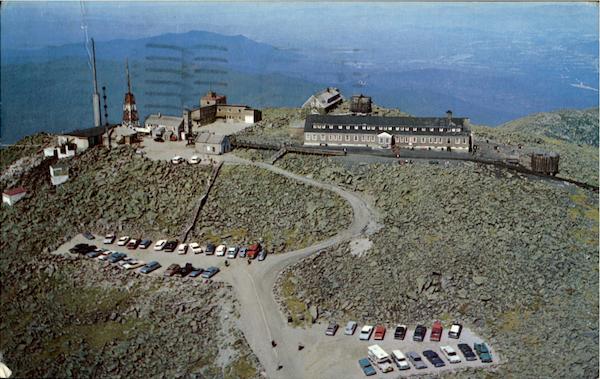
aerial view of Mt Washington's summit
So, what does constitute a wilderness experience? Firstly, being present. Secondly, being quiet is typically involved, but not always-- it just helps you connect, since language is so human, and so wrapped up in the symbolic, rather than the real. Nature speaks a thousand languages, so quiet down and listen. Thirdly, being alone or in small groups; that helps, but if you stay present, you can still be attuned to the world on as crowded a summit as Mt Washington in New Hampshire (they have a post office, cafeteria, and weather facility up there, with a road and a passenger train to the top). Leave work at work, home at home, and be in the forest, be on the mountain, subsume yourself into the greater system.

That's what it comes down to. Being present is being present, but there is a special character to a wilderness experience. Otherwise we wouldn't have a word for it, it'd be the same as deep meditation, the ecstacy of a beautiful symphony, the experience of being moved by a painting. The point is opening up to a larger world, one that doesn't have a big place for you, that doesn't revolve around you, but does still include you. Setting ego aside, the personal story of you, and falling into a greater whole. Towering rocks. Weather. Vast tracts of untended vegetation (tended by itself). Wildlife, things that can eat you, be it mosquito or mountain lion. The simple rhythm of the daily cycle, sun-time. Water that flows not because people are thirsty and dirty and have cars to wash and flowers to water, but because that is what water does. Where no concession or provision is made for you, but neither is there antagonism. It simply is, and a wilderness experience is when you simply are, too.

The problem is doing it. I've been many places, like Old Faithful, Yosemite Falls, Mt Washington, Clingmans Dome, and so on, where it's been too crowded to really reap the beauty of the place. It's possible in theory, but very hard in practice. You're too jangled by the commotion, too eager to go about grabbing at nature with your camera, it's too much. Most of us are not Buddhas, and so to really have that wilderness experience, as opposed to just a pretty view in the fresh air, you gotta get away, get alone, and get quiet.

Saturday, January 7, 2012

Nature and Spirituality

Appalachian Trail approaching Roan Mountain, NC/TN border

(A version of this post appears also at The Rambling Taoists)

Sorry for the slackness around here lately, just haven't been writing at all, not in a couple weeks, strange for me. I've either been working (or watching TV after work), or walking around in the woods, which I've been doing a lot more of lately. What little writing I have been doing has been limited to edits for a book I'm writing on my Appalachian Trail thru-hike.

I've long noticed that the only time I have no inclination to read (something I do, if I must be honest, as much for escape as for knowledge or general entertainment) is when I'm in a natural setting, the forest, the mountains, even by the sea, if I can get away from the crowds. Being away from books (and blogs/the internet) generally takes me away from the world of thought, the interplay and exchange of ideas. Not that I'm not thinking at all out there, but since that's not the point of my excursions, the thoughts are more of a passing thing than something I dwell upon. Thus, I have less tendency to write

One thing I've realized lately, as a result of all the woods-walking I've been doing, is that I'm beginning to feel like all the talk I do on here about Eastern religions, and spirituality in general, is a load of shit. Not the religions themselves, of course, but my take on them: it's like I'm trying to be someone I'm not. I'm not really into meditation, but I feel like I should be and so I occasionally do it, at times in consistent streaks, but usually not. I'm interested in the religions on an intellectual level, but I'm not the spiritual type and never have been. While I believe there is much about the world I don't know or understand, and am fully open to your more spiritual notions, when it comes right down to it, I don't experience life on that level. Like, the notions about the Tao, yin and yang, are fascinating, but rather than think about them, I tend to be impatient to embody them somehow. This is probably why I wrote once about how I realized, while in the middle of climbing a mountain, that I really was an atheist (of sorts).

I wouldn't say I'm a practical person, even though I'm currently working in the building trades. Little of what I do at work comes natural to me, though I'm not terrible at it-- it's just not intuitive for me, and I end up asking a lot of stupid questions. I wouldn't say I'm athletic either, as I've never taken part in organized sports; though I sometimes think I might have, had my heart been healthier and I had better endurance; probably not team sports, but maybe track or something. I think in some ways I was talked out of athleticism, talked myself out of it, even. Still, it hasn't stopped me in my adulthood from a thru-hike of the Appalachian Trail, an attempt at the Pacific Crest Trail, and in general physical work and the active outdoors life. The point is, in personality, I lean more towards the practical and physical than I do towards spirituality and the more intuitive side of things.

It's sort of like a masculine/feminine split. Well, we don't have to drag gender issues into it, because it's not clear cut like that in real life. Maybe it would be better to speak of left/right brain issues, though that is also an oversimplified view. Perhaps yin and yang is the best way to think about it. Point is, I tend towards masculine, left brain, yang, intellectual, rational, active, physical, rather than the feminine, right-brain, yin, intuitive, spiritual, emotional, artsy, touchy-feely. Which isn't to say I fall only one one side, few people would; but that's where my tendencies are. I have to work for the other side.

But as I've been walking around in the woods more and more lately (now that the dry season is here and they aren't flooded shin-deep anymore), I'm realizing that I've almost never had any kind of spiritual experience while meditating or pondering spiritual matters. I've been deeply impressed by the ideas presented... but the only time I feel truly peaceful, connected, present and awake is when I'm on nature walks. I don't discount the meditation, and I said I've almost never had a spiritual experience that way; there have been brief moments. But nothing sustained or reliable, not like while I'm wandering the woods and mountains.

And I don't so much mean while hiking-- which after a while does bring one in tune with nature, but overall is often more about making miles, grand vistas, camaraderie with fellow hikers, and the pleasure of physical exertion. No, I mean while out walking slowly or even standing still for long periods, meandering off-trail through the forest following deer or pig trails, attempting to observe wildlife, practicing tracking skills and being attentive and attuned through hearing and what I, following Tom Brown Jr, call splatter vision. That is, softening the gaze to incorporate peripheral vision, which helps you spot movement as well as to see the whole picture, instead of focusing on a tiny part. Doing the latter is why most people go into the woods and never see anything. I read once that according to Don Juan (via Carlos Castenada), this mode of seeing is the only path to inner peace; I assume that means applying the "splatter" mode not only to vision but one's entire being.

Nature helps me put aside the intellectualization like I never can while sitting cross legged on the floor. This is absolutely reliable. Within a very short period of being out there, I'm already calming down and tuning in. It's literally like going home, it's where I feel most comfortable and able to be myself, it's like switching into another mode of being. I don't know if this is because this "feminine" world of Nature quiets the "masculine" or yang side of me, or brings it to fruit; Nature being a place where it is practical to be quiet, inside and out. It's like a fork in the road, but in the sense of two roads meeting, not splitting. The right and left brain, yin and yang, come together in a harmony, and the inner merges with the outer.

Saturday, December 31, 2011

Apple (part 3)

(This is part 3 of this story. Go here for part 1, and here for part 2)

The seed took root in the compost, and then the leaves stretched out.  Someone found it and transplanted it to the garden, and the years passed.  The first winter was hard on the tiny tree but it weathered it, and over the years slowly grew tall and fair.  One spring, the tree flowered for the first time, delicate white blossoms against the light green leaves.
Something foreign entered.  A few days later, something woke up.  I guess it was me, but I had no memory of anything; it was more like being born.  I went through the same motions as before, the questions, the endless nagging questions that demanded a search for answers.  Again I found the truth, again I ripened, again I was torn away, again I died, forgetting everything… and again I sprouted.  Things began to speed up, like a fast forward blur, generations of trees, from flower to apple to seedling to tree and back again repeated, the search for truth undertaken again and again, different each time, but always the same, over and over.  At some point I learned of other apples, each with their own seeds, and I found cuttings and grafts from other, unknown trees.  Together with these I traveled often, studying the tree and its growth history, learning how it worked.  From one another we learned many things.  Together we questioned the Mysteries.
One summer I, or some version of me, found myself lost in the maze of wood grain in an old knothole where a limb had been removed and a scar had formed.  I had realized, for the thirty-third time, that the tree exists to make me, but as far as I knew it was the first time.  Though happy as ever, something nagged at me; I wasn’t quite satisfied with the discovery this time, and was out exploring the particulars of my tree to pass the time.  Then, as I was just working my way out of the knothole, I was stopped dead in my tracks by a realization.  I don’t know where the thought came from, or what might have caused it to come to mind just then.  Like the rain when it starts falling, there didn’t seem to be a certain cause; it just happened, thanks to some mysterious combination in the clouds.  And often when you least expect it.
All this time exploring, noticing the vague familiarity of the tree, as if I’d been there, in this or that very spot before… the answer why finally opened itself up to me.  I had been wrong before; I’d had everything backwards.  The apple is not the sole purpose of the tree, but just the opposite— the tree is the purpose of the apple!  In some way the apple is the servant of the tree, perhaps containing the concentrated essences of it, but forever secondary to it. Apples, like the limb that had once grown from this spot, fell away, but the tree remained. 
            I considered further: no, that wasn’t quite it, not yet.  As I sat there dumbstruck by the ideas coming into my mind, I looked around at the wood around me, dead but healed, and felt the subtle pulse of the sap close by running through the living tree that wrapped around the lifeless center.  I knew high above leaves were making sugar, and far below roots were probing deeper, searching for water and nutrients.  I began to know things that I should by rights have had no way of knowing.
  This is where I’d come from.  What a fool I’d been, to think the tree was there simply to produce me.  How small to think I was there only to serve the tree.  I was the tree; I was an outgrowth of it.  The Source I’d searched so long for was everywhere around me, was me.
No longer was I enraptured by the selfish glory of being the sole purpose of the tree, a glory somewhat, but not completely, subdued by the fact that there were many other apples on the tree.  I realized that I was one with the tree, and that the apple is no more the purpose of it than the root hairs twenty feet underground were. But at the same time I could see I wasn’t just an afterthought, nor was I some sort of article of clothing, to be dropped whenever the tree was done with me.  The tree was its own purpose, and I was a part of that.  I began to sense that the tree had once been much smaller, and that as it had grown, I had grown with it; I had been there all along, reaching along it’s branches, stretching up with the trunk, digging with the roots, and moving between each and every cell with the flow of sap every spring and every fall.  This is where the sense of familiarity came from; I felt as if I’d been there before because I had been there, long ago, and because I was always there, as an integrated part of the greater organism.
When I fall in my apple, this tree will still be here, will go on making more apples in other seasons.  But, eventually I will sprout, and grow, and make apples of my own. 
Suddenly, with that thought, the confines of time and my understanding of it fell away, and in a way that was more like remembering than learning, I saw the generations that had preceded me.  I saw myself being born again and again, without ever really dying, only changing from seed to tree to seed.  The other trees were a part of me and I of them; through time in ancestry, through space in flowers, pollen, bees and grafts.  By seeding do we stretch apart like branches on a single tree, by pollen and graft we come together, like sap from disparate leaves meeting in the trunk in Autumn.
The Source is everywhere and nowhere, never and always.  I sat for a long time doing nothing, simply knowing these things.  After a time, I realized that I had to forsake my apple this year, and stay in the tree teaching the others this truth.  I wasn’t sure if I’d be able to claim another apple or if I’d be trapped forever in the tree and die at last, but the feeling was certain; others had to know.  Immediately I began making my way back to the outer branches. 

*     *     *
            “Well, that’s when I woke up.”  There was silence in the room for a long moment.  “What do you think it all means, doc?” Cory asked, fidgeting with the bottom edge of his shirt as he lay on the couch facing the bookshelf.  His throat was dry from his long monologue, and the air in the room felt somehow tense, full of the doctor’s thought.
            “I’ll be honest, it worries me,” he answered, after a time.  “There are threads of megalomania, a hint of a Jesus complex, and a strange fascination with death.  But most bothersome is the deep mistrust this hallucination speaks of; where your apple falls and is eaten over and over.  I wonder if your mother dropped you as an infant…” he mused, trailing off into a thoughtful silence.
“Well, no matter; there is certainly a deeper problem there, one we’ll have to discuss further, over many sessions.  In the meantime,” he said, reaching over to the table beside his chair, “I’m going to write you a prescription for some Toxiloft.  And perhaps for Poisonax too.  These will help you feel a lot better, and you’ll sleep better at night; deep and sound, and no more hallucinations.”
            “Are you sure that’s all it means?”
            “Of course, young man, of course.  I didn’t go to school for seven years and not learn a thing or two about dreams.  They are a specialty of mine, you know.”  The doctor glanced at his watch.  “Well, our time is over for today, I’ll see you next week.  Make sure your mother sends the session fee, that’s a good boy.  And get those prescriptions filled as soon as possible.”
            “Yes sir, thank you,” Cory said politely as he left.

Friday, December 30, 2011

Apple (part 2)

(This is part 2 of this story; for part 1, click here)

For a while, I just drifted aimlessly.  I eventually found myself in the heartwood, which I had not seen before.  So far during my journey, I had stayed just under the bark in the living tissue where the sap flows.  Now I went laterally, deeper, into the deadwood below.  I wandered through the empty cells, the old dead from many seasons passed, now only shells, mere scaffolding and support for the living tree.  There was a great deal of it, but little to see or find, and very dark.  A long time passed, until I realized I was moving steadily upward. 
I kept going, all the way to the top of the tree, returned to the living cambium, and then slipped into a leaf.  Never had I seen such light; the whole place was infused with it, saturated, far beyond the dimness I had known before in the apple-stem, and unfathomably brighter than the deadwood of the trunk where I’d been so long lost.  Here was an ocean of light, and I watched the chloroplasts in every cell swimming in it, making rapid circles, up and down, round and round.  I learned of air, coming up from little holes in the leaf's lower surface. It made the place very spacious-feeling, more than anywhere else I’d been, and the openness was very relaxing. 
Again came the uneasy sense of familiarity, a tip-of-the-tongue sort of feeling.  There was a diluted sweetness here, which I’d been tasting all along, and I realized that it was here in the leaf, in all the leaves, that it was being produced.  Yet it had been strongest in the apple where I had come from.  Then I was struck by an epiphany, my mind rocked by the realization.  This whole tree, every part, was there to make me!  The leaves to make the sugars from light and air, the roots to gather the water and minerals, the trunk and branches to convey both and hold the whole thing up; it was all there so it could make my apple!
I cannot remember ever having felt such happiness.  The relief of finally having my answer, the satisfaction of knowledge… it was indescribable.  I shot back to my long-abandoned apple, giggling with sheer delight.  I never stopped smiling, not for all the weeks it took for me to come fully into ripeness.  I was a beauty to behold, glorious and red with joyful life.  The masterpiece of the tree was I; me, the tree’s ultimate realization and purpose.
But then something terrible happened, incalculable in the horror it held for me.  A wind picked up, a violent storm, and my whole tree whipped and thrashed.  If I could have, I would have clung for dear life to my twig— but I fell.  The apple-stem broke and I dropped to the ground beside the road.  This was, I knew deep down, the beginning of the end.  A series of events completely beyond my accounting had been set into motion.
I found myself being lifted, and rubbed clean of the dust and mud I’d gathered on the ground.  The horror that followed I can hardly speak of.  I was being eaten.  If this was what the ripening had been all about, I wanted no part in it, and my despair was beyond telling.  I retreated back to the core and closed myself up inside a seed, shaking with fear.
The end did not come; my deepest fears were not realized.  I felt myself being thrown, sailing through the air, bouncing and tumbling and finally coming to a stop on a compost pile.  I came out of the seed and beheld the devastation: nearly the entire apple, my highest pride and joy, was demolished, gone.  So avid the man’s teeth had been in gnawing my beloved apple that several of the other seeds were missing, either fallen out or eaten.  I wept and retreated again into the seed.
It was to be my sad fate to watch the mold come; the same mold with which I had felt a warm, if somewhat distant, sense of connection to that time down in the root.  But now it was devouring the ruined remains of the apple, my apple, turning it into brown mush.  In two weeks nothing but my seed remained.  The seasons passed, grew colder, snows came and went. And then I died.  I felt a cracking sensation, as if my whole body was tearing apart. There was a splash of light, and then nothing.  I knew nothing more. 

Saturday, December 10, 2011

To Tao From Zen

I love the little book of wisdom that is the Tao Te Ching, but sometimes it strikes me as extremely useless. All this stuff about how the sage does this, the sage does that... well, that's fine and good for the sage, but what about the rest of us? If we try to emulate what the book says denotes a master, all we end up with is hypocrisy. We're aping the saints, not a saint ourselves. You need only look as far as the religious right to see what I'm talking about. They're rigid legalists, not Jesus-like Christ figures. They're faking it. A real sage doesn't read in a book how to act, it comes from his or her inner nature, from their oneness with Tao. If a sage lives as an ascetic, it isn't out of self-denial from guilt, or to set an example, or to not pollute the world with reckless consumption; it's because he realized he didn't need all that stuff to begin with. If he is generous and full of kindness to all, it isn't because he should, but because he deep down must.

The Tao Te Ching often just seems not like a how-to book, but more of a snapshot of the sage. Full of lofty sayings and statements that tantalize but don't quite deliver. Interesting, in a way, but not always entirely helpful. What we all want is to know how to actually embody such sagacity. How do I find the Tao? I know it's a ridiculous question to even ask, knowing intellectually that it is all around us (so sayeth the texts and wise ones), it is all that is, as well as all that isn't, we couldn't get away from it if we wanted to.

How do you do without doing? It's a bootstrap problem: wei wu wei, doing non-doing, is impossible to achieve. Attempt it, and you are acting with expectation, forcing things, and forcing is wei, not wu wei. Like in Buddhism, when you accept that desire causes all suffering (dukkha), and go on to desire to end desiring. This is the hypocrisy, and actually dangerous, because you may be deluding yourself, and get the spiritual pride going. You're doing all this religion/philosophy stuff to achieve enlightenment, which is something you (think you) don't have, but want to attain in the future, and thus you're always a seeker, never a finder. You are getting in your own way.

So how does one get out of one's own way so as to flow with the Tao? There is nothing simpler, nor harder; it's always the most obvious thing that gets missed. But as always, I circle around to acceptance in the broadest sense. The only way to act without expectation is to not be in the future, by being in the present. You get there through surrender, surrender to your experience, whatever it currently is, without comment or opinion. In the present, you can't act with expectation, because it's all there, and you're just grooving with it. This is the point of insight meditation

Or perhaps this bootstrap problem is the point, to throw you against your ego's incapability, and knock you sideways into the Void-- a sort of Taoist version of a Zen koan-- Taoism being the mother of Zen (who's father was Mahayana Buddhism). You read the TTC, see how impossible it is to do this, get wrapped up in the dilemma, until the whole thing dissolves in a sort of ego-death or satori, if only for a moment. Sometimes I think this is the main point of sacred writings, from the Law in Judaism, Jesus' teachings, the Tao Te Ching, the Buddhist sutras, and so forth. Not to show you the way, but to prove that the way is impossible for the "i" to attain, thus pushing you into the realization of "I".

This post is also posted on The Rambling Taoists as a guest post.

Friday, September 16, 2011

Ideas About Enlightenment

There must be something wrong with our ideas of enlightenment if we think that it must mean an end to so much of the richness and pleasure of life. (Probably much of the problem is simply that we have ideas about enlightenment). As an old master once said:

“Thirty years ago, before I had studied Zen, I saw mountains as mountains and rivers as rivers. And then later, when I had more intimate knowledge, I came to see mountains not as mountains and rivers not as rivers. But now that I have attained the substance, I again see mountains just as mountains, and rivers just as rivers.”

Who could not love Zen, if only for little gems like these? One interpretation or understanding is this: at first, we see only our idea of mountains, a symbol or abstraction. As we study and learn, we realize our error, but it's a while before we actually get to the third phase, enlightenment: that mountains are mountains. Seeing the real itself, rather than the idea of it. Or, as Dogen cryptically puts it: “The meaning of these words is not that mountains are mountains, but that mountains are mountains.”

In the discussion on my previous post, it seems we're all seeing mountains as mountains, or, mountains as idea-mountains, word-mountains. We get in our own way, like having a cataract: you don't see the world, you see your own eye. We don't know enlightenment or true clarity of mind, so we theorize about it. Ignorance.

We don't really know what it's like to encounter the world free of that ignorance. Or, if we do, it's mainly in tiny glimpses, soon overcome by mind and ideas, thought about, commented on, and analyzed back into ignorance. So though I don't know what it would be like living as an enlightened man, and though this is just more ignorance talking, I just can't believe that enlightenment (or whatever you want to call it) means getting rid of all the ups and downs. The Eagles sang about it in "Desperado," when they sang, "you're losin' all your highs and lows, ain't it funny how the feeling goes away..." And it's a tragic song; this is not something to be sought. No one wants that kind of numbness.

So, I'm wary when all this talk about ending desire and suffering, about detachment and dispassionate awareness comes up. I am beginning to think of that as metaphorical language, or as meaning something I can't quite grasp. I consider such notions, embraced literally, as confused and wrong, even if I can offer no alternative. Call this itself ignorant faith, but bland serenity being the highest attainment, simply doesn't ring true. It's not human. And not inhuman as in, not Homo sapiens, but as in... there's no heart.

I think what I was trying to say in the last post was that there's something somehow beautiful about getting wrapped up and absorbed in something, be it football, political activism, a TV show, a love relationship, a job, a hobby, anything. I sometimes think that a serene, detached viewpoint would turn the world into a sort of dictionary. But what we all want is a story, man... drama. A romance, an adventure, a mystery; hell, for some of us, even a self-help book will do, a way of editing of our own story. We all choose sides somewhere, and any enlightenment worth my time must play to that as well. Balance and moderation in all things, including balance and moderation, eh?

Sunday, September 11, 2011

Attachment vs Enlightenment


Cym over at Effortless Flow wrote a post just recently about how it seems wrong to her, all this Eastern religion and its insistence on detachment from the world, on being dispassionate and finding the non-dual. I don't have an answer, just some musings.

My whole family is fanatical about college football. My dad, mom, my sister, her husband, and most of my uncles are all crazy about University of Michigan. My dad and sister especially, I'm pretty sure, would bleed maize and blue if cut. They are totally into it, watching interviews of the coaches and players as the week goes on, reading all the articles and hype, finally Saturday comes and there's the pregame show, and at last, kickoff! Afterwards there are replays, analysis, and the beginning of hype for the next game. Somehow, I missed the boat; I'm at best a very tepid fan, but am more generally ambivalent about it, and rarely watch the games.

It's interesting to think about, though. On the one hand, I can sit back and watch the madness, and note how silly it all is. None of my family even went to the damn school; my parents knew some people who did; my mom went to high school with a former quarterback (Johnny Wangler), and my dad knew some other players from back then as well. So there's that. But in a way it's just arbitrary, a line drawn that lets them say "we won" and somehow include themselves in it. I really don't get it.

Yet they do seem to have a lot of fun. There's a lot of excitement and energy and pleasure in the game and the trappings of being a fan: the stats, the strategies and plays, the new draft picks, the t-shirts, the team flag out on the porch, the fight song, the little rituals every fan has... Of course, there's also the anxiety of the uncertain outcome, the anger over the missed tackle, the dropped pass, the bad call by a dumbfuck ref; and of course, the agony of the losses. Anyone who knows my family knows not to call after Michigan loses a game. Seriously. The let-down, the depression is very real and fills the house; we lose when the team loses. That arbitrary line works both ways.

So there seems to be a choice involved. Either you are involved deeply in the world, in its ups and downs, wins and losses, or else you aren't. You are either a fan of Michigan, or of Ohio State, but to say you are a fan of both is to say you are no fan at all-- you aren't involved in the game. To be above such dualities is to not care ("he who stands for everything stands for nothing"), and to not care means not to have compassion. Compassion meaning "to suffer with."

But I wonder if there really is a choice. The Buddha says that to end suffering, we must end desire, no longer be attached to outcomes, because attachment to outcomes creates karma, and good or bad, karma glues us to the wheel of joy and sorrow, life and death. I'm speaking near the edge of my understanding, because I don't know what it would mean to be free of such attachment. I'm not convinced it means compassion must cease. If, after all, the axiom thou art that is true, then even to be enlightened and serene in mind and spirit, pain anywhere is pain to you, and thus, you'd naturally care and suffer with those who suffer, love with those who love, in a word, be at one with the passions of the world, yet somehow not owned by them.

But I have to say I do agree with Cym in one respect at least. If what I said in the above paragraph is false, that to be enlightened or one with the Tao is to not have compassion, then fuck being enlightened. I wouldn't wish my family to not have the fun of fandom, I know their lives would be in some way diminished without that. Sure, it's just football, we all know that, but it's fun. If the enlightened life is a flatline of emotion somehow, it's not anything we want. But I really doubt that is the truth of the matter, it doesn't feel right. If anything, such a state might be the mystic's ecstacy, but is not a truly enlightened state, it's not all the way there.

Wednesday, September 7, 2011

On Getting, And Missing, The Message

Sorry for the gap in the posting; just haven't felt much like writing lately. But finally, here is this:

I mentioned a couple posts ago that I'd written an essay on atheism that I might post in the future. I've decided not to. In it I basically describe my total lack of belief in a theistic god, such as is laid out in the Bible, the kind that is a disembodied "person" somewhere, that loves and watches over us. I was going to use it as a sort of example of coming to one's own senses when the echoes die. It was in fact the main reason I started thinking about these echoes; I'd had the notion about the echoes before, but this really prompted it in my mind again, helped me really sort the ideas out.

See, when I was hiking along one day I realized, almost with a shock, that I guess I really don't believe in God, that it wasn't some mere intellectualization but a more deeply felt personal truth. I'd just climbed several thousand feet, had a good rhythm going and felt relaxed and cleansed by my exertions and sweat and the cool clean air. I was looking out over the stunning view of California's snowcapped San Jacinto Mountains when it hit me. I'd just mentioned to my hiking partner, walking just ahead of me, that his pace was perfect, and was marvelling to myself that I was able to climb so steadily, given my heart condition; I was just steaming right along. And it occurred to me then that though in the past I might have prayed for strength or endurance, to do so was foolish. In actuallity, I either keep hiking, or I sit down and die. I'm out there and I have to keep going. It's survival instinct; or at the least, it's that my urge for my goal is stronger than my fatigue (since to return to the town we'd left that morning was in truth all downhill). A simple instance, but that was how it hit me just then. I've never had any experience of God granting me anything, it's been my own will all along, given that even when things go wrong, we either deal with it, or kill ourselves-- we may not even deal with it well, we may gripe and fight the situation all the way, but because time invariably passes, we get through even the worst times so long as we don't die. Anyway, it became crystal clear that I had no basis whatsoever for a belief in god, no experience of my own, just words from others.

This was before my dad's accident, which only served to lay some strong and admittedly confused emotions on that realization. I realized then that on some level I'm angry as hell at a God I don't believe in, and have been for years. Later, in the hospital, I found myself wanting to pray for my dad to be healed, while at the same time realizing I'd be praying to nothing. Which is an example of why I feel robbed of my mind: so surrounded am I by the forms of belief that I think in those forms against my own belief or will. Is this proof of a natural inclination towards god, or is it proof of indoctrination, ideas foisted upon me from without?

So though I still stand by what I wrote in the essay, the truth is, all of this that I've been going on about has so far been but a partial examination. The real issue is what I mentioned before, that I feel I've been robbed of my mind. I was given a language with definite boundaries (words) and rules (grammar), raised up with ideologies and indoctrination, namely, that of Western Culture (specifically, American Culture) and, though it didn't quite take, Roman Catholicism. Therefore, even to think about this issue as I have been is an exercise in confusion. The issue is framed in the way it is because I approach it with this corrupted mind; the discussion occurs within parameters I haven't set and can hardly even see.

The only way out of this morass is satori of some sort, somehow seeing through all the bullshit, to break through somehow to something pure and basic. I felt I had such a satori in the mountains, that day, and others, when I'd look at the mountains and see simple rock: not evidence for a Creator, nor even for a billion year geologic history: after all, history exists nowhere but in the mind. The mountains, as I said before, are simply themselves, they stand for nothing, they are just piles of rock. But, because since birth all my experiences have been understood and interpreted through ideas, forms and patterns that were surimposed upon me by the people and the media around me, how do I really even know what "rock" is, what "mountains" are?

Truly those mountains-- standing for nothing, simply themselves-- are a goddamn mystery. My materialist viewpoint isn't somehow a reality just because I've seen through one set of illusions; that viewpoint has been given to me as well, and I'm still not really seeing the mountain. Mother Culture educates us so well, does it not? So my concern is, how can I know or be able to trust in satori? The message may be recieved, but if all our lives we've been taught how to interpret it according to certain forms and patterns, then how can the message be experienced at all? As soon as we percieve it we distort it.

When truth knocks, how can you even know it's truth?

Saturday, August 6, 2011

The Natural Capacity For God

"I devoted myself to Renaissance philosophers and I discovered that the men of secular modernity, once they had emerged from the darkness of the Middle Ages, had found nothing better to do than devote themselves to cabala and magic."
                           Umberto Eco, in Foucault's Pendulum

Why are we humans always drawn to the occult, to spiritual things, to religions and UFOs, to the unexplained and unexplainable. A friend of mine says humans have a natural capacity or urge for the sacred. He then, being a fundamentalist Christian (strange how I hate to levy that word, 'fundamentalist,' on a friend!), goes on to say that all other religions are falsehoods spread by Satan, who capitalizes on this urge, but I digress. I like how he put that notion of an inborn draw towards... well, we won't name what, but towards something.

Now, I've long been a skeptic, and even went through a straight up "atheist stage" in my late teens. But I thought that was behind me; I'd discovered eastern religion at age 19 and finally had a system or spiritual basis that appealed to my mind as well as my heart. Yet, as I was hiking, looking at Nature with a mind that wasn't daily ingesting books, blogs, movies and even music sprinkled or saturated with spiritual undertones, away from a culture that, though post-Christian, still has Christian underpinnings, after the mental echoes of these things had died away and my mind had cleared enough to think its own thoughts, I realized I'm still an atheist. I wrote an essay on it, which I may post later; for now, I'll just say I was struck with how deep that goes. I began to doubt even all the Zen stuff, the notion of inner peace and balance, higher states of consciousness, all of it.

Of course, there's much I don't know. I don't really know anything. Descartes built a whole system of thought on his phrase "Cogito, ergo sum: I think therefore I am." I can't seem to go any further than that statement, in itself. I know that I am, because I experience things. Beyond that, what am I? What the hell is this world? Don't know.

So there's a sort of confusion in me. My friend is right; there does seem to be a natural inclination towards spirituality. Even now I'm attracted to philosophical and even spiritual books. I'm considering taking yoga, and I still meditate, if rarely now, and erratically. I wonder if all my life I've been trying first one thing, than another, going first one place, then another, looking for something outside myself that would bring satisfaction, and think maybe I just finally need to get serious with the spiritual thing.

But another part ridicules that thought. I just don't know anymore. Nature seems totally blind to us, random and indifferent. When I'm out there for extended periods, and am theoretically at my clearest, it really does seem empty of all meaning, like that poem Dover Beach gets at. So I wonder if I'm just again being deluded by any of the various myths and fairy tales we've been telling ourselves for centuries, a miserable soul grasping at straws.

I'll likely expand on some of these topics later.

Monday, April 25, 2011

What is Worship?

I always wondered what worship really was. Is it just singing songs of praise, burning sacrifices, and giving lip service to your god? No one ever seemed to have a good definition of this, and I never understood what it meant. How do you do it? What am I supposed to be feeling? Finally I heard a good definition of worship: listening.

Worship as listening... yes, this seems more worshipful than anything. To silence the self and all its commotion, to settle into the underlying Silence of... what? Divinity? Reality? Whatever. I remember Kazantzakis wrote something like, of all the angels flying around God, the one named Silence flies the closest, a lovely image.

Every tradition has it's meditative parts. Yet western religion, like western life, focuses almost exclusively on activity: reading the texts, singing, chanting, praying, endless talking about God, and of course, social improvement. All have their place; social improvement through charity and such are good, and we must talk to one another about our shared faiths if we are to sustain a church (one could question the need for organized religion, but as a social species, I'm willing to let that go for now).

A moment of silence at church doesn't get it, either, because no real understanding is ever taught of what that really means. We may pause in the hymns and prayers, but no one ever said it meant internal silence too. The point was never made; for myself I always thought I was supposed to pray silently, that is, "think" to God instead of talking to him. The upshot is we talk to God so much in prayer that no one takes a moment to listen for a response, which is never going to come like a booming voice from the sky.

I really like the story of Elijah on the mountain. He hears a whirlwind, but God isn't in the whirlwind. He hears an earthquake, but God isn't in the earthquake. He beholds a roaring fire, but God is not in the fire. Finally, he hears God as a still, small voice.

Now, the difference between a loud sound and a quiet sound is far less than the difference between any sound and silence. And the passage is pointing to a profound qualitative difference from the tremendous events that he just witnessed and the still small voice. So I think that line would be better understood as referring to Silence than a whisper.

Elijah was listening, he was worshipping.

Lastly, every time I write worship I seem to type whorship, which I think is sort of funny.

Sunday, March 13, 2011

Acceptance Part 2


I feel I must revisit my thoughts about Acceptance, as written about in that post. Mostly I stand by what I said, but I feel I glossed over the most important issue: how can you accept clearly negative things? Didn't really deal with the issue. So I'm going to hash it out here, and see what I can come up with. Your thoughts and ideas, as always, are welcome.

For me, right now the best example is silence. As I wrote in that original post, while reading One Square Inch of Silence a part of me kept feeling annoyed at all the bitching about the noise the author experienced. Like, the Zen side of me saying, hey, the air traffic is part of the landscape you're trying to get a recording of, it's not an intrusion, it just is. The problem is your preconcieved notions of what it should be. But of course, then the environmentalist, asthetic, and Wild Man sides of me come out and I'm right there with him, arguing against human created noise.

So as I sit out on the patio evenings after work, I can accept the endless jet traffic roaring over me; but will I ever really like it, will it ever sound beautiful, and will I ever be able to relax in its context? Perhaps on a deep Zen level, all existence is beautiful... but I kind of doubt this will ever happen.

But now, as I write, an idea occurs to me. I suppose, if I'm really accepting the experience, I also have to accept the thought and feeling within me that the sound is ugly. Acceptance doesn't delete all the old feelings, does it?

So I no longer fight my experience... but the experience is inherently disharmonious. Accepting that the noise is there, but also accepting that I hate it. This must be the motive for action, right? Not asthetics, but this, a more primal urge: the move towards harmony between the inner and outer experience?

Or does this disharmony mean I haven't really accepted the noise? Does working to change a thing equate to non-acceptance of a situation or condition?

Monday, March 7, 2011

Spirituality Simplified

It seems to me that all of spirituality can be summed up in one word: relax.

That's it. That's all the scripture you need. You don't need the Tao Te Ching, the Bible or Qu'ran, priests and sages, insense, candles, beads, techniques, or exercises. Or maybe at some point you do (I'm no expert), but at least not for starters. Just relax. That's it. All the words just get in the way. Make it seem like there's something to do.

There's nothing to do!

It may take some time, stilling the body, letting your mask of tense muscles in the face, the neck, and wherever open up again. It may take some practice, learning how to let your brain settle into those theta waves. But meditation seems to me the only (and here words fail me) "activity" that is founded not in practicing something, but in practicing nothing.

(You might say you are practicing attention, because obviously attention is key to meditation; but I think of it this way: Relaxing is like ceasing to stir up the waters of attention; the waves get smaller and finally stop, and the water remains, and now you can see deeper through its glassy, unroiled surface).

So just sit down an just really groove on the word, follow every implication. Get into it deeply. You can go a long way with this as your only practice.

Monday, February 7, 2011

Nirvana For All! 2

I suppose my previous post may have been misleading, as it was simply a thought experiment, hoping to illustrate some of the ridiculous aspects present even in great wisdom traditions. It is not my position of things. The spiritual progression I was referring to was our increasingly clear understanding of things, not the actual advancement of souls through "better and better" forms of life.

I don't think I believe in a spiritual evolution, or any hierarchy of plant vs animal vs human. Not to say I don't believe in biological evolution. But, well, biological evolution is not linear, for one thing. The bacteria in my colon is just as modern as I am, and they are not trying to evolve towards humanity. And spiritually, they are as much one with the Tao as am I. I don't think the trees, birds, and bacteria are the souls of humans that have fucked up and gotten all this karma stuck to them, nor do I think humans are higher spiritually than anything else.

My original question was, how could a tree devolve at all? It can't fight against its upward growth, can't stop its roots from searching downwards, can't stop its leaves falling in autumn. And how can it progress? It is already perfectly at one with its nature, and has no way to be otherwise. As for acting instinctually: I don't think instinct means unconsciousness. Animals are directly aware of the world, but they aren't self-aware, aren't actively choosing, aren't questioning their motives.

But, wouldn't some ability to choose or change be required to spiritually evolve? What other mechanism is there for spiritual growth? It seems to depend on awareness, self-consciousness, reflection, self-discipline and/or increasing understanding. We should be careful about judging other beings by human standards. A bird doesn't have self-knowledge or the ability to reflect on its actions. I don't consider this ignorance. Humans have these abilities, and I don't consider them as better or higher for it. It is just a different "inner nature," a different way to be.

(Now, gradations do exist. Apes, dolphins, elephants, and such do have some level of self-awareness, and the ability to reason. That itself is a fascinating question and perhaps useful for understanding the “human question,” but is a topic for another post.)

Often we say, we are not in harmony with the Tao. But this is not true. In reality, we are one with it, and could never be otherwise so long as we exist; there is no escaping it. Just as when we think about the past or future, totally wrapped up in it, those thoughts occur in the present moment. Somehow, the discord is part of the harmony. Seeing through the illusion that we are anything other than our nature, that is enlightenment.

This is why I don't think spiritual evolution is a helpful idea. All that is, is at one with the Tao. All this about progressing towards something is actually a hindrance. We're already there, it's just a matter of seeing it. This is why the Buddha was right: there's no need to be born into the Brahmin class, and this is why I don't think animals and plants or anything has to wait to be a human. Tao is always right there, waiting to be seen. The only “problem” anywhere, is that we humans are living in illusion. Animals (and plants and bacteria) aren't in illusion, because they are directly confronting reality as it is, not as they pretend it to be; so there is no need to "evolve" towards any spiritual state. They're there.

At most I'm willing to grant a sort of spiritual evolution that has nothing to do with progress or higher or lower states. One where the universe is toying with novelty, in finding new (not better) ways of looking at itself. Maybe a sort of ratcheting up into more complexity, as per Teilhard de Chardin's Omega Universe or Robert Pirsig's Metaphysic of Quality. So novelty arises. For us that means self-consciousness and reflection. But that doesn't mean all living things are going that way. It just means the universe ratcheted "up," and it stuck in humanity. From here it may ratchet some more. And who knows, maybe in some animal out there, it will ratchet in a still different direction, unknown to us.

Disclaimer: it's amazing how easy it is to sound like you know what you're talking about with these things, isn't it? Truth is, the "human question" continues to baffle me. We do seem unique, and I don't know what to think about it. At the same time, no one knows what it's like to be a tree or a bird, so it's all speculation in the end. For that matter, I don't understand what living in tune with the Tao while still having self-consciousness and reflection means, what that would look like. How to be human without this inner conflict and tension. I don't really even know what consciousness is, though I consider it the ground of being. This blog is just a way for me to work on hammering all these questions out, and is to be taken provisionally. Your comments often spur me on, forcing me to think deeper, or see different angles, so I appreciate that.

Saturday, February 5, 2011

Nirvana For All!

Not yet become a Buddha,
    this ancient pine tree,
          dreaming --Issa

Issa was a great poet, my favorite haiku master, he's very "human." But while the image here is beautiful, I don't like the philosophy underneath it. Okay, so: the Hindus believed that one must be born in the Brahmin caste in order to attain Moksha, enlightenment. Buddhism arose out of that milleau, asked, "why wait?" and said Nirvana is there for all, always. But it was said that all other beings, from gods to demons, angels to the grasses and insects, were stuck in the wheel of Samsara, waiting to be human; for only humans could attain Nirvana. Now, this seems pleasant, for a moment-- even the gods envy our auspicious position; good for us, we're in the right sphere of life. But there are implications (aren't there always?).

I look out my window at the oak growing up through the lawn, and wonder what this tree could ever do to produce the karma, good or bad, that is required to keep it in this wheel of samsara, the round of suffering. It's just a tree! It grows exactly as it does, perfectly. No ulterior motives, no nothing. Likewise the birds in its branches; they are simply themselves. Even if they do have glimmers of recognizable consciousness, they act on instinct, they live in the moment, as the Buddhas instruct. Karma is translated as "action," understood as acting with expectation; trees and birds don't act that way. Crossing into Taoism, the central idea is to attain a state of wu-wei, or "non-doing," in the sense of just going with the flow of the situations, of the Tao; it is the mark of a sage. And yet this is exactly what the tree is doing out there.

So one must wonder: if a tree or a bird or any other living thing dies, after its life of pure existence, is it reborn as a human again? It there, between one human life and another, a one-life interlude as some other creature or plant? It leads to a ridiculous chain of logic: imagine how many insects die every day, how many rodents, or any of the smaller creatures. A seed, an acorn, is alive, it is a baby tree; but most do not live to adulthood, most don't make it out of the seed. What about individual cells? In my body, untold numbers of cells die every day, both my own cells and the bacteria. They didn't ring up any karma, surely. Point is, there aren't enough humans to be born to offset the supposed progression from plant to animal to human.

And on the other hand, if a man is bad in this life, accumulates much karma, he is often imagined to be reborn as a worm or a bean plant or whatever. This is seen as bad. I say, hey, great! To live as anything other than a human is to live in peace. Ever seen an irritated tree? Or a spiteful worm? A bird miserable about his lot in life? Animals, and of course plants, don't worry, don't plot, don't stress, don't agonize over decisions, don't act out of hatred (or out of compassion for that matter). They simply do their thing, purely. Wu-wei.

The difference is the difference between pain and suffering. The former is physical, but the latter is purely mental. It's the build-up of all suffering into one moment, through memory and the miserable, self-centered "why me?" thoughts. Animals feel pain as pain, but they don't worry about hurting; they simply hurt. Only humans suffer. We're the ones out of sync; the trees are doing just fine. And if bitter old grandpa was reborn as a dung beetle, good for him! He's escaped the wheel.

All kidding aside, it's kind of a natural progression of thought, I think. From class oriented salvation, to human oriented salvation, to Buddhahood for all that lives, and for the rocks as well. Ever farther from the heirarchies we go. To leave behind the human centered concepts has been a theme of the past few centuries, thanks to telescopes and microscopes and science. It's good; it lets us shed such confusions and contradictons, it leads to a more honest spiritual system, a more reasonable philosophy.