Showing posts with label civilization. Show all posts

Sunday, December 16, 2012

What We Leave Behind

I picked up Derrick Jensen's book What We Leave Behind the other day. As always, I find him hard to read. I respect him for what he's saying, and I know he's just being honest and unrelenting in his condemnation of our ravaging civilization, but it's still very gloomy reading. He's definitely a glass-half-empty type of guy:
Back to this morning. I step outside, napkins in hand. I hear the birds singing back and forth, and I'm reminded of the ongoing destruction of the planet.
There's Derrick, being his usual cheerful self. Like I said, hard to read, though he's right on target and has a lot of good info. Especially the first part of the book, much of it about waste, garbage, feces, and so forth. The historical perspective was interesting, about how people viewed garbage (really, they didn't, since garbage was not waste, but a resource, and was utilized). Made me think about my own.

For starters, human waste. The napkins he's holding were for toilet paper, as he now prefers to poop outside in the forest. As I pondered, I remembered something I wrote long ago as a teenager:

I feel so cut off from the jump and flow of life. I am totally disconnected from almost every part of my life. I have never seen the plants or animals that produce my food; I don't usually even know what country they come from, let alone what specific farm or farmer produces them. I do not know where my water comes from, where it has been, or where it goes. I don't know the people who made my tools, furniture, clothes, or electronics, I don't know the trees, plants, and mineral deposits where the materials came from. They show our leaders on the television, but I've never met them. I do not know where my urine or feces goes, or what is done with it. And the heat for my house comes from fossil fuels I've never seen burned in plants I've never seen.  

I wrote that when I lived in Michigan, and it still applies today, in Florida. I've looked into some of these things, for this post, and learned about a few of them. For example, I know the water here comes from reverse osmosis plants pumping water from the aquifer under my feet. I could go see the plants if I wanted to, all three are in this very city. My garbage ends up in an incinerator -- pleasantly called "waste to energy" or, even better, "resource recovery" plants --  from which [some of] my electricity also comes. The sewage, hard to figure out, it seems that after treatment, the dried sludge used to go to a landfill, then Cape Coral started turning it into humanure, but something changed this year and I can't find out if they still do that or now send it to a landfill; all the newspaper links are inaccessible, and this article is ambiguous

So it's not that I can't find these things out, though some are rather more difficult to find than they should be. No, the real problem is that I have to ask at all. Shouldn't it be painfully obvious to an organism where it's shit goes? I mean, it's my shit, I put it where I put it; but we've built a system in which the shit doesn't stay where it's put, it goes somewhere, is acted upon by others. That's weird. Of course, it always was acted on by others, but those others used to be merely soil organisms, or maybe a hungry dog. And to not know where my water comes from? Or my food? This is a matter of grave concern, all of it. 

Because (I skipped ahead in the book) Jensen talks about fighting back. But I think he's deluded. On the other hand, this may be why he's so sad. Of course in the end people know the Earth supports them. But our experience (and Jensen even says this himself) is that water comes from a faucet, food from the supermarket, shit goes somewhere else. Everything is abstract. And when it comes down to that, one will fight to the death to defend it; not to overthrow it. No one is going to work to destroy that which supports them. Which is weird to say because that is what modern civilization is actually doing, but it's removed from experience, a mere abstraction. Our immediate reality tells us that to fight back is to fight against getting food, water, sanitation, and all the rest. 

Jensen quotes someone saying something like "do not have a revolution until you are prepared to eat rats." And this is the crux. One might fight back against a regime, or even a type of economic system, as they have done for all of history. But even the communists didn't want to destroy civilization, not even industrial civilization. This is a whole other order of problem which we are being asked to fight against. Something right down to the core of our lives. No one knows how to live without civilization, except a few pockets of indigenous peoples around the world. In fact, to overthrow civilization would be to doom billions to starvation and death, because you can't support that many without it. 

Which is tragic, because of course this is what the Earth needs most, an overthrow of, at the very least, modern civilization as it works now. I don't know if civilization in any form is sustainable, let alone if a high tech one is, as the techno-futurists fantasize. But we're going to hit limits eventually, probably soon, or maybe already. And that's going to hurt, and things will change as a matter of course. I've read that Native American civilizations like Cahokia, when they got overpopulated and teetered over the unsustainable cliff, just went back to hunting and gathering and small farming, having never lost the skills totally. They were never so many, or so estranged, that this was impossible; this is not true for us. 

The other tragedy is, of course, that of human dignity and self-determination. A man used to be his own sanitation engineer, by moving his outhouse now and then (actually, this isn't sustainable either, read this). He didn't have to delegate his power out to specialists and technicians. He grew or hunted his own food, drank from a local stream, which didn't need reverse osmosis plants, made his own clothes, tools and furniture, or knew the men and women who did. His garbage decayed and enriched the soil, and so was not garbage. His body would eventually do the same. 

I have to admit, I was especially irritated to not be able to find out where the sludge solids go around here. Here we are, mining the worlds soils of nutrients with our agricultural model, never adding anything back but poisonous fertilizers, converting it into feces, and then, where do those nutrients go? I hate the thought of them being stuck in a landfill, or incinerated (the ashes to go to a landfill), to mix with heavy metals and toxic chemicals (which they've already done in the sewers and incinerators). It's like taking the world's fertility, mixing it with poison, and burying it far from the access or use of any living thing save some extremophile anaerobic bacteria. Same goes for human bodies, for that matter. We're running 200 species extinct daily, stealing the Earth's productivity to make human flesh, then, when they die, soaking them in embalming chemicals for burial in hermetic concrete vaults. 

Madness. Madness. How can this go on?

Sunday, November 25, 2012

Was It Worth It?


I'm reading Alan Watts' book The Supreme Identity again. It's one of his older works, and one of the best books I've read on metaphysics, because it is a very reasoned argument he makes, building up on some pretty solid premises. It's a pretty hard read, therefore, for both that reason, and the fact that he takes a lot of time explaining things, to try to make clear a subject that is inherently hard to talk about. I will also note that he wrote this while still an Anglican priest, and he admits in the intro that, because he was still "in the system" as it were, trying to match Vedanta and Christian theology, it is, perhaps, "somewhat torturous." Still I find it illuminating. Not a good intro to his writing, though. 

I'm on the part where he's discussing the Problem of Evil. I won't get into the arguments here, I haven't the time and it'd be better if you just read it (the whole book, that is), for I'm sure to ruin the argument in trying to simplify it here. But briefly, he argues for a God that, rather than being absolutely good, is the source of both good and evil (in the finite, relative realm), while Himself transcending both. Towards the end of the chapter he says something like how, from our limited perspective, evil seems absolutely terrible, yet, from the standpoint of the infinite, it is an integral part of the finite duality, and even the most atrocious acts are worth it, for the overall beauty of the whole Creation. He likens it to standing with your face pressed to a painting; stepping back, you suddenly see that those ugly shadows are what give shape, form, balance, and identity to the light and color.

Now, I talk a good deal on here about civilization and it's pitfalls. I've long sympathized with the Daniel Quinn/Ishmael position that civilization has been the cause of many of the negatives we see in the world today: war, poverty, starvation, disease, environmental degradation. These may exist at a basic level in all humanity, true, but civilization grows them to a scale unimaginable at that level.


So, has it been worth it? Much as we hate war and genocide, crushing poverty and tyrannical rulers, plagues and pollution and extinction...do things like high art, advanced medicine, the internet and global communications, justify it? I have a hard time here. Human history has been a bumpy road, full of inhumanity and horrors that we in the West can hardly imagine, given our plush lifestyles. No living American has had a war happen in their own backyard, we really have no idea. Though there are systemic problems, the vast majority of us don't know true poverty, true starvation. These things are everywhere in poorer places, a vast suffering of masses of people. They would still be living at peace if it weren't for civilization, close to the Earth, in communities where no one is left behind. If it weren't for agricultural surplus, expanding populations, and urbanization, there could never be slums and shantytowns.

But I must admit it hurts my very heart to imagine a world without Ode To Joy. Whenever it plays, I feel like I want to burst with happiness, and tears often come to my eyes. Or Starry Night, by Van Gogh; my favorite painting. A perfect case in point, actually; the man, like civilization, was tortured and half-insane, yet look what came of it! Or, appropriate to today's topic, Edvard Munch's The Scream; a creepy painting, yet it stirs the soul. What about all the poetry, the great novels and plays, the elegance of higher mathematics? What about telescopes revealing the heavens, microscopes showing us worlds within? What about the rush of foreign money and help when a disaster strikes a place like Haiti? Before such a thing would be impossible, if ever we learned about the disaster in the first place.

One can narrow it down to religion, as they did in one of the Intelligence Squared debates. We all know of the bigotry, the crusades and jihads, the suicide bombers on buses, the gay-bashing and abortion clinic bombings, the strife in South Asia, the Troubles in Ireland. They are terrible. But religion has also brought us the stained glass at St Denis Cathedral, in fact all of the great cathedrals, mosques, temples, and shrines. Most of the art down the long centuries has been religiously inspired, if not overt iconography. And what about the joy and giving at Christmas, the pillar of Islam that requires charity, the ideals of love and brotherhood, compassion and kindness? It hasn't been all bad, you know?

Tribal equality is a wonderful thing, and clearly mankind evolved to fit that lifestyle. We certainly have problems squaring a tribal mind to a globalized world. Yet, we have grown, stumbling, into something more. Tribes are isolated, closed within themselves, extremely conservative and narrow. Today, we have ideals of universal brotherly love, individual freedom and innovation. Such things would never occur to a hunter-gatherer, because it is born out of the long march of history, which has slowly built upon our awareness.

Is this all we've become?
I'm also reading Lord of the Rings (I usually have several books going at once), and think of the elves in this case. Immortal, they watched as evil first came down into the world, and watched as many great and lovely things died or faded. At one point, Merry, a hobbit, states that he has never until this quest been outside his country, and, had he known the perils that awaited, he should not have had the courage to do so. Haldir, an elf, says in his reply, "The world is indeed full of peril and in it there are many dark places. But still there is much that is fair, and though in all lands love is now mingled with grief, it grows perhaps the greater."

It grows perhaps the greater. The play of duality in the world is inevitable, and is what gives us joy and love, even if it also requires we know sorrow and hate. And of course, civilization is, and all this discussion is rendered moot by that fact. We are here, and there's no going back. Even if we had the deepest, darkest collapse from modern society, we would have the memory of civilization, would still almost surely continue agriculture, metallurgy, the use of animal labor, and other such advanced things. I doubt we could ever slide all the way back to the sort of natural tribal state that the Cro Magnon lived within.

I'm not sure we should want to, either. I've never been too sure about "spiritual evolution" but in some sense, we have in fact matured as a species. Many things have been discovered within ourselves that likely would not have been under the simple tribal conditions. We needed a more complex substrate, that of civilization, to bring it out of us. Emergent properties. We often do a lousy job exhibiting these higher things, of course. But they are there, waiting for each one of us.

To those of you who have read this far, I beg you to reply. This is one post I'd be very interested to have a discussion on, to hear your opinions and thoughts on the topic: Has it been worth the pain, to walk this road of civilization? Would we have been better off remaining stone age adepts, wise in a simple way, in tune with Nature? Or is it a good thing, in spite of all the hurt and horror, to have come this way, and to have found the more refined aspects of heart and mind?

Saturday, October 13, 2012

Slavery


Is civilization possible without slavery? 

I don't know that it is. You can read online that not every civilization has had slaves, but then again, most have. Certainly the most "civilized" have kept humans as chattel. In the West, our origins are tainted by this fact, as Athens and all of Greece was a slave society, and Rome, the West's Classical model, was very much dependent on the slave class. I'm not even getting into the Arab slave trade, nor what was going on in the East, which were monumental in their own ways. 

There was less slavery at other times. It declined in the Dark Ages and on into Medieval Europe. Not to the point of being absent, and it differed country to country, but it was largely replaced by serfdom. Which is still basically forced labor, though not as explicit and carrying somewhat more freedom. But then the Renaissance hits, the great "rebirth" of Western civilization, and what does it bring? The horrors of the African slave trade, the enslavement of whole nations of Native Americans, plus indentured servitude, which was in some ways worse, as far as how the people were treated (an African slave was an investment for life, so was somewhat less abused than someone only "owned" for 4-7 years. They worked the latter to death, more often than you'd think, to get their money's worth). 

I've heard that if people had been civil and patient, slavery in the Old South would have died out on its own, without the national bloodletting of the Civil War. Much the way Canada waited patiently to themselves eventually split from England by a gentlemen's agreement, no Canadian Revolution required. Canadians like to use these examples to prove how violent we Americans are. They are only partially right, because things aren't black and white or simple like that. There were principles at stake, and institutional human suffering, and these are worth fighting for and against, respectively.

Thoreau had something to say about this:
When the majority shall at length vote for the abolition of slavery, it will be because they are indifferent to slavery, or because there is but little slavery left to be abolished by their vote. (1)
It's true, it would have ended of itself, the way things were going. But only because we replaced human slaves with machine slaves. Be certain that I am not saying that it is immoral to use machines to do our work. I am simply saying that slavery has not been abolished, only mutated and changed. Of course, there is still wage slavery, as machines have not replaced all human labor, and actual human slavery still persists in pockets all around the world, even here in the US. But that is not my overall point here. The point here is that high civilization is not possible without free labor, and that the degree of civilization is based on how much free labor (energy) is available.

Hell, take animal domestication, the final nail in the slavery case. No civilization has existed that did not have domesticated animals, that is, enslaved animals. Perhaps the American civilizations like Cahokia, the Aztecs and Maya did (the Inca had llamas), but they practiced human slavery, were not as stable or long lasting, and not as developed (at least in the case of Cahokia) as, say, Greece, Rome, China, India, or the Arab world. That is, they were not as far removed from the hunter-gatherer and simple horticultural models they grew out of, and that is why they so easily disappeared back into those models when their civilizations dissolved (in the case of Cahokia and the Mayans). 

Animal slavery is where higher civilization began. It's one thing to keep a herd of sheep around to eat, or even cattle for milk and cheese and meat. But when you strap a saddle on a horse, or a yoke on a pair of ox and force them to do the work for you, you free up human labor to do things like form more refined administrative techniques, writing, art, religious embellishment, war, and technological invention. 

And it all comes down to energy, no? The Age of Fossil Fuel is exactly the same as the Age of Animal Domestication, in that the vast power available in either the livestock or the oil barrel frees humans from drudgery and labor to do other things. Each is a step up of an order of magnitude from what went before. That's why higher civilization developed out of the use of animal labor, and why the Industrial Age sprung up when we tapped the energy of machine labor running on fossil fuels. 

This is the issue around which our current energy woes revolve. Naturally no labor is free, even slave labor, since the slaves need to be bought, and fed, and at least minimally maintained in good health, much as a horse or ox needs to be. Likewise the machine, which, while often cheaper than human workers, still needs maintenance and fuel. It's funny, the way the owner class comes to depend on its slaves, and the energy they represent.

So now the upshot. If it turns out to be true that Peak Oil is not resolved via new energy sources, things are going to decline in complexity. This is obvious, but one must understand what's at stake. You read books like James Kunstler's A World Made By Hand, and it seems like democracy and freedom largely survive the fall. I wonder at that. Power doesn't let go so easily, and I wonder if instead of a sort of benign localism of freeholders and townsfolk, we won't end up with something more akin to a world under a myriad of Pol Pots. Those used to living high on the hog are not going to want to climb down, and I fear that they will simply see that as the oil energy goes, they must return to human energy in the form of serfs and slaves.

(Finally, check out this link, and savor the irony)

Wednesday, August 29, 2012

Pressure Valve

I was sitting at the library reading The Story of B by Daniel Quinn, a second reading for me on that particular book. There is one lecture given by the character B, where he goes through the doubling of population through the ages. He details how the problems facing complex societies, from the instituting of kings and rulers as war chiefs, to crime, corruption, plague, famine, and the like, get worse as populations grow more crowded. Reading the section, now I forget the exact years, but it was something like 1500-1700, as he's talking about how as the population has doubled yet again the issues have gotten worse, he mentions in passing something about the New World.

It occurred to me that the New World was sort of a pressure valve for the Old World, Europe especially. Just as Europe was starting to really rub up against its geographical limits, and therefore whatever limits the land's carrying capacity entails, just as any possible agricultural land had been put to the plow, just as the rivers and nearby seas were about fished out, just as the socio-political pressures were building to really dangerous levels, an avenue of release was found.

Now Europe could continue expansion without the dangerous conflagrations of peasant revolts and uprisings, or at least with somewhat less of them. They could grab the riches of the new lands, the timber, furs, gold, and silver, and thus have the material with which to continue the project of civilization. They could reap the fish, the new crop-foods, could colonize and farm the new lands, and so feed their hungry masses. They could shunt off the agitating lower classes and religious sects to the New World, far from the political power, thus weakening their complaints further. They could ship criminals off, could sell the street urchins, beggars, and poor into indentured servitude, a fate often worse than actual slavery.

Just as Europe was reaching a crisis point, it almost seems, it found a backdoor for a brief respite. Much like the development of the North Sea Oil Field put off Peak Oil for a couple decades. Because this backdoor into the Americas was only a prolonging of things. Now the Americas are in many ways filled up and used up. Most agricultural land is in service (there are exceptions, like land the government pays to keep fallow, for price controls, for example). Most of the old forests are gone, most of the major gold deposits have been mined. We were again saved by the Green Revolution, which increased crop yields, but in a way it was a Trojan Horse: we grew the population while destroying the soil's ability to produce, and created superweeds and superpests, each with a growing resistance to our pesticides. Sometimes the soil just washed or blew clean away.

We're living on the dregs, just as Europe was around the time the New World was discovered. They were certainly growing close, at least. And so are we. We're tearing down the Amazon to grow beef and soy, but each acre only lasts in this way for a few years, before it is an exhausted wasteland. We are tearing apart Alberta for the last dregs of any sort of petroleum, like a junkie selling off the furniture and appliances for just a little more smack. We've pushed things longer with our technology, but that only means we'll have even less left when all is said and done than otherwise might have been.

The collapse that is 4 centuries in the making is looming again, and this time there's no escape. 

Saturday, August 25, 2012

A Sort of Optimism


I've been thinking lately that one of the main reasons that nothing is done on climate change, Peak Oil, and cultural collapse is because we Americans are too optimistic. Our thinking is constantly castrated with notions of "technology will save us," "the free market will save us," "the scientists will find a new energy source," "America is blessed by Gawd," and the like. We always want to feel that everything will be okay, the universe will provide, or Providence, or the market, or the engineers... something will come along. It is best expressed by a friend of mine, noting that money was getting tight here at the end of the month, when he said something to the effect that "I'm not worried, though; it'll all work out, always does."

I admit part of me agrees heartily. I've learned and viscerally experienced the wisdom of being patient, of being open to things, and have noticed that things you need really do seem to come along, just like the Rolling Stones famously sang. But  The Universe Shall Provide is not a rule of the universe. Or maybe it is, but there is a correlative: Shit Happens. We all die, many of us horrifically. Poverty happens even to the most positively thinking create-your-own-reality believers; events like war, famine, and natural catastrophe can sweep down and devastate all and sundry, with total indifference to prayers or optimism. 

Yet, though we all know that truth, we still refuse to confront it in policy making. Seems to me that the real theater of our political system is the fact that the power brokers fight for control of the ship, trying to steer it this way and that, while the ship itself is sinking, and needs no help from them in finding its way to the bottom.

So I wonder if the rise in fundamentalism throughout the world, and namely in the Arab/Islamic world and in America, is in some way a form of blind optimism. Europe, I'll add, doesn't seem to experience this optimism. I may be talking out of my ass here, but the Europeans, they seem far less optimistic than we do. They lived through two world wars, right there in their own front yards. Bombs destroyed whole towns, millions of men bled to death on their soils. They have seen the devastation, they know what a disaster looks like; anyways, they have been slaughtering each other, back and forth, since time immemorial. They seem to be more willing to engage in both social programs and alternative solutions, and protest much more enthusiastically over such things. 

Meanwhile, we Americans have only our 9-11, which, though horrific, was very limited in size and scope, if not in sheer psychological impact. We've been insulated, by our oceans and by our imperialist strength, so it seemed all the worse. We have only had two wars on our own soil in the last 225 years, since the Revolution-- and one of them was a civil war (the other being the War of 1812). The Mexican American war was fought largely in Mexico, so it doesn't really count, and all the Indian wars were far removed from the main population centers, on the fronteirs.

So, optimism, but with a dark shadow. An optimism more like whistling past a graveyard, or having your head in the sand; a refusal or inabillity to see the real issue. A response to cognitive dissonance, that is, "the discomfort felt by a person seeking to hold two or more conflicting cognitions (e.g., ideas, beliefs, values, emotional reactions) simultaneously." 

You can look at the crazed fundamentalism in the Middle East and North Africa as the reaction to the unacknowledged but subconsciously understood fact that their lands are horribly overpopulated and that the oil isn't going to last. Some of those areas can sustain higher levels of civilization, like the Nile River, the Fertile Crescent, and some of the oases. But mostly it was always a land of nomadic herders. Certainly it took the Oil Age to create a Dubai. The old curse about American energy independance that goes, "let the Arabs eat their oil, for all I care," basically tells the tale. There isn't much else there. 

In Saudi Arabia there is a saying that goes, "My grandfather rode a camel, my father rode in a limo, I ride a private jet, and my son will ride a camel." At some level they understand their predicament, and are in a sort of collective despair over it, and can cling only to their religion for comfort as they wait for their world to crumble around them, literally and figuratively. We think of collapse maybe as a sort of Dark Age, a fall to simpler times, more hard labor and some suffering; but for them, it's going to be a horrendous die off, massive migrations and thus massive conflict. And I think they know it. 

Here in America, we have our own fundamentalisms. The obvious one is the Christian Evangelicals, who consider America a blessed land, God's country, and cannot believe anything bad could ever really happen here. Obviously bad things happen, like hurricanes and earthquakes and even housing bubbles, but it's always blamed on the homosexuals, the atheists, the blacks, the Mexicans, abortion doctors, and so on. Still, I doubt they would accept a fundamental end to all Western Civilization as we know it. Maybe for those secular, atheist Europeans, but certainly not to America.

Likewise the free marketeers, the engineers, the technophiles. Nothing bad will happen, they say, because the market will supply what is demanded, the scientists will develop new technologies to solve all our problems. This is a fundamentailst faith in reason, in science. It is, much as it may pain rational people to hear such a thing as "faith in science" uttered (or written, as it were). 

My belabored point is this: it's going to take the shit really hitting the fan before we really come around to facing the looming disaster coming straight for us. It will take something bad for us to not only wake up, but come together, energized and with a renewed community ethic. Europeans suffered through the travails of the 20th century together, the wars, the economic struggles... so it is no wonder that they have more social programs and a more progressive mindset. They don't want to go through that again. We haven't dealt with it at home, not really, so it may take something like a serious, prolonged oil shock or an actual famine to help us get the idea. 

Saturday, July 28, 2012

System Disruption and The World Without Us


I recently read a book called The World Without Us. There was a TV series a couple years ago of the same name, perhaps based on or inspired by this book. Basically, it is about how things would fare if, in one sudden instant, all humans simply died or disappeared in a sort of Rapture or human-specific disease (think biological weapons), or whatever. A thought experiment.

I think I enjoyed the TV show better, because the visuals help, but the book was interesting. Both go into how long buildings (and everything else human-made) would last. Surprisingly not very long for most things. Concrete dissolves in acidic rain, and if there's rebar in it, it goes even faster, since concrete is permeable and when the iron rusts, it expands, crumbling the human-made stone. True stone (granite, marble) lasts millenia, but concrete, steel and glass is cheaper, so our empire's buildings will not inspire people two or three hundred years from now. Besides stainless steel and plastics, very little trace of us will be lasting.

Water turns out to be the major force of destruction. A quote in the book goes, "if you want to tear down a barn, cut an 18 inch hole in the roof and stand back" or something like that. The rot sets in, comes through where roof nails rust, or the plywood glues decay or dissolve, or when the window caulk crumbles, or animals chew holes in. It doesn't take long after that.

There are places in Detroit, abandoned schools, homes, hotels, factories, and so on, where urban explorers like to haunt. I never went myself but I've seen blogs and photos and such about it, plus the afore mentioned TV show which talked about Gary, Indiana, in a similar state of abandonment and decay. Trees growing under broken roofs, pigeon guano and windblown leaves and dirt creating new soils and hastening the rot and rust, root-swell and the freeze-thaw cycle breaking down what was built. Of course, looters, explorers, and vandals hasten this process, but either way it goes quick. There are whole city blocks in Detroit that could be better named prairie than urban. The houses are all gone, burned by vandals or demolished by the city. Feral dogs roam in packs, deer move in, the game-bird population swells during hunting season, there in the new refuge, where the center is hollowing out in this late stage of our modern urban development cycle. Post-worthy all on itself, really.

The thing that really got me thinking, though, was the chapter late in the book about Houston. With all its refineries, chemical plants, and heavy industrialization, and the talk about nuclear plants in general. This is important to consider not merely for the fun of wondering what the world would look like if humans disappeared, how Nature would fare. No, this is important because of what could result from "system disruption." We live in frightening times. Climate is changing, the West is burning, the seas will be rising, cities flooded by the rising tide and destroyed by storms, Peak Oil is here, the Hollow State is here, confidence in the future is looking pretty bad. Who knows what could happen in the next decade or two? The collapse of our modern system is not as far fetched as it was ten, fifteen years ago.

So what about all these highly technical, delicate, and unfathomably dangerous and toxic systems we have. When the power goes out, when the oil and the money stops flowing, who is going to man the power stations, the chemical plant safety systems. It's not terrorism I worry about, and maybe not even World War Three, but systemic failure of these just-so systems and long supply lines is possible and terrifying.

Complex systems WILL fail. I read in the book Deep Survival about this, it's an aspect of Chaos Theory. The example was a pile of sand in a kitchen timer. Flip it over and watch. The sand piles up, up, up. There are little collapses of grains cascading down, but once in a while, the big slip happens, and the whole mound collapses. That may not seem a complex system, but it is, in a way: thousands of irregular-shaped grains piled up randomly and with stress (weight of more sand) being continually added. This model applies to survival disasters, like mountain climbing (all those many factors: snow conditions, sunlight and temperature, the ropes, knots, and anchors, human choice, etc); how much more so must it apply to what goes into creating and maintaining a working nuclear power plant?

I recently saw a show about nuclear weapons, the arms race, and disarmament, and one segment talked about near-accidents. A bomber carrying nukes accidentally drops one in South Carolina, and 14 of 15 redundant safety systems failed. One switch was all that stood between us and a nuclear explosion in a populous region. That was one example in a long list given: nuclear subs sinking with numerous warheads never recovered, false alarms at command posts (on both sides of the Iron Curtain), mid-flight collisions of bombers carrying nukes, the list went on.

And then look at Japan's recent tsunami, and the nuclear disaster. The earth can shift, the weather can turn, and suddenly we're swamped in toxins. I worry every time a hurricane looks like it might hit Houston. And how many chemical and nuclear plants and storage facilities are located in the area of the lower Ohio River and on down the Mississippi? The New Madrid Fault could slip at any time, and who knows what could happen then. Last time it did, in 1812, the Mississippi jumped out of it's bed, flowed backwards for a time, and finally took a new course. Chimneys toppled in Maine, sidewalks cracked in Washington, DC. Back then, the immediate area of the quake was almost unpopulated, save for a few white settlements and of course the Native American villages. Now, we have heavy industry, major cities, and a lot at stake.

So. If humans disappeared, Nature would suffer in the short run. The chemicals and radioactivity would be hard on selected regions for a good while. But left alone, Nature clenses itself rather well. Even if we remained, things could be alright if we'd stop piling on the hurt to the environment and let the healing procede. Truly, the main problem with the human effect on the world is what it does to humans. Yes, extinction is tragic, and the individuals that are dying would surely like to live. But on the whole, the Earth doesn't care, and Nature will fill the niches, or it will have simpler ecosystems. Whether there are lawns, or prairies winking at the sky with a million wildflowers, doesn't matter except in the minds of humans. If things went back to bacterial sludge, so be it. Evolution would start out again, perhaps. And of course, eventually the sun will expand and boil the oceans away and that will be the end of it. Nature, evolution, the Earth, none of them care about any of that. Humans do, or, at least they can.

Environmentalism is about people. Keeping people healthy and well, physically, aesthetically, spiritually, economically, et cetera. Naturally, all is One, so this means that the highest good for humanity is also that for the natural systems; biodiversity is resilience. So it does tie back in to saving the forest for the forest's own sake, because it's sake and ours are the same in the end. But my worry about system disruption in terms of chemical spills and nuclear disasters is more about the horrors it will cause for society, for people. Chernobyl is already basically a nature preserve, though too radioactive for humans thus far. 

And that's sort of the point, right? We could be walking into a world-wide Chernobyl. Humans aren't about to be erased from the world, so we need to be asking ourselves, just what kind of future do we want for ourselves? With so much hanging by a thread, we should be acting far more cautiously than we are, with our cavalier attitude, building cities on fault lines, toxic industry in the path of hurricanes and on the shores of rising seas, arming ourselves to the teeth and powering our cities with things we have no way of disposing of safely, simply waiting for some panicking fool in a bunker to push the big red button or for the safety systems to fail. Yeah, Nature will get by, and even some level of society will get by, but is this sort of progress worth the suffering?

Sad thing is, we will do nothing to change. We know we're warming the planet, but nothing is done. There's even a big new coal rush happening in Africa. We know how bad it is, but we keep making it worse. We build one Sword of Damocles after another. Why more people aren't lost in despair is beyond me.

Sunday, April 22, 2012

Growth


Is growth necessary? I've long thought of the growth economy as a problem, summed up so succinctly by Edward Abbey: "Growth for the sake of growth is the ideology of the cancer cell." But I wonder, is there any other kind of economy? At least in a civilization? Sure, hunter-gatherers are extremely stable, but if you look at things historically, once agriculture began, and thereby this project of civilization, that is when change began. Change and growth. Earlier societies were largely changeless, in that they changed so slowly that it was imperceptible to a people with no memory storage devices besides their elders. If something took longer than a few generations to happen, it didn't happen at all, it was always so.

But with agriculture, now things start to move. Slowly at first, because there is less to build on. The wheel, domestic animals, new ways of building houses, the first villages, towns, cities, new forms of governance. But there is a definite movement of change, the civilizations, the cultures, the empires, always expanded, either into the wilderness or into neighboring tribes, and either by assimilation or by conquest. And of course recent history has shown an explosion in innovation, starting in the 1850s or so. Along with this, human populations are growing all the while. Now, I'm not saying it was a smooth increase for the last 10,000 years; obviously it was not. There were discrete civilizations all that time, which rose and fell and birthed the next.

But that's sort of my point. The rise and fall of civilizations: they form, expand, maybe plateau a while, then decline. It seems a natural pattern, and one senses that civilizations are almost living organisms themselves. Most things behave this way. Water rises and falls in waves, continents rise as mountains and fall with erosion (imagine watching that in a sort of geological time lapse, that'd be incredible!).

Certainly most life follows the growth/decline cycle, with the exception of bacteria, and maybe single-celled life, which seem to divide, grow to normal size, and divide again. Bacteria don't decline or die of old age, only from predation and environmental constraints. But higher life seems to embody this rhythm. Remember the cycles of population booms and bust in the lynx/rabbit relationship? The rabbits produce more young, and a few years later that change is embodied in a growth in the lynx population, which eventually eats up more of the rabbits, leading to their decline, then eventually the lynx decline as well... and on and on. Nature is stable, but in a dynamic way. They call it dynamic equilibrium, in that nothing ever gets an upper hand for good, but maybe for a while.

Boom and bust, the way of the world? That is my question. It seems to be an inherent feature of nature-- nature meaning the process of existence, not some "thing" apart from mankind, a usage I am more and more switching to. You can appeal to the concept of yin and yang and be done with it. So you can see my concern. I've long been interested in and read much about sustainability-- though often what is to be sustained is not specified by such speakers and writers. For myself, I'm about sustaining not the current mode of civilization, complete with superhighways and space shuttles, but some mode of life that keeps alive and well human happiness and wellbeing, meaning of course living in tune with the rest of our environment. I for one do not see "subsistence" as inherently negative, as if we always need to be in a state of progress, though again, to what we are to progress towards is never defined-- therefore we are a ship without a port to sail for, eternally lost and merely thrashing about the planet in a gluttonous, terrified rage. But I digress.

Can we have sustainability? Is stasis always to be in the backwaters, the stagnant pools far from the main flow of Life? Is it inherent in all Being to expand and contract? If one culture decides to go the sustainable route, is it then doomed to be overrun by the cultures that do not so choose? Is there a way off this treadmill? I mean, we can't simply forget the last 10,000 years' worth of knowledge. We aren't simple hunter-gatherers anymore, we know farming on vast scales, transportation at incredible speeds, mass communication all around the globe. We can't simply go back, if only for the simple fact that there's too many of us. We're stuck working within the constraints of what we know, i.e., civilization, lest we perish.

Yet to continue with civilization is to perish as well, as we seem to be on a collision course. I've long thought of nuclear weapons as an opportunity, a litmus test for humanity: either control our violent streak, or die. It is far beyond such simple concepts now, as we threaten to topple the entire biosphere. We hack at mountains for the coal, we drill deep into the crust for the creamy nougat center of oil, we burn, burn, burn everything in sight, swallowing everything in our path towards progress: forests, cultures, oceans of fish, entire rivers, and millions of lives in our wars. Extinctions are peaking at a frightening rate. Horrifying.

A lot of times you'll hear from the environmental crowd, especially some of the Deep Ecologists, that humans are a disease, a cancer. I think that is ridiculous, and am in line with Daniel Quinn and others who see that it is civilization that is the problem. And perhaps it is only our concept of being separate from the rest of the world, the ego divide, dualism of city and country. The concept of civilization itself, and its counterpart "nature." Dualism everywhere destroys a clear understanding of reality: look at the Occupy movement. I sympathize with it and I'll explain why in a moment, but clearly the evil and greed in the 1% is present in the 99% just as much. The only difference is, in the 1% it is magnified by sums of money and power far above what the 99% has access to when we try to put our schemes into effect. In the end, the world can never be saved by political action, only by everyone killing their ego and opening their eyes in an enlightened state. But, as this will never happen, I must support this movement that at least tries for evenness and fairness. Yet therefore also do I dwell in despair. A corrupted means will never attain an uncorrupted end, and we are all corrupt. This is why communism failed, and why capitalism also failed.

So we seem to be doomed, and our happy talk about sustainable civilization is a sad joke, an oxymoron gone unrecognized. Growth and expansion seem inherent, and of course that means decline and collapse. I know I harp on this a bit, but it is obvious that we have overshot certain limits and are basically in the position of the Coyote: we have run over the cliff but haven't looked down yet, floating on a fading illusion and moments away from a fall. And there's nothing we can do; like Wiley E., technology isn't going to save us, and it's actually part of what put us here. Or our misuse of it, based on our clouded worldview.

I welcome your thoughts on all this: the concept of growth vs. stasis, as well as what I consider the imminent collapse of [our] civilization. This is something I'd love a discussion over. Also, as I've changed the blog around a bit, feel free to comment and critique the design as well. Note also that I've added some links there on the right: especially relevant to this post is The Dark Mountain Project, which I will hopefully talk about in an upcoming post.

Saturday, March 31, 2012

Water


I've recently been reading a lot about water. Namely, water politics, the use and misuse of water and the problems it's causing in the world. It started when, browsing the rather bare ecology section at the library, I happened across this book, When The Rivers Run Dry by Fred Pearce. This is a supurb book, I cannot recommend it enough; I blasted through it in about five hours, I was so engrossed... and it's not a small book. Pearce takes us on a worldwide tour of water issues facing the globe; being an egocentric American, I was naturally most interested in the parts on the Rio Grande and especially the Colorado River (despite these not being anywhere near the focus of the book).

Part of the interest here was that these rivers are the first I really learned of water crises or shortages, aside from vaguely knowing about thirsty kids in Africa. To know that these great rivers no longer reach the sea most years-- what an eye opener this was for me! I mean, it boggles the mind. The Colorado especially, with its enormous flow rates... I recently read this book about John Wesley Powell's incredible first boat trip down the Green and Colorado Rivers in 1869, and the way the author goes on about the sheer force of the unimaginably massive flow of water squeezed between sheer canyon walls and crashing over huge rapids-- and somehow all that water is almost completely gone by the time the river reaches the Mexican border! And then the Mexicans use what little remains, leaving the once rich Colorado River Delta a death zone.

One interesting non American water issue was what Pearce called the world's first water war: the Six Day War between Israel and its neighbors in 1967. Apparently, less than 3 years before the war, Israel completed a dam on the Jordan River just below the Sea of Galilee, capturing most of the flow and pumping it over the mountains and west into Israel's farms and faucets. The Kingdom of Jordan was left with next to nothing, aside from one tributary. The Dead Sea is truly dying now, and Israel continues to occupy lands for their water (the Golan Heights is where the Jordan originates, and the West Bank has 3 large aquifers, the water from which is still being stolen daily by Israeli settlers from the Palestinians). Water is truly a major flashpoint in the region, hampering peace to this day.

Another crazy thing is the issue with dams. Now, I'm a student of Edward Abbey, and therefore hate dams. I hated them before I read his books, but it's safe to say I hate them more thanks to him. And now, after reading Pearce's book, I hate them more than ever. Dams are almost always disastrous. Talking about the environmental effects hardly needs to be done, we all know the damage done to fisheries thanks to these giant plugs in their rivers, halting both the travel of fish and the drainage of pollution. Consider dams to be concrete arteriosclerosis blocking the lifeblood of the world. But here's one I never knew, or thought about. All the vegetation buried by a dam decays slowly, and anaerobically, producing large volumes of methane, a gas that is 8x more powerful a greenhouse gas than carbon dioxide. And it's not just the initial trees covered by the water, but the vegetation brought yearly by floods. Bad news.

End of the line for the Colorado River
Here's another one. Dams are often sold to the people as being built to prevent floods, as well as the benefits of hydropower and recreation. What do you need out of a dam/reservoir system to prevent a flood? An empty reservoir. What do you need to produce hydropower, and for the most recreation? A full reservoir. Ninety-nine percent of the time a flood is not imminent, and power is always needed, so the flood gates are kept shut and the water impounded. But what happens when, in a land that gets, say, 20 inches of rain a year, gets that much in two or three days? Well, the reservoir is already full, so the only way to prevent the total collapse of the dam is to open the floodgates wide open and let the water through. So, uh, how does this stop a flood, exactly? And this is if the spillways going at full bore is indeed enough to prevent the water from overtopping the dam, a pretty big if, depending on how full the reservoir was to start.

Dams also cost on average 50% more than they are budgeted for. Of course, in the end these books (I picked up two more books about water today) are largely about money, economics. I came across this line today in Every Drop For Sale: "People, as we've learned clearly by now, are driven more than anything by market forces, by the desire to improve their lives with commerce, transactions, robust economies, and profits." The author lends no support to this statement, it is blithely written, taken as blindingly obvious. In the author's defence, he does say a few pages back the "skewed attitude" adopted by some "environmentalists... that unless a price tag is placed on water, people won't value it enough to protect it...", clearly written as a critique of such a view.

This is a strange thing to come across in a book, for me at least. I've seen studies that show that after a certain level of affluence, money ceases to become a driving motivating factor. It's still there, of course, but, once people have attained what is considered (subconsciously) a normal, average way of living (or maybe just a bit above average), they stop being totally driven by money. Really, it is clear that very few people are totally driven by money, save for the money addicts comprising the 1%; most people are at least equally interested in love, children, their hobbies, their passions, and even their work for its own sake. Not to mention their spiritual beliefs and principles, which, at least here in America, is, at least in talk if not in practice, a central theme for millions.

So, do people only value things that have a price tag? I doubt this very much. I know I don't. People look at me crazy for my need for wilderness, because I walk away from decently paying jobs to go hike around in it for months at a time. But many people quit jobs for love, or because of their principles, or any number of things. I might be on the fringe because my passion is directed towards Nature, but only because of the object, the direction. The passion, one could say, values, are normal. Which is it crazier to value: money and luxury, or the human passions of love, spirituality, principles, and yeah, even nature?

Sunday, March 25, 2012

Doomsday Preppers


Anyone ever seen that show Doomsday Preppers? At first I thought it would be pretty hokey, but I watched a few episodes last night and it wasn't filled with crazies like I though it would; not completely anyway. Of course, that may only speak to my own craziness, given that I agree with the general principles these people are after: being prepared, being self sufficient, getting off the grid and mostly independant of society.

The first guy featured, living in Phoenix, had converted his swimming pool into a fish pond and aquaculture garden. He covered it over into a sort of greenhouse, and keeps hundreds of tilapia in the deep end pool, the rest of it being drained and full of vegetables. The water in this system is recycled, and much of the process depends on duckweek, your typical pond scum, which is great for the fish and chickens, and not bad as a protein shake either. Urban homesteading, right up my alley.

The guy was worried about a coronal mass ejection he thinks will occur this year, and has for him and his wife and two kids, gas masks and suits, stored food, bug-out bags, evacuation plans, etc. Pretty well thought out. There were many other people featured, many with a slant on defending their home, family, and stores, including one guy who was a little off the deep end, with his spider holes and special ops background. One hippie from the 60's bought an old missle silo and turned it into a pretty nice home, but also with food and water stores, the original barbed wire fences, security cameras, and an automatic rifle in the closet.

Which brings me to the point. I watched these shows with interest, but also with a bit of disagreement. These people have little faith. That whole thing about look not to the morrow. But I'm not really talking about religious faith, but the faith that things will be all right. It's a lesson I've learned in my own life, a sort of trust in the universe. That sounds naive, and I can't really help that... it is what it is. So let me supplement that view.

Some of these families had almost a year's worth of food and water stored in their basement caches, all this gear, and so forth. I'm very much for preparedness and such forward thinking is not lost on me, but, what if the issue isn't a coronal mass ejection, a huge economic collapse, or a nuclear winter (and who the hell really wants to survive a nuclear winter anyways?) but something you haven't planned for? What if your survival depends on abandoning your stores, bugging out for somewhere else? It would be hard to leave such an investment of time and money behind. This is called inertia. It's like how we all sort of know building suburbs is ruining the country, but how can we abandon 60+ years of investment and development? Psychologically, that's hard.

Furthermore, these people storing canned foods and manufactured ammunition and all this stuff, they're not becoming independent at all. They depend fundamentally on society by doing that, they haven't learned the real skills of survival. Some of the folks were growing food, true, but only one guy the show featured really took it to its logical endpoint. This guy lived in rural Maine, eats (fresh) roadkill, makes and uses simple but effective hunting weapons (throwing sticks, hatchets, bows), and is teaching his kids real survival skills.

This is real independence. I mean, what are you going to do when your canned goods run out, or some roving gang steals them? Naturally that last point is why all the guns, and I'm not against having something put aside, nor am I against guns; but I think it would be better to throw your time and energy into learning skills than on hard assets like food, ammo, and so forth. Carry your survival cache in your head, and you're truly free.

The rest depends, yes, on faith. Faith and luck. No one knows what the future might bring, what kinds of problems will come up. The most prepared can die from the smallest oversight, while the naive massman might just make it through. You can't plan for everything, and in the end, you know what they say: "the best laid plans of mice and men often go awry." Or if you prefer the more modern take, "if you want to hear God laugh, tell him your plans."

Flexibility, creativity, knowledge, and ability. These things are not widely developed these days, as people sleepwalk through their lives, doing their often menial jobs, watching TV, playing games on their iPhones, and generally not thinking about the big picture. We lock into a role and drift with it as long as possible, as long as the money is good and life is easy.

Think it can't happen here?
Lastly, I must mention cities. Cities to me feel like they'd be death traps should a sudden collapse come. They already roil with barely surpressed rage and desperation, the more so the larger the city. Who knows which way it would be directed in a catastrophe; I like to believe that in general, people would be good to each other and help one another out, but eventually, hunger and thirst will make people do terrible things. And with the general lack of real communities, again, the more so in the big cities, but also in the small towns, it might end up feeling like it's every man for himself. That's where you get your apocolyptic Hollywood flicks from.

Like, take grocery stores: they don't keep a lot of food in stock, thanks to "just in time deliveries" from far off places. The shelves could be emptied quickly by those who get their early. After that, what is a New Yorker, or Chicagoan, or Angelino to do? Try to trap the few remaining squirrels and songbirds? Doubtful. They're going to first try to grab what supplies they can, but generally you'll see people heading for the hills. Yet, how many will even know what to do once they get there? Think of the people living in Phoenix, there's no resources there, especially water, the most frightening limiting factor of all.

Personally, I doubt we're going to see a sudden catastrophe like many on this show predict or at least plan for. I think the system will fall, but will fall slowly, crumbling bit by bit. The bigger they are, the harder they fall, but also slower, because there will be many small, if insufficient supports and "solutions" to slow the descent.

But of course, you never know.

Friday, January 13, 2012

The Wilderness Experience

Sonora Pass, Sierra Nevada, CA

Well, I did it. Today I went running, found I felt so good that I went and pushed myself, meeting and slightly exceeding that goal of 4 miles which just a couple days ago I doubted I'd be able to do, since I was suddenly struggling to run 1.5. It always comes down to how much dust I'm breathing at work, I guess. But today I felt great, hardly breathing hard, and surely could have been going faster had my legs felt up to it. As it was I stuck to my tortoise pace and met my goal. Good enough.

Since I was able to lift my mind off of pain for once, my mind drifted, and finally came back to something I'd read earlier on Del's blog. He mentioned hiking up Wilson Mountain Trail, a popular, highly used trail in the Red Rock-Secret Mountain Wilderness Area near Sedona, saying that although few were out on that particular day (it being late December), generally he doubts that anyone could have a wilderness experience out there, with the crowds. Made me think: what exactly is a wilderness experience? What goes into creating one? Del was insinuating that solitude is a reqirement, as was being in a wilderness area in the first place. Is that the case?

Lord knows I'm a bit of an extreme case, having spent such extensive time in the backcountry, the trails, the mountains, forests, and deserts. I can't even car camp anymore because it still feels too civilized. But it's all relative. When I was working as a ridgerunner on the New Jersey Appalachian Trail, I met tons of people, all ages, who seemed just bowled over by their trip. We're talking about people who are mostly from that malignancy, the New York City Metropolitan Area, people for whom the gentle woodlands of the New Jersey State Forests are as wild as any Amazon rainforest. I've seen their eyes go wide as dinner plates when I informed a family group that yes, there are in fact bears out here. I thought the woman was going to faint.

Anyway, what I'm saying is, one can have a wilderness experience walking out the front door, or in the midst of Times Square for that matter. The sunrise can be seen from anywhere, and anyone can get lost in the flight of a bird, or the mysteries of ants building their hill in the crack of a sidewalk. Lawns are boring at the usual scale, but up close are teeming with life. And though we easily forget, people are wild animals too.

Perhaps we should think about the definition of wilderness. The thing is, "wilderness" and "Nature" are human concepts, and recent ones at that. Blame the Romantics. In truth, there is no natural world versus an artificial human one. The made world of cities and modern materials don't come ex nihilo out of the void. They may be new combinations, and even harmful, disharmonious ones, but they are the same old atoms, maybe atoms that used to be a block of granite, or a deer, or a fern from the Carboniferous Period.

And yet...

Clearly there is a difference from grokking a tree in your front yard and a 5 day solo trip in a wilderness area. Or perhaps the difference is not the setting at all. Perhaps it is the mindset of the person in question. I've seen many people out on the trails who were not on the trails at all. Walking by, I heard their conversations, and they are all kinds of weird. Middle aged women discussing the latest fashions in shoes and purses (and who has them and who doesn't), young people discussing the pros and cons of alternative educational systems, some older men talking office politics.

These are all fine and worthy topics, I guess, but they could be had in any coffee shop, bar room, or living room in the country. If you're still dwelling in your workaday world, you're not walking on a mountain, you're still only travelling your mind. You can do that at home; so why did you come all the way out here?

I think you can have a wilderness experience literally anywhere, even right at home, sitting cross-legged in the dark meditating on your heartbeat. That's Nature. I sometimes wonder if "wilderness experience" is getting at the same thing as "spiritual experience," "wonder and awe," and "nirvana." Perhaps it's a manner of degree, but I mean, why should it be impossible to have a wilderness experience if there are dozens of hikers on the summit or trail? The difference is whether you're involved in the place you're in, conscious of it and integrating in it, or if you're just caught up in the same old disconnected world you always live in.

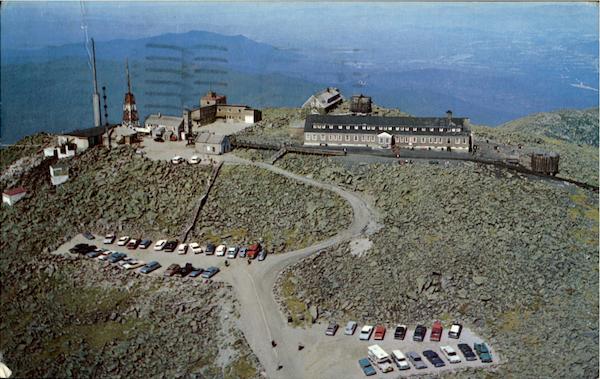
aerial view of Mt Washington's summit
So, what does constitute a wilderness experience? Firstly, being present. Secondly, being quiet is typically involved, but not always-- it just helps you connect, since language is so human, and so wrapped up in the symbolic, rather than the real. Nature speaks a thousand languages, so quiet down and listen. Thirdly, being alone or in small groups; that helps, but if you stay present, you can still be attuned to the world on as crowded a summit as Mt Washington in New Hampshire (they have a post office, cafeteria, and weather facility up there, with a road and a passenger train to the top). Leave work at work, home at home, and be in the forest, be on the mountain, subsume yourself into the greater system.

That's what it comes down to. Being present is being present, but there is a special character to a wilderness experience. Otherwise we wouldn't have a word for it, it'd be the same as deep meditation, the ecstacy of a beautiful symphony, the experience of being moved by a painting. The point is opening up to a larger world, one that doesn't have a big place for you, that doesn't revolve around you, but does still include you. Setting ego aside, the personal story of you, and falling into a greater whole. Towering rocks. Weather. Vast tracts of untended vegetation (tended by itself). Wildlife, things that can eat you, be it mosquito or mountain lion. The simple rhythm of the daily cycle, sun-time. Water that flows not because people are thirsty and dirty and have cars to wash and flowers to water, but because that is what water does. Where no concession or provision is made for you, but neither is there antagonism. It simply is, and a wilderness experience is when you simply are, too.

The problem is doing it. I've been many places, like Old Faithful, Yosemite Falls, Mt Washington, Clingmans Dome, and so on, where it's been too crowded to really reap the beauty of the place. It's possible in theory, but very hard in practice. You're too jangled by the commotion, too eager to go about grabbing at nature with your camera, it's too much. Most of us are not Buddhas, and so to really have that wilderness experience, as opposed to just a pretty view in the fresh air, you gotta get away, get alone, and get quiet.

Wednesday, March 16, 2011

Surviving peak oil

Thurman told me to look into this documentary, called The Power Of Community: How Cuba Survived Peak Oil. Well, I found a video of it online, you can watch it here.

It's pretty fascinating, a real case study of a society experiencing and dealing with Peak Oil and its issues and problems. Gives me a more hopeful feeling than I've had, which I really needed.

There were some interesting points raised at the end. For one thing, the idea that we have used in 100 years half of the oil the Earth has been producing for hundreds of millions of years. As the man in the film says, it's absurd.

Secondly, they made reference to the way Cuba, like all island nations, have a sort of natural sense of limited resources. And it seems this island consciousness is what started the whole environmental movement, when we had for the first time an image of the whole world, as pictures of Earth from Space came out back in the late 1960s.

But it still hasn't sunk in for most of us on the necessary scale. Earth is an island of habitable, livable environment in a sea of inhospitible space. But we still think in terms of growth, endless growth. Not gonna happen. Especially if this century long spasm has used half of one of the most energy dense, versatile, easily used fuels ever known.

Wednesday, March 9, 2011

Counting

The mug of coffee sits hot between my hands, sitting window-side in the cafe. The quiet conversation, jazz music, and banging of the baristas behind the counter fuse into that old familiar rhythm which keeps me coming here time and again.

Out the window, I am watching the airplanes. More than that; I am counting them. There goes one... and another two... and two more... there's one...

Over a half hour, I tally the flights rising up from the airport just to the northeast, watching the planes nose up into the south wind. I count 30 in as many minutes, give or take a couple; chalk that up to this caffeine buzz and my imperfect attention to what passes beyond the window. The endless traffic on Main Street and the intersecting Airport Freeway distracts me. So many cars, so many faces, so many utter strangers whom I will never know, never meet, never see again. And one plane every minute. Every minute!

Hundreds of souls foreign to me hurtle through the sky, leaving only a haze of spreading contrails behind, as the roads outside fill with a flow of glass and steel and exhaust and noise, never absent, never returning.

Tired of this sordid game, I return to my mug, now cooler and half empty; back to my book with a slight shake of my head, as unable as anyone to ponder long on these subtly frightening realities. Averted eyes are our only answer to this madness.

Saturday, March 5, 2011

Don't just sit there, DO SOMETHING!

My last two posts have been circling a central issue that I feel underpins a lot of what's going on in the world. Energy. Energy is central to the functioning of economies and states. Naturally, by energy I mostly mean fossil fuels, and especially oil.

Well, there's this thing called Peak Oil. It's a multifaceted issue, but the long and short of it is, as with any limited resource, there is a production peak. After half of the oil is gone, it becomes harder and more expensive (in terms of money and energy investment) to get the rest out. What remains is lower quality, and harder to get (deep water, for example, or in or smaller reserves). So, you plateau a while as the market struggles with it, then the long slide down of production begins, while the line of expense goes ever up. Eventually the two lines cross and it takes more energy to get than to use, and it becomes not worth going after... this happens long before all the oil is actually used.

I'm reading now that oil peaked in 2006, putting us in the volatile plateau area. We're massively fucked. Consider:

With the immense petroleum input that goes into modern agriculture (fertilizer, herbicides, pesticides, tractors, transit...), food prices are going up and will continue to do so. Thus the unrest in the Arab world these days. They want freedom and an equal share in their economies, but driving it is the need for affordable food. Adding to that are other systemic problems, like depleted fossil aquifers, wasting food for making ethanol (gotta keep soccer mom's SUV and joe sixpack's pick-up going!).

Goodbye soil,
goodbye future.

That alone should make us worry. Food is life, after all, and we aren't ready to jump into a local, organic food production system. The sooner we start the better. Modern agriculture is ruining the soil (what doesnt blow or wash away), which is a crime against the generations to come. This is one of the top issues in my opinion.

This reality of Peak Oil also helps explain the two wars we have going on (it's the oil, stupid!). It helps explain the power grabs and corruption in our government, and the endless recession we've fallen into, which I personally doubt we'll ever climb out of. The point is that the system is in chaos, and probably falling. Those who can are scrambling to grab what they can, it's looting at the highest levels. Peak Oil isn't the only variable in all this, of course; the system is complex. But it's a major one.

So. As I mentioned at the end of my recent post on unions, the system looks like it's going to crash. No other state or economy so depends on fossil fuels as does America's. We live too far from our jobs, from grocery stores (which are themselves too far from food sources), and from clean water (clean water? what's that?). We have paved over miles and miles of prime agricultural land. The suburbs were built on and depend on cheap oil/transportation, as does trade and manufacturing. Part of the housing bubble's collapse might be a growing if yet unconscious awareness of the coming death of suburbia. Our jobs are largely service jobs now, and do not create tangible goods or wealth. In fact, the growth economy and globalism seems to be in its death throes, which is very good for the long term but very painful for the short term. Do the words "die off" mean anything to you?

This is part of why I think getting into sustainability is vital. It's half environmental ethic, half awareness of the end of western civilization as we know it if we aren't proactive. Sounds extreme, but surely a Roman in the year 400 would have said the same of his Empire. Yet just 100 years later, Rome, at least in the West, was a memory as the so called Dark Ages began.

I don't really want another Dark Ages, and I'm sure no one does. But to avoid it, we have to wake up and realize that we are not going to be saved by a miracle technology or fuel source or some other deus ex machina. We have realities to face. We need to stop being lulled by the politicos and economists who are blind, stupid, or corrupt. The storm is coming, and praying for blue skies won't save us. We need to prepare. Large systems fall slowly, and we can help soften the blows, but we need to start yesterday.

Here's a few interesting sites, blogs and otherwise, that I've been reading lately on this topic and others. I'll be adding them to my link list as well.
http://thearchdruidreport.blogspot.com/
http://thurmanhubbard.com/
http://blog.sustainablog.org/
http://www.kunstler.com/index.php
http://www.ted.com/

Sunday, February 27, 2011

Grumbles

The people are grumbling. As usual, about the wrong things.

For myself, I think that it's fine that gas prices have shot up a few dozen cents. The debatable evils of price speculation and stock markets aside, these soaring prices are occurring as a result of the people of northern Africa and the greater Arab region fighting for freedom. If the price of having a half dozen countries topple despots and dictators is for me to pay a few dollars more per week for the privilege, the luxury, of driving distances that once took all day to traverse, and doing it in a mere a quarter of an hour at inhuman speeds two, three, four times a day, well, I'll do it smiling. I won't support a war fought (supposedly) to force freedom on people who didn't ask us for it, but I'm glad to pay extra when the people themselves decide they've had enough of tyranny and choose to do something about it. It's the least I can do.

(the fact that the protests and revolts may be caused by soaring food prices thanks in part to us turning a quarter of the U.S. corn crop into the boondoggle of ethanol to keep the SUV fleet going leaves me a bit muddled-feeling, but the point stands).

(there are other reasons for the rising food prices. Here, read this: The Rising Prices of Food & Political Instability )

Friday, February 25, 2011

Union Thoughts


Been thinking lately about unions and the stuff going on in Wisconsin. So this may be a long, rambling post, a bit all over the place. Sorry, but my head is spinning. I really wish I was in Madison, part of the happenings.

The other day I started asking myself if I really felt the alienation Marx talked about that was inherent to the wage woker. Is my labor being unfairly bought, or is the valuation represented by the wages fair? For the first time, instead of just assuming they were unfair, I began to really consider how I feel, if it really feels like alienation, or if it's more of an intellectual belief.

I started to wonder just who it is that sets these values. Physical labor by and large brings less in wages than non-physical work. Why is that? Now, I'm not only talking about the work of essential services, like garbage collection, farm labor, and the like, which one could argue should be paid far far more given the value of the work; but also work such as wiring for all our fancy electronics-- labor for luxuries, so to speak. Of course, it seems to come down to skilled vs unskilled labor, the latter making the least.

But why should, say, construction laborers, who put astounding amounts of energy into their work make so much less than some guy who maybe just went to school longer, who sits easy in his office, at most exerting mental effort, which can be stressful but is not an equivalent to energy (read: life) expenditure. Yet that guy makes more money (read: energy, i.e. life). This is madness.

I don't see why skill must come into it like it does. Yes, a skilled mason should make more than a guy lugging bricks (and don't give me that bullshit apples-oranges comparison of a doctor to a janitor); but lugging bricks is fucking hard, and he should be compensated well for it, not paid a measly minimum wage which won't support a family and won't allow his work to sustain himself into old age, when his work has ruined his body and he can't continue lugging bricks.

I also don't see why someone who is sitting in a factory somewhere in China, plugging one wire into one port on a chip all fucking day makes a fifty cents an hour (yes, I made that figure up), while the laptop is sold for hundreds of dollars. The laptop is impossible without the guy plugging the wires in, and he's giving his entire life to this task, for the chance to continue eating. Those profits should be shared-- the labor is the essence of the laptop's creation.

So yes, obviously without unions, labor is devaluated continually. The "race to the bottom." They say the market sets the prices, but it's really the "owner" class. They want to make the most money with as little cost to themselves, and sadly labor is counted a cost. They will pay a worker as little as they can get away with. And when the workforce is over-large (high unemployment), they can get away with ever lower wages. It's an interesting fact that wages (and union membership, hmmm...) have declined since the 1970s, while profits have soared. It's also "interesting" to know that the boom and bust cycles of capitalist economies are in many ways created by the elites via interest rates and such, and are not accidents or strictly inherent. 

Power to the People

I consider unions the essence of (healthy) capitalism. I also think the term "collective bargaining" is redundant. Without the collective, there is no bargaining. There is only groveling before the boss, a sort of tyrant of the economic world. You can ask for a raise, but there's no negotiating. You are free to find work elsewhere, but of course all the other factories are paying the same, or less maybe, and you know, you aren't getting any younger. I actually find it amazing that a society that loves to talk about democracy is terrified of democracy in the workplace.

Well, to answer my initial question, which I've been thinking about almost nonstop for days, is yes, I do feel alienation, I do feel used. Here I am, reboxing files from their damaged boxes into new ones at a storage warehouse, helping keep Bank of America's and EMC Mortgage Company's and tons of other banks', lenders', lawyers' and businesses' files neat and clean and safe, knowing they're making millions and I'm here slaving in the dust and fluorescent lighting of a warehouse for a pittance, straining my back and tired on my feet. So, the first thought I had when I saw the seemingly endless rows of file boxes keeps coming back to me: a fire in here would be... amazing to see. Huge. Spectacular. And perhaps even just.

Now, I'm not terribly unhappy at my job. The people are cool there, I get along well with most of them, especially the guy I work closest with, another guy doing reboxing. The boss is cool, and generally stays in his office, so you don't have anyone breathing down your neck, and the work, though boring and mindless isn't terrible; it gives me time to think as I do this repetitive task. I laugh plenty, and, except for Fridays, the days pass quickly enough. It works for now. (and just to be explicit, to avoid idiotic accusations, I would NEVER set fire to the place. Not my style of bucking the system. I'd rather just live a life less ordinary)

Still, it's sad to be wishing for the day to end. I often half-jokingly refer to wage work as selling my life for money, but that's exactly what it is. I'm just waiting for 4 PM and the weekend (the 8 hr day and the weekend, of course, brought to you by unions). I'm wishing my life away. So yeah, I'm alienated. I don't share in any of Bank of America's profits, though I'm indirectly working for them. As a temp, I'm not even a real employee of the corporation I work for. And of course more than half of the employees are temps, a clever way of cutting costs; that is, for paying people less money than they should be getting. When this happens in France, the students and youth fill the streets of the cities with protests; here in America, we just bend over and say "please sir, may I have another."

So yeah, it actually terrifies me to see the unions so under threat. They were built over grueling decades by the actual blood of courageous men and women who would not be taken advantage of. They stood up to the goons and pinkertons, the police and the bosses, and won their right to a decent wage. That's all it was about. All the rhetoric about "greedy unions" is mostly bullshit. They're not being unreasonable, though I admit there is corruption in them. But the idea of unions is sound, and all they want is a proper value for the life-energy they give an employer. The unions are in a weak shape, but it's the main thing standing between us and full on fascism. It's interesting to note that the first people Hitler sent to the concentration camps were unionists. They are a direct threat to corporate control (fascism being just another word for corporatism).

This is one of the biggest issues facing the nation right now. I pray that the public union members in Wisconsin don't fold over; and if they are stripped of their rights to bargain, I hope the outrage persists and that, whether physically or in terms of "the process," they rage against this corporate machine and fight until they win.

...divided we fall

It saddens me to know that if in the end the unions fall, it will require another uphill fight someday down the line to build new ones, and that the people will probably have to suffer in tenements and degrading work in terrible conditions for terrible wages until the fury has built enough. Because that is what is at stake. Think these penny pinching CEO's won't slowly whittle down all the unions' hard fought wins? Watch for the 6 day work week to return, and longer hours, ever fewer and poorer benefits and ever lower wages, worse conditions... it's already started, folks.

What makes me wonder is, who do these corporations think is going to buy their junk when no one has enough money for food or rent or enough clothes to cover their bodies? That is, when the middle class is gone and we're all serfs again.

Of course, the fact of Peak Oil (occurred in 2006, I now read) and the coming end of growth economies may make most of this all moot, as the entire system falls, but that's a whole other post.