Showing posts with label politics. Show all posts

Saturday, August 25, 2012

A Sort of Optimism


I've been thinking lately that one of the main reasons that nothing is done on climate change, Peak Oil, and cultural collapse is because we Americans are too optimistic. Our thinking is constantly castrated with notions of "technology will save us," "the free market will save us," "the scientists will find a new energy source," "America is blessed by Gawd," and the like. We always want to feel that everything will be okay, the universe will provide, or Providence, or the market, or the engineers... something will come along. It is best expressed by a friend of mine, noting that money was getting tight here at the end of the month, when he said something to the effect that "I'm not worried, though; it'll all work out, always does."

I admit part of me agrees heartily. I've learned and viscerally experienced the wisdom of being patient, of being open to things, and have noticed that things you need really do seem to come along, just like the Rolling Stones famously sang. But  The Universe Shall Provide is not a rule of the universe. Or maybe it is, but there is a correlative: Shit Happens. We all die, many of us horrifically. Poverty happens even to the most positively thinking create-your-own-reality believers; events like war, famine, and natural catastrophe can sweep down and devastate all and sundry, with total indifference to prayers or optimism. 

Yet, though we all know that truth, we still refuse to confront it in policy making. Seems to me that the real theater of our political system is the fact that the power brokers fight for control of the ship, trying to steer it this way and that, while the ship itself is sinking, and needs no help from them in finding its way to the bottom.

So I wonder if the rise in fundamentalism throughout the world, and namely in the Arab/Islamic world and in America, is in some way a form of blind optimism. Europe, I'll add, doesn't seem to experience this optimism. I may be talking out of my ass here, but the Europeans, they seem far less optimistic than we do. They lived through two world wars, right there in their own front yards. Bombs destroyed whole towns, millions of men bled to death on their soils. They have seen the devastation, they know what a disaster looks like; anyways, they have been slaughtering each other, back and forth, since time immemorial. They seem to be more willing to engage in both social programs and alternative solutions, and protest much more enthusiastically over such things. 

Meanwhile, we Americans have only our 9-11, which, though horrific, was very limited in size and scope, if not in sheer psychological impact. We've been insulated, by our oceans and by our imperialist strength, so it seemed all the worse. We have only had two wars on our own soil in the last 225 years, since the Revolution-- and one of them was a civil war (the other being the War of 1812). The Mexican American war was fought largely in Mexico, so it doesn't really count, and all the Indian wars were far removed from the main population centers, on the fronteirs.

So, optimism, but with a dark shadow. An optimism more like whistling past a graveyard, or having your head in the sand; a refusal or inabillity to see the real issue. A response to cognitive dissonance, that is, "the discomfort felt by a person seeking to hold two or more conflicting cognitions (e.g., ideas, beliefs, values, emotional reactions) simultaneously." 

You can look at the crazed fundamentalism in the Middle East and North Africa as the reaction to the unacknowledged but subconsciously understood fact that their lands are horribly overpopulated and that the oil isn't going to last. Some of those areas can sustain higher levels of civilization, like the Nile River, the Fertile Crescent, and some of the oases. But mostly it was always a land of nomadic herders. Certainly it took the Oil Age to create a Dubai. The old curse about American energy independance that goes, "let the Arabs eat their oil, for all I care," basically tells the tale. There isn't much else there. 

In Saudi Arabia there is a saying that goes, "My grandfather rode a camel, my father rode in a limo, I ride a private jet, and my son will ride a camel." At some level they understand their predicament, and are in a sort of collective despair over it, and can cling only to their religion for comfort as they wait for their world to crumble around them, literally and figuratively. We think of collapse maybe as a sort of Dark Age, a fall to simpler times, more hard labor and some suffering; but for them, it's going to be a horrendous die off, massive migrations and thus massive conflict. And I think they know it. 

Here in America, we have our own fundamentalisms. The obvious one is the Christian Evangelicals, who consider America a blessed land, God's country, and cannot believe anything bad could ever really happen here. Obviously bad things happen, like hurricanes and earthquakes and even housing bubbles, but it's always blamed on the homosexuals, the atheists, the blacks, the Mexicans, abortion doctors, and so on. Still, I doubt they would accept a fundamental end to all Western Civilization as we know it. Maybe for those secular, atheist Europeans, but certainly not to America.

Likewise the free marketeers, the engineers, the technophiles. Nothing bad will happen, they say, because the market will supply what is demanded, the scientists will develop new technologies to solve all our problems. This is a fundamentailst faith in reason, in science. It is, much as it may pain rational people to hear such a thing as "faith in science" uttered (or written, as it were). 

My belabored point is this: it's going to take the shit really hitting the fan before we really come around to facing the looming disaster coming straight for us. It will take something bad for us to not only wake up, but come together, energized and with a renewed community ethic. Europeans suffered through the travails of the 20th century together, the wars, the economic struggles... so it is no wonder that they have more social programs and a more progressive mindset. They don't want to go through that again. We haven't dealt with it at home, not really, so it may take something like a serious, prolonged oil shock or an actual famine to help us get the idea. 

Saturday, March 17, 2012

Keeping Clean


Cym's recent post on garbage made me remember something I've thought about before: it's weird how humans are the only "neat" creatures. Like, if you leave a dog in a house with plenty of food and water, he'll trash it in no time. He just can't imagine caring about protecting "things," keeping them neat, because for animals, things don't matter (they do know enough not to shit where they sleep, though). Humans go to all these lengths to clean and keep neat and tidy and not damage things. When company comes over, we clean extra hard, to impress them.

But we live in our house, and don't feel like we live in the public sphere. We live in the house, so we keep it neat. But no one feels any ownership in public. That's the city's problem, not mine. The government's. It's like Thoreau spoke of about voting, that weakest mode of civic involvement. Here, we pay our taxes, and therefore the job of keeping the park neat is dumped into the lap of the city council or whatever. Most people probably go their whole lives without even thinking about the issue, it's completely off the radar. Like sewage, water treatment, garbage collection; someone else does that, not my problem, I pay my taxes and fees, and that's enough.

But what happens if no one's paying attention. You  know, who guards the guards, who watches the watchers? We turn the responsibilities over to others and forget about it, but what if they don't do their job? Will they do their job, 100%, if they aren't monitored? Or will they take our money, do a half assed job, good enough to remain under the radar, but not really what we're paying them for? This, incidentally, is why regulations are needed, but of course, again, it still falls to the citizens to ensure the regulators aren't corrupt or negligent. The buck stops here, with the people. You and me, friend.

But we've been duped into a false divide: that between private land and public land. We take care of our homes and yards (in theory); most people don't live in trash and filth if they can avoid it (as for the ones that do, that is something I just don't understand at all). But that is because it's ours. We own it, and know the responsibility falls only to us; no one's going to come clean it up if we don't. But we now don't think of public land as ours, we think of it as the government's. When the money is tight, your state may shut down parks, bar entry. I've written in to newspapers and to politicians about this in the past; who the fuck are they to keep me out of land that is in part owned by me? Let them take their rangers and fee collectors out, but I'm still going in, facilities or not. But they say I can't, it's closed. Most people don't bat an eye at such a thing, because to them, isn't the people's park, it's government property.


What a frightening disconnect, that public land isn't even thought of as being partially ours anymore! What it means is that we no longer feel we have a stake in the government, it is a foreign entity divorced entirely from our control. We go about our little lives, as battered by city, state and federal laws as peasants of old were, as if it were as out of our hands as the weather. So fully trapped in this system of living hand to mouth, mounting debts in the form of mortgages and car loans that most people are too busy working all day, then trying to just freakin relax in the evening, that we can't be bothered to even think about it. Not to mention raising kids, which is a further diversion (if surely a worthwhile one).

Of course, as I've often thought with regard to the Pro Life anti abortion issue, what kind of world are we raising these kids to live in? The way I see it, things are going to eventually get so bad that people will be forced to act. Sad to say, but there's a lot of guns in this country, and a people who are still spoonfed and still fully believe in the ideals of freedom and liberty, even though in practice they don't live it. I know that if people really knew what was going on with the Federal Reserve and the money system, the bailouts, the deal with the IRS, and the total sellout of our government, the Second American Revolution would start... tomorrow. The handwringing and economic despair we feel right now would turn quickly into rage. It's an ugly future that we seem to be hurrying into.

This is long, but well worth watching

Maybe that's what it will take. But maybe it can be averted if we didn't simply simmer in our anger and powerlessness and remember that we do have power. Public land is public, and hey, guess what, you and I are the public! That's my park, that's your library, that's our government! We can do more than vote, than pay our taxes. We can remember that we are more than just a Republic, but also a Democracy. Yes, we have representative government, but in the end-- power to the people.

Wednesday, March 14, 2012

Grow Ops and Special Ops

What is this, freakin' Vietnam? Oh, it's California...

Happened onto this show on the National Geographic Channel about marijuana growing in California's backwoods. It was just the last couple minutes, but what I saw was rather disturbing. Here was this drug agent (what agency I don't know), all decked out in his digital camo, face painted, gun strapped on, and I'm thinking, well Jesus Christ, if you go and militarize it, of course these growers are going to fight back. Criminalize a thing, and you only create criminals. Turn it into an all out war, and you get soldiers. Seen this way, the cartels, and even the smaller independent growers, are easy to understand, with all their armed guards and serious weaponry.

Why not relax the grip a bit? Look at tobacco: more addictive than heroin, but Philip Morris isn't having gun battles in the streets with R. J. Reynolds, smokers aren't mugging old ladies in the street to get their fix. They grow tobacco right out in the open in the fertile fields of the Upper South, and there's no gun running, no paramilitary agents lurking in the bushes with an M-16 and night vision goggles, nor any doing recon from their helicopters. And I've never heard of anyone decapitated by a tobacco cartel.

So my first instinct on seeing this asshole ranger was to sympathize with the growers. I don't like the violence, I don't like them trashing national/state forests and parks, don't like the chemicals they use out there, the garbage they leave, the danger they might pose to the random, innocent bushwhacker (me!). But they're just growing a freakin' plant! So people can smoke the dead flower and feel different. Why is this a crime? Why not let them down from the hills, out from the basement, and into legitimacy?

Especially with the way we fetishize freedom here in America. Now, all people love freedom, but here in the US you can't turn on the TV without hearing the idea hammered on over and over. Then, we go and tell people what they may and may not consume, and how they may and may not perceive reality. Outlawing states of consciousness, absurd! And to throw them in prison for it, taking away that all important freedom, well, it's easy to see why people would fight back. Especially with the cruel and unusual punishment that prison actually represents: prison rape is no secret. Think about it: ingesting an plant is now enough to get you thrown into a state sanctioned Roman wilderness of pain and humiliation. What a nightmare.

So, I say legalize it. I'm very libertarian on drug issues. And by the way, the comparison with tobacco is not a perfect one, and thank god for that. Tobacco is ruled by huge companies making lots of money on a plant that is finicky and hard to grow. Much like alcohol, which requires a lengthy process for most of it. But Cannabis is easy to grow; they don't call it "weed" for nothing. Legalized, we wouldn't even have to deal with sketchy-ass corporations and their big money control over government. You throw some seeds in the garden, and you're good to go. All you need to know is when to harvest and how to dry it; pretty easy stuff, I'm sure. Yeah, there'd be companies selling it, since not everyone can or will grow it, but still, I doubt there'd ever be a Philip Morris of marijuana.

This is all not to even mention the diverse applications for hemp, nor the medical aspects, which are interesting and worthy but which I don't feel like going into right now :)

Sunday, March 11, 2012

The Responsibility of Sex

This post is a reply to comments made on the previous post.

Who is supposed to be more responsible when it comes to sex, men, or women? Of course it takes two to tango, and it absolutely shouldn't all fall on the woman. Baroness said a man having sex without a condom is like a loaded gun. Not entirely untrue.

On the other hand, as pregnancy by nature does affect women and men differently; maybe she doesn't bear more responsibility, but she owes it to herself to be more careful. Like it or not, the woman is stuck carrying the baby, and nursing it afterwards, while sex holds no such physical implications for a man, who can (irresponsibly) sow his oats all over the place. As humans we must move beyond mere physicality and biology, but we are still animals, and those millions of years of evolution are still strong in us. Especially with the way sex has been so much diminished and debased into an often purely physical act (due in part, ironically enough, to widespread contraception).

Is the responsibility perfectly equal, or even, as Cym once said, slanted towards the man who "got her that way" meaning pregnant? The loaded gun theory. I'm not so sure. Men are only half the equation, they don't "get" a woman pregnant, because there's more than sperm involved. There's the egg. The language reflects the fact that we didn't know about the egg for a long time, thinking it was the life force in the man's semen, but now we know that he isn't planting something in an empty vessel, they are joining their respective gametes together.

So unless it was a rape, which is akin to shooting someone, it is AT BEST equal responsibility. In a way, consensual sex without birth control is more like her playing Russian roulette with her uterus and his "gun." I would argue that women, being affected far more substantially by unprotected sex (not taking into account STDs), might bear more responsibility. Like, with monogamous animals, they don't mate until a strong pair bond is established, because it takes two to raise the offspring. Everyone knows sex causes babies, at least sometimes, so the fact that casual sex exists is pretty freaking stupid on both sides; it only makes sense because birth control exists. Babies are not easy to raise, if they were, this and abortion would not be an issue. Isn't this why men historically protected daughters' and sisters' virtue, and why women used to deny sex until marriage (theoretically) or at least a good while into the relationship, to be sure the guy will stick around? Now we have contraception, so women have more freedom, but only if she uses it or demand he use it, otherwise we're back the the old days, which is stupid.

That's probably going to piss all the women off who read this, but I'm coming at this from a practical, not ideal, angle. Just like when I said people are going to have sex; preach abstinence all you want, but ignoring the reality is causing some major problems. Like the way the Catholic Church won't distribute condoms in Africa, where there's an AIDS epidemic going on, amid a culture that, like it or not, encourages the men to have sex with multiple partners. Ideals are great, but not when they cause suffering.

I'm NOT saying things are how it should be-- the African cultural trait, the irresponsible men (though not all of us!)-- but that's how it is, at least for now. Work to change all that, yes, work to get men to accept their due responsibility for sex and pregnancy, to help there be less pressure and emotional coercion on women, especially young women, to have sex in order to feel loved by their pushy boyfriend... but in the meantime we have to work with what is. That seems the enlightened, Taoist thing to do, at least to me. I favor this sort of two pronged approach.

By the way, when you do return to the issue of STDs, which I wasn't really talking about in the main issue of this post (only when I mentioned the AIDS crisis), then there is absolutely more responsibility on the man to wear a condom.

Lastly, Baroness, you wrote "People like to eat too, but if we put the same kind of "moral" efforts into sexuality as we are beginning to with health-based nutrition, maybe things would be better. Celibacy is sort of like veganism...maybe you SHOULDN'T have so much sex." Unfortunately, your food analogy fails, because celibacy is akin to fasting. Eating healthier is akin to having sex using birth control. No one's going without, they're just doing it intelligently. And there's been centuries of moral efforts on controlling sex, some very violent and repressive, and it just plain doesn't work.

Friday, March 9, 2012

Socialized Contraception

Thinking about all this business about contraceptives and health care and the righty-tighties not wanting their tax money going to helping people screw more, an old essay popped into my head-- John Donne's Meditation XVII. It's a famous work, which I'm sure you have all heard of, inasmuch as you have read the following lines:

No man is an island, entire of itself; every man is a piece of the continent, a part of the main. If a clod be washed away by the sea, Europe is the less, as well as if a promontory were, as well as if a manor of thy friend's or of thine own were: any man's death diminishes me, because I am involved in mankind, and therefore never send to know for whom the bells tolls; it tolls for thee. Neither can we call this a begging of misery, or a borrowing of misery, as though we were not miserable enough of ourselves, but must fetch in more from the next house, in taking upon us the misery of our neighbours.

Donne was talking about hearing the death tolls from a church ringing out over the land, while he lay sick with his own serious illness. Certainly he wasn't talking about socialism. But then, aren't we all equally sick with the illnesses and ailments of our society? How we deplore abortion, yet refuse to do anything about it besides try to ban the procedures, or try and guilt women into not doing it, calling them sinners, whores, sluts, hellbound. Clearly contraceptives are the first and best way to prevent abortions. No fertilization, no problem.

We have to accept, of course, that people ARE going to have sex. It's what humans do: we walk upright, speak symbolic languages, make tools, and have a lot of sex. No amount of moral finger wagging is going to stop it. So, with that out of the way, we can move on to other points, like how family planning gives more benefits and a brighter future to the children you do have, children you want and are prepared for (such as you can be prepared for parenthood). There are issues of women's health as well, which I am not qualified or informed enough to speak for; I understand, however, that the Pill has uses beyond contraception, such as preventing ovarain cysts.

In the wider context of what this debate is really about-- that being, are we or are we not willing to use public money towards curing certain social problems-- Donne makes his point quite explicit. We are all connected; what harms one harms all. We aren't begging or borrowing misery from elswehere, because there is no elsewhere; the misery is already ours. And it can be flipped: what helps one helps all. Help a family have only as many children as it wants and can afford (financially, emotionally, etc), and you will reduce welfare costs, crime goes down, the populace sees an uptick in educational levels, and so on. Or health care, for gods sake! Provide universal, public option health care, and you automatically improve your entire country's future, because people aren't floundering in debt to hospitals, people can get preventative or early care for ailments before they explode into major problems requiring surgery, radiation, all the invasive care that costs so much. Prices would probably fall, at that, and over time fewer people would be on disability, instead being productive (tax-paying) workers.

Look, if it seemed like the Invisible Hand were ever going to reach down to help the little guy (who makes up a huge chunk of the country, mind you), I'd be the biggest cheerleader for free market capitalism you ever saw. But I see millions falling through the cracks out of this selfish and false idea of individuals existing somehow apart from the community, who demand they get what's theirs and not be forced to help others. That might have worked as a pioneer, living alone on the harsh and empty prairie, but that shit don't fly no more. We already socialize roads, police, fire departments and education because we can see the obvious social good. But with a little thought, the social good of things like socialized health care, contraception and more is just as apparent.

Wednesday, November 16, 2011

Talkin' Old Truck Blues

It's a strange thing. Here I just wrote about the burden of possessions, and then I go and dump over $1500 into my truck's front end. Ouch. At the same time, I'm reading Grapes of Wrath, about the Great Depression, the masses of people suffering through hard times, with Steinbeck's musings on what might be when those distressed and angry people all get together... and as I'm sitting in the mechanic's lobby, thinking not only of my times on the trails with only what was on my back, but also about the times this country and world is facing now, the Occupy protests being shut down, unemployment up and no end in sight... I'm a bit conflicted, and stirred up inside.

On the one hand, I know the pain of being stuck, the difficulty in staying ahead of bills and costs, and though I resent it at times, I know I'm not getting rid of my truck any time soon. But ah, how nice it would be to not need it, if public transit existed or could exist in these diffuse, scattered cities of single-family housing, cities with no real centers, just sprawls of development on the cheap and cheapened land. I'm as stuck as anyone else in a system that I requires I dump money into the suck-hole that is a vehicle, which I need for getting to work, where I have to work all the harder for it, and for less of a wage than I should be making. Wages always fall behind inflation; even when we get raises, we're still getting pay cuts every year.

On the other hand, I've lived the truth of simple living, I've walked that path and found it good. How we value things, and how little those things mean in the end! Yes, you need some gear to get by, be it hiking gear on a trail or the accouterments of daily life. We make so much of nothing: the owners on the one hand obsessed with owning, those without always trying to become owners themselves, and always failing and being miserable about it. Everybody always looking up, and trying to climb there, never happy where they are. I say, the less you need, the less you need to work-- and then look how much more free time you have! Time for what matters, and less stuff to worry about, and less stress about "getting ahead."

We should have let the banks fail, should have let this system crash, and from the ashes built something more sensible. So, I have an idea that it would be better to opt out. Of all of it. Let's get local currencies going, let's barter among ourselves, get black markets going, and cut the banks out of it. Why should they, or for that matter the government, profit because you and I make a private transaction of goods and services? We use the banks' money, Federal Reserve Notes, and we are taxed by the government to do it. Then the banks fuck around with interest rates and push inflation on us, constantly devaluing the money we have to use, so it gets harder and harder to live. Why do we go in for these shenanigans?

It just seems we are all working so hard to stay in the same place, though more often falling behind, and all because we can't see outside the box, can't see that this system is not set up for our benefit, can't see that there are other options, other perspectives. I'm not saying that all of our woes fall on us, the lower classes. In fact, it is my adamant belief that this system was built not by us, and that is why it fucks us every time; it is of, by, and for the rich and powerful. But I am saying that we have a responsibility and a right to do something else that is in our own interest. But first one has to see other possibilities, other ways of looking at it.

That's why this Occupy movement seems so cool to me. I like that people are talking about this stuff, in living rooms, in diners, in mechanics' lobbies, in bars. I'm disheartened a bit that the green movement seems dead, since all anyone cares about now is jobs (growth), but maybe if this system really gets the shaking up it needs, that will be part of the new order. And I know it's hard to live against the grain, to find a new way to order your life; so much easier to just go along.

But one thing is for sure, something has got to change. We're so inflexible, so unable to act responsibly in everyone's interest, that we're heading for environmental disaster. I know I've been talking economics mainly, but these two things are deeply connected. The insane lust for profits (growth) is killing our planet, but we can't stop the killing without somehow fundamentally altering our economy. I'll leave you with this: I heard the other day that there's a 1 in 10 chance now that by the end of the century, global temperatures will go up 7 degrees Celcius, effectively ending life on Earth as we know it. You like those odds?

Sunday, April 24, 2011

Communism's Flaw

I think I just realized the real problem with communism and socialism in this day and age. Under such systems, one is asked to put the group ahead of the individual. This is excellent in theory. It fosters teamwork, cooperation, many good qualities.

But when we are asked to put the group ahead of the individual, that group is no longer the people you live and work with, but an abstract thing called "the state," "the fatherland," "America," etc. I've seen a lot of Americans, seen mountains, farms, rivers, cities, and towns, but I've never seen "America," never encountered "the state." The concept is too abstract, too easily manipulated towards corrupt ends. It isn't real.

No one had to explain communism to the Indians; they either lived for their tribe or band, or they perished, all of them. Now, there is a time for self even among such peoples, but never, or rarely, at the expense of the larger community, which can almost be looked at as the true organism. Man is a social species, no man is an island, etc. Without the tribe, the community, the culture, the greater whole, we are nothing, we die.

And that's the problem. We don't have community anymore, not really. I don't depend on my neighbors, I don't even know their names. I work far from where I live, with people who don't live near me or have anything to do with me outside of work. Even when there's somewhat more connection than that, in cases where my coworkers have become my friends, it's never been anything deep like a tribe.

Communism, communalism, these things would work if they arose organically, out of the actual need, the actual fact of interdependance. The interdependance now known by modern societies is a twisted one, in that it is impersonal. We depend on the systems of waste removal, food delivery, consumerism, etc; people are involved in these things, but it doesn't matter who, it doesn't matter if I never know them as people. Cogs in a machine, really. None of us probably know our garbage collectors, but we depend on them all the same.

But communism and socialism can't thrive in such a milleau. How can one care about someone they don't know or love? I would work hard, even kill, for my family, but would I do that for the guy next door, with whom I have no interaction? Same problem crops up in environmentalism, by the way. Who will defend lands they have no connection to? Easy for the hillbillie back in the hollers to care about mountaintop removal mining, but for everyone else, it's abstract, and thus their concern is shallow. Plus, we get electricity from it.

I guess this is why both environmentalism/conservation, and communism are both largely failures. We are too isolated for others to matter anymore, everything is about self, or maybe the few souls we know very well. No one else matters, much. And so, we get to watch society unravel slowly.

Monday, March 21, 2011

Swing of the Pendulum

It seems incredibly self evident to me why our country has shifted so much to the right. Beyond the (often credible) conspiracies of banks, business, and government, our population is aging. You look at the countries like Libya and Egypt, they're massively young countries, with the majority under 30 years old. Here in the US, we've got this big bubble of the Baby Boom hitting their old age.

Revolutions and rebellions tend to be more common among the young. Hell, it was this same generation that led during the 60's hippie revolution. Now they're aging, have become conservative, and want security more than they care about ideals. A natural shift, really. Sad for the rest of us, and sad for the state of democracy in general.

And we all know old people vote far more than the young. Plus, kids/young people these days are all hypnotized with their iPhones, iPods, wii games, internet, and the good old TV. We have no time or energy anymore to put towards social rebellion. We guage our ears and get tattoos, which is all pretty bland and safe as far as rebellion goes; even the drugs are largely passe; at least, they don't lead anywhere like one might say they did in the 60s with the psychedelics. Now it's just party drugs, like ecstacy and rave shit.

It's like Tom Petty sang, about rebels without a cause. There's no more idealism.

Thursday, January 27, 2011

Socialism, Health Insurance, and Eating the Rich

Talking with my sister about the health care reform, we often come to the same split between our positions: I see it as an imperitive to take care of the least among us, a moral issue, while she, a very hard worker, is repelled by "all the people soaking the system" and hates to think of her tax dollars as helping such lazy bums. She works in the medical industry, as a front desk receptionist, so she says she sees a lot of this sort of fraud. I don't disagree that it happens.

Here's the thing. First, in America we have a very individualistic mindset, we idolize the frontiersman, the cowboy, the self made man. That was fine mindset when you were the only settlement for dozens of miles and had to do it on your own. But this is out of date: the frontier closed in 1890. We live in stable communities now, there are no Indian raids, we aren't battling to tame a wild land. And let's get one thing straight: no one is a self made man, that is a myth. Rags to riches, yes, but no one does it alone. If nothing else, such advancements are made possible by the society a person finds himself surrounded by. We use the public roads and bridges, the public schools, public libraries, the public police and fire departments, and of course legal frameworks, and a general culture that supports the entrepeneurial idea. One uses other people's capital, often, and/or the labor of others to do the work. Which isn't to discount the person's hard work, but let's have some perspective.

This is why I feel that the rich need to be taxed heavily, and provide for those whose labor actually provides their wealth. They (the rich) benefit most from this society, and thus owe the most. They can best afford it as well. Yes, they may have a much higher percentage of their income taxed away, but their living standard will still remain very high, they won't be lacking anything, will still live in great luxury. What is the difference between making 10 million and 20 million, as far as actual living standard goes? Nothing. You might buy a few less sports cars or a somewhat smaller mansion, or fewer mansions than before. Big fucking deal. Why are we expected to cry over this tragic loss? Get it together, people. You're still successful, and no one's "deincentivizing" it.

But some really do call this punishing success. I don't know. Only if money is your only measure of that, and only if you consider success being wealthy in a society that's rotting at the bottom. Do doctors go into medicine to make money, or because they want to help cure diseases and help others? Of course it's bound to be both. But then, the real problem isn't doctors who are reasonably wealthy, but the super rich, who just play financial games with inherited wealth. But either way, we must ask ourselves: at what point is enough enough? At what point does "success" turn into "theft" and "the rape of the lower classes"? This is a question that we as a society need to answer for ourselves. Or shall we just keep letting all the capital flow towards the few? I like what nationally syndicated talk show host Peter Werbe says: Eat the rich! (because they're eating the rest of us).

What I always end up getting around to is the question of morality. Chasing after the money dream has it's place, but it can't, in a compassionate society, be the end all. It is immoral for a tiny percentage of people suck all the wealth towards themselves, using the labor of the poor to benefit themselves, mangling the legal and financial system to their benefit, only to then leave everyone else out in the cold. If I break my arm or need an emergency apendectomy, I'm in debt up to my ass. Yet isn't the right to recieve medical care rather basic? Why should an accident or emergency turn me into a slave to some insurance company?

Yes people will take advantage, there's always going to be corruption and "soaking the system." But the sun shines on the just and the unjust alike, the rain falls on the fields of the industrious and the lazy. Is it right to not help the majority because a minority "ruin it for everyone"? I argue that it isn't. The rich can still be wealthy, they can still be comfortable. But not when it's at the expense of a basic standard of living for everyone. That is intolerable to a reasonable, compassionate person. 

Friday, January 7, 2011

System Fail

Is it too late to change course?

Everyone is worried about the economy. I say fuck the economy. Let the whole thing collapse and take the whole cultural system, the military-industrial-media complex down with it. The only reservation I can find in myself about it is the suffering and human misery that such a collapse will bring with it. But since our population only continues to grow, to wish for it to fall now rather than later (as fall it certainly shall) is an act of mercy. Because the growth economy is coming to an end. We've put most of the even marginal land into cultivation, we're losing topsoil, we've mined the earth of the easy-to-access minerals; the ocean is running out of fish, oil production is peaking (oil, which underlays the entire convulsion of growth). We're out of room. Are we going to colonize space? Ha! Proponents of this don't understand exponential growth and its implications. It can't happen soon enough for us. The limits will be reached in our lifetime.

Stop and think: what do we really need an economy for anyways? Well, for jobs of course, so we can earn money to buy food, water, shelter, heat. The essentials of life. Yet why does no one ask why these essentials have been turned into commodities? Why does no one wonder why these are not human rights (like the air we breathe) but are instead things we are required to labor for? Why are they withheld to the point of starvation, homelessness, and maybe freezing to death in an alley, if we haven't the means to procure them?

I say, fuck this economy, fuck this system. It's no good for us. We can do better. Go outside and plant a garden. Dig up that useless lawn. This is the most revolutionary thing you can do. The energy of life is meant to be free, ask any plant. Ask any animal for that matter. A cat does no work, it just walks around until it finds a mouse (and sleeps the rest of the time). A crow does no work, it just flies around until it finds a corpse. A cow does no work, just puts it's head down and eats. Only man... no, only civilized man must toil for his food, which he himself has locked away from himself. And it has been locked up, since the first chieftain built a silo to hold his tribesmen's grain and realized the power this gave him.

I'm not telling you to go out and stone your grocery store manager, or to rampage with pitchforks and torches against the president, the Congress, the bankers, or any of that. No; I'm saying plant a garden. I'm saying collect rainwater or dig a well. I'm saying buy used clothing, or make your own, trade for it where you can, leave the money society at every chance. Don't use more natural gas for your home heating, put on a sweater. Bike, don't drive; better yet, walk. Wean yourself away from this inhuman system. I'm not urging this over global warming, or corporate greed, or any of that. Those are effects, not causes. Mainly I'm talking about mitigating the looming disaster. When the system falls, will we have another ready to turn to?

You say gardening is still work? Yes, agriculture requires some labor input. But you're laboring anyways, why not be working at something worthwhile, sustainable, out under the open sky, and under your own control. Why should grain prices in Mexico affect your grocery bill? Why should cotton prices in Asia mean you pay more for a shirt? Why should a people's revolt in Nigeria or a war in Palestine mean it costs more for you to get to work? Grow your own food, live your own life, local scale, human scale. It's empowering. There's a reason the sickle was one of the symbols of communism, screwed up as the Soviet system became, or was from the start.

Let our symbol be the shovel up-raised. Let us build our communities, based on friendliness and sustainability, not money and the cancer of the growth economy. All your cucumbers came ripe at the same time? Eat what you can, pickle a bunch, and give away the rest to your neighbors. Let our revolution be the only meaningful one this world has ever seen: out of the soul-sucking economy based on things and towards a culture and lifestyle based on benefiting people.

This is our only safety net as the collapse rushes towards us. We must stop chasing after the wind in the form of Ipods, hi-def TVs, sports cars, 4000 sqft homes, and designer clothes. We must stop listening to the news, to the politicians, to the fear-mongers that pervade our lives. Terrorism is not the threat. The crumbling economy is not the threat. We are the threat, we are the problem; but because of that, we can be the solution. But not in the same old "solutions" of the past. We are here, at this time in history, and we are here to do something truly new. It begins with your garden.

Wednesday, January 5, 2011

On Fighting the System

I see what my problem is. Thank you coffee shops and caffeinated bursts of free thought. It's all about the scale of things. We watch the news, and see terrible problems. We incorporate these problems into our lives, yet we have no power in the sphere of our living to do a damn thing about them; not unless we are hardcore activists, politicians, or involved within the field of a specific reported problem. Generally we donate a bit of money, or sign a petition, to make ourselves feel better, but it's largely ineffectual.

So, there is is. It sounds defeatist: "well, it's too big for me, what can I do? Guess I'll give up." But it's true for most of us, and there's nothing wrong with being real about it. Think how much energy it takes just to get by in life. Most of our lives are on the edge chaos, we can hardly manage them (exaggeration alert). It's good to be involved, but man, to take the weight of global warming, destructive farming practices, pollitical corruption and the swing toward fascism, religious hate, ethnic hate, racial hate, strip mining, clear cuts, and all the rest upon our shoulders... well, there's a reason they call us liberals "bleeding hearts." We must revel in agony, consoling ourselves that at least we feel bad about the genocide in Darfur, though we don't and can't actually do anything about it.

It's silly. Why waste all our energy and emotion on what we can have little or no effect on? I think it's better to focus our energies right where we are, in the scale of our lives. That may include donating money to a club or organization you favor, or being involved in other ways, true; I'm not saying it can't. But I'm all about localism, of "think globally act locally," but I mean really do it. Don't think about the huge global issues then mope around despairing over it. Kick in the TV, cancel the newspaper delivery, and just live your life well. Put your energy to work where it will do the most good: right here. Live at the human scale.

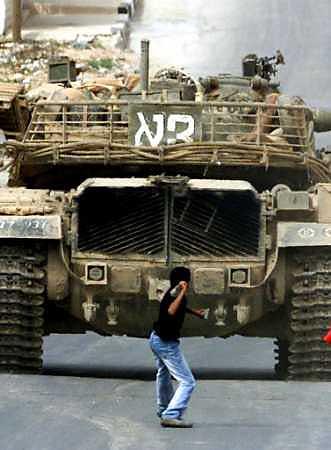
You can't fight tanks by throwing rocks at them. What you can do is take you attention elsewhere, live as if the tanks weren't there, kill them by ignoring them. Armed revolution would likely be a disaster: winning, we'd probably do no better, but we'd probably be crushed mercilessly. But what evil corporation can survive a sustained boycott? What government can survive once deemed irrelevant? The power that sustains these great systems comes from you and me, and nowhere else. And if we break from the trance of the supra-human scale, turn our backs permanantly and return to a focus on what's really here before us, and work simply to improve that, well, the whole will improve as a matter of course.

I mean that. There is no "whole," no such thing as a "nation," "state," "corporation," or "government" -- have you ever actually seen one? Of course not, they are imaginary mental constructs; over in reality, where I want to live, there are only individuals living their lives, via individual decisions. For example, there are no "vegetarians," there's just this person who isn't eating meat at this specific meal. The labels are useful shorthand, but to believe they are actually real is what has gotten us into this mess.

So alright, keep a finger on the pulse of events, but only one finger. Just live better. Starve the beast. Make choices to further your exit from the system. Bring this nightmare vision of globalism back to earth. It only exists in your mind, so stop giving it any mental attention. I believe this is the only peaceful route, and difficult; the beast will fight it like a starving lion. But eventually it will die, if we stay strong.

Eat, drink, and be merry

My other problem has been that I've been far too serious. I've lost my sense of humor about life. I must remember Death and it's great lesson: this too shall pass. Death, transience, allows us to relax in life. Not to disregard the suffering of others, but it puts things in perspective. This is, after all, a passing dream. What good does it do to live in despair the whole way through, over things beyond our control?

Our revels now are ended. These our actors,
As I foretold you, were all spirits, and
Are melted into air, into thin air:
And like the baseless fabric of this vision,
The cloud-capp'd tow'rs, the gorgeous palaces,
The solemn temples, the great globe itself,
Yea, all which it inherit, shall dissolve,
And, like this insubstantial pageant faded,
Leave not a wrack behind. We are such stuff
As dreams are made on; and our little life
Is rounded with a sleep.
The Tempest Act 4, scene 1, 148–158
And didn't someone once say laughter is the soundtrack of the revolution? Laughter is immeasureable, truly a power. Yes, it's hard to find a balance between being concerned, as we are when we hear tragic things, and having a good time, laughing and enjoying life. Keep in mind, wallowing in despair doesn't help the ones wrapped up in the tragedies; they don't need our pity and our tears. What might help is to stop feeding into the system that brings such tragedy to their distant shores. You can only act where you are. I think this guy has the right idea, showing us what can be done, at the human scale:

Monday, January 3, 2011

On the wrongness


WHY IS EVERYTHING SO WRONG?!

Was at my sister's and brother's-in-law for the New Year's Eve, watching some news before dinner. We had several emotional discussions about weighty subjects: the health care bill, economic systems, Constitutional rights (cops were being given licence to demand blood samples without consent for drunk drivers), the class divide, etc.

How depressing the world is. Everywhere I look, things are moving in the wrong direction. Chasing more fossil fuel fantasies, more war and imperialist foreign policy, more trampling of the Constitution in the name of security (read: fear), more favoring of business and wealth over the good of the people or the nation as a whole, more pollution and environmental wreckage, ever more hypnosis by iPhones and technology. They're pushing this new phone really hard, on every other commercial. The trance of distraction our society is in totally precludes any meaningful resistance, or God help us, revolution against the wrongness.

I don't know how to keep positive anymore. I don't watch or read the news but I know it's happening, it hangs in the very air. I don't see any positive outcomes. We're speeding towards a nightmare, a cliff with the various names of neo-Fascism, Climate Change, Mass Extinction, Cultural Collapse, Die Off. I just want to run off to the mountains while everything falls to pieces. Let the idiotic masses have their shiny techno-dreams and neon hallucinations. Even the people who care don't do anything against it-- and most don't care. There's no help for us anymore. There's no hope.

At least I'm going to take a bit of a break from the internets. In honor of the new year, so to speak. I need to reset my mind, return myself to some thinking about choices I need to make in my life. I have to break this techno-trance which I hate so much but have been slipping into. I need to reassess what's important, what's meaningful, and how I'm going to get by in this madness we call American Civilization.

What does it mean for the blog? Dunno. I'll still be writing, so I may end up posting. We'll see.

Saturday, October 30, 2010

Volunteering

I was having a discussion the other day with my friend Clayton, about how it would be beneficial to have a sort of required term of service for America. Something like how some countries require their young people coming out of high school to join the military. Well, I'm not at all for making the military even bigger, nor do I support conscription. I know the military is more than a war machine these days, having many non-combat aspects, but it still remains one at its core, and I would never join such a monstrosity. Nor would I support forcing everyone to have to have a part in it. We need a smaller military and less war, and let's face it, having a huge standing army is just asking for trouble.

But I do think some service would do us all good. This discussion came up occasionally last summer when I was doing a stint with Americorps in Utah, the Utah Conservation Corps. The most startling example of the need for this was when my crewleader Ryan told the rest of us about some guy he'd met who had never left the county. Carbon County, Utah isn't a very diverse place, there's a handfull of tiny towns, with ranchland, desert, and mountains taking up the rest. These are the kind of people who would benefit the most from a mandatory volunteership. Because, how can we as a nation have a rational discussion about, say, race, when people such as these live in all white communities? America, outside of the cities, is extremely white.

But beyond issues of race, it would be extremely helpful to take people out of their tiny little world in small town Utah, and mix them up with people from all over, to put them in crews with people of all kinds of other backgrounds. The exchange of views would benefit all.

Maybe it sounds like I want the Mormons, the conservatives, to be exposed to diversity and liberal views. I assure you I'm not trying to conspire to convert the rural folk to liberalism. Although I'm definitely left-leaning on many issues (though not all issues), I fully recognize that it would greatly help liberals to expose them to other views; they can be just as isolated as these Mormons from Carbon county. A real benefit would be to mix rich and poor, since I believe this issue, that of class differences, is actually the root of most of our national disagreements. Across all these divisions--race, class, sexual orientation, gender, ethnicity, and more--we could see a greater interaction and, as a matter of course, a growing respect among all concerned. This would be a major step forward for the US and for humanity as a whole.

Lastly, a required term of service (which could count toward college credits, mind you), would help to re-instill a sense of civic duty and participation in the life of the country. We'd joke in Utah about "gettin' things done for 'Merica" but this is and could be a truly valuable program. Like the Civilian Conservation Corps back in the Depression, not only would we really be working on the problems this country faces, like that of failing infrastructure and broken cities, but it would give us all a chance to be involved in fixing it.

There is a great deal of pride that comes with that, and self-respect. It might bring back that sense of belonging to this country (beyond mere slogans like "we're number one" and "god bless america"). We'd have a stake in it, and might start to care more about what the politicians are doing; rather than grumbling among ourselves in the diner or in the living room, we might actually take a stand, together, as Americans rather than liberals or conservatives, rich or poor, black or white... and do something about it. This may be the real way through the polarization being foisted on us by the rulers and the media.