Showing posts with label freedom. Show all posts

Saturday, October 13, 2012

Slavery


Is civilization possible without slavery? 

I don't know that it is. You can read online that not every civilization has had slaves, but then again, most have. Certainly the most "civilized" have kept humans as chattel. In the West, our origins are tainted by this fact, as Athens and all of Greece was a slave society, and Rome, the West's Classical model, was very much dependent on the slave class. I'm not even getting into the Arab slave trade, nor what was going on in the East, which were monumental in their own ways. 

There was less slavery at other times. It declined in the Dark Ages and on into Medieval Europe. Not to the point of being absent, and it differed country to country, but it was largely replaced by serfdom. Which is still basically forced labor, though not as explicit and carrying somewhat more freedom. But then the Renaissance hits, the great "rebirth" of Western civilization, and what does it bring? The horrors of the African slave trade, the enslavement of whole nations of Native Americans, plus indentured servitude, which was in some ways worse, as far as how the people were treated (an African slave was an investment for life, so was somewhat less abused than someone only "owned" for 4-7 years. They worked the latter to death, more often than you'd think, to get their money's worth). 

I've heard that if people had been civil and patient, slavery in the Old South would have died out on its own, without the national bloodletting of the Civil War. Much the way Canada waited patiently to themselves eventually split from England by a gentlemen's agreement, no Canadian Revolution required. Canadians like to use these examples to prove how violent we Americans are. They are only partially right, because things aren't black and white or simple like that. There were principles at stake, and institutional human suffering, and these are worth fighting for and against, respectively.

Thoreau had something to say about this:
When the majority shall at length vote for the abolition of slavery, it will be because they are indifferent to slavery, or because there is but little slavery left to be abolished by their vote. (1)
It's true, it would have ended of itself, the way things were going. But only because we replaced human slaves with machine slaves. Be certain that I am not saying that it is immoral to use machines to do our work. I am simply saying that slavery has not been abolished, only mutated and changed. Of course, there is still wage slavery, as machines have not replaced all human labor, and actual human slavery still persists in pockets all around the world, even here in the US. But that is not my overall point here. The point here is that high civilization is not possible without free labor, and that the degree of civilization is based on how much free labor (energy) is available.

Hell, take animal domestication, the final nail in the slavery case. No civilization has existed that did not have domesticated animals, that is, enslaved animals. Perhaps the American civilizations like Cahokia, the Aztecs and Maya did (the Inca had llamas), but they practiced human slavery, were not as stable or long lasting, and not as developed (at least in the case of Cahokia) as, say, Greece, Rome, China, India, or the Arab world. That is, they were not as far removed from the hunter-gatherer and simple horticultural models they grew out of, and that is why they so easily disappeared back into those models when their civilizations dissolved (in the case of Cahokia and the Mayans). 

Animal slavery is where higher civilization began. It's one thing to keep a herd of sheep around to eat, or even cattle for milk and cheese and meat. But when you strap a saddle on a horse, or a yoke on a pair of ox and force them to do the work for you, you free up human labor to do things like form more refined administrative techniques, writing, art, religious embellishment, war, and technological invention. 

And it all comes down to energy, no? The Age of Fossil Fuel is exactly the same as the Age of Animal Domestication, in that the vast power available in either the livestock or the oil barrel frees humans from drudgery and labor to do other things. Each is a step up of an order of magnitude from what went before. That's why higher civilization developed out of the use of animal labor, and why the Industrial Age sprung up when we tapped the energy of machine labor running on fossil fuels. 

This is the issue around which our current energy woes revolve. Naturally no labor is free, even slave labor, since the slaves need to be bought, and fed, and at least minimally maintained in good health, much as a horse or ox needs to be. Likewise the machine, which, while often cheaper than human workers, still needs maintenance and fuel. It's funny, the way the owner class comes to depend on its slaves, and the energy they represent.

So now the upshot. If it turns out to be true that Peak Oil is not resolved via new energy sources, things are going to decline in complexity. This is obvious, but one must understand what's at stake. You read books like James Kunstler's A World Made By Hand, and it seems like democracy and freedom largely survive the fall. I wonder at that. Power doesn't let go so easily, and I wonder if instead of a sort of benign localism of freeholders and townsfolk, we won't end up with something more akin to a world under a myriad of Pol Pots. Those used to living high on the hog are not going to want to climb down, and I fear that they will simply see that as the oil energy goes, they must return to human energy in the form of serfs and slaves.

(Finally, check out this link, and savor the irony)

Saturday, October 6, 2012

On Change and Being Stuck


Watched this amazingly inspiring video a week ago, and since then have been thinking a lot about making changes. Changes in my own life, changes in the greater world around me. The message isn't particularly new for me, but really had an impact, and I urge anyone coming across this page to watch it.

So I'm trying to figure out what I'm really going to do. I keep running into this problem of feeling utterly trapped. I've felt this way ever since I came of age, out of the egocentric world of the child and teenager. I guess around age 18, especially after 9-11. Started getting into politics and bigger issues, trying to understand this system in which we live, and trying to figure out my place within it, and finding very few good options before me.

I know I've talked a lot on here about living the change, saying stuff about opting out of the system as it is. But man, how? How can people operate outside of the system? If you don't play by the rules, you don't get to eat. If you don't work, then you don't get to sleep indoors. They got us by the short and curlies.

One example I know I've thrown out there was gardening. Want to grow a garden? Well, you have to own land, but homesteading is so far from what most people are capable of, it's hard to imagine it happening. I mean, for those who can afford to buy land, often they buy it in town near their job. They have a house, not property. A huge building of outsized proportions, a weight around their neck, often, because we've become accustomed to such foolishness. And to really be free of the system, you can't just grow a token garden out back, a few tomato plants and maybe some lettuce, beans, and cucumbers. You need to plant a sizable amount of land (in terms of an acre or more) and have a host of skills that few people really have anymore: food preservation, crop rotation, what to do about plant disease and pests, and maybe tending livestock, among much else. I'm talking about farming, and farming requires a lot of knowledge.

And that's just for food. What about everything else we need? Clothing, shelter, transportation, medical care, etc etc. How to opt out of all that? I mean, they own our lives, whoever "they" is, if there is a "who" besides the inhuman system itself... they own our lives because they own the means of sustaining our lives. I say again: you dont work, you don't eat, you don't sleep indoors, you don't get to go to the doctor, you lose every which way. How can you fight back against such a thing? You can put out your recycling, consume less, you can try to elect better leaders, take your money out of the banks, but in the end, youre going to go to work every day because your stomach demands it, and more importantly, your children's stomachs.

I think often of Grapes of Wrath, which I know is a novel but it's such a vivid image of the Depression, and seems accurate from what I've read. And not just the Depression, but the way the union battles went for decades back then, the brutal fight it was. Brutal not just because Power fights you on it, but because you have to sit there, watch your children cry because they're hungry, while you strike and picket. What a thing to do! Most men would work for the lowered wages, rather than strike and get nothing. The only ray of hope is that, in spite of those horrible stakes, people did it anyways. They fought back, they suffered, but they did what they had to do.

But here we're talking not about just getting more workplace rights, fairer laws and economic practices, but a whole new economic paradigm. We don't have a clear goal, like better wages, the 8 hour workday or the 5 day work week, or an end to child labor. It's hard to even know where we're trying to go.

So I just don't know. I'm constantly inspired by these sorts of videos, books, ideas, but never know how to proceed. The edges of this problem are just out of reach. I can't imagine any way to have a real impact on the sort of paradigm shift I'm referring to, and can imagine even less a mass movement in this direction. I don't want to give into despair, but I feel like I've been stuck for the last 11 years and it just plain sucks.

Thursday, August 9, 2012

Walking


You know, I really like walking.

Okay, big surprise, right? I did, after all, thru-hike the AT and attempt the PCT, and loved every minute of both. But even when we're not talking about hiking or backpacking, walking is great. Even in relatively boring places, there's something to be said for it. I used to walk miles and miles, often at night, around my hometown back when I was a moody teenager. Somehow it seemed to help. I've always loved going out walking the dog, or wandering a bit in the woods, the train tracks, or just cruising the neighborhoods. I used to walk to work, back when I lived where it was feasible.

I walk a lot less these days, unfortunately. Laziness, depression, and being tired from work, all conspire to keep me sitting on my duff, reading or watching TV. But a couple months ago, I took a walk while my truck was being worked on. It wasn't an interesting route, less than a mile each way, past a couple car dealerships and strip malls, then some empty lots, one being an abandoned trailer park, with nothing but concrete slabs and electric and water hookups scattered throughout the grassy field. Finally, there was the library, where I dropped off a book and loitered around killing time.

Like I said, pretty boring, bland scenery. But though I'd driven that route a ton of times, it was like experiencing an entirely new place...which I was. Driving, you zip by at 40 miles an hour, speeds unheard of until, what, 170 years ago? Maybe less. And not counting race horses. Until passenger rail got going, almost no one had any experience of speed past their own fastest run, and most of the time they walked. Now it's backwards, where we are so much behind the wheel that our own cities at walking speed are totally strange to us.

So while I didn't have any great experience on this short jaunt, I did reflect a bit on how enjoyable it was, even in the chafing humidity. It's a good way to see the world, and commonplace though it was, I enjoyed what I saw. It reminded me again of that Thoreau quote, mentioned in my post Lines of Travel, about how "There is in fact a sort of harmony discoverable between the capabilities of the landscape within a circle of ten miles’ radius, or the limits of an afternoon walk, and the three-score-years and ten of human life. It will never become quite familiar to you." There's always something fresh.

And I can't imagine a better way to see the world. This is a scale and tempo that fits perfectly. And it's nice to dream, of a future where people walk a lot, and they have shaped their cities to be human. No more walking the mean streets past blank brick walls, endless strip malls and dealerships on cracked and broken sidewalks, where sidewalks even exist. These are low things, and I think this is part of why people don't walk much anymore. We got so used to the convenience of driving, that everything began to be built at car scale and car speed. Blocks got longer, signs got bigger, there was less need for detail or interesting things to look at because at 40 mph, it's sort of a blur. So we end up with cities that are ugly and repellent to walk in, further strengthening the vicious cycle of more driving.

These guys all know what I'm talkin' 'bout.
And it's a shame. We lose our health, we lose our cities, we lose meeting random people. We also miss our thoughts. For walking is, I think, the movement-aspect of thought. You start walking, and before you know it, your thoughts are flowing just the same way as your body is. The only other time I get such thought-flow is when I'm three cups of coffee deep. Not that they're always important thoughts. Walking, though, is unique in this (save perhaps for running, but given my limitations, running is so demanding that I am rarely able to get past the effort and pain so I can zone out into free-thought). I never get thought-flow from bicycling, for example, not even on my bicycle tour. After a week, I was so in shape and comfortable on the bike I had to sing aloud to keep from falling asleep while I pedaled (!), but though my mind drifted, it had a different quality: moreso regular internal-monologue stuff.

I used to reflect on my AT hike that what I was doing was the most natural thing for a human to do: I was walking. I was also thinking. Are these two traits not among the most important when it comes to discerning humans from other animals? Walking erect on two legs, and complex thought. Since I was hiking in a group and meeting people all the time, you can throw in talking/language too. I think this is part of the allure to a long hike. It's literally back to basics: just the act of walking brings you back to yourself, to your basic nature.

Yet this is attainable on any neighborhood jaunt. A thru-hike is a special case (in all senses of the word), but just walking down to the grocery store gets you there. It may take a mile or so to get into the rhythm, but it's always there. I begin to wonder about the "science" of reflexology, whether they are on to something, whether the stimulation of your stepping feet sends energy running like jolts of electricity up the legs all the way to the brain, inspiring thought, and energizing the body along the way.

Saturday, March 17, 2012

Keeping Clean


Cym's recent post on garbage made me remember something I've thought about before: it's weird how humans are the only "neat" creatures. Like, if you leave a dog in a house with plenty of food and water, he'll trash it in no time. He just can't imagine caring about protecting "things," keeping them neat, because for animals, things don't matter (they do know enough not to shit where they sleep, though). Humans go to all these lengths to clean and keep neat and tidy and not damage things. When company comes over, we clean extra hard, to impress them.

But we live in our house, and don't feel like we live in the public sphere. We live in the house, so we keep it neat. But no one feels any ownership in public. That's the city's problem, not mine. The government's. It's like Thoreau spoke of about voting, that weakest mode of civic involvement. Here, we pay our taxes, and therefore the job of keeping the park neat is dumped into the lap of the city council or whatever. Most people probably go their whole lives without even thinking about the issue, it's completely off the radar. Like sewage, water treatment, garbage collection; someone else does that, not my problem, I pay my taxes and fees, and that's enough.

But what happens if no one's paying attention. You  know, who guards the guards, who watches the watchers? We turn the responsibilities over to others and forget about it, but what if they don't do their job? Will they do their job, 100%, if they aren't monitored? Or will they take our money, do a half assed job, good enough to remain under the radar, but not really what we're paying them for? This, incidentally, is why regulations are needed, but of course, again, it still falls to the citizens to ensure the regulators aren't corrupt or negligent. The buck stops here, with the people. You and me, friend.

But we've been duped into a false divide: that between private land and public land. We take care of our homes and yards (in theory); most people don't live in trash and filth if they can avoid it (as for the ones that do, that is something I just don't understand at all). But that is because it's ours. We own it, and know the responsibility falls only to us; no one's going to come clean it up if we don't. But we now don't think of public land as ours, we think of it as the government's. When the money is tight, your state may shut down parks, bar entry. I've written in to newspapers and to politicians about this in the past; who the fuck are they to keep me out of land that is in part owned by me? Let them take their rangers and fee collectors out, but I'm still going in, facilities or not. But they say I can't, it's closed. Most people don't bat an eye at such a thing, because to them, isn't the people's park, it's government property.


What a frightening disconnect, that public land isn't even thought of as being partially ours anymore! What it means is that we no longer feel we have a stake in the government, it is a foreign entity divorced entirely from our control. We go about our little lives, as battered by city, state and federal laws as peasants of old were, as if it were as out of our hands as the weather. So fully trapped in this system of living hand to mouth, mounting debts in the form of mortgages and car loans that most people are too busy working all day, then trying to just freakin relax in the evening, that we can't be bothered to even think about it. Not to mention raising kids, which is a further diversion (if surely a worthwhile one).

Of course, as I've often thought with regard to the Pro Life anti abortion issue, what kind of world are we raising these kids to live in? The way I see it, things are going to eventually get so bad that people will be forced to act. Sad to say, but there's a lot of guns in this country, and a people who are still spoonfed and still fully believe in the ideals of freedom and liberty, even though in practice they don't live it. I know that if people really knew what was going on with the Federal Reserve and the money system, the bailouts, the deal with the IRS, and the total sellout of our government, the Second American Revolution would start... tomorrow. The handwringing and economic despair we feel right now would turn quickly into rage. It's an ugly future that we seem to be hurrying into.

This is long, but well worth watching

Maybe that's what it will take. But maybe it can be averted if we didn't simply simmer in our anger and powerlessness and remember that we do have power. Public land is public, and hey, guess what, you and I are the public! That's my park, that's your library, that's our government! We can do more than vote, than pay our taxes. We can remember that we are more than just a Republic, but also a Democracy. Yes, we have representative government, but in the end-- power to the people.

Wednesday, March 14, 2012

Grow Ops and Special Ops

What is this, freakin' Vietnam? Oh, it's California...

Happened onto this show on the National Geographic Channel about marijuana growing in California's backwoods. It was just the last couple minutes, but what I saw was rather disturbing. Here was this drug agent (what agency I don't know), all decked out in his digital camo, face painted, gun strapped on, and I'm thinking, well Jesus Christ, if you go and militarize it, of course these growers are going to fight back. Criminalize a thing, and you only create criminals. Turn it into an all out war, and you get soldiers. Seen this way, the cartels, and even the smaller independent growers, are easy to understand, with all their armed guards and serious weaponry.

Why not relax the grip a bit? Look at tobacco: more addictive than heroin, but Philip Morris isn't having gun battles in the streets with R. J. Reynolds, smokers aren't mugging old ladies in the street to get their fix. They grow tobacco right out in the open in the fertile fields of the Upper South, and there's no gun running, no paramilitary agents lurking in the bushes with an M-16 and night vision goggles, nor any doing recon from their helicopters. And I've never heard of anyone decapitated by a tobacco cartel.

So my first instinct on seeing this asshole ranger was to sympathize with the growers. I don't like the violence, I don't like them trashing national/state forests and parks, don't like the chemicals they use out there, the garbage they leave, the danger they might pose to the random, innocent bushwhacker (me!). But they're just growing a freakin' plant! So people can smoke the dead flower and feel different. Why is this a crime? Why not let them down from the hills, out from the basement, and into legitimacy?

Especially with the way we fetishize freedom here in America. Now, all people love freedom, but here in the US you can't turn on the TV without hearing the idea hammered on over and over. Then, we go and tell people what they may and may not consume, and how they may and may not perceive reality. Outlawing states of consciousness, absurd! And to throw them in prison for it, taking away that all important freedom, well, it's easy to see why people would fight back. Especially with the cruel and unusual punishment that prison actually represents: prison rape is no secret. Think about it: ingesting an plant is now enough to get you thrown into a state sanctioned Roman wilderness of pain and humiliation. What a nightmare.

So, I say legalize it. I'm very libertarian on drug issues. And by the way, the comparison with tobacco is not a perfect one, and thank god for that. Tobacco is ruled by huge companies making lots of money on a plant that is finicky and hard to grow. Much like alcohol, which requires a lengthy process for most of it. But Cannabis is easy to grow; they don't call it "weed" for nothing. Legalized, we wouldn't even have to deal with sketchy-ass corporations and their big money control over government. You throw some seeds in the garden, and you're good to go. All you need to know is when to harvest and how to dry it; pretty easy stuff, I'm sure. Yeah, there'd be companies selling it, since not everyone can or will grow it, but still, I doubt there'd ever be a Philip Morris of marijuana.

This is all not to even mention the diverse applications for hemp, nor the medical aspects, which are interesting and worthy but which I don't feel like going into right now :)

Tuesday, December 13, 2011

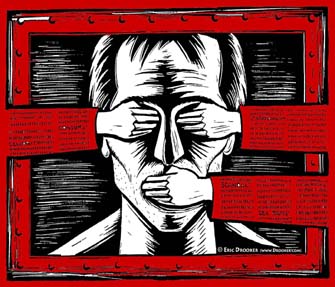
Censorship

Sucka say what!?


I was watching Pillars of the Earth last night, a mini-series being shown on REELS channel, based on the Ken Follet novel of the same name. Besides noticing that the truth of "the book was better than the movie" yet holds true, I couldn't help but notice something else as well.

Isn't it weird the way we censor things? Here you have violent scenes, including main, likable characters being violently murdered, battle scenes with blood splashing everywhere, and so forth... but the brief glimpse of a woman's nipple during a love scene is fuzzed out. That's television; movies are different, yet, the same rule holds true in principle. In whatever medium, the showing of sex and/or the body always lags behind what they show of violence and death.

Look at Braveheart-- you have two people get their throats cut open in full view with blood flowing and everything, you have people getting limbs cut off, or a pick-axe slammed into his head, or an dagger stuck in his eye, or his face crushed with a mace... this graphic violence gets an R rating. Graphic sex, though, gets an X rating; they didn't actually show William Wallace screwing Murron. I mean, you'll never see a penis in an R rated movie, at least no more than a very quick flash in a non-sexual scene. In fact, the only time I can remember such a thing occurring was in Eastern Promises, in the very bloody fight scene in the Russian sauna. Viggo Mortensen's character was naked, attacked, and there was the moment's flash of his groin as he was thrown across the room. As for the nether regions of a woman in an R movie? Forget about it; I bet it's never been done.

Doesn't it seem odd that it's far more acceptable to show ugly acts of violence, but not beautiful acts of love-making? Personally I'd rather children saw the latter, instead of the former; yet the taboo goes the other way, for what would the action movie be without a ten minute gunfight, the severed limbs, the splashes of blood? Even just the sight of a nipple requires a pixellated blur, or an uproar on the Super Bowl. But is this really more harmful for a child to see than the thousands of enacted murders a kid sees by the time he's ten?

We as a civilization are really freaky weird about our bodies. Here's another example, I can only think of two instances of people sitting on the toilet on TV or the movies: one of the Lethal Weapons movies, where Danny Glover is on the shitter when he realizes there's a bomb attached, and once on Two and a Half Men. I feel like there may have been a couple more, but the point stands: something we all do several times a day is almost never shown on the screen. It's okay to ruin the body, but not to celebrate it in the act of love or as a beautiful thing in itself, or even to use it in it's normal functions.

It's not that I really want to watch people taking a shit on TV, but I'm just saying it's weird the taboo we have about our bodies. I know where it comes from, sort of; in general a Christian thing. The Romans had communal toilets in their public baths-- a row of shitters without stalls or walls, and instead of toilet paper, had a sponge on a stick, one for each latrine, used by all comers, washed in water trough after each time. Imagine that, eh? Lord knows they were violent, with their gladiator games and such, and they also had their orgies, their feasts (where they'd often intentionally vomit so they could go and eat even more). I guess the Christians reacted to this vulgar sensuality and hedonism, and took it too far the other way.

I also find it irritating how they censor cuss words. If someone says "God dammit," they bleep the God and leave the dammit! That's pretty weird. I recognize the hierarchy of badness for words, from ass and hell being weak, to shit and fuck, on up to cunt and nigger (dependant on context). But I'm beginning to notice they're sometimes not bleeping shit anymore, which is promising. I'm pretty much against censorship as a rule, especially when the issue is "protecting the children" from stuff they already know and words they already say.

Monday, November 28, 2011

Restlessness

Canyon country under Mesa Arch

Funny thing, how I now have all my stuff back, and how little most of it means to me. Sure, I have a ton more clothes, but most of them just sit in the dresser. Sure, I'm reading some books I had bought and not read yet, or simply missed. Actually, that is one mistake I've made-- I dug out my Everett Ruess books (A Vagabond for Beauty, and The Wilderness Journals), and now I gots the itchy feet again.

I thought that by reading this stuff, I'd satiate the urge vicariously, but it's having the opposite effect. I mean, I've been feeling dissatisfaction about Florida since I got here, but now it's taking shape into a real urge to wander again. I know one thing, that for a man who loves mountains, I'm in the wrong state, boy. And what I really miss is the desert and canyons, the Colorado Plateau of Utah and Arizona where Ruess did much of his journeying. Red rock country. I also came across this quote, which reminded me how much I hate the unspeakably boring flatness of Florida:

From there we pushed on faster because the passage over the blackened plain was easy. By eleven o'clock the highest of the hills rose above the blue of distance, and between us and them lay a bush of shimmering peacock leaves. After so many weeks in flat land and level swamp, the sudden lift of the remote hills produced an immediate emotion and one experienced forthwith that urge to devotion that once made hills and mountains sacred to men, who then believed that wherever the earth soared upward to meet the sky, one was in the presence of an act of spirit as much as a feature of geology... -The Lost World of the Kalahari, p194

And all this talk about simplicity isn't helping. There's nothing simpler and more true to my heart than living out, hiking around in beautiful natural areas, with thoughts only of where I'll sleep tonight, where's water, and how much food is left. All else is taken care of, or dispensed with. There's no daily grind of work. Remodelling homes isn't bad, as jobs go, but so much of it seems futile. Sometimes, for example, I'm amazed at just how much time goes into dicking around with outlet and switch-plate covers. Details that people require in their home that I just can't fathom. Why does the screw slot in the outlet cover have to be perfectly vertical? It's so meaningless, and is a waste of time for all involved. I mean, we do a lot of more important stuff too, but that one always irritates me. The fucks should just be glad they have electricity and leave me the hell alone. No, I'm not bitter.

Zion Canyon
In all seriousness, though, I just can't see why I need to waste my life at work if it doesn't make me happy doing it and don't have a family to support. No joy, no obligation... I figure it'd be better to walk away from it. I've always felt that as long as I can keep myself fed and clothed, there's no worries; and its remarkable how easy it is to achieve that. Earning the necessities of life isn't terribly difficult, at least when you're living like a vagabond. And homeless poverty isn't a huge deterrent to me, per se, so long as I can do it away from the cities, which make one feel poor rather than free and easy. I can earn my meals, or live a bit off the land, even, and stick to the backcountry, much like Everett did for his short life. I always wanted to know more about wild edibles, and I already know how to fish. I can learn trapping and hunting, and dipping into the money economy when I need to is alright by me. I just don't want to be a slave to it.

Alright, I'm being a bit extreme, for effect. Maybe I don't want to do this forever, since I do want to have a little farm someday, but I think it's going to be a while before I get this restlessness out of me for good. I've certainly seemed to decide against a career, thus far, though the thought of returning to school still bounces around in my head from time to time. Right now, I'm starting to consider a move to Santa Fe, Durango... or maybe Moab, which I always liked. Not gonna make any decision now, but I mean to return to canyon country sooner or later.

Saturday, November 26, 2011

Simplicity


Cym over at Effortless Flow recently put up a few posts about living simply and some issues she sees going along with it. I think she's pretty much right in her assessment, and just wanted to share my own thoughts on it, because after I mentioned a book Possum Living in a reply, I started musing it over some more.

Firstly, I don't see the simple life as being one of poverty. Poverty to me implies suffering and deprivation. I don't think I've made over $10,000 a year since 2007, and often quite a bit less than that, with my wandering ways keeping me unemployed for about half the year, usually. Part of the ease of me living cheaply is that I'm often either camping out on a long hike, or, in two cases, living free in government housing as part of a job (Forest Service cabins in Utah, a Fish and Wildlife bunkhouse in New Jersey). Otherwise I live in a cheap rented room, or with family, as I do currently. But I'm also able to go without a lot of stuff that others consider essential, which is key.

A big one is TV, which I've lived without for most of the last 4 years, quite happily I might add, as well as not having in-home internet most of the time. Internet is nice, but, as a bit of an aside, ever notice how you'll Google whatever random question comes into your mind? On the Appalachian Trail, we'd sometimes keep a "Google list" of stuff we'd discussed and wanted to know more about, or to settle a debate on something. Then we'd get to town and realize how irrelevant those things were, and how little we cared. Most of the time, no list, and forgetting what transient curiosities we'd wanted to look up proved their irrelevance. The internet is often a great time waster.

Anyways, the point is, I don't mind not having these things. And that's the point: simplicity has nothing to do with suffering. If you have denied yourself something, like, say, your television, and then constantly worry about missing all your shows, you haven't simplified your life at all: you still hang on to the thing, even in its absence. I think this is where the Christians got confused, with their renunciation ethic, of suffering with the poor. The point isn't to add more suffering to the world out of some sense of righteous guilt. It isn't a duty, to be taken up with regret or as a discipline. Renunciation and living simply are about realizing you don't really want or need a thing, it's about letting the extraneous stuff fall away easily like autumn leaves. It's like Diogenes, who owned only a cup until he saw someone drinking with his cupped hands, causing him to realize the cup was unnecessary, so he threw it away. This requires examination into your life, your desires, your fears, and so forth.

Diogenes with his friends
I go along with Lao Tzu: he who knows he has enough is rich. I'd add to that: he who thinks he needs more than he has is still poor; even those we call the wealthy. I also like the Bob Dylan line, What's money? A man is a success if he gets up in the morning and goes to bed at night and in between does what he wants to do. This is the essence of possum living. This possum thing I keep referring to is from the book, Possum Living, written by Dolly Freed back in the 1970s, about the life she and her father lived in their home outside of Philadelphia. Possum living is quite a lot like what Thoreau did on Walden Pond. It's leaving the world of work (save for the occasional odd job), raising your own food (gardening, chickens, rabbits) or gathering, fishing, hunting for it. It's buying clothes, when needed, at thrift stores. It's not owning a car or most of the other stuff of modern life. It's being your own boss, doing your own thing, and realizing life does not equal work, and that unemployment does not equal starvation. It's freedom.

There are a few requirements. When they started living this way, Dolly's father already owned his home and land, free and clear, just as Thoreau built his cabin on a friend's land with permission and at no cost. Living in a society that believes firmly in land ownership means that, unless you want to pay rent, the best way is to own your land. Then all you have are property taxes, not negligible but probably less, depending on where you live. You can get land cheap, even in or near cities, through police and bank auctions, and foreclosures, you just have to put in the time to find it. For myself, I'd want a decent sized chunk of land (5-10 acres) in a more rural area, but not too far out of a town (at most a small city). Then I'd build a small, simple cabin on it to fit my needs and desires, rather than buy land with a house already on it, which would surely be too big for me (thus too much work to maintain, and too expensive to buy, heat and cool).

Owning is really the main issue. It'd be hard or impossible to live this way from an apartment, though you can certainly live cheaply; but growing your food, having chickens and such sounds like a real stretch, unless your landlord is really, really cool and lets you put in a garden and chicken coop in the courtyard or something. Yeah right. It'd also be easier in a more rural area, where more wild foodstuff will be available to supplement what you grow and raise yourself; though there's always something to be found anywhere.

That's the other thing: work is still involved. Not wage work, really, but there is an element of labor. Dolly makes this point in this YouTube documentary, a point I've made in the past myself. It's work, you have to do things, but the question is whether those tasks are work or leisure. Fishing is fun, but can feed you, so is it work or play? I love gardening and even composting, which both feed my body, directly and indirectly, and my soul, because it's enjoyable, it's leisure and work at the same time. And above that is the fact that I'm my own boss, and much more free in general.

Of course, one doesn't have to go to the extreme of homesteading, though I advocate it and hope to do it someday. Even city folk can simplify their life, drastically cut their expenses, and still live well. Eating a simpler diet doesn't mean sacrificing good food; it means you buy in bulk, beans, rice, flour, and so on, and learn to prepare tasty meals for yourself. Farmers markets often cost less, and are fresher and support local economies to boot. They allow you to taste the seasons as well, since you'll only have squash in the fall, asparagus in spring. Clothes are to be had cheap at thrift stores, though this is admittedly dependant on the overconsumption of others.

As for entertainment, there's always libraries, which often also have movies and music, if you have the electronics to play them. With my laptop alone, I'm set on that. If you're athletic, there's sports that you can do for cheap or free, like pickup basketball games, cycling and running clubs, neighborhood soccer, etc. Or you can take a walk somewhere. Call your friends up and have a poker night, or, in my case, preferably euchre. Lord I love me some euchre. Nature provides much diversion: birdwatching, wildflower or butterfly hunting, learning the natural history of your area, or adding to it with amateur studies, etc. People act like the only way to have fun is to go to the bar and spend a hundred dollars on alcohol, or going out to nice restaurants. Fine if this is really what you love, but there are a million other options, often more creative and enriching options, and cheaper too.

The upshot? The less money you need, the less you have to work. Now, I'm not allergic to work, and when I do have a job, I always work hard; but I don't mean to devote my life to the accumulation of things, and I have other things to do with my time than slave away after wages. I work because I need to, and the less I need, the less I must work, and the more I can devote myself to the things I enjoy doing but haven't yet really figured out how to get paid to do. As a bonus you get to not be a hypocrite, or far less of one, when you bitch and gripe about the banks, the wealthy, the 1%, the corruption of government run by big business. You've stopped voting for those pricks by not using their dollars, and found your happiness away from their rat-race economic prison.

Wednesday, August 10, 2011

Echoes, or How to Cultivate A Free Mind

"Men do not mirror themselves in running water--they mirror themselves in still water. Only what is still can still the stillness of other things." ~Chuang Tzu.

It's a strange world we live in. The more time I spend thinking about these questions, these things that I fill this blog with musings about, the less I know. Every idea has its flaw or failure. Which, in a world that turns more towards fundamentalism and failure every day, just goes to show the amount of thinking most people do, the scale to which our world is dominated by ideas.

Thoughts echo. As I hike in the backlands this becomes quite clear. Out there things begin to quiet down, since nature doesn't speak with language, which thoughts require. Out on a trail for weeks or even months, you begin to really realize this. But, say while hiking I listen to my mp3 player for an hour, for motivation or entertainment; after hearing the songs, I will have them bouncing around my head for hours, sometimes days.  So one must wonder what the constant bombardment of television, radio (talk and music), newspapers, advertising, school, and preachers have on the mind. Even normal socialization has its impact. When do any of us ever have a chance to truly think our own thoughts, free of influence, free of echoes?

Of course, this echoing keeps us in touch. If a person spent decades alone only to later return to society, he'd likely be so out of touch as to be considered insane (or enlightened; same thing as far as the dominant culture is concerned). We trade ideas, realities actually, with this mutual exchange of mental echoes. We keep similar thoughts bouncing around in one another's heads, so we maintain contact with a "common" reality. They call this consensus reality, and yeah, it's not all bad; humans are a social species, and this is necessary. But all things in balance, right?


It's easy to forget this truth, about the echoes. We are too immersed in them to notice. You get home from a whole day at school or work and flip on the TV, or surf the internet, or read a book, or go to church, constantly bombarded with other people's beliefs, some scripted or manufactured reality imposed from without. Programming. Dogma. Education. Indoctrination. Conformity. You never give yourself a break, never get to think your own thoughts, to have time enough away from the media blitz to really learn what it is you truly believe.

I get out to Nature in large part to let the echoes fade. It's not so much that I go out there for answers; I've tried that road, and the truth is, I no longer believe there are any answers to the questions we ask. Not the big questions, about the meaning of life, God, what we're supposed to be doing. The question "why" is a constant agony, a cruel joke. Even the smaller, more personal questions often seem unanswerable. No, in nature there are no answers, per se, but there is clarity. As the babbling of culture stills, as one's own mind quiets down, I recieve the best result that I can hope for. I subsume into my immediate experience; my former troubled thoughts quiet amid the truth of the world around me.

When I get away from the greater culture, away from its whispering, letting it bleed out of me as I walk in the wilds, I find myself thinking about the things around me, wondering about them; like why there's just that one strip of pines running up the canyon wall that is otherwise mostly scrub vegetation, why there and not anywhere else? Sometimes its just running commentary, like normal, but based on the real surroundings and events, not mental fictions; maybe musing about my weariness, the heat, or wondering when my group will stop to eat. Sometimes I get philosophical, and though I know I carry culture within me, the influence of language and years of immersion in our modern world, I feel that without any immediate or recent influence, only the more strongly held beliefs and ideas bubble up. Well, maybe that's not true, who knows. But with all day on my hands, I can spend time with them, examine them, follow the thread of their logic out, see if I really agree.

Now, I want to say that there's no reason we have to live this way, that we don't have to take a month off in the mountains to be free of the bullshit; but I'm not sure I can. Sadly, taking an hour or two a day isn't enough, the echoes take too long to fade. It's a start, and there is a benefit even with that, but nothing like a real vacation from it all. Like, I think it's interesting, that the less you read, the greater an impact a book has on you. That's my hypothesis, anyway. But it makes intuitive sense, because you are giving your mind time to process it, rather than jumping right into another book. If the echoes are like ripples, you aren't throwing pebbles, shovelful after shovelful, into the pool, but letting the ripples of that one pebble roll out and have their clear effect.

The best we can do, while living in the system, is to tune out as much as we can. Throw out your television. That is job one-- the television is becoming our government, and that is unacceptable. Then, read less. Turn off the radio. Avoid advertising, that is, real-life psychological warfare, at all costs. Increase the time each day spent without cultural input: whether in meditation, writing, running, playing with your kids or your dog, cooking, getting rid of clutter, working out, home improvement, inventing things, painting, gardening, making crafts for fun or for sale, or any of a hundred other things you could name.

Ideas are great, but often over-indulged in. So although one might say that meditation or quiet time is the key, and I do agree that it's useful and recommended, even just woodcarving or something might work. You have to be there with the wood, not off in la-la land thinking about the B.S. you watched on TV earlier, or the guy babbling on the radio you have on in the background. Otherwise, through lack of attention, you're going to fuck it all up. You might notice my list didn't really involve social activities. That was on purpose: we need to disconnect a bit. People are culture carriers, and the point here is to get to know ourselves. But since you are a culture carrier too, I don't know that this will work without extended time away.

Maybe I should have just posted the Chuang Tzu quote, rather than making all these ripples.

(This post is first in a series of three, Click Here for the second post)

Sunday, February 27, 2011

Grumbles

The people are grumbling. As usual, about the wrong things.

For myself, I think that it's fine that gas prices have shot up a few dozen cents. The debatable evils of price speculation and stock markets aside, these soaring prices are occurring as a result of the people of northern Africa and the greater Arab region fighting for freedom. If the price of having a half dozen countries topple despots and dictators is for me to pay a few dollars more per week for the privilege, the luxury, of driving distances that once took all day to traverse, and doing it in a mere a quarter of an hour at inhuman speeds two, three, four times a day, well, I'll do it smiling. I won't support a war fought (supposedly) to force freedom on people who didn't ask us for it, but I'm glad to pay extra when the people themselves decide they've had enough of tyranny and choose to do something about it. It's the least I can do.

(the fact that the protests and revolts may be caused by soaring food prices thanks in part to us turning a quarter of the U.S. corn crop into the boondoggle of ethanol to keep the SUV fleet going leaves me a bit muddled-feeling, but the point stands).

(there are other reasons for the rising food prices. Here, read this: The Rising Prices of Food & Political Instability )

Friday, February 11, 2011

Freedom


Freedom. You hear a lot about it these days, they harp on it incessantly. They, you know: the politicians, the law makers, boundary drawers, those blind to irony. Or maybe it is we who are blind to it. I mean, the Liberty Bell is cracked...

Stop to think on freedom but a moment, and the limits loom into view. It is, we say, a free country, but just how free really? Boundaries always lurk in the shadows of the mind, the hidden recesses of a culture. Cultures are defined by these; definitions, edges, these are boundaries, seperating us from them. No society is truly free.

But, free in many ways we are. Free to be different, in a non-threatening way. Free to think, but not to alter consciousness. Free to choose between a million worthless products. Free and encouraged to be distracted. Freedom of the open road, but if you walk, expect the police, the mirrored sunglasses and pointed questions. Don't be caught without any money, or you will be free to go to jail for vagrancy. Free to think but not to act; that is, free to go along in a thousand different ways, but not to protest: expect handcuffs, billy clubs, tear gas. Or else free to be ignored. Free to live anywhere, save on the street, where the cops rouse the sleeping bums. Free, however, and very free, to be poor. Free to change your social position, if you can afford it. Free to sink in free fall to utter loneliness, isolation, poverty, despair, sickness and insanity, but not free to put an end to it all. You are free, you are required, to live. But not free are the basics of life: water, food, housing. Free to breathe dirty air, drink dirty water, and to leave the lights on always.

I guess what I mean is, I no longer understand this word the politicians use. I guess what I really want to know, is what does liberty mean to you? What does it mean to be free?

Monday, December 6, 2010

Down and Out

Recently I've been stressing a lot about money. I'd like to say that this isn't like me, but it is, sort of. I've always been a saver, always socking away cash. Even when I have a sizable store of it, I still fear not having enough, am reluctant to spend money even on the necessaries. For some reason I need a good thick cushion to feel at ease. I remember while I was on the AT-- I suddenly realized I was treating food the way I treat money: I would always have extra in the food-bag, sometimes rolling into town with a full day's worth of food left, while not actually eating enough on the trail. I was always afraid to run out. When you consider that food and money are both forms of energy, of getting things done, you start to really wonder.

It also seems to me that being down and out is much the same feeling as lonliness. Without money you are not connected to the civilized world.Surrounded by all the things I'm supposed to buy and people who all seem completely wrapped up in the ambition for more money... it makes me feel isolated, alone, like some working class stiff, the kind who's not just poor but who's also bitter about it. I'm not even of the same mindset, do not desire that life of striving; yet all the messages around here make me feel low. The energy of it pervades the city.

I never feel that way in the woods. Nor do I ever really feel lonely out there; it's only in the cities that the real ache becomes apparent, with all these people who will forever be strangers to me, people I don't relate to and can't fit in with. But it's like I'm seeing a life I've been excluded from; I could never live that way and live with myself, but that means I'm stuck on the fringes of society, which is hard. It's the longing, I suppose, of one who is banished to the island of the misfit toys.

But I don't know how to let go of this clutching at life. My belief is that it's necessary to let things flow; be free in your spending, the it will come back around. It's like closing an electrical circuit: act as if the money doesn't matter, and you'll never run out. But damn if it isn't a hard first step to make. For right now all I see is the cash flowing away, to mechanic bills, rent, food, gas...

I'm coming face to face with the nugget of fear that lives in my heart, but right now I'm having a hard time even looking at it.

Wednesday, December 1, 2010

Pebbles and Burning Bridges

Reading this excellent post at a favorite blog of mine, as well as recent events in my own life, have me thinking about the future again. Right now I'm adrift. I had a job, moving and cleaning rental cars down by the airport, but ParkWest, the company who was doing this work for Enterprise, had its contract terminated. So we all got laid off, myself only a week and a half into employment. This is alright, the job wasn't great anyways, nor the pay. But it was something, useful especially since my truck needs some somewhat pricey repairs.

Now, I'm wondering, looking at all my options: Should I keep looking for work here in Dallas? I like being around my sister and brother-in-law. Should I WWOOF, and learn about farming? Should I go back to Florida, where I have residency, and try to go back to college? Should I just go piss away the winter in the desert, like a friend of mine is suggesting, then hike the PCT as I still intend to do?

Any choice I make rules out others. Right now I'm thinking work a few months, then PCT, then school. But It's a very hard thing for me though, because school means leaving behind the freedom of this more or less bohemian, hiker-trash lifestyle I've been living-- having adventures and trying to do the things I want to do. To saddle myself with a 3 or 4 year obligation, complete with massive loans (being in debt scares the shit out of me) is an extremely difficult move. I know it's the rational thing for me to do-- I know I'm better than the minimum wage jobs I'm looking at, and the future, though not guaranteed, is as it turns out pretty likely to occur. I'm not going to die next year, probably, even if the future to me still continues to look like a giant Void.

If I continue to forgo education, I may never climb out of this hole I'm in, yet how do I balance the fact that it's only a "hole" if one measures life by money and material success, a ruler I'm not prone to use? That's society's measure, not mine. I'm happy as hell out on the trails, with next to nothing. Mountains, sunshine, simple, down-to-earth people. It's all good. It's just the inbetween time, the winters and time spent saving for the next adventure, living in the slum that is modern life, around selfish, frustrated people that is so depressing for me. I have dreams of being a writer, and of having a little "homestead" and living more or less off the grid, the simple life.

But it's hard to live against the grain, being on the fringes, looked down upon, having your entire lifestyle put down constantly even by those close to you. It's also hard to live with the grain, and be so lonely and unfulfilled. But who knows? Maybe the choice to continue this life of "adventure" would lead somewhere great for me. Or maybe it will crush me. It's all so uncertain. As stated in the first link, he ripples from that pebble (choice) hitting the water will go out, and who knows what it will do out there.

What's both deeply frightening and madly exhilarating is to know that every decision we make, in every moment, is going to make more ripples, have more unforseen consequences. Ripples making ripples of their own. Every moment we live changes our possible futures, by closing some doors forever and opening others. How does one make rational decisions when the information needed is infinite, and the outcomes completely unknown?

I've never been decisive. The future is a wild adventure, enjoyed in the present. This is the cutting edge. And I'm afraid of burning bridges.

Saturday, November 27, 2010

Absolute Freedom

Sometimes, if rarely, in the middle of a conversation, and for no apparent reason, out of no animosity or anything... it occurs to me that I could just... take a swing at my friend, knock him right to the ground. Or sometimes that it'd be kind of fun to just walk away while the person is in the middle of a sentence. To just intentionally do something extremely antisocial. Sometimes I get this sudden objective appraisal of the scene I'm in, and the countless options available, most of them absurd. It's a weird feeling. I've never acted on them. I wonder if this occurs to other people.

This isn't about desiring to do these things; but it's interesting, that you are free to do whatever you want, whenever. You could go down to the airport and get on a plane for Argentina or something, right now. Or just go out your front door and start walking, to see where you'll end up. You could bark like a dog at the next person you see.

What's stopping you? Nothing but the rules you have written in your mind, rules you have let society write in there. Society in the guise of well-meaning teachers, parents, friends, and others, of course. Mostly they make life livable and sane; imagine the chaos if people were really free. But there's always the option. Not that in the next break in the conversation you should kick your friend in the crotch. I'm not saying that.

But wouldn't it be fun to make use of that vast freedom now and then, albeit in a somewhat more constructive fashion? It could-- it would change your life, from the flow of countless consequences and effects. You never know where it might lead.