Thursday, December 1, 2011

Moneyless Society

Here's one for you guys. I was discussing with my uncle today, and he brought up the idea of a moneyless society. I kinda dig that, and thought I'd share it here. Basically, it's simple-- there's no more money. You need something, you go to the store, get it, and walk out. Everything's free. Of course, I argued that without money as an incentive, there's a lot of jobs that would never get done. No one's gonna want to clean toilets or work in mines, for example. Not entirely sure how to resolve that, but my uncle had a great way to ensure that at least there wouldn't be any do-nothing slackers: either you do something, anything, productive for society, or you get stoned to death. I figure that with this system, we'd end up with a lot of artists, poets, musicians, and so forth, and mediocre ones at that, and still not have any janitors, miners, and so on. Maybe there could be a rotation, where the clean-up jobs get passed around, so no one's stuck doing it forever; you do so many days a year at janitorial stuff. The dangerous stuff, like mining, logging, and so forth, well, I don't know. You hate to incentivize it, or those incentives will become the new money. And anyways, I'm sure people will find a way to corrupt this, and end up with the same old ugly power/wealth hierarchies.

So I don't know, give me your ideas. I'd really like a discussion on this, hear your thoughts.

Monday, November 28, 2011

Restlessness

Canyon country under Mesa Arch

Funny thing, how I now have all my stuff back, and how little most of it means to me. Sure, I have a ton more clothes, but most of them just sit in the dresser. Sure, I'm reading some books I had bought and not read yet, or simply missed. Actually, that is one mistake I've made-- I dug out my Everett Ruess books (A Vagabond for Beauty, and The Wilderness Journals), and now I gots the itchy feet again.

I thought that by reading this stuff, I'd satiate the urge vicariously, but it's having the opposite effect. I mean, I've been feeling dissatisfaction about Florida since I got here, but now it's taking shape into a real urge to wander again. I know one thing, that for a man who loves mountains, I'm in the wrong state, boy. And what I really miss is the desert and canyons, the Colorado Plateau of Utah and Arizona where Ruess did much of his journeying. Red rock country. I also came across this quote, which reminded me how much I hate the unspeakably boring flatness of Florida:

From there we pushed on faster because the passage over the blackened plain was easy. By eleven o'clock the highest of the hills rose above the blue of distance, and between us and them lay a bush of shimmering peacock leaves. After so many weeks in flat land and level swamp, the sudden lift of the remote hills produced an immediate emotion and one experienced forthwith that urge to devotion that once made hills and mountains sacred to men, who then believed that wherever the earth soared upward to meet the sky, one was in the presence of an act of spirit as much as a feature of geology... -The Lost World of the Kalahari, p194

And all this talk about simplicity isn't helping. There's nothing simpler and more true to my heart than living out, hiking around in beautiful natural areas, with thoughts only of where I'll sleep tonight, where's water, and how much food is left. All else is taken care of, or dispensed with. There's no daily grind of work. Remodelling homes isn't bad, as jobs go, but so much of it seems futile. Sometimes, for example, I'm amazed at just how much time goes into dicking around with outlet and switch-plate covers. Details that people require in their home that I just can't fathom. Why does the screw slot in the outlet cover have to be perfectly vertical? It's so meaningless, and is a waste of time for all involved. I mean, we do a lot of more important stuff too, but that one always irritates me. The fucks should just be glad they have electricity and leave me the hell alone. No, I'm not bitter.

Zion Canyon
In all seriousness, though, I just can't see why I need to waste my life at work if it doesn't make me happy doing it and don't have a family to support. No joy, no obligation... I figure it'd be better to walk away from it. I've always felt that as long as I can keep myself fed and clothed, there's no worries; and its remarkable how easy it is to achieve that. Earning the necessities of life isn't terribly difficult, at least when you're living like a vagabond. And homeless poverty isn't a huge deterrent to me, per se, so long as I can do it away from the cities, which make one feel poor rather than free and easy. I can earn my meals, or live a bit off the land, even, and stick to the backcountry, much like Everett did for his short life. I always wanted to know more about wild edibles, and I already know how to fish. I can learn trapping and hunting, and dipping into the money economy when I need to is alright by me. I just don't want to be a slave to it.

Alright, I'm being a bit extreme, for effect. Maybe I don't want to do this forever, since I do want to have a little farm someday, but I think it's going to be a while before I get this restlessness out of me for good. I've certainly seemed to decide against a career, thus far, though the thought of returning to school still bounces around in my head from time to time. Right now, I'm starting to consider a move to Santa Fe, Durango... or maybe Moab, which I always liked. Not gonna make any decision now, but I mean to return to canyon country sooner or later.

Saturday, November 26, 2011

Simplicity


Cym over at Effortless Flow recently put up a few posts about living simply and some issues she sees going along with it. I think she's pretty much right in her assessment, and just wanted to share my own thoughts on it, because after I mentioned a book Possum Living in a reply, I started musing it over some more.

Firstly, I don't see the simple life as being one of poverty. Poverty to me implies suffering and deprivation. I don't think I've made over $10,000 a year since 2007, and often quite a bit less than that, with my wandering ways keeping me unemployed for about half the year, usually. Part of the ease of me living cheaply is that I'm often either camping out on a long hike, or, in two cases, living free in government housing as part of a job (Forest Service cabins in Utah, a Fish and Wildlife bunkhouse in New Jersey). Otherwise I live in a cheap rented room, or with family, as I do currently. But I'm also able to go without a lot of stuff that others consider essential, which is key.

A big one is TV, which I've lived without for most of the last 4 years, quite happily I might add, as well as not having in-home internet most of the time. Internet is nice, but, as a bit of an aside, ever notice how you'll Google whatever random question comes into your mind? On the Appalachian Trail, we'd sometimes keep a "Google list" of stuff we'd discussed and wanted to know more about, or to settle a debate on something. Then we'd get to town and realize how irrelevant those things were, and how little we cared. Most of the time, no list, and forgetting what transient curiosities we'd wanted to look up proved their irrelevance. The internet is often a great time waster.

Anyways, the point is, I don't mind not having these things. And that's the point: simplicity has nothing to do with suffering. If you have denied yourself something, like, say, your television, and then constantly worry about missing all your shows, you haven't simplified your life at all: you still hang on to the thing, even in its absence. I think this is where the Christians got confused, with their renunciation ethic, of suffering with the poor. The point isn't to add more suffering to the world out of some sense of righteous guilt. It isn't a duty, to be taken up with regret or as a discipline. Renunciation and living simply are about realizing you don't really want or need a thing, it's about letting the extraneous stuff fall away easily like autumn leaves. It's like Diogenes, who owned only a cup until he saw someone drinking with his cupped hands, causing him to realize the cup was unnecessary, so he threw it away. This requires examination into your life, your desires, your fears, and so forth.

Diogenes with his friends
I go along with Lao Tzu: he who knows he has enough is rich. I'd add to that: he who thinks he needs more than he has is still poor; even those we call the wealthy. I also like the Bob Dylan line, What's money? A man is a success if he gets up in the morning and goes to bed at night and in between does what he wants to do. This is the essence of possum living. This possum thing I keep referring to is from the book, Possum Living, written by Dolly Freed back in the 1970s, about the life she and her father lived in their home outside of Philadelphia. Possum living is quite a lot like what Thoreau did on Walden Pond. It's leaving the world of work (save for the occasional odd job), raising your own food (gardening, chickens, rabbits) or gathering, fishing, hunting for it. It's buying clothes, when needed, at thrift stores. It's not owning a car or most of the other stuff of modern life. It's being your own boss, doing your own thing, and realizing life does not equal work, and that unemployment does not equal starvation. It's freedom.

There are a few requirements. When they started living this way, Dolly's father already owned his home and land, free and clear, just as Thoreau built his cabin on a friend's land with permission and at no cost. Living in a society that believes firmly in land ownership means that, unless you want to pay rent, the best way is to own your land. Then all you have are property taxes, not negligible but probably less, depending on where you live. You can get land cheap, even in or near cities, through police and bank auctions, and foreclosures, you just have to put in the time to find it. For myself, I'd want a decent sized chunk of land (5-10 acres) in a more rural area, but not too far out of a town (at most a small city). Then I'd build a small, simple cabin on it to fit my needs and desires, rather than buy land with a house already on it, which would surely be too big for me (thus too much work to maintain, and too expensive to buy, heat and cool).

Owning is really the main issue. It'd be hard or impossible to live this way from an apartment, though you can certainly live cheaply; but growing your food, having chickens and such sounds like a real stretch, unless your landlord is really, really cool and lets you put in a garden and chicken coop in the courtyard or something. Yeah right. It'd also be easier in a more rural area, where more wild foodstuff will be available to supplement what you grow and raise yourself; though there's always something to be found anywhere.

That's the other thing: work is still involved. Not wage work, really, but there is an element of labor. Dolly makes this point in this YouTube documentary, a point I've made in the past myself. It's work, you have to do things, but the question is whether those tasks are work or leisure. Fishing is fun, but can feed you, so is it work or play? I love gardening and even composting, which both feed my body, directly and indirectly, and my soul, because it's enjoyable, it's leisure and work at the same time. And above that is the fact that I'm my own boss, and much more free in general.

Of course, one doesn't have to go to the extreme of homesteading, though I advocate it and hope to do it someday. Even city folk can simplify their life, drastically cut their expenses, and still live well. Eating a simpler diet doesn't mean sacrificing good food; it means you buy in bulk, beans, rice, flour, and so on, and learn to prepare tasty meals for yourself. Farmers markets often cost less, and are fresher and support local economies to boot. They allow you to taste the seasons as well, since you'll only have squash in the fall, asparagus in spring. Clothes are to be had cheap at thrift stores, though this is admittedly dependant on the overconsumption of others.

As for entertainment, there's always libraries, which often also have movies and music, if you have the electronics to play them. With my laptop alone, I'm set on that. If you're athletic, there's sports that you can do for cheap or free, like pickup basketball games, cycling and running clubs, neighborhood soccer, etc. Or you can take a walk somewhere. Call your friends up and have a poker night, or, in my case, preferably euchre. Lord I love me some euchre. Nature provides much diversion: birdwatching, wildflower or butterfly hunting, learning the natural history of your area, or adding to it with amateur studies, etc. People act like the only way to have fun is to go to the bar and spend a hundred dollars on alcohol, or going out to nice restaurants. Fine if this is really what you love, but there are a million other options, often more creative and enriching options, and cheaper too.

The upshot? The less money you need, the less you have to work. Now, I'm not allergic to work, and when I do have a job, I always work hard; but I don't mean to devote my life to the accumulation of things, and I have other things to do with my time than slave away after wages. I work because I need to, and the less I need, the less I must work, and the more I can devote myself to the things I enjoy doing but haven't yet really figured out how to get paid to do. As a bonus you get to not be a hypocrite, or far less of one, when you bitch and gripe about the banks, the wealthy, the 1%, the corruption of government run by big business. You've stopped voting for those pricks by not using their dollars, and found your happiness away from their rat-race economic prison.

Thursday, November 24, 2011

The Book of Job

Well, fml

I never understood why the Biblical story of Job is supposed to be some great source of solace in times of trouble. I saw this recently on a church pamphlet my parents had, something about finding hope in these hard economic times. I read it, and kept waiting for the reassurance, but it never came. Oh sure, they tack Jesus on to it, but, in itself, the book of Job details the ugliest of injustices! Taking the story on its own premises, Job is a totally righteous man, with no fault before God, yet God decides to throw catastrophe at him in some sort of "whose dick is longer" contest with Satan. And don't go blaming Satan for this, because the authority for what Satan did rests in God. Satan is just a sort of employee here, a lackey. God ordered it done, and just like that, there goes Job's wealth, his children, even his health.

The whole time, Job is demanding to hear why, why has this been done? He has to sit there with his boils and his pot shard while his long winded finger wagging friends tell him over and over what a sinner he must surely be. God at long last shows up, and, instead of answering his still-righteous servant, He goes on to upbraid Job, asking him sarcastically, "what, were you there when the world was made? Do you control the rains and winds, did you spread the constellations through the sky?" Job has gone through all this shit, never following his wife's apparently good advice to "curse God and die"-- and all he gets is a haughty lecture, a big know your role, bitch! from the Lord Almighty. Doesn't he at least deserve an honest answer?

And what are we readers supposed to come away with from this story? Where is the justice of God? Don't tell me that God's justice is too far beyond understanding, because he's even going against the basic stuff we do understand: you don't torture people, nor, you know, murder innocent bystanders ::cough::Job's kids::cough::. If God's justice is so much greater, it must be greater in depth; otherwise, if His justice is so incomprehensible, if it differs in substance, then all the moral striving the Bible demands is for nothing-- what's the point of even trying to be just if we can't see or comprehend the standard? To hell with all this religion stuff, we'll never get it anyways, so why bother about that?

And then there's the idea of the testing of one's faith, which to me sounds malicious and wrong. This monster of a god talks of love, but meanwhile throws famine, strife, disaster and dead babies at us. What an asshole. At best we get the notion that the universe is merely capricious, there is no intention good or bad, but that we suffer randomly. This differs not at all from the notion of a godless, purely material world-- there is no reason for our troubles, at least, no good reason-- and the best we can get is to know we're not alone as we suffer together under the finger of a god not worthy of trust, faith, respect, or love.

On that note, Happy Thanksgiving! :)

Saturday, November 19, 2011

Scarcity, Abundance, and Food


Well, I just finished reading the Grapes of Wrath. That book always hits me so hard, no matter how many time I read it, infuriating me, tearing at my heart. The Joads may be characters in a book, but they stand for a reality, archetypes, so to speak.

Got me thinking, as you'd expect, about the Depression, the banks, debt, and our economic system. Seems the depression's travails were largely brought about by overproduction, as well as the environmental catastrophe of the Dust Bowl, and rampant speculation. It really boggles the mind to consider that in a time of overproduction, people were starving. And it's because we have an economy based on scarcity. We had so much food back then, so much fruit in the vinyards and orchards, too many cattle and pigs, that prices fell so much that they couldn't sell it. It cost more to pick the fruit then you could get for it, cost more to raise the beef than you could sell it for. So they let the fruit rot on the vine, or piled it in heaps and poured gasoline on it so it would be inedible; they slaughtered 6 million pigs and wasted them.

This, to stabilize prices. We are so insane in our abstraction that we forget reality. Money is a symbol for wealth. Who the fuck cares about dollars? The point is the food you can get with it. And we are so insane as to let the big owners to let people starve rather than forego their symbolic wealth. A moral people would have distributed the food, to save those starving masses. Only, then the system of scarcity (that is, scarcity for the masses, not the owners) would fall: the masses would get used to having enough to eat, they might get cocky, and surely won't go back to buying it, will they?

Starvation in a time of plenty. It is literally a mark of craziness on our society. And it goes back thousands of years, since the first guy had a silo and kept everyone's grain in it. He sure had 'em by the short and curlies then. Like when there was a famine and all the Hebrews went to Egypt to buy food, often indenturing themselves for it. It took a Moses and ten plagues to liberate them. Ever stop to think what plagues might be coming our way? Climate change is a giant monkey wrench coming down the line, and the roiling and growing poverty is going to work great changes on our society. Given that the Depression was a man created thing, and moreso a bank-and-owner created thing, I have to wonder who's orchestrating our Great Recession now, and what tricks they're using. I'm not educated or informed enough to know, but I do know the boom and bust cycle is part of our planned economy, to a much greater extent than it is a natural thing.

How few  and consolidated ownership is getting. Monsanto and Conagra control vast swaths of the food production. Five corporations own almost all of the major media sources, so even truth in news and information, food for the mind, is scarce (thank God for the internet! For now, at least). What happened to abundance? I once read this comic book series called Testament. It's a weird story mixing a fascistic near-future with biblical narrative and pagan gods of long ago, the storylines mixing and eventually merging. Anyways, at the end the human protagonists figure out a way to screw the meddling gods that live beyond the panels; the people exit the worldview of scarcity in favor of one of abundance. This is what we need to be doing.

I recently read a book called the Voice of the Planet, a compelling if strange book, where an environmentalist professor is contacted via computer by the planet itself, and is taught many lessons about the wrong path we're going down as a species, and some things that need correcting. Has some pretty amazing sequences in it, though it's a bit tedious getting to the point. Anyways, it makes the point, when talking about famine in Bangladesh, that most people there work land owned by absentee owners, who deal in money, not crops. Ownership is concentrated in relatively few hands, and thus are grown fewer and less nutritional or non-food crops (like cotton) for export to the global market. Sound familiar? This is as true for Bangladesh as it was for America in the 30s and today, for food production as well as everything else.

Beyond the giant ownership problem, which cannot be overstated, is the way we think about food. Firstly that we call it a commodity, rather than the foundation of life. That says a lot about us, and relates to the aforementioned poverty and famine. Second, we eat very little of what the Earth has to offer. Who would think to eat an insect? Ants are supposed to be delicious roasted, and most insects are edible and nutritious. In the Grapes of Wrath, the family is half-starved, but when they run over a snake, no one stops to pick it up, even though that's good meat. You can go out and eat cattail roots, very high in starch, as are day-lily tubers, right there in your own garden. Pine sap can be chewed like gum and has some sugars, acorns can be eaten if blanched of the tannins, dandelions are extremely high in vitamins and minerals and medicinal to boot-- there's food everywhere!

Yet we limit ourselves to a few key crops (wheat, corn, soy, rice, the few popular vegetables and fruits) and a few animals (cow, pig, chicken, a few fish); and being limited, these are all the more at the mercy of market fluctuations. Native cultures don't do this, not the hunter gatherers. Even though today the few remaining hunter gatherers often live in more barren areas, like the Bushmen in the Kalahari, since the good land was long ago stolen by agriculturalists, they still have a hugely more diverse diet than us, even with our supermarkets and global exchange. If one food gets scarce, they have many others. Native Americans, even the agricultural tribes, even those that developed civilization, the Moundbuilders, especially the Mississippian culture at Cahokia, even they maintained, if only as a back-up should the crops fail, a diet founded in the diversity of the natural world. They could always melt back into the forests and prairies, and often did. Diversity was their way, they didn't put all their eggs in one basket.

Homes for people, but what about
the rest of the biosphere?
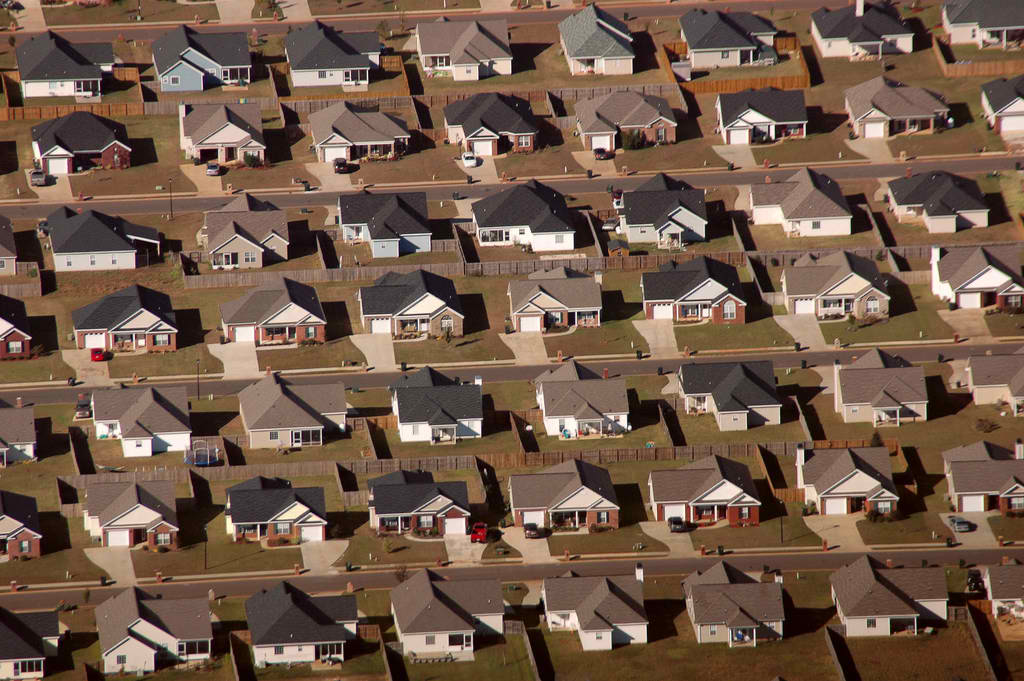
How does this apply to us? Well, I forget the statistic, but something like between 70% and 90% of our processed food contains corn in some form, it was something staggeringly high like that. Meanwhile, the dwindling numbers of homeowners grow wasteful gardens of ornamentals, rather than food, thereby ceding power they might realistically and easily keep. The sprawling development here in Florida is displacing the crackers, the traditional cattlemen this state once was filled with. All across the Midwest, in California's and Pennsylvania's valleys, and in the Southeast, like around Atlanta, we put the new suburbs and strip malls on excellent farmland, erasing productive land from use, and then grow lawns or asphalt on it. We're losing our topsoil because we care about profits, not fertility; because we live in a mindset of scarcity (not enough dollars!) rather than one of abundance. We need more CVS stores, more Walmarts, more 2000 or 3000 sqft single-family dwellings! Even though a 12x16 cabin used to do for a family of 8.

Even without submitting to eating beetles, we could do better. As Aldo Leopold wrote, "Nothing could be more salutory at this stage than a little healthy contempt for a plethora of material things." The simple life, to be brief. That is, to step back from the relentless rat race (it takes a rat to win a rat race) and reevaluate. I'm not talking about simplicity as scarcity. I mean it as clarity. If people had done that in the 30's, those cattle wouldn't have been wasted, the fruits wouldn't have had to rot while thousands starved. Possession is nine-tenths of ownership-- squatter's rights. We might have took charge of that model of scarcity that exploits the many for the comfortable few, and realized that this world is seething with food and the stuff of life, if only we could see it, and if only we could share.

And that is the hope Steinbeck gives us in Grapes of Wrath. Yes, we're left hanging, wondering about the fate of the Joads; yes, it's a sad and bleak ending, but not entirely. The people have found each other and forged a community of the road; the migrants share what they have, poor as they all are. Community over ownership. If you have a little and he has none, you get together and you both have a little. This is the power of the people, this is resilience. No one has a right to starve another, but we're right back where we were in the Depression, lesson not learned. But when the 99% finally get together to realize that they are the majority and strong when they stand together, we're unstoppable. I don't know if I'm advocating localism or socialism or communism or what; can't label it like that, and don't know what the change is going to look like. But change is in the air, and the elites are getting scared.

And they should be.

Wednesday, November 16, 2011

Talkin' Old Truck Blues

It's a strange thing. Here I just wrote about the burden of possessions, and then I go and dump over $1500 into my truck's front end. Ouch. At the same time, I'm reading Grapes of Wrath, about the Great Depression, the masses of people suffering through hard times, with Steinbeck's musings on what might be when those distressed and angry people all get together... and as I'm sitting in the mechanic's lobby, thinking not only of my times on the trails with only what was on my back, but also about the times this country and world is facing now, the Occupy protests being shut down, unemployment up and no end in sight... I'm a bit conflicted, and stirred up inside.

On the one hand, I know the pain of being stuck, the difficulty in staying ahead of bills and costs, and though I resent it at times, I know I'm not getting rid of my truck any time soon. But ah, how nice it would be to not need it, if public transit existed or could exist in these diffuse, scattered cities of single-family housing, cities with no real centers, just sprawls of development on the cheap and cheapened land. I'm as stuck as anyone else in a system that I requires I dump money into the suck-hole that is a vehicle, which I need for getting to work, where I have to work all the harder for it, and for less of a wage than I should be making. Wages always fall behind inflation; even when we get raises, we're still getting pay cuts every year.

On the other hand, I've lived the truth of simple living, I've walked that path and found it good. How we value things, and how little those things mean in the end! Yes, you need some gear to get by, be it hiking gear on a trail or the accouterments of daily life. We make so much of nothing: the owners on the one hand obsessed with owning, those without always trying to become owners themselves, and always failing and being miserable about it. Everybody always looking up, and trying to climb there, never happy where they are. I say, the less you need, the less you need to work-- and then look how much more free time you have! Time for what matters, and less stuff to worry about, and less stress about "getting ahead."

We should have let the banks fail, should have let this system crash, and from the ashes built something more sensible. So, I have an idea that it would be better to opt out. Of all of it. Let's get local currencies going, let's barter among ourselves, get black markets going, and cut the banks out of it. Why should they, or for that matter the government, profit because you and I make a private transaction of goods and services? We use the banks' money, Federal Reserve Notes, and we are taxed by the government to do it. Then the banks fuck around with interest rates and push inflation on us, constantly devaluing the money we have to use, so it gets harder and harder to live. Why do we go in for these shenanigans?

It just seems we are all working so hard to stay in the same place, though more often falling behind, and all because we can't see outside the box, can't see that this system is not set up for our benefit, can't see that there are other options, other perspectives. I'm not saying that all of our woes fall on us, the lower classes. In fact, it is my adamant belief that this system was built not by us, and that is why it fucks us every time; it is of, by, and for the rich and powerful. But I am saying that we have a responsibility and a right to do something else that is in our own interest. But first one has to see other possibilities, other ways of looking at it.

That's why this Occupy movement seems so cool to me. I like that people are talking about this stuff, in living rooms, in diners, in mechanics' lobbies, in bars. I'm disheartened a bit that the green movement seems dead, since all anyone cares about now is jobs (growth), but maybe if this system really gets the shaking up it needs, that will be part of the new order. And I know it's hard to live against the grain, to find a new way to order your life; so much easier to just go along.

But one thing is for sure, something has got to change. We're so inflexible, so unable to act responsibly in everyone's interest, that we're heading for environmental disaster. I know I've been talking economics mainly, but these two things are deeply connected. The insane lust for profits (growth) is killing our planet, but we can't stop the killing without somehow fundamentally altering our economy. I'll leave you with this: I heard the other day that there's a 1 in 10 chance now that by the end of the century, global temperatures will go up 7 degrees Celcius, effectively ending life on Earth as we know it. You like those odds?

Saturday, November 12, 2011

Back from Texas

So I just got back from Texas today, drove for 20 hours straight (or, if you don't count the hour and a half break at a friend's, it was really more like 24). It turns out, sleep deprivation can be kinda fun. Though, that last hour this morning was a little dicey. It was 8 A.M., but the last sleep I'd had was over 26 hours ago at that point, and it was only 4 hours' worth at that, so... I was definitely zoning. At one point I remember noticing the mileage number, then looked again in what felt like about two minutes... but I was fifteen miles down the road.

Turns out also that I have way too much stuff. Not that most people would agree, since it all fits in my little extended cab Ranger, and there's no furniture at all. Still, I thought I'd winnowed my possessions down before putting it all into storage, but apparently this was not the case. Perhaps it's just because I've been living without all this stuff for so many months, that it just seems so much more superfluous than ever-- I obviously don't need it. In a way, it felt like a weight on me just to go and get it all. Like, I'd missed some of it, namely my CD collection, but clearly it's not necessary to my life or even my enjoyment. Maybe someday I'll be like Diogenes, eh?

But the truth is, I have a lot of crap I don't need. Probably about a third of my stuff is books, another third is backpacking/camping gear, and the rest clothes, CDs, my bike, and a lot of miscellany. Doesn't really add up to much, but I had what we'd call on the trail a "pack explosion" when I unloaded it all here at home. A room explosion, I guess. It was immediately stressful to me, even back there in Texas as I tried to get it all in my truck's extended cab. In fact, I couldn't do it, if partly due to haste. Fortunately the forecast was good, so I just put the overflow in the bed.

Shoes I'll probably never again wear, too many shirts, some of which don't even fit me or are getting rather worn, random scavenged cookware... I also have several backpacking stoves I probably won't use again, having switched to alcohol stoves and woodburners, but I can't throw them out, they're perfectly good stoves, and kinda pricey. Too much gear altogether, but one tends to collect such things when one hikes and camps as a partial lifestyle.

I got it all organized though, and filled a garbage bag with junk, as well as collecting a pile of clothes for donation. There's still more I could get rid of, much more, though not much in terms of space-saving... but I just can't do it. Those shoes, for example. I'm not a shoe collector, at all. But since I have them, and they're still perfectly good shoes, I hate to toss them; shoes aren't exactly cheap. Of course, I wear my homemade sandals most of the time, or otherwise my work shoes, so I'm not sure what the issue is. Guess it's just hard to let go sometimes, even for me, the anti-packrat.

On a related note, I've decided I'm going to start meditating more. Which is to say, I'm going to start meditating. Kinda fell off in the practice there, but I've been meaning to get back into it. I suppose I write this just to help encourage myself, since I'm sure no one cares. I just find that I've been getting sucked into too much TV in the evenings, which could be time better spent, including sitting for a while every day.

This post it a little scattered, sorry. I still haven't slept...