Friday, February 17, 2012

Leave No Trace


Despite my grumblings about how I dislike the landscape down here, I do still go out into it. Even the boring, flat, open savanna forests of endless spindly slash pine are better than walking around in a subdivision. I like it best when the wind is blowing, because you can hear the gusts coming in over the distant tree tops, closer and closer; that's a beautiful thing. And unless there's a plane going by, the wind masks all human sound, which, in my preferred haunt, is minimal anyways, being in a pretty undeveloped area. It's a mix between a large wildlife management area and extensive privately owned land.

Which means yes, I'm trespassing on that private land. Even when I'm not, I still am, because I have to cross through a large private swath to get to the WMA; and as for that, you're supposed to pay $3 to go in there. But I've walked too far in too many forests to want to pay for the pleasure. I'm just walking around; if I were hunting or something I'd pay. As for the private land, I sort of abide by the "possession is nine-tenths of ownership" maxim; absentee landlords don't have much right to the land as far as I'm concerned; at least not to keep me out. Same principle as "no cop, no stop." I've only seen people in there twice, and staying hidden is pretty easy in such brushy terrain, especially since I'm always bushwhacking anyways. Actually gives a minor element of danger to a land where the predators have been mostly exterminated.

And really, what a silly concept ownership is, if you really sit down and think about it. I, transient creature, own this piece of land, that has been here for millions of years. What an ego trip! Now, humans are a territorial animal, so there is a point to which it makes sense. When your relationship to the land is what sustains your life, you have a right to that territory, because without it your life is at risk. Everything has a right to defend itself, and in that case, defending the land is defending yourself. But beyond that, to think that somehow this piece of dirt belongs to me, just because I decided so, makes no sense. If you think about it a minute, you can see why the Native Americans just didn't get it. The Earth belongs to itself; if anything, we belong to it.


Yikes.
I've been thinking about Del's post about how Northern Arizona University cut down a patch of ponderosa pines to add another office building, leaving only a few token trees. It's like I said before, about how people have no relationship with the land save that of buying and selling, and "resource extraction," rape by another name, or just plopping down buildings that have no connection to where they've been put. Architects' drawings always look like this: a lone building in some sort of post-apocalyptic wasteland, with no other buildings or people or anything at all. (Of course, given the new designs that seem aimed to make one feel uncomfortable and alienated, and which are usually freakish attempts for the architect to stand out, why bother with context? I refer you now to James Howard Kunstler's Eyesore of the Month series).

But his post really hit me, because it's the same issue as my day's irritation, that being trash left in the woods. Today I brought home four pop cans, and would have grabbed more, and the water bottles, beer bottles (broken and whole), random bits of clothing, and so on. I know there's a bunch out there, but I forgot, again, to bring a bag. How can people so blithely desecrate the land like that, even land they claim to own? They take their dirt bikes or ATVs out there, drink their beer, and leave the wreckage behind without a thought. I just don't get it.

I'm always especially amazed at it in the little patches in the city, since "nature" is so rare there; it's easier to notice that this patch of woods is beautiful because there's no human artifacts, given that it's an all-human world everywhere else in sight. I can't really imagine any reason anyone would be there save to enjoy that natural atmosphere. Well, I guess it's often kids out drinking illegally, or doing drugs, and the above mentioned vehicular "wreckreation." And in some state parks, I've even seen beer cans stuck on the ends of twigs, as if to showcase the fact that they've come all the way out to this natural space and decided to fuck it up with their garbage.

I don't expect everyone to be the kind of nature nut that I am, though a guy can hope... but a little respect would be nice. Is it really so hard to carry your trash out? You carried it in, and it even weighs less with the beer gone. Half the time the people are driving in a vehicle, with all that space to put a couple beer cans. Why do I constantly have to come across these things? One time, when working as a ridgerunner in New Jersey, someone had built a four foot fire ring directly on the trail, and had strewn about their beer bottles in every direction, several smashed against a tree, at least two six packs' worth, as if having themselves a competition; not to mention plastic bags, food wrappers and tin cans. It was part of my job to pack it out; which is alright, it let me get paid to hike, so to speak, but it's all just so asinine.

Sunday, February 12, 2012

Paradigm Shift

Kirlian photograph

I mentioned in the last post about earthing, which is the process of grounding yourself electrically to the Earth. I made it seem like an offhand comment, but to be honest I've been a little interested in this lately; not so much earthing in particular, but the notion of the body as an electrical system, and the way science has not incorporated this truth fully. I mean, we're living in the age of electronics, but science still takes a mechanistic stance on most things.

I wonder how long it will take to catch up. Science seems to have switched from the spiritual-organic understanding of the body and world to the metaphor of "world as machine" or especially "world as clock" pretty quickly back in the 1500s. Not that machines were new: they'd had siege machines and mills and such for a long time, but the great refinements were recent. Astrolabes and especially clocks, as well as other new scientific instruments, were literally changing the world by allowing the Age of Navigation to take off. Shortly after, Newton and Descartes and others explicated a new way of seeing Nature. It was a machine, for them at least. This is the basis of most scientific investigation. I'm not sure how long it took medicine itself to begin considering the body in the same way, but I know that early on in this, scientists were looking at the muscles and joints in terms of levers and pulleys and the like.

Gears, pulleys, levers
But we've been pretty serious about electricity for a while now, call it a century and some. Not that electricity is new either; Ben Franklin's apocryphal kite experiment notwithstanding. The Romans were said to have bathed in pools filled with electric eels for the healing qualities, and there have been discoveries of supposed ancient batteries in the Middle East.

Clearly, though, we're now in a whole separate situation. It inundates our lives, shaping nearly every aspect. Yet science largely dwells in a mechanistic mindframe. Well, I know your more theoretical, physical sciences don't, things like field theory and quantum mechanics; but it hasn't filtered down greatly into the natural sciences like biology and chemistry, especially not in medicine. They're still treating illness as if it were a flaw in a machine, by attacking that flaw, either with surgery to remove it, or with drugs to kill it. Those are the only two legal methods in the US; drugs 'n' surgery. "Alternative" techniques cannot claim to cure or treat any disease.

I don't deny that the official methods have had great success; they certainly have. Polio, smallpox, measles, these things used to kill innumerable people, now they are gone or nearly so. But I've watched what the invasive treatments of chemotherapy, radiation, and surgery can do to people, people close to me. It's sickening. I know that in many cases it works, maybe only for a while, maybe for good. That's great. But for many it doesn't work, and the patient's last days or years are spent in more misery than was necessary; besides the fact that such techniques weaken the body so much that it makes it hard for the body to aid in the fight. These techniques are only marginally more harmful to the cancer than to the healthy cells.

So, the mechanistic way of medicine is pretty damn effective, but, is it the best it can be, if it causes so much harm in the process? Are we taking all knowledge about the body into account? We know that the human body is an electrical system. You can measure current on the skin, that's how they do lie detector tests, which simply measure emotional response. The heart has its current, timing the beats, and obviously the neural systems are electrical... its a huge part of what we are. But the only ones who seem to really be taking this seriously are the fringe elements, your kooks, quacks, and New Age types. I know change happens at the fringes, but my point is that this shouldn't be fringe: it's solid science.

Take, for example, Georges Lakhovsky's Multi Wave Oscillator. I first heard about it years ago in the book The Secret Life Of Plants, starting with his experiment with geraniums. He had ten plants, all inoculated with a form of plant cancer. One plant he surrounded with a copper spiral, one turn, about a foot across and not touching the plant. Within a few weeks, all the plants were dead, except the one with the copper, which had healed and ended up thriving.

I did a similar experiment on my own, with some maple seedlings. I had 3 with the copper spiral, 3 without. I tried comparing their growth, but didn't find much variation and after a couple weeks decided to cancel the experiment. Only then did I find, while dumping them out of their pots, that the three seedlings with the copper had vastly larger, bushier root systems than the other three, which had very simple, thin, scraggly root systems. It was immediately visible, and I was taken aback by the evidence before me. I'd like to repeat this with better controls and possibly something that grows faster, so as to better be able to note differences, and especially a larger sample size.

Still, that's remarkable. Lakhovsky theorized that health was mainly about the various resonances of healthy vs diseased or germ cells, and whichever one can overpower the other. He though that rather than try to kill the disease, it would be better to empower the healthy. Rather than irradiate or chemically attack the cancers or whatnot, which hurts the healthy cells almost as bad, leaving one weak and thus vulnerable... why not work to make the healthy cells healthier? They can then take care of themselves.


Multi Wave Oscillator
But of course, if cancer could be cured in a few weeks of simply sitting between some copper coils a few hours at a time, without invasive techniques and hard to get medicines, a huge industry would flounder, and we can't have that. We all know there's no money in a cure, only in "disease maintenance." They don't want an end to cancer, they want patients. I'm not saying the doctors are evil or intentionally holding back research. I think mainly they just aren't exposed to ideas like this, certainly not in the schools, and they have a right to be conservative in their practice, where life and limb are on the line. I do blame the pharmaceutical and insurance companies, and hospital administrators, who see medicine only as a business venture with high profit potential, and the governments they are in bed with and partly control; they don't provide or encourage research in anything but "traditional" means (calling modern medicine traditional feels really strange to me). But mainly even they are stuck in a system that has somewhat gotten away from us, and taken a life of its own. Such is the nature of living in a paradigm; it shapes your worldview so much that it's hard to see things any other way.

But where control remains, big money and entrenched power prevent the fringe ideas from making headway, as it always has. Physics is already several paradigm shifts ahead of medicine, getting into bizarre territory where objective science is now proving to itself that objectivity doesn't exist, that the observer is part of the observed, and so on. Medical philosophy is miles behind, still thinking the body is a clock, with finely tuned, if organic, gears and levers. You'd think that with the general fascination with electronics in our Western world, we'd be thinking about everything in terms of electricity, but we are still stuck in the sixteenth century as far as scientific understanding goes, at least for the majority of us.

Of course, as with much of science, I suspect that part of the problem is that although the force of electromagnetism and its effects have been described quite finely, and the use of the effects are put widely into use, no one really understands electricity. It reminds me of this blind clam that lives in rivers that I saw on the series Planet Earth. It has an appendage that is shaped and colored exactly like the fish that it eats: the clam opens its shell, wiggles the mock fish around, and when the real fish come to investigate, snaps shut and feeds. But ask the clam how it evolved this perfect little mimic, and it'd come up blank. It uses it, but has no idea how it got that way or why it works, or even what's really going on.

Likewise, we create these fabulous technologies that make use of great universal forces, but just because we've named them and come up with structured models of how they go together, we don't know how it works at all. I mean, gravity was described hundreds of years ago, but they still don't really understand it. Same with electricity. It's still magic, but so commonplace that no one even stops to think about it. No one but those moony New Agers, that is, who often muddy the waters and destroy the credibility of what could be real and important ideas by going too far with them. Admit it, it's hard to take someone seriously who not only believes in the healing powers of resonant vibration, but also that humans are the slaves of a race of shapeshifting intergalactic reptilians.

I just wonder what medicine might look like with such a paradigm shift.

Sunday, February 5, 2012

Charlotte Harbor


Wow, it's been weeks since I've written here, sorry for the lag, my loyal readers, whoever may remain. (You know your blog is in trouble when you start with the apologies about the lack of posts, haha).

I went walking yesterday down at Charlotte Harbor, which is really the estuary for the Peace River down here in southwest Florida. There's a little park there, with a boat ramp and a little beach (if you can call that a beach, it's more of a sandy area held away from the water by a concrete wall); I personally favor the area to the right of the "beach" which is undeveloped. There's a little path, no more than a quarter mile (if that) along the shore through the mangroves, and that's where I usually go when I stop by the place.

The scenery does very little for me. I certainly try, but the sea just isn't my thing; though born on the urbanized flats of the Midwest, I have become a man of the mountains, and although the shore has its own beauty, it is not my asthetic or atavistic preference. At least, not this shore. I can dig the Northwest coast, with its wild forests marching down the rugged mountainous land to the sea in a dramatic flair. Same goes for the California and Maine coasts; they are interesting at least. Here on the dreary coastal plain, it's just a slow, slow crawl under the waves. There's a great feeling of lassisitude about the place, in more ways than one.

Firstly, the land. You can think of this in terms of some sort of spiritual energy, a fung shui or earth energy, or simply in terms of variations in topography, soils, vegetation, climate/microclimates, and so on, but either way, the feel of this place is as flat as it looks. The rivers are sluggish, the tides are almost nil, the soils are a near-uniform sand, the forests repetetive. The soil probably explains the repetitive forest, as well, in conjuction with topography: there are no hollows, no north or south side of a hill, no high dry ridges to affect vegetation patterns, save for the little ponds that harbor pond cypress instead of endless slash pine-and-cabbage palm.

Mangrove islet

Mountains give you that. You walk for ten minutes anywhere and you stumble into little microclimates, new forest areas. Some places the rivers rush, some places they slow, there are little hollows where water, and soils, build up, ridges where there is little water or soil, and so on. You can easily find "special" places in such areas. I can think of several I found even back in some tiny nature preserves back in metro Detroit that I used to visit. Like that bend of a branch of the main branch of the Rouge River; just the way the river turned, and ran over some riffles, where I sat up above the undercut bank. Or at various moments hiking along the Superior Tail in Porcupine Mountains State Park, just little places where the rocks and trees and light all came together to feel unique and set apart. You know what I'm talking about if you've spent any time walking around in the woods. But I can't find anywhere like that down here, though I've spent a lot of time out in the woods, which around where I live there's still plenty of, in the form of preserves and wildlife management areas and just undeveloped private land. It's all same same same.

I really think the flatness is a large part of this. If you like, you can think of energy flowing and stalling in the same way as water; I only bring it up because it is something you can feel, rather than merely knowing about, in terms of hydrology and soils and such. I don't understand it, don't know what it is or how seriously I take the "energy" thing, but I'll put it out there all the same. I figure, the more complicated the terrain, the more interesting the energy flows. It can gather, it can seperate, form in pools and eddies, or rush away. I think this is the reason the standing stones over in the British Isles were set up where they were, at least in part. Here, it's sort of spread out, diffuse, stagnant.

It's a matter of having a relationship with the land. Most people reading this will think I'm a crazy fool for even entertaining the notion of "Earth energy," but consider the fact that we spend out lives almost entirely cut off from it. Even in terms of electricity: we are insulated by our buildings (wood, concrete, carpet and tile floors), and the ubiquitous rubber soled shoe. I remember, years ago, suddenly realizing that it had been months since I'd last touched the Earth with my skin. I don't know how much there is in the notion of Earthing, but, being that we are electrical beings, it's worth thinking about. And as far as our view on land, it's just something to buy and sell, and something to build on. That's not a relationship, especially considering that what we build almost always has zero relation to the land it sits on. If any trees are left standing, they are tokens. We name streets after what we have destroyed: Iroquois Avenue, Cherry Hill Lane, Swan Hollow. We do things in the buildings that have nothing to do with what's outside, which, these days, has often been homogenized into bland suburbia, replanted with non-native trees and plants to suit our tastes.

Horseshoe Crab shells

Another aspect of the dullness around here is that, there's no industry. I'm not huge on big industry, of course, but I simply mean that no one produces anything down here. There's some fishing and shrimping, and inland, mostly cattle (dying out thanks to development), some citrus, and some vegetables being grown. But the economy here depends for its very existence mainly on two things: tourist dollars, and retiree dollars. Both classes of people are down here to relax, to lay around in the sun on the beach, to bask in the all-year warmth (half the year living in A/C, of course). I call the place Vacationland. The place is a sort of energy sink, in terms of money and in terms of activity.

On the other hand, I do admit feeling a sort of ease down by the water. There is a reason that the beach is relaxing to people. Electrically, you can ground yourself to the earth and sea, because you're probably barefoot. There's the warm sun on your skin, cool water to swim in, pleasant breezes, and so on. You can listen to the sound of the waves, endlessly repeating, at least when the power boats and constant air traffic allow you to tune in to it. Among the mangroves, there's plenty of life, birds and crabs and offshore, pelicans, manatees and dolphins occasionally, depending on where you are (I have yet to see a dolphin).

Yesterday, I happened to see a Golden Crowned Night Heron hunting crabs among the mangrove roots. At first, when I spooked the big bird out of the trees, I thought it was a Great Blue Heron, which are far more common; fortunately it only flew about fifteen yards away then proceeded about its business, so I got a good look. Couldn't get a good picture, but here's an old video of one I saw on Padre Island a couple years back. They "dance" before striking for the crab, to distract or entrance the prey, I suppose. Sorry, I couldn't catch an actual strike.

Saturday, January 21, 2012

Some Scattered Thoughts

So I watched Castaway last weekend. I love survival movies, and though they say no one but Tom Hanks could have pulled that movie off, I don't care, I'd have watched it anyways. Not huge action like The Edge, but I love the Man vs Nature motif, in film and books.

But I've been wondering: if you're thought dead for over four years, what is your legal status? Do any loans or debts you have go away? Sure, banks keep that stuff for a while, but how long? And, if you're dead, do they expedite the destruction of said documents? What about your house? I suppose it gets sold or foreclosed. Your car is likely sold. All your stuff. I guess you come back to nothing, and are supposed to just be glad to be alive and "home," even when home probably means on someone's couch somewhere.

I wonder if there's any legal redress. If your family sold your car, do they owe you money? If the bank foreclosed your house, do they owe you a new one? Are you gonna get busted for not paying your taxes the year you disappeared? I wonder what the legal precedent in this is...

On another topic, I came across this in a comment on this article talking about the drumbeat to war with Iran:

The Prisoner’s Dilemma provides the logical foundation of why civilization must always continue to grow. Each society faces a choice: do we continue to intensify production, adopt greater complexity, and increase the size or scale of our society, or do we happily accept the level we’re already at? If you choose not to intensify, you will be out-competed by those who do–and your lower level of intensity and complexity will become a resource they can absorb to fuel their further acceleration, whether by outright conquest or more subtle forms of economic or cultural exploitation.

This is the underlying logic of Joseph Tainter’s argument concerning collapse in peer polities in The Collapse of Complex Societies. If one peer polity does choose to collapse, that region becomes a resource that can be exploited by its neighbors. Whoever conquers it first will have an advantage over the others in the continuing race of escalation.

(Link to commenter's source: Click [#12]) 

Which is interesting, not to say discouraging, in an environmental context (obviously, the political context is disheartening enough). How can any society attain to sustainability if we have neighbors who are going to see your stability as stagnation and eventually outcompete and absorb you? Are we doomed to the cancer of the growth economy until we reach the catastrophic tipping point (which we may already have reached: large systems can fall slowly)? Are we completely slaves to the systems we have created, such that we no longer really control them?

Is the economy alive? Is it going to eat us until it falls dead for having no food left? I know I talk a bit on here about individual choice, and that individuals are the only real part of a country that exists, the rest being abstract ideas like "society" "city" "nation" and so on. That's because I come at the world from a psychological angle; yet the sociologists have something to say too. Mob behavior is markedly different from that of individuals, systems are entities in their own right, and have their own emergent properties. The human body cannot be explained purely in terms of the molecules within it, and groups cannot be explained solely in terms of individual humans. Often it seems as if the power brokers of the world are sort of flailing about, caught in the current and merely reaping benefits but not really guiding anything. There is no captain at the helm, and it seems the storm is upon us.

So. What now?

Wednesday, January 18, 2012

Wilderness

Tillmans Ravine, New Jersey

So in my last post I talked about the wilderness experience, and touched momentarily on what wilderness is. But it merits further thought. I said things about tracts of untamed vegetation, flowing streams and towering mountains, but that's pretty general. Rivers flow through the largest of cities, and plants run wild everywhere, they call them weeds. And how big need a patch of trees be before it becomes "true" wilderness?

What constitutes wilderness? This is more complicated a question than it seems at first brush. In legal terms there are specific criteria that constitute official Wilderness Areas. One notion includes the land being "pristine" and "untrammelled by man." But the thing is, humans, a relatively tiny part of the living world, are causing some major, global changes to the biosphere. Global warming; fished-out oceans; pollution in rivers, lakes, and seas; soil erosion; extinctions; habitat loss or transformation... the list goes on. You can be canoing deep in the Adirondack Mountains, the portrait of New England wilderness, and yet the "pristine" lakes all have skewed pH from the acid rain. You can hike out into the less travelled parts of Yosemite National Park, but the wolves and grizzlies are gone.

So even deep wilderness isn't deep wilderness anymore. There is no "land untrammelled by man," no escape from the impacts of civilization. Hell, most of our national forests are more like lumber reserves, or lands set aside for mining and especially grazing. "Land of Many Uses," goes the USNF slogan-- human use, that is. They haven't been set aside to be truly wild, but as resource banks and giant fun-parks for recreating humans. Heavily managed, they are not wild.

Worse than that, we've come to a point where we have to manage these lands. Fire programs are a good example. We spent so long trying to prevent fires in our national and state forests and national parks, that the ecosystems got all fucked up. Turns out that the North American continent, a vast "wilderness" to the first European settlers, was very much so managed by Native Americans. They set fires to run through the old growth forests, which have relatively low productivity in terms of big game animals, in order to encourage a patchwork effect of forest in all levels of succession, from open fields, to scrubby brush, to young forest, and back to old growth. Edge habitats are extremely productive. Same goes out on the prairies, which were pushed further east than aridity dictates.

Or think of species reintroductions. Wolves were hunted out of most of the US, surviving only in Minnesota until the protections of the Endangered Species Act allowed them to expand into parts of Wisconsin and Michigan, and a few down into Montana from Canada. Then the wolf reintroductions began in Yellowstone and Idaho in the late 90s, from which they have spread into Oregon. Which I'm all for, by the way. More predators, please.

But what this means is we are no longer in the position to maintain the idea of wilderness. What a blow for the conservation movement! If we don't use prescribed fires, if we put out every lightning fire, the natural vegetation and wildlife suffer, because they are adapted to wildfire, thanks to a history of long term human management. If we do set fires, and let natural ones run their course, then we are impacting supposed wildlands by taking an active role. If we leave the wolves extirpated from areas, the wild is not wild, because we have taken from it some of its constituents. If we reintroduce them, they are not there naturally, but only because we deign to put them there and suffer a wolf to live. It's the old problem of damned if you do, damned if you don't: inaction is still a form of action.

But really, I think that's okay. As I said before, humans are part of nature too, and the division between human and nature has been detrimental anyways. Time to move beyond such simplistic dualisms, which reach back to notions of a Fall from grace.

No one gets upset thinking about Indians burning the forest-- that is, managing it-- so why shouldn't we do the same? They were increasing biodiversity, a worthy goal, if somewhat self-serving. We can do the same; we can be as gardeners on this planet, rather than miners and pillagers. We are having an effect, so we might as well embrace it and do it right. Obviously this is already happening in the various agencies; when I worked in the Utah forests, they let several fires burn their course, and there was evidence of controlled burns in various places (including one that got wildly out of control, burning around 10 times the area planned).

Obviously, we shouldn't over do it, or we'll end up with bigger versions of urban parks, which is not what we need. If we can get beyond the notion of wilderness versus human world, we can see that the forests and mountains are just responding to us the same way they respond to weather, seasons, and the like. We're just a "new" influence upon them. Bill McKibben talked about this in his book "the End of Nature." It's been ages since I read it, but he details and decries the global impact we are having, saying Nature is no longer natural. But I don't think it really matters that that the land is managed, and it doesn't take away wildness to have global climate change and all the other problems. They remain problems, of course, but a tree doesn't know or care if the climate is altered naturally or by fossil fuel emissions. It's just going to grow how it must.

Not that this is to advocate turning the National Parks, the Forests, and any of our other wildlands into zoos or living museums, or worse, farms, like they already somewhat are, in terms of lumber and grazing, and even fishing, with stocked lakes and rivers. In the city, and even on the farm, by and large, the world is man-made, it is what matter looks like when first passed through the human mind. It is a land of ideas made material, it is a monarchy. Conversely, nature, wilderness, is what matter looks like on its own terms, in a democratic, communitarian way. We have to learn to manage with a light touch. Logging won't stop, nor grazing, but right now we're overdoing it, we are mining it, rather than using it.

I envision a world of responsible use, which takes into account not only human needs, but the needs of the ecosystem, giving legal standing to nature itself. There is a movement for this very thing, though I don't know how large or effective it's been thus far. Where we can see ourselves as a member of the world, not some distant overseer or landlord.

(I'd add Wikipedia links like I often do, but the site is being self-blocked to raise awareness over the SOPA and PIPA bills, and internet censorship in general. I may come back and add some later, but either way, if you're interested in learning more, go here: SOPA and PIPA)

Friday, January 13, 2012

The Wilderness Experience

Sonora Pass, Sierra Nevada, CA

Well, I did it. Today I went running, found I felt so good that I went and pushed myself, meeting and slightly exceeding that goal of 4 miles which just a couple days ago I doubted I'd be able to do, since I was suddenly struggling to run 1.5. It always comes down to how much dust I'm breathing at work, I guess. But today I felt great, hardly breathing hard, and surely could have been going faster had my legs felt up to it. As it was I stuck to my tortoise pace and met my goal. Good enough.

Since I was able to lift my mind off of pain for once, my mind drifted, and finally came back to something I'd read earlier on Del's blog. He mentioned hiking up Wilson Mountain Trail, a popular, highly used trail in the Red Rock-Secret Mountain Wilderness Area near Sedona, saying that although few were out on that particular day (it being late December), generally he doubts that anyone could have a wilderness experience out there, with the crowds. Made me think: what exactly is a wilderness experience? What goes into creating one? Del was insinuating that solitude is a reqirement, as was being in a wilderness area in the first place. Is that the case?

Lord knows I'm a bit of an extreme case, having spent such extensive time in the backcountry, the trails, the mountains, forests, and deserts. I can't even car camp anymore because it still feels too civilized. But it's all relative. When I was working as a ridgerunner on the New Jersey Appalachian Trail, I met tons of people, all ages, who seemed just bowled over by their trip. We're talking about people who are mostly from that malignancy, the New York City Metropolitan Area, people for whom the gentle woodlands of the New Jersey State Forests are as wild as any Amazon rainforest. I've seen their eyes go wide as dinner plates when I informed a family group that yes, there are in fact bears out here. I thought the woman was going to faint.

Anyway, what I'm saying is, one can have a wilderness experience walking out the front door, or in the midst of Times Square for that matter. The sunrise can be seen from anywhere, and anyone can get lost in the flight of a bird, or the mysteries of ants building their hill in the crack of a sidewalk. Lawns are boring at the usual scale, but up close are teeming with life. And though we easily forget, people are wild animals too.

Perhaps we should think about the definition of wilderness. The thing is, "wilderness" and "Nature" are human concepts, and recent ones at that. Blame the Romantics. In truth, there is no natural world versus an artificial human one. The made world of cities and modern materials don't come ex nihilo out of the void. They may be new combinations, and even harmful, disharmonious ones, but they are the same old atoms, maybe atoms that used to be a block of granite, or a deer, or a fern from the Carboniferous Period.

And yet...

Clearly there is a difference from grokking a tree in your front yard and a 5 day solo trip in a wilderness area. Or perhaps the difference is not the setting at all. Perhaps it is the mindset of the person in question. I've seen many people out on the trails who were not on the trails at all. Walking by, I heard their conversations, and they are all kinds of weird. Middle aged women discussing the latest fashions in shoes and purses (and who has them and who doesn't), young people discussing the pros and cons of alternative educational systems, some older men talking office politics.

These are all fine and worthy topics, I guess, but they could be had in any coffee shop, bar room, or living room in the country. If you're still dwelling in your workaday world, you're not walking on a mountain, you're still only travelling your mind. You can do that at home; so why did you come all the way out here?

I think you can have a wilderness experience literally anywhere, even right at home, sitting cross-legged in the dark meditating on your heartbeat. That's Nature. I sometimes wonder if "wilderness experience" is getting at the same thing as "spiritual experience," "wonder and awe," and "nirvana." Perhaps it's a manner of degree, but I mean, why should it be impossible to have a wilderness experience if there are dozens of hikers on the summit or trail? The difference is whether you're involved in the place you're in, conscious of it and integrating in it, or if you're just caught up in the same old disconnected world you always live in.

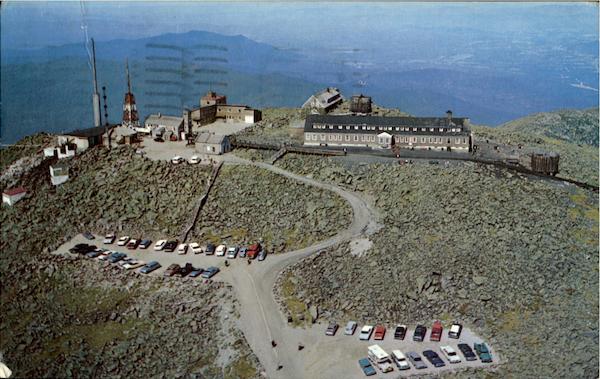
aerial view of Mt Washington's summit
So, what does constitute a wilderness experience? Firstly, being present. Secondly, being quiet is typically involved, but not always-- it just helps you connect, since language is so human, and so wrapped up in the symbolic, rather than the real. Nature speaks a thousand languages, so quiet down and listen. Thirdly, being alone or in small groups; that helps, but if you stay present, you can still be attuned to the world on as crowded a summit as Mt Washington in New Hampshire (they have a post office, cafeteria, and weather facility up there, with a road and a passenger train to the top). Leave work at work, home at home, and be in the forest, be on the mountain, subsume yourself into the greater system.

That's what it comes down to. Being present is being present, but there is a special character to a wilderness experience. Otherwise we wouldn't have a word for it, it'd be the same as deep meditation, the ecstacy of a beautiful symphony, the experience of being moved by a painting. The point is opening up to a larger world, one that doesn't have a big place for you, that doesn't revolve around you, but does still include you. Setting ego aside, the personal story of you, and falling into a greater whole. Towering rocks. Weather. Vast tracts of untended vegetation (tended by itself). Wildlife, things that can eat you, be it mosquito or mountain lion. The simple rhythm of the daily cycle, sun-time. Water that flows not because people are thirsty and dirty and have cars to wash and flowers to water, but because that is what water does. Where no concession or provision is made for you, but neither is there antagonism. It simply is, and a wilderness experience is when you simply are, too.

The problem is doing it. I've been many places, like Old Faithful, Yosemite Falls, Mt Washington, Clingmans Dome, and so on, where it's been too crowded to really reap the beauty of the place. It's possible in theory, but very hard in practice. You're too jangled by the commotion, too eager to go about grabbing at nature with your camera, it's too much. Most of us are not Buddhas, and so to really have that wilderness experience, as opposed to just a pretty view in the fresh air, you gotta get away, get alone, and get quiet.

Saturday, January 7, 2012

Nature and Spirituality

Appalachian Trail approaching Roan Mountain, NC/TN border

(A version of this post appears also at The Rambling Taoists)

Sorry for the slackness around here lately, just haven't been writing at all, not in a couple weeks, strange for me. I've either been working (or watching TV after work), or walking around in the woods, which I've been doing a lot more of lately. What little writing I have been doing has been limited to edits for a book I'm writing on my Appalachian Trail thru-hike.

I've long noticed that the only time I have no inclination to read (something I do, if I must be honest, as much for escape as for knowledge or general entertainment) is when I'm in a natural setting, the forest, the mountains, even by the sea, if I can get away from the crowds. Being away from books (and blogs/the internet) generally takes me away from the world of thought, the interplay and exchange of ideas. Not that I'm not thinking at all out there, but since that's not the point of my excursions, the thoughts are more of a passing thing than something I dwell upon. Thus, I have less tendency to write

One thing I've realized lately, as a result of all the woods-walking I've been doing, is that I'm beginning to feel like all the talk I do on here about Eastern religions, and spirituality in general, is a load of shit. Not the religions themselves, of course, but my take on them: it's like I'm trying to be someone I'm not. I'm not really into meditation, but I feel like I should be and so I occasionally do it, at times in consistent streaks, but usually not. I'm interested in the religions on an intellectual level, but I'm not the spiritual type and never have been. While I believe there is much about the world I don't know or understand, and am fully open to your more spiritual notions, when it comes right down to it, I don't experience life on that level. Like, the notions about the Tao, yin and yang, are fascinating, but rather than think about them, I tend to be impatient to embody them somehow. This is probably why I wrote once about how I realized, while in the middle of climbing a mountain, that I really was an atheist (of sorts).

I wouldn't say I'm a practical person, even though I'm currently working in the building trades. Little of what I do at work comes natural to me, though I'm not terrible at it-- it's just not intuitive for me, and I end up asking a lot of stupid questions. I wouldn't say I'm athletic either, as I've never taken part in organized sports; though I sometimes think I might have, had my heart been healthier and I had better endurance; probably not team sports, but maybe track or something. I think in some ways I was talked out of athleticism, talked myself out of it, even. Still, it hasn't stopped me in my adulthood from a thru-hike of the Appalachian Trail, an attempt at the Pacific Crest Trail, and in general physical work and the active outdoors life. The point is, in personality, I lean more towards the practical and physical than I do towards spirituality and the more intuitive side of things.

It's sort of like a masculine/feminine split. Well, we don't have to drag gender issues into it, because it's not clear cut like that in real life. Maybe it would be better to speak of left/right brain issues, though that is also an oversimplified view. Perhaps yin and yang is the best way to think about it. Point is, I tend towards masculine, left brain, yang, intellectual, rational, active, physical, rather than the feminine, right-brain, yin, intuitive, spiritual, emotional, artsy, touchy-feely. Which isn't to say I fall only one one side, few people would; but that's where my tendencies are. I have to work for the other side.

But as I've been walking around in the woods more and more lately (now that the dry season is here and they aren't flooded shin-deep anymore), I'm realizing that I've almost never had any kind of spiritual experience while meditating or pondering spiritual matters. I've been deeply impressed by the ideas presented... but the only time I feel truly peaceful, connected, present and awake is when I'm on nature walks. I don't discount the meditation, and I said I've almost never had a spiritual experience that way; there have been brief moments. But nothing sustained or reliable, not like while I'm wandering the woods and mountains.

And I don't so much mean while hiking-- which after a while does bring one in tune with nature, but overall is often more about making miles, grand vistas, camaraderie with fellow hikers, and the pleasure of physical exertion. No, I mean while out walking slowly or even standing still for long periods, meandering off-trail through the forest following deer or pig trails, attempting to observe wildlife, practicing tracking skills and being attentive and attuned through hearing and what I, following Tom Brown Jr, call splatter vision. That is, softening the gaze to incorporate peripheral vision, which helps you spot movement as well as to see the whole picture, instead of focusing on a tiny part. Doing the latter is why most people go into the woods and never see anything. I read once that according to Don Juan (via Carlos Castenada), this mode of seeing is the only path to inner peace; I assume that means applying the "splatter" mode not only to vision but one's entire being.

Nature helps me put aside the intellectualization like I never can while sitting cross legged on the floor. This is absolutely reliable. Within a very short period of being out there, I'm already calming down and tuning in. It's literally like going home, it's where I feel most comfortable and able to be myself, it's like switching into another mode of being. I don't know if this is because this "feminine" world of Nature quiets the "masculine" or yang side of me, or brings it to fruit; Nature being a place where it is practical to be quiet, inside and out. It's like a fork in the road, but in the sense of two roads meeting, not splitting. The right and left brain, yin and yang, come together in a harmony, and the inner merges with the outer.