Forays into Florida Out of Doors, occasionally further afield, and the ideas that go with that.
Saturday, April 20, 2013
Portrait of Fractal Nature
Cypress knees poke up through the swampy waters, perfectly themselves, completely of place they are. Yet they are also fractal images of other things. Here is a Zen garden of its own creation, needing no silent monks to maintain them. Here is an island chain in miniature, with moss for the vertical forest of some precipitous Pacific archipelago, or some South China mountain range. I wonder, if one looked closely enough, if a tiny temple might be perched somewhere in these craggy peaks, there in joyful worship of its own very nature, the nature of us all. For do we not all, on seeing such a place, exult in some inward place, some hidden temple of the heart?
Thursday, April 18, 2013
Cypress Swamp Dreams
The soft, delicate spray of needles of a bald cypress glows with a living light in the early morning hours. There in the shaded confines of the forested swamp, amid large and dark trunks and covered by the dense canopy, I stood still and silent, at peace with the moment, asking nothing more.
There
were many birds about, the small ones flitting about in the trees,
the larger ones sailing in on outstretched, motionless wings, or filling the
forest with strange, haunting calls from afar, quavering screams that
seem of another age entirely. These kinds of places don't just feel
wild, they feel ancient, a part of the long unbroken continuum.
This is the way things used to be.
Sunday, April 14, 2013
Six Mile Cypress Slough
I did go back to Six Mile Cypress Slough, as I said I would. How could I not? I knew I'd found something special. My thanks go out to the students who initiated the whole preserve back in the '70s, high school kids who recognized the value and took it to the county commissioners, convincing them and the citizens of Lee County to tax themselves to save it. Much land has been added to the Preserve since, and it is an extremely valuable wildlife corridor and refuge for birds and mammals of many kinds. Such corridors are increasingly rare in our country, and this is especially true here in Southwest Florida, where rampant development has taken a very large bite out of the forests and swamps. But a place like this gives hope to the cause, and someday, and perhaps even now, roaming Florida panthers may make use of wild strips like this as they slowly repopulate the area.
For this is a place of life. Much of southern Florida is, in a way, half desert. I mean that in the sense that there are wet and dry seasons, and the dry seasons are very dry, often with no rain for months. The dryness for half the year is a major limiting factor on living things here, and of course, those dry adapted species must also be able to handle all the rain in the summer. Further, the soils tend to be poor, sandy soils that drain quickly, holding less water and leaching out nutrients faster. It is the wetlands where the biodiversity really thrives here, and this is one such place. The soils are black as night, full of organic material, and of course, water. Even in the dry season, most of the place is still damp, and of course much remains under water altogether even then.
I came to this place just after dawn, having risen before the sun to make the drive out there, for the double reason that dawn is a time of greatest activity for living creatures and that the inverse is true for the human flocks; therefore, I had come early for the relative solitude. The crowds would come later. I again stuck to the boardwalk the whole way. Someday I plan to do some bushwhacking, or more accurately, swamp wading, to get into quieter zones away from all the people. Perhaps find a well sited hummock or stump, and sit quietly for a few hours, seeing whatever comes and whatever is, grokking the wildness of the place.
There was one pond where I spotted several alligators, small ones like this one, young from a few years back, or so I was told. Most were motionless in the weedy shallows, basking in the sun, but this one swam right past me where I stood on the platform, heading for a dry log in the sun on which to do his own requisite reptilian sun worship. A larger one, maybe a 7 footer, had appeared briefly not long before, gliding across another, larger lake, ducking under the glassy surface hardly as soon as I'd spotted it, having raised the camera excitedly just in time.
Wednesday, April 3, 2013
Time Lapse
So, I have a little treat for you guys today. I ended up buying a time lapse camera the other day, always wanted one and finally the one I'd been watching went on sale, plus free shipping. Ended up spending $168 for this Brinno TLC200, and thanks to the sale saved maybe 50 bucks, so that's cool by me.
I got excited and had to use it right away. It helps that I had the second half of the day off work. I admit it didn't come out as well as I'd hoped, but here's a time lapse (or really, a stop-motion) video of me kayaking about in a couple canals here in Cape Coral. Next time, I'll try to remember to level the camera, as well as setting the interval to 1 second rather than 2. That's as low as I can go with it, but it would clearly make a difference, cutting the jumpiness by half and slowing it down. But I'll share it anyways, just to give you a more animated view of my neighborhood. I take you with me as I explore for the first time a couple undeveloped canals I scoped out on Google Earth.
Now, I'd like to point out, most of the canals in Cape Coral or the rest of SW Florida don't look wild like this. For some reason I ended up living in an area surrounded by relatively built out areas (say, 75% built), while my actual area is probably only 20% built out. Just born lucky, I guess (ha). So, some of the canals around here have a lot of trees. Non-native, invasive trees, mainly, but trees nonetheless. And cattails, sedges, reeds, and other vegetation. Beats paddling past stuff like this all day:
First thing they do when they build a house, it seems, is scrape the lot clean of life and build a sea-wall (though a few homes have no wall), thereby eliminating the main attraction of living in the area (in my humble opinion). I mean, if all the city's canals were lined in cement walls, devoid of the strips of riparian habitat, they'd be little more than water roads and, lets face it, open sewers, what with the murky pea-soup water filled with garbage, pesticides, fertilizer runoff, and effluent from the many old and leaking septic systems that the city has yet to deal with. [[deep breath]]
![]() |
| photo snagged from Google Earth |
Of course, in the wealthier areas of the city, mostly the south part near the Caloosahatchee River, the homes are huge and all have pools, are nicely landscaped with palms and flowering shrubs, and don't have big piles of broken concrete in the back yard as the [vacant] home on the right does in the first picture. Most will have boat docks and, in the salt water ocean-access canals, boat lifts. Pretty nice neighborhoods, really. It reminds me of bicycling with my dad back in metro Detroit; we'd sometimes get over to the richer suburbs, and he'd always say how nice it was to bike in such upscale places. Me, I don't really want to look at stuff like that. I always preferred the farm country, open spaces with greenery, or the often-wooded rails to trails. Give me nature any day.
Labels:
Cape Coral canals,
Florida,
nature,
pictorial,
time lapse
Saturday, March 30, 2013
Stillness
So the other day, around 9:30 in the morning, after finishing my first and shorter job of the day, I found out that the rest of my day had suddenly been canceled, and that I was free. Taking advantage of my underemployment, I lit out for the Six Mile Cypress Slough Preserve, over in Fort Myers. I was two thirds of the way there anyway. Sadly, I did not have my camera, even my binoculars, as I had not really planned on any such trip; so I had to make do with the monocular that I found in the woods a few years ago. I hate the thing, causes eye strain, but I always have it in my truck, just in case I need it. Ah, the first world problems of the modern wildlife watcher, eh?
I will be back there, though, to take some pictures for you all to enjoy. In fact, I'm pretty sure the slough (pronounced "slew") is my favorite place in Florida so far. I walked their boardwalk trail of a bit over a mile, moving very slow. I loved the way the cypress trees actually met in a canopy, it felt a lot like being back home in the shadowy hardwoods of Michigan. What a forest should be like, in my mind. Not that I was really comparing, because, this is a subtropical cypress swamp, not a temperate forest. The point is there I was in mostly shade, with the filtered sunlight dappling its way through from a very clear sky, and this felt good to my soul, if I may put it so.
The wildlife, according to this one guy I talked to, was very sparse, with far fewer birds and such out and about than usual. It was late morning, and cold for Florida, in the 50s and windy. But I still saw three small alligators, plenty of birds and turtles, and one close encounter with a grey squirrel. He was running down the boardwalk railing toward me, and came within a few feet of me and the above-mentioned guy. He surely saw us, as he kept running towards us, then back, dithering back and forth before finally going around on the muddy ground.
And that gets me to what I wanted to write about today. This wild animal, if only a common squirrel, only came so close because we were so quiet. I mean, we were sort of tuned in to the stillness of the forest, so we didn't immediately scare him off. This is in contrast to the other people out there that morning; quite a few at that.
It is simply amazing to me how people are when they visit parks, preserves, and nature in general. They act like they're walking around in a shopping mall, they make no adjustment in their demeanor at all. Their footfalls are so loud and heavy, or else shuffling, their gestures and motions sharp and broad, their voices ring out among the trees. Some of them even walk with their heads down, going viewing station to viewing station, I presume. Meanwhile they're missing everything, mostly from scaring it away. Then they have the nerve to complain about never seeing any wildlife!
The guy I mentioned above, he was one of the exceptions; him and his wife. They had some serious looking cameras and seemed to know what they were doing out there; they walked as soundlessly and slowly as I did, stood still a lot, and spoke to me in whispers. My kind of people. For myself, I can't help but be this way. I get out there in the trees, breathing the air, and instantly start quieting down. My motions become slower, steadier. My feet find the ground softly. My mind clears of the usual mental clutter. When I must speak, I do so quietly. It feels almost a sacrilege to speak loudly in nature, where everything is so quiet. And I don't have to think about these things, it just happens, until, within a few minutes, I'm entrained with the world around me, moving into its larger rhythm.
Standing still helps immensely. I think most people who "never see anything" when they go out in the woods must believe that they simply aren't where the wildlife is, and if they could just cover more ground, they'd find it. Quite the contrary! The world is so freaking alive that it would boggle most people's minds, even my own I'm sure, if they'd only stop moving so damn much. I'm better than many, but still a city kid by birth, a civilized man, and I know I have a long way to go to that aboriginal quietude of body and mind.
Check out the book What the Robin Knows, which goes into detail about how birds sound alarms, are tuned in to the different creatures in their world, how they flee perceived threats, and basic insight into ecosystem communities. The author states that it may take up to 40 minutes for threat levels to fall back to a background level, and it may take the neighborhood residents getting to know you as well; that is, over several visits. One thing I liked best about this book, by the way, is that it reminded me that the animals I see around my yard, live there. I mean, that blue jay, that squirrel, that hawk, is the same one I see every day, they are individuals, my neighbors. They're watching me as they watch each other, and they know the area better than I do. Their lives depend on it as mine doesn't, you see.
And of course the same is true in the woods. You walk into a forest (or anywhere), and the animals there don't know you, may not really know what to make of you. You aren't one of the locals, all of whom they know. So someone calls an alarm and everyone hides until you go off somewhere else. You are a foreign element. The least you can do is to at least move in forest ways, so you at least seem to belong a little bit. Maybe they'll be a bit less frightened and a little more curious about you, or at least indifferent.
And I can vouch for that, by the way, having thru-hiked the Appalachian Trail, and only seeing, by and large, what I spooked into flight, from chipmunks and grouse to bears and moose. Hiking is great, and I highly recommend it, but the rewards of hiking lie in areas other than wildlife viewing. It's just too motion-oriented, too much hustle.
I will be back there, though, to take some pictures for you all to enjoy. In fact, I'm pretty sure the slough (pronounced "slew") is my favorite place in Florida so far. I walked their boardwalk trail of a bit over a mile, moving very slow. I loved the way the cypress trees actually met in a canopy, it felt a lot like being back home in the shadowy hardwoods of Michigan. What a forest should be like, in my mind. Not that I was really comparing, because, this is a subtropical cypress swamp, not a temperate forest. The point is there I was in mostly shade, with the filtered sunlight dappling its way through from a very clear sky, and this felt good to my soul, if I may put it so.
The wildlife, according to this one guy I talked to, was very sparse, with far fewer birds and such out and about than usual. It was late morning, and cold for Florida, in the 50s and windy. But I still saw three small alligators, plenty of birds and turtles, and one close encounter with a grey squirrel. He was running down the boardwalk railing toward me, and came within a few feet of me and the above-mentioned guy. He surely saw us, as he kept running towards us, then back, dithering back and forth before finally going around on the muddy ground.
And that gets me to what I wanted to write about today. This wild animal, if only a common squirrel, only came so close because we were so quiet. I mean, we were sort of tuned in to the stillness of the forest, so we didn't immediately scare him off. This is in contrast to the other people out there that morning; quite a few at that.
It is simply amazing to me how people are when they visit parks, preserves, and nature in general. They act like they're walking around in a shopping mall, they make no adjustment in their demeanor at all. Their footfalls are so loud and heavy, or else shuffling, their gestures and motions sharp and broad, their voices ring out among the trees. Some of them even walk with their heads down, going viewing station to viewing station, I presume. Meanwhile they're missing everything, mostly from scaring it away. Then they have the nerve to complain about never seeing any wildlife!
The guy I mentioned above, he was one of the exceptions; him and his wife. They had some serious looking cameras and seemed to know what they were doing out there; they walked as soundlessly and slowly as I did, stood still a lot, and spoke to me in whispers. My kind of people. For myself, I can't help but be this way. I get out there in the trees, breathing the air, and instantly start quieting down. My motions become slower, steadier. My feet find the ground softly. My mind clears of the usual mental clutter. When I must speak, I do so quietly. It feels almost a sacrilege to speak loudly in nature, where everything is so quiet. And I don't have to think about these things, it just happens, until, within a few minutes, I'm entrained with the world around me, moving into its larger rhythm.
Standing still helps immensely. I think most people who "never see anything" when they go out in the woods must believe that they simply aren't where the wildlife is, and if they could just cover more ground, they'd find it. Quite the contrary! The world is so freaking alive that it would boggle most people's minds, even my own I'm sure, if they'd only stop moving so damn much. I'm better than many, but still a city kid by birth, a civilized man, and I know I have a long way to go to that aboriginal quietude of body and mind.
Check out the book What the Robin Knows, which goes into detail about how birds sound alarms, are tuned in to the different creatures in their world, how they flee perceived threats, and basic insight into ecosystem communities. The author states that it may take up to 40 minutes for threat levels to fall back to a background level, and it may take the neighborhood residents getting to know you as well; that is, over several visits. One thing I liked best about this book, by the way, is that it reminded me that the animals I see around my yard, live there. I mean, that blue jay, that squirrel, that hawk, is the same one I see every day, they are individuals, my neighbors. They're watching me as they watch each other, and they know the area better than I do. Their lives depend on it as mine doesn't, you see.
And of course the same is true in the woods. You walk into a forest (or anywhere), and the animals there don't know you, may not really know what to make of you. You aren't one of the locals, all of whom they know. So someone calls an alarm and everyone hides until you go off somewhere else. You are a foreign element. The least you can do is to at least move in forest ways, so you at least seem to belong a little bit. Maybe they'll be a bit less frightened and a little more curious about you, or at least indifferent.
And I can vouch for that, by the way, having thru-hiked the Appalachian Trail, and only seeing, by and large, what I spooked into flight, from chipmunks and grouse to bears and moose. Hiking is great, and I highly recommend it, but the rewards of hiking lie in areas other than wildlife viewing. It's just too motion-oriented, too much hustle.
Wednesday, March 27, 2013
On The Basking Log
Making my way slowly down the canals via kayak, I spotted this basking Florida cooter ahead in the distance. I ceased paddling, and allowed myself to drift for the most part, only occasionally dipping the paddle in to keep myself straight, for the wind was coming somewhat crosswise from behind. Slowly I gained on him, taking pictures as I floated nearer. Finally, I came too close; really, it was the wind that did me in, as it was making my boat pivot. I tried to stop it with a very slow paddle, but it was too much for this turtle, and he dove at last for cover.
I'd never seen a turtle laying as he was, with his legs kicked out behind him. I am sure, however, that this is the local basking log, as there are very few other such logs in that canal; only one, actually, and for much of the day it is shaded, being mostly under the trees on the south bank.
Saturday, March 23, 2013
Cape Coral Wild
| Sorry 'bout the blurriness. |
I had discovered through the wonders of the interwebs that there are several bald eagle nests here in Cape Coral; being a threatened species, many all over Florida are documented and monitored. So I went to see one, having also learned that in Florida, bald eagles begin breeding in October or so, meaning the new crop of eaglets are about to fledge. If I wanted to see some young eagles in a nest, I'd best go soon, or I'd have to wait until next winter.
| Note the homes nearby. The block this tree is on is undeveloped and so long as the nest is there, off limits. |
Another day took me, again, to the northern reaches of Cape Coma, this time to see another threatened species. We have several around here, as I'm sure many places do, given the rampant habitat loss across the nation. Some I see all the time: wood storks are relatively common around here, and bald eagles too can be easy to find, in the right areas. There are burrowing owl burrows all over the place, many marked out with white stakes so they aren't mown over. I have four burrows right in my neighborhood. Unoccupied this year, unfortunately.
| Hey. Yeah, you. Gimme all your cashews and no one gets hurt. |
| What, what is it? Is there something on my face? |
| nom nom nom |
Friday, March 15, 2013
Stealthing at Charlotte Harbor
I decided to do a little camping last weekend, spur of the moment though I'd had this spot in mind for a long time. The only issue was that there is no camping allowed there ("there" being a site along the expansive Charlotte Harbor Preserve S.P.); but I had no fears. There are only two houses anywhere near the trailhead, and a convenient piece of undeveloped forested land right there, with a helpful two track trail heading in. So I just drove my truck a couple dozen yards down the track, past a bend where it'd be concealed, grabbed my pack, and hit the trail.
I walked quickly through the pine flatwoods, more eager to get to the shore than I was interested in present surroundings. Ten minutes later, almost there, I heard voices ahead, likely fishermen, and, wanting to maintain a low profile given the laws and regulations I was breaking, I jumped off-trail into the brushy meadow and proceeded via bushwhack. Now, the forest around here isn't forest like most people are used to. It's very sparse, technically savanna which is a wooded grassland whose canopy doesn't close. 'Round here, unlike the ones in Africa, they're often flooded with the summer rains, and fires are common in the dry spring. This all contributes to the open character.
So you'd think the hiking would be easy (indeed, such excursions are usually not problematic). But it just got worse and worse. There were no pig trails like I'm used to finding and following, and the vegetation just became a horrible tangle. There were random ditches running across my line of travel, and it seemed that on the other side a wall of brush would always rise against me, forcing me ever sideways, sort of like the Withywindle. I struggled through.
The last thirty yards were brutal. The resurrection ferns were chest high and dense, while the briars and thorns meshed together as a malicious screen. I should probably also mention that I was hiking barefoot. Just before reaching the band of mangroves, I came to the last check: brush piles from windblown mangroves, impossible to climb over or through. But you know how it is, you've come this far, and damned if you're going to swallow your pride, or let your previous efforts go to waste; you will push forward. This is why lost people die in the wilderness. This is also why we are loath to abandon our doomed 75 year project of suburbia, prating on about the non-negotiable American Dream. But I digress.
After ten minutes of aborted tries forward, I finally found a gap, not much of one but enough to squeeze through. With a sigh of relief and accomplishment, I hid my pack in the mangroves and stepped out onto the shore, picking the burrs from my clothing. The sun was still pretty high, leaving me a long afternoon of excellent bird watching. Unfortunately, I forgot I had a camera until much later, and anyways without telephoto lenses, bird photography for me is often sub-par. I have yet to invest in a high quality camera.
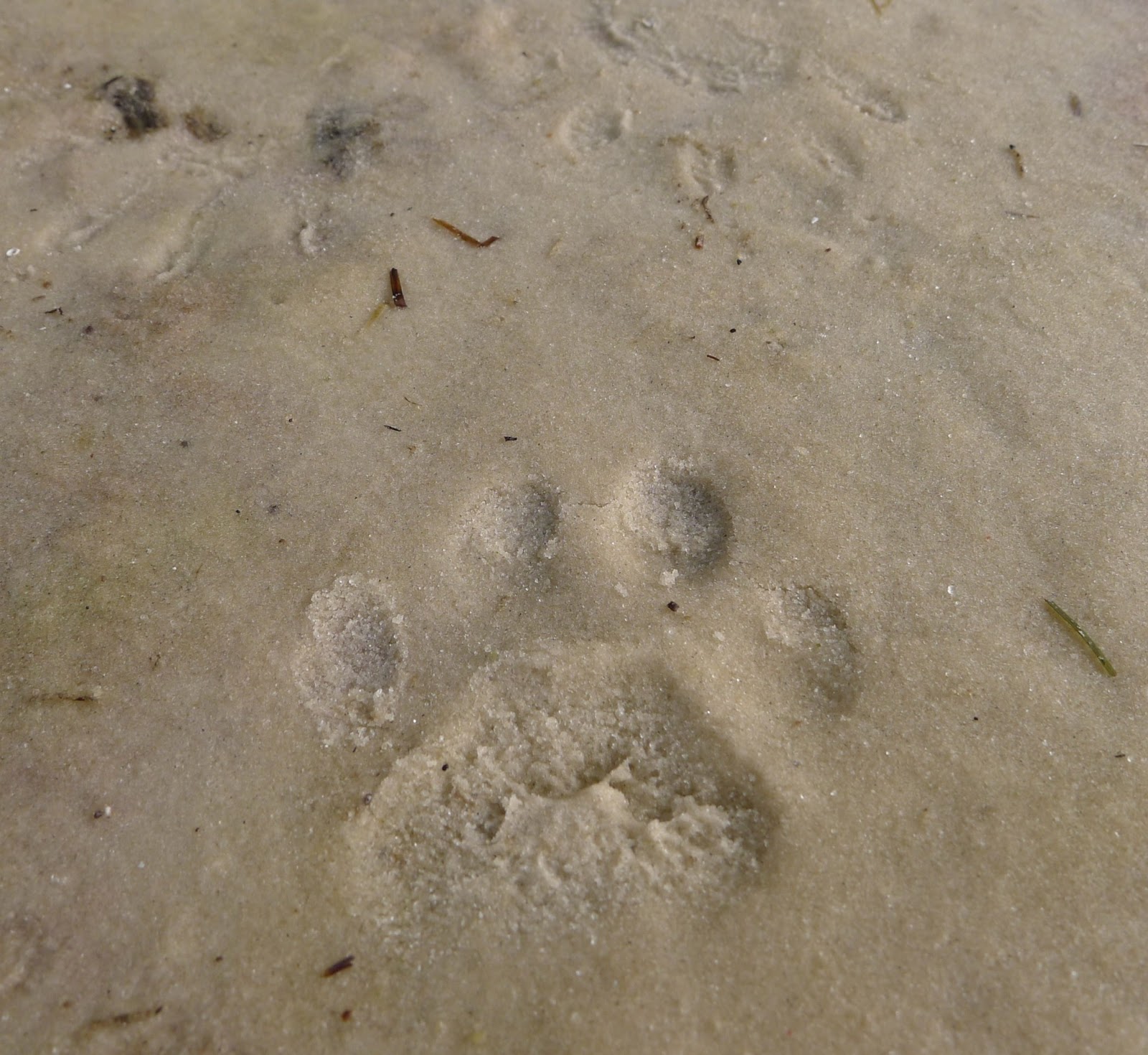
| Bobcat track, with a couple raccoon tracks at the top. |
I walked back and forth, soaking in the sun, feeling the cool wet sand under my feet, enjoying the quiet (save for the occasional boaters further out on the bay). I found tons of raccoon tracks on the sand, as well as a single bobcat heading south, which I followed for a good way. I didn't catch up with her, though; maybe someday i will find her at the end of her trail, standing in her tracks.
Finally the time came to find a campsite, so I poked around up the beach, looking for a break in the mangroves with a place to lay a sleeping bag. Finding it, I settled in, and soon had a fire going. I almost never make fires when stealth camping, but I needed it to cook, having opted to go old-school on this trip, and I felt safe enough in this rather isolated spot. If I'm being truthful, though, it's not that isolated: later that night I could hear strains of rock music drifting from the resort a bit to the north, and I really wasn't very far from the main trail to this shore.
| A friend said I looked sad in this picture. I was going for "contemplative" |
The whole place is rich. I am still amazed at how alive this place is, how productive a habitat, not to mention varied: you have the mudflats of the shore at low tide, the shallow estuary with varying salinity levels all the way down to the Gulf, the mangrove fringe, the pinewoods and prairie just inland... edge habitats often host more wildlife than the interiors of a given habitat, and here are about 5 different edges all in one place, with all kinds of microhabitats mixed in.
| At least 70 ibis in just this flock alone |
The hike out was pleasant as well, taking my time now through the pines. I kept seeing more and more species of birds; in the end, came to 28 species in less than 24 hrs, likely a new record, though I've never before kept track so specifically. Mourning doves, an eastern wood peewee, an eastern towhee, grey catbirds, black and turkey vultures, a hairy woodpecker, mockingbirds, and more. All in all a fantastic, if short, excursion. I'd love to go back during a full moon, to maybe spot that bobcat after all.
New Directions
Hey all, just wanted to announce that I am planning on resurrecting this blog, and turning its focus more towards outdoor adventures, trip reports, bushcrafting tips, and the like, rather than all the philosophical ramblings. There will likely still be some of that, because that's just who I am; but hopefully I'll be having more posts and photos referencing my doings in the great Florida out-of-doors. I had thought to create a new blog, but this one has the right name for where I want to take this project, so I'll just stick with the tried-and-true rather than start a new one. I know I've surely lost all my old readers after two or three months of inactivity here, but anyways, that's what I came to say today.
Friday, December 28, 2012
Get Off The Mountain
Get off the mountain--
we are not wanted up there.
To climb is only an offense
to gravity, to the earth
and the sea which birthed us.
Feel this truth in your bones
with every heavy step uphill,
hear it with every pebble
skittering down the slope;
we are not wanted up there.
Even the sages have left,
back down to the valleys
where life is made, their only answer
to the seeker's many questions--
we are not wanted up there.
To climb is only an offense
to gravity, to the earth
and the sea which birthed us.
Feel this truth in your bones
with every heavy step uphill,
hear it with every pebble
skittering down the slope;
we are not wanted up there.
Even the sages have left,
back down to the valleys
where life is made, their only answer
to the seeker's many questions--
we are not wanted up there.
Sunday, December 16, 2012
What We Leave Behind
I picked up Derrick Jensen's book What We Leave Behind the other day. As always, I find him hard to read. I respect him for what he's saying, and I know he's just being honest and unrelenting in his condemnation of our ravaging civilization, but it's still very gloomy reading. He's definitely a glass-half-empty type of guy:
Back to this morning. I step outside, napkins in hand. I hear the birds singing back and forth, and I'm reminded of the ongoing destruction of the planet.
There's Derrick, being his usual cheerful self. Like I said, hard to read, though he's right on target and has a lot of good info. Especially the first part of the book, much of it about waste, garbage, feces, and so forth. The historical perspective was interesting, about how people viewed garbage (really, they didn't, since garbage was not waste, but a resource, and was utilized). Made me think about my own.
For starters, human waste. The napkins he's holding were for toilet paper, as he now prefers to poop outside in the forest. As I pondered, I remembered something I wrote long ago as a teenager:
I feel so cut off from the jump and flow of life. I am totally disconnected from almost every part of my life. I have never seen the plants or animals that produce my food; I don't usually even know what country they come from, let alone what specific farm or farmer produces them. I do not know where my water comes from, where it has been, or where it goes. I don't know the people who made my tools, furniture, clothes, or electronics, I don't know the trees, plants, and mineral deposits where the materials came from. They show our leaders on the television, but I've never met them. I do not know where my urine or feces goes, or what is done with it. And the heat for my house comes from fossil fuels I've never seen burned in plants I've never seen.
I wrote that when I lived in Michigan, and it still applies today, in Florida. I've looked into some of these things, for this post, and learned about a few of them. For example, I know the water here comes from reverse osmosis plants pumping water from the aquifer under my feet. I could go see the plants if I wanted to, all three are in this very city. My garbage ends up in an incinerator -- pleasantly called "waste to energy" or, even better, "resource recovery" plants -- from which [some of] my electricity also comes. The sewage, hard to figure out, it seems that after treatment, the dried sludge used to go to a landfill, then Cape Coral started turning it into humanure, but something changed this year and I can't find out if they still do that or now send it to a landfill; all the newspaper links are inaccessible, and this article is ambiguous.
So it's not that I can't find these things out, though some are rather more difficult to find than they should be. No, the real problem is that I have to ask at all. Shouldn't it be painfully obvious to an organism where it's shit goes? I mean, it's my shit, I put it where I put it; but we've built a system in which the shit doesn't stay where it's put, it goes somewhere, is acted upon by others. That's weird. Of course, it always was acted on by others, but those others used to be merely soil organisms, or maybe a hungry dog. And to not know where my water comes from? Or my food? This is a matter of grave concern, all of it.
Because (I skipped ahead in the book) Jensen talks about fighting back. But I think he's deluded. On the other hand, this may be why he's so sad. Of course in the end people know the Earth supports them. But our experience (and Jensen even says this himself) is that water comes from a faucet, food from the supermarket, shit goes somewhere else. Everything is abstract. And when it comes down to that, one will fight to the death to defend it; not to overthrow it. No one is going to work to destroy that which supports them. Which is weird to say because that is what modern civilization is actually doing, but it's removed from experience, a mere abstraction. Our immediate reality tells us that to fight back is to fight against getting food, water, sanitation, and all the rest.
Jensen quotes someone saying something like "do not have a revolution until you are prepared to eat rats." And this is the crux. One might fight back against a regime, or even a type of economic system, as they have done for all of history. But even the communists didn't want to destroy civilization, not even industrial civilization. This is a whole other order of problem which we are being asked to fight against. Something right down to the core of our lives. No one knows how to live without civilization, except a few pockets of indigenous peoples around the world. In fact, to overthrow civilization would be to doom billions to starvation and death, because you can't support that many without it.
Which is tragic, because of course this is what the Earth needs most, an overthrow of, at the very least, modern civilization as it works now. I don't know if civilization in any form is sustainable, let alone if a high tech one is, as the techno-futurists fantasize. But we're going to hit limits eventually, probably soon, or maybe already. And that's going to hurt, and things will change as a matter of course. I've read that Native American civilizations like Cahokia, when they got overpopulated and teetered over the unsustainable cliff, just went back to hunting and gathering and small farming, having never lost the skills totally. They were never so many, or so estranged, that this was impossible; this is not true for us.
The other tragedy is, of course, that of human dignity and self-determination. A man used to be his own sanitation engineer, by moving his outhouse now and then (actually, this isn't sustainable either, read this). He didn't have to delegate his power out to specialists and technicians. He grew or hunted his own food, drank from a local stream, which didn't need reverse osmosis plants, made his own clothes, tools and furniture, or knew the men and women who did. His garbage decayed and enriched the soil, and so was not garbage. His body would eventually do the same.
I have to admit, I was especially irritated to not be able to find out where the sludge solids go around here. Here we are, mining the worlds soils of nutrients with our agricultural model, never adding anything back but poisonous fertilizers, converting it into feces, and then, where do those nutrients go? I hate the thought of them being stuck in a landfill, or incinerated (the ashes to go to a landfill), to mix with heavy metals and toxic chemicals (which they've already done in the sewers and incinerators). It's like taking the world's fertility, mixing it with poison, and burying it far from the access or use of any living thing save some extremophile anaerobic bacteria. Same goes for human bodies, for that matter. We're running 200 species extinct daily, stealing the Earth's productivity to make human flesh, then, when they die, soaking them in embalming chemicals for burial in hermetic concrete vaults.
Madness. Madness. How can this go on?
Labels:
books,
civilization,
environmentalism,
sustainability,
waste
Sunday, November 25, 2012
Was It Worth It?
I'm reading Alan Watts' book The Supreme Identity again. It's one of his older works, and one of the best books I've read on metaphysics, because it is a very reasoned argument he makes, building up on some pretty solid premises. It's a pretty hard read, therefore, for both that reason, and the fact that he takes a lot of time explaining things, to try to make clear a subject that is inherently hard to talk about. I will also note that he wrote this while still an Anglican priest, and he admits in the intro that, because he was still "in the system" as it were, trying to match Vedanta and Christian theology, it is, perhaps, "somewhat torturous." Still I find it illuminating. Not a good intro to his writing, though.
I'm on the part where he's discussing the Problem of Evil. I won't get into the arguments here, I haven't the time and it'd be better if you just read it (the whole book, that is), for I'm sure to ruin the argument in trying to simplify it here. But briefly, he argues for a God that, rather than being absolutely good, is the source of both good and evil (in the finite, relative realm), while Himself transcending both. Towards the end of the chapter he says something like how, from our limited perspective, evil seems absolutely terrible, yet, from the standpoint of the infinite, it is an integral part of the finite duality, and even the most atrocious acts are worth it, for the overall beauty of the whole Creation. He likens it to standing with your face pressed to a painting; stepping back, you suddenly see that those ugly shadows are what give shape, form, balance, and identity to the light and color.
Now, I talk a good deal on here about civilization and it's pitfalls. I've long sympathized with the Daniel Quinn/Ishmael position that civilization has been the cause of many of the negatives we see in the world today: war, poverty, starvation, disease, environmental degradation. These may exist at a basic level in all humanity, true, but civilization grows them to a scale unimaginable at that level.

So, has it been worth it? Much as we hate war and genocide, crushing poverty and tyrannical rulers, plagues and pollution and extinction...do things like high art, advanced medicine, the internet and global communications, justify it? I have a hard time here. Human history has been a bumpy road, full of inhumanity and horrors that we in the West can hardly imagine, given our plush lifestyles. No living American has had a war happen in their own backyard, we really have no idea. Though there are systemic problems, the vast majority of us don't know true poverty, true starvation. These things are everywhere in poorer places, a vast suffering of masses of people. They would still be living at peace if it weren't for civilization, close to the Earth, in communities where no one is left behind. If it weren't for agricultural surplus, expanding populations, and urbanization, there could never be slums and shantytowns.
But I must admit it hurts my very heart to imagine a world without Ode To Joy. Whenever it plays, I feel like I want to burst with happiness, and tears often come to my eyes. Or Starry Night, by Van Gogh; my favorite painting. A perfect case in point, actually; the man, like civilization, was tortured and half-insane, yet look what came of it! Or, appropriate to today's topic, Edvard Munch's The Scream; a creepy painting, yet it stirs the soul. What about all the poetry, the great novels and plays, the elegance of higher mathematics? What about telescopes revealing the heavens, microscopes showing us worlds within? What about the rush of foreign money and help when a disaster strikes a place like Haiti? Before such a thing would be impossible, if ever we learned about the disaster in the first place.
One can narrow it down to religion, as they did in one of the Intelligence Squared debates. We all know of the bigotry, the crusades and jihads, the suicide bombers on buses, the gay-bashing and abortion clinic bombings, the strife in South Asia, the Troubles in Ireland. They are terrible. But religion has also brought us the stained glass at St Denis Cathedral, in fact all of the great cathedrals, mosques, temples, and shrines. Most of the art down the long centuries has been religiously inspired, if not overt iconography. And what about the joy and giving at Christmas, the pillar of Islam that requires charity, the ideals of love and brotherhood, compassion and kindness? It hasn't been all bad, you know?
Tribal equality is a wonderful thing, and clearly mankind evolved to fit that lifestyle. We certainly have problems squaring a tribal mind to a globalized world. Yet, we have grown, stumbling, into something more. Tribes are isolated, closed within themselves, extremely conservative and narrow. Today, we have ideals of universal brotherly love, individual freedom and innovation. Such things would never occur to a hunter-gatherer, because it is born out of the long march of history, which has slowly built upon our awareness.
![]() |
| Is this all we've become? |
I'm also reading Lord of the Rings (I usually have several books going at once), and think of the elves in this case. Immortal, they watched as evil first came down into the world, and watched as many great and lovely things died or faded. At one point, Merry, a hobbit, states that he has never until this quest been outside his country, and, had he known the perils that awaited, he should not have had the courage to do so. Haldir, an elf, says in his reply, "The world is indeed full of peril and in it there are many dark places. But still there is much that is fair, and though in all lands love is now mingled with grief, it grows perhaps the greater."
It grows perhaps the greater. The play of duality in the world is inevitable, and is what gives us joy and love, even if it also requires we know sorrow and hate. And of course, civilization is, and all this discussion is rendered moot by that fact. We are here, and there's no going back. Even if we had the deepest, darkest collapse from modern society, we would have the memory of civilization, would still almost surely continue agriculture, metallurgy, the use of animal labor, and other such advanced things. I doubt we could ever slide all the way back to the sort of natural tribal state that the Cro Magnon lived within.
I'm not sure we should want to, either. I've never been too sure about "spiritual evolution" but in some sense, we have in fact matured as a species. Many things have been discovered within ourselves that likely would not have been under the simple tribal conditions. We needed a more complex substrate, that of civilization, to bring it out of us. Emergent properties. We often do a lousy job exhibiting these higher things, of course. But they are there, waiting for each one of us.
To those of you who have read this far, I beg you to reply. This is one post I'd be very interested to have a discussion on, to hear your opinions and thoughts on the topic: Has it been worth the pain, to walk this road of civilization? Would we have been better off remaining stone age adepts, wise in a simple way, in tune with Nature? Or is it a good thing, in spite of all the hurt and horror, to have come this way, and to have found the more refined aspects of heart and mind?
Sunday, November 18, 2012
It Is What It Is
It is what it is.
Man am I sick of this phrase. I used to joke that this was the most common five words on a construction site. Probably true. But I'm starting to think it less funny. It's actually rather depressing. What is this fatalism that seems to be sweeping the nation? Everyone is saying this, or things like it. I hear it in class, on the radio, from friends, and from strangers overheard in diners and coffeeshops. Everyone seems to be throwing up their hands at the world and saying, "there's nothing I can do."
I heard a story on NPR the other day, about teaching strategies, East and West. Here in the West, kids are taught that smart kids are the ones that do well in school. In the East, kids are taught that it's the hardworking kids that succeed. An experiment was done, some years ago, where children from Japan and from American were given a math problem far above their ability. The Americans gave up after, on average, thirty seconds, saying "we haven't had this yet." The Japanese children worked on it for over an hour.
We deride the East, saying they are robots that learn only by rote. Somewhat true, their creativity is less pronounced. But it seems that Americans are helpless without being told exactly how to do things. We don't work for things, we give up. They said it was because failure in the West is taken as a personality flaw, not merely a lack of effort or even luck. So when confronted with an insurmountable problem, we turn away. What has happened to us?
I said to my uncle that back after WWII, there was a surge in energy, a sort of collective testosterone rush after having won the war. We were invincible, unstoppable. Just as in any contest, the victors go home, full of optimism and pride, have lots of sex (baby boom) and build lots of things (suburbia, highways, etc). The post-war boom. Things got stagnant more or less in the 70s, and now we're on a downswing it seems. Oh, there's been GDP growth, but that means little, especially to the common man, who's wages have stayed stagnant for decades.
I think the fatalism is a defensive strategy for this decline. Things are failing, and people are stepping back from it in a sense, as a way of insulating themselves from it. That's the way things go, they seem to say, and as it falls, they try to remain separate. When things slip downwards, there is no collective energy for doing things. It is a period of waiting, to see which way things are going. But to wait too long is to fail entirely. And anyways, insulating yourself from the failure of the world is to cause the failure of the world: if no one does anything to sustain, to build, to keep alive, then, it will not be sustained, built or kept alive! It's a positive feedback loop, also known as a vicious cycle.
Not that it's all bad, this accepting of reality; in a way it is a good thing. In remodeling homes, a specific case, you see that there's nothing you can do about the shoddy work that went before, or the fact that the wall studs are warped. The baseboard is going to have gaps between it and the wall. You grab your caulk gun and go to work. But too often I see, even in myself, an unwillingness to go the extra mile, to put in the effort and time and care to make things right. Money rules the day, and working quickly in some ways trumps doing things precisely. The evil profit motive ruining things once again. Again with the baseboard: if the corner joints aren't perfect, even when the walls were, it's okay, caulk will hide it. You say things like, "good enough for paint-grade," "can't see it from my house," and "spackle caulk and paint make a carpenter what he ain't."
True enough. In the end, we make it look good. And often, as I said, you just have to fudge things to make them work. A good carpenter is one who can hide his mistakes, they say. One must work with what is there, must be able to see clearly what is.
Of course, for myself, very often I rage internally against the standards some people hold. They want their walls smooth and their woodwork perfect, even in an old house, every joint hidden, every nailhole covered, and so forth. The smallest defect, they freak out over. (They also want it done for next to nothing, and as fast as possible). I may not have the patience for finish carpentry. These Euclidian ideals do not square with the world, they do not follow the curves, so to speak, of the earth. Thus the old man wastes much energy picking every leaf off of is lawn, though more fall every day, and becomes bitter and obsessed.
So in a sense, the fatalism is a positive response. We are awakening to the reality around us, seeing it clearly, and in a sense realizing that certain things cannot be altered, and do not need to be. We are tuning in a bit better to what's there to be tuned into, ditching these Platonic ideals for a more empirical reality. This shall be the birth of the new world, as the old crumbles.
But that it is a fatalism, and not mere clarity, is what makes me think it is an example of a greater problem. We are getting soft. We have had it too good, been too insulated from real work and real things. We have fewer than ever people entering into the trades as apprentices. In 20 years, who is going to be doing the work that will so desperately needed to be done, as we recreate our society? Mexicans, I suppose; such work has always gone to the latest wave of immigrants, from the Irish, to the Italians, the Polish, and so on. Yet as goes the prosperity, so go the Mexican immigrants, I bet. I'm sure they'd rather be poor in their own land with their families nearby, than poor in a foreign place.
Even our wars, we are loathe to fight. The hoopla over the Benghazi attacks. We are fighting a global War on Terror, however misconceived, people. Do you really think there will be no casualties? Do the Taliban or al Qaeda, after a drone strike, freak out and lob investigations and controversy at their commanders and leaders? No. These are men who know what a war is. They know about suffering, they know about effort. They mourn their dead, and go right back to the fight.
If we are going to fight wars, which I'm not saying we should, we should do it 100%. I agree with our military leaders in this. Clear goals, and support your commanders. If you can't do both, it's time to pull out. There will be mishaps, there will be pain, there will be death. If you can't handle that, don't fight a war.
So while I'm all for recognizing reality, we need to ditch this phrase and the attitude behind it. We are not mere slaves to fate. Perhaps the government is corrupt, business self-interested and insane. Fine, but don't submit to it with fatalism. Fight! Build something new! We can't wait for the old to fall before we work to make the new, we must start now, with hope and energy. Otherwise we're going to be stuck with some dystopian future we really aren't going to like.
Saturday, November 10, 2012
One Night
I worked my way around the small pond, pushing the willow branches into the soft, damp earth along the margins. The world around me had fallen silent-- muffled, perhaps, by the dew already settling on the grass. The stars shone clear high above, the silky wash of the Milky Way spanning the velvet dark; and as I finished up, my eye was caught by a sudden light to the east. It was the moon, heaving its luminous bulk over the horizon like a revelation. It hung there, unreasonably still, as if this waning gibbous moon longed to remain, to hold on to what light it had left. But incrementally, it lifted over the trees, accepting its nature and the changes of time.
Soon my backpack full of fresh branches was emptied, and I took to roaming the night, glorying in what I had done, ignoring roads and property lines as I strode across the soaking fields and lawns. Boundaries of all kinds were falling away. All my usual reference points were gone, swallowed by the dark maw of night, and elation surged in me, my awareness sharpened, expanding laterally. The world dissolved into a mysterious enormity which I drifted through, a singular point of perception made whole, and joining with the rest, as much as my feet were soaking in the chilly wetness, and my lungs the misty air.
Something had transformed the trees. Trees that, by day, seemed isolated and dwarfed by the spaciousness of these open fields, a place that was, in fact, former forest, long ago bulldozed. Now, under the cover of night, they rose up before me, looming against the moonlight, phantom spirits of the forest this land, in its hidden heart, even yet remains, though long held down by the mowers.
They seemed to rise, physical manifestations of the very night itself, the growing soul of darkness itself. But not darkness in any evil sense, no-- dark only in the way of things unknown, unfathomed, but very much alive. One pine, as I wandered free over those fields, seemed itself to walk towards me, though of course it was I who, by no design of mine, was steering straight for it. A large, two-trunked pine, feathering dark branches out against the star littered sky, each needle singular in its existence, glistening in the moon. It was a silhouette of pure presence.
It seemed to hold a quiet wisdom, a strong sense of knowing, and as I drew nearer, even seemed to hold the moon itself between the tongs of its split trunk. A living memory, random remnant from a bulldozed wood, survivor of wild storms and man alike, standing quite alone in a vast sea of undeveloped property. This tree remembered a different owner, and this, I knew then, in a way I cannot quite recapture now, was the tree-lord of this patch of ground, one of the sovereign sentinels who wait, wait... wait for the day the mowers come no more, ready to tend a fresh growth of seedlings, the someday lords of a forest yet to be.
Friday, November 9, 2012
Guerrilla Gardening
So, as I said in the last post, I'm realizing I'd like to work in a nursery or something, to have my hands in the dirt; merely designing landscapes or whatever isn't enough. But in the meantime, this past weekend I struck out into the world of guerrilla gardening. I've started planting trees. Trees are some of my favorite plants, because they often have that freedom thing going. Aside from some of the lower branches, they tend to grow as they will. They are impossible to ignore, towering over you. They are in themselves wildlife habitat. And, they live a long time, so planting them is a lasting effort. I could see myself becoming an arborist, a tree planter of some kind, maybe even a forester, but from a conservation angle.
So, guerrilla gardening. I've been collecting acorns from the live oaks in the yard, and planted over 130 last weekend while house and dogsitting for my parents, mostly in a wildlife management area and in a bit of neglected, undeveloped land. I have also been planting willow cuttings. Willows are amazing because you can cut any old branch, stick it in some damp ground, and you'll get a tree from it. Their bark has loads of rooting hormone in it, and you can make "willow tea," and with it get cuttings of anything other tree to root and grow themselves.
For starters, let's just say that, though still young, I'm well on my way to being that weird, "eccentric" old gentleman stereotype (as much as you can stereotype eccentricity). I went out one afternoon to a drainage ditch by that neglected bit of land, where a few willows grew (specifically, native Coastal Plain Willows). Cut over 30 branches. I had to walk a half-mile back to the house, and watched as passing motorists slowed down to bend their necks at the weird guy with a huge bundle of leafy branches walking down the road, with more sticking up out of his backpack. I looked ridiculous.

Later that night I made my stealthy way, dressed in black, out toward the park area in the middle of this partially developed subdivision, where there is a man-made pond. See, one thing I hate about southwest Florida is the lack of trees. It's all so newly developed here. Everything that isn't still pine forest looks bald and naked, literally scalped, and the houses just sit there, starkly dominating the scene. Horrible. So I'm working on remedying that. Also, I hate that a park has so few trees, and that this pond has no shoreline vegetation conducive to wildlife. The whole shoreline is just lawn and weeds growing a bit unruly beyond the reach of mowers. No reeds or cattails, even, which I find strange. May have to remedy that as well...
But for the moment, I just started setting the willow branches. I put about 20 there at the pond, in select locations; another 8 or so along the ditch draining it, and the remaining 10 or so in another smaller pond that forms part of the ditch system. I figure they have a great shot at growing, given that the soil was all quite damp; and as we're heading into the dry season, if it's damp now, they'll be fine the rest of the year.
So, this isn't quite "traditional" guerrilla gardening, which is to beautify neglected areas, especially in urban zones, or to plant food crops in the same sorts of places. Well, I think the delicate willow branches growing up there in the sun-baked park will help a lot, shading the waters a bit, sheltering frogs and minnows and birds, waving gently in the wind. That's beautiful in my book.
I keep true to the guerrilla aspect by not asking permission, and plan to put in more trees when the time is right, probably oaks and pines. May make some seed bombs as well, though since the grass is mowed regularly it might be wasted there. I have wider plans for the trees I'm growing (I have a ton of acorns started in pots here at the house, as well as some found-seedlings). There are many places I'd like to plant acorns, but with the mowers, it is necessary to have an actual tree to put in, with stakes for a warning, or any seedling coming up will be mindlessly destroyed.
And of course I'm still working on aligning my life in better accord with my new understanding. For now, this is a mere hobby, but eventually I know I've got to make a living this way. I just had to get started right away, in some manner, because who wants to wait, once they've figured out what they're supposed to be doing?
(A note on seed bombs, for any who are interested: in sunny, drier climates, such as Florida in the dry season, or in the Southwest US, I hear that seed bombs made with clay may bake solid. Because unless it rains a good bit, to soften the clay, it will sit there in the sun, basically firing itself almost into a ceramic, and therefore becomes useless. I read that instead one can use a recipe of seeds, compost, and a bit of egg whites as a binder. These will come apart better when the rains do come.)
Tuesday, November 6, 2012
Gardening
Not very long ago I had a bit of a personal epiphany. I was over at my uncle's house, trimming his hedges. The sun was shining, but had just rained a few hours before, so the leaves were dripping wet. And as I went down the row of bushes, manually shearing off the excess, I realized that I really love doing this. The sharp yet quiet sound of the shears, the fresh coolness of the rain against my skin, and mainly, working with the plants. There is something about gardening that really appeals to me at a deep, soul level.
Seems like most of the other jobs I've had has been somehow anti-life. Certainly the home remodeling of recent times, which is hugely energy and resource intensive, very wasteful, polluting (with toxic chemicals), etc. Even retail jobs produce a lot of waste, and encouraging consumption doesn't quite appeal to me. Generally our economy is anti-life, speaking broadly, which is why we say it's unsustainable. This of course filters down to the lowest level, where everyone contributes to it.
I don't feel like I'm contributing anything positive to Life, not even really to the human world; I'm helping some investors make their unholy profits, and managing to feed myself on their scraps. If I were merely providing housing for people, fine, that's honorable; but we can all be real about this. No matter how used to them we are, our 2000 sq ft houses are wildly out of proportion to human needs. Unless you have a very large family, who needs such a big house? The way we arrange ourselves, everyone having their own room, typically at least 10'x10', it's pretty gluttonous in terms of space and housing. Certainly it is not the only way things can or should be. Indeed, humans evolved living in tents and huts, or large but communal long houses or lodges.
I visited, on my way to Utah last spring, some of the ancient pueblos in Arizona and Colorado. It is incredible how small those things are. The buildings seem large, but the actual rooms are claustrophobic, hardly enough space to fit a man's body laying down. Yet this is how they lived, for centuries, them and their families cuddling in these small spaces. Why do we all sleep separately (save for couples)? Why do we need so large a space for a bed room, where the chief activities are sleep, sex, and general rest? Many of our basic assumptions on this and other aspects of every day life are so clouded and myopic it sickens me.
It's the same thing with most fields of work these days: everything is tainted by the profit motive, even such basic and honorable things as farming and medicine. I've never been afraid of hard work, but I do hate knowing that my work has, inseparable from it, this threading of dishonor, the sleaziness of greed, corruption, power. Nothing is pure. This is the stuff Marx and Engels talked about. How can I really love what I do if I know that, even if I'm farming and feeding the world, I'm also poisoning the soil and rivers, or keeping livestock in barely livable conditions? I've never been able to find a fit for myself, because everywhere our system is corrupted, and I'm looking for truly honorable work.
With gardening, I am able to encourage and produce life; at least if done right. For example, trimming a bush doesn't hurt it, because it will just come back twice as hard. You can grow food and also build the soil and biodiversity as you do. In this there is still some true honor. And as I stood there in the sunlight and the rain-wet leaves, I realized that I need to be doing something with plants in my life. I'm almost thirty years old and I think I've found my calling, in general at least.
So I've been brooding on this a bit. Brooding is kind of dark sounding; call it musing, pondering. Trying to figure out which way to go with it, while realizing all the more how right this epiphany is. I mean, since I can remember I've loved plants and gardens. My parents say I used to play under the bean poles as a small child, they were like teepees, and even as I grew older I preferred being outside. I loved helping my dad in our massive flower gardens as I matured still more, propogating plants, helping design new plots, turning the soil, adding truckload after truckload of compost. Never felt like work to me. We'd smile and attribute it to our Irish blood, which makes us love to have our hands in good soil.
There was this one corner of the garden, it was my spot. It was a fairly large, lush bed on our side of the fence; meanwhile, the neighbor behind us had a big hedge, like a green and living wall. The neighbor to the side had let that part of his yard grow wild, as it was out of sight out of mind, behind his garage. There was a huge Norway spruce growing there, a good sized white cedar, tons of weeds, and a thicket of some kind of bamboo sort of plant, which spilled over into the yard behind him, also a forgotten place of decaying firewood and weeds. It's pathetic, because I'm talking about a very small area, but it was the wildest part of the yard, and I was drawn to it.
I know also that I've been missing having a garden for years. Every spring I wish I had a plot to put some seeds down in, and every summer and fall I simmer in jealousy at a few of my friends' pictures they post online, of their produce. Seems like every year, I'm not situated somewhere that I can do this for myself. Part of that is, of course, me following my other loves: camping, and, later on, hiking. Wilderness has always called me, but I'm realizing that maybe half of that call was the call of plants. To simply be in places surrounded by the vegetal world. The wild-freedom-call is another thing aside, and not to be ignored here. But plants... they are strange to me, mysterious. Living beings so far removed from my human experience that they rather baffle me. Alive like me, but mostly foreign. Their body form is different. Their senses are different. Their life cycles, different. Gardening is a conversation with this mystery. Even hiking in the forest is a sort of communion with kingdom Plantae, though it goes beyond that into general ecology too.
I think even the way I get all fired up over sustainability and permaculture and all that, is largely fueled by this. There are many good things to be done in those fields, and I'm not saying I'm purely all about the growing of plants. I'm fascinated by many aspects of sustainability, the basic philosophy of it, the science and ecology of it, and specific fields, like urban design, new building materials and methods, and new energy sources and methods.
But those will have to be for other people. I want to have my hands in the dirt, somehow, some way. My part in all this, I think, must be working with plants. I titled this "Gardening" but it could be anything: farming, working in a nursery, or as an arborist, or a conservation forester. I hardly know where this could take me.
Friday, November 2, 2012
Infinite!
I was going to write this big post to follow the ideas of the last one, but I just haven't had any focus lately. I jump around from one thing to another, can hardly sit still or stick to any one thing. So I think I'm just going to post this link to an article I read recently in Astronomy magazine (The official article is pay-only, but I found it posted in full on a forum). It sort of blew my mind. It shouldn't have, because the idea is latent in the concept of a Multiverse, but somehow it never had an impact on me until now:
It means the Big Bang was probably just a local event, a big to-do in the ’hood, confined to only the observable universe.
and:
But she slightly misspoke. It’s not a very small percentage that’s observable. You see, any fraction of infinity is essentially zero. It means we cannot see even a few paintbrush strokes of the celestial masterwork. All we can ever hope to study is 0 percent.
That is just straight up amazing, in the original sense of being lost in a maze. I've been trying all week to work out the implications, but it's like my mind keeps sliding off the issue. That in addition to my general lack of focus. Where does it leave us?
Personally an infinite [and eternal] universe makes much more sense to me than one starting from one place at one time. That is to say, the big bang still makes a lot of sense, but not as the start of literal existence. I can see that it would explain how the current state of things got going, under these specific natural laws and in this specific form; but the whole getting something from nothing is kind of a deal breaker for me.
Also, as far as my metaphysical understanding goes, it jives better with that as well. This concept of knowing 0% doesn't refute what science has found. No. But it does allow for a deeper understanding. If the "Laws of Nature" aren't absolute across the wider multiverse, there's nothing to say they're absolute even here in our universe. Knowledge becomes relative, which is demonstrable regardless of this finding.
The easy, simple analogy is a dictionary. A dictionary contains all words, defines one word with other words, which can themselves be found in that dictionary. It rests upon itself. The Bible does the same, and so do the collected works of science. Internally, it works beautifully (well, not the Bible so much, which contradicts the crap out of itself). But the question is whether it has external consistency. A dictionary is great, but what ties it to reality besides its own circular logic? A dictionary of the Spanish language is also true, for example.
Likewise science, which does tie out to the wider world in most cases. This is why I love science, because it works from observation and facts. But from any given set of facts, any number of ways of connecting the dots (the facts) exists. Science goes for the elegant, simple theory. But a Rube Goldberg universe is possible too, full of horribly complex interactions causing things. And there is also the problem of spontaneous events, not replicable in a laboratory, plus the whole inner mental world which so far is completely beyond the Pale of the scientific method, being a materialist method (as it should be, mind you).
In the end, the good thing about an infinite universe it that, if truly understood, it would free us from the provincialism of ego and prejudice. Everything becomes possible, and nothing is sure. Our boundaries remain, of course, I am still me, the Theory of Gravitation is still the Theory of Gravitation... but now the backdoor is opened, connecting everything and erasing the isolation of a worldview that rests upon itself.
Some would say that is a horrible, insecure way to live. Like blindly flailing about in a void, with nothing to stand on. Me, I believe it is freeing. To know nothing is to stand in awe of everything. Who knows where that might take us?
Looks like I wrote a big ass post anyways. Oh well.
Friday, October 26, 2012
Great Blue Heron
I saw this Great Blue Heron, one of my favorite birds, out on my dock today when I went down to the kitchen for dinner. I think this can serve as a brief example of the sort of intelligence I was talking about in the last post. Because, typically you would expect to see herons standing in shallow water and weeds, hunting fish and frogs. Certainly it seems strange that he was standing in the open like he was, especially since I noticed him at 6 PM, and he remained there, essentially motionless, until 7:30 when I went inside. I sat on the balcony, hoping to see which way he would fly off, wondering where his nightly roost would be; but he outlasted me, as nature so often does. I grew tired of waiting and went inside. It was nearly full dark by then, and he'd been there at least an hour and a half-- who knows how long he'd been there before I spotted him.
What was he doing there? Definitely not hunting. For one thing, he was not in a good place for hunting: at least a foot and a half above the water's surface, not in the productive weed beds lining the shallows. Also, he barely moved for over an hour, hardly a twitch, aside from incrementally increasing the S-curve of his neck until his head was resting nearly on his shoulders. As dusk deepened, he did some slow wing stretches, similar to how I might stretch the muscles that lie across my shoulder blades. He also did a few knee bends, lifting one leg up, then the other. I thought he was getting ready to fly off. I think he was waiting for me to leave.
I wondered about predators. Certainly not many things prey on these the largest of herons. Possibly a bald eagle, but they prefer fish. An alligator might snap one up, but this heron was mostly safe from that, given the distance it is down to the water surface from the edge of the dock. A Great Horned Owl might take one, but probably not very often. Bobcat? Maybe. Coyote? Possibly. But this was the genius of the bird's chosen location. Not only was it far from any cover a stalking predator might use, but look at his placement. He set himself up right where the fourth tie-off post would have been, had it not been broken off. I don't think this was random or by accident.
| One post, two posts, three posts, fo-- HEY! |
To a casual glance, and in the growing gloom of dusk, though right out in the open this bird had in a way concealed himself within a regularity of his environment. This is intelligence of a certain manner. Not mere chance, nor the determinism of a genetic behavior. He probably didn't have to think about these things, but this intelligence isn't necessarily rational or lingual; more akin to intuition. Rational thought is just a recent layer of complexification of intelligence.
He wasn't ready to fly off to roost, was probably wanting to wait for full darkness, so no hungry eyes would see where he would finally bed down for the night. Most likely he was digesting a large meal. Often, birds feed just before nightfall, to see their high metabolisms through the night. I guess this one had gotten lucky with a large fish, or several smaller fish or frogs, and was content and satisfied for the day. So what did he do? He flew off to a good place in which to rest. He would have done the Buddha proud, as he faced toward the setting sun across the water, alert, but quiet in body and mind.
I suppose it's easy to discount all of this about inner intelligence. There are always two sides to any story or issue. Here, one could say the bird's behavior was the result of an inner intelligence, but one can just as easily say it is all genetic programming, just a dumb bird in a dumb universe. Sort of like the debate between materialism and idealism:
George Berkeley put forward the contention that nothing is real, in the sense that the universe exists only in our perceptions. When asked by Boswell what he thought of Berkeley's theory that matter may not, in fact, exist, Johnson kicked hard at a stone and stated, "I refute him thus!"
Johnson felt the reality of his foot hitting the stone, but Berkeley could say that he only perceived it, and cannot prove the reality at all. It goes round and round. I posit that both are correct. That is, there is the external view of science, which talks of the material evolution, but I also think there is an inward sense to everything, not just mere mechanics and behaviorism.
I guess the point is, I'm arguing for an acknowledgement of this "two sides to everything" fact. Materialism is not, in fact, the only possibility. It is ignorance to rule out the opposite position categorically; such a ruling out cannot be done, as it would have no basis in fact. This either-or thing cannot be resolved by choosing one or the other, the solution is to transcend the question by subsuming both in to a larger answer. This, really, is why, though I've been interested in both science and religion since earliest childhood, eventually this interest led me into metaphysics. I don't want just to cheerlead for one side, a relative understanding. Like all humans, I long for absolutes.
As Morihei Ueshiba, founder of aikido, said: everything—even mountains, rivers, plants, and trees—should be your teacher. And this is what natural philosophy is all about, what materialist science has lost, and what my next post, I think, is going to be about.
(By the way, the gator to the left of the frame in the second picture is, of course, fake)
Labels:
Cape Coral canals,
nature,
philosophy,
pictorial,
science
Subscribe to:
Posts (Atom)