Friday, April 15, 2011

Night and Darkness


As a poet, I've long been an advocate for night, darkness, silence, etc. Darkness in our culture is associated with evil; an unfortunate development, and untrue. Night represents ignorance, confusion, corruption, the time of terrors, demons, death. But it is also a very spiritual time. You may lie awake in bed thinking about the things that matter most; there is time and space, few distractions, you are able to center yourself. It is the place of intuition, reflection, thought. Lovers meet, philosophers dream, and all things can rest.

Darkness, silence, emptiness, and stasis all seem negative. They ARE negative, in that, to use a phrase out of art, they are a sort of negative space to the positive space of light, sound, form, and movement. But clearly both are necessary.

Even where there is light, darkness remains. Light is a wave, and contains within it the "off" part of the pulse, the trough of the wave. Sound is the same way. I like to think of all existence as being a vibration. Matter is basically energy, in packets called quanta. Such is one theory at least. Another is, "we work with being, but non-being is what we use." (TTC 11)

Lao Tzu is always talking about the feminine (or yin) as the base, saying "know the male, but keep to the female" (TTC 28). And yin was, I read, originally associated with the north side of a hill (the darker, shaded side). It is the dark side of the Tai Chi symbol. (Yang of course being the male, and the south, sunny side of the hill.)

The fact that light contains darkness in its very form, as a necessary condition of existence reminds me of something that Jesus said in Matthew 6, as he spoke about the lilies of the field. After talking about having to serve either God or money, he goes on to say, do not worry about what you will eat, what you will wear. If you serve God above all, the rest will follow naturally.

In Taoist terms, return to the Tao, and the worldly things take care of themselves. Nothing is done, but nothing is left undone. Be at peace with the emptiness, the darkness. Because money, material things, even spiritual things, like aping the morality of a saint or sage, are all part of the busy-ness of life. They come and go, on and off. But the emptiness, the space, the Tao, exist everywhere, foundationally. The infinite surrounds and infuses the finite; darkness dwells within the light, poverty within the wealth.
Colors blind the eye.
Sounds deafen the ear.
Flavors numb the taste.
Thoughts weaken the mind.
Desires wither the heart.

The Master observes the world
but trusts his inner vision.
He allows things to come and go.
His heart is open as the sky.
(TTC 12)
So you see I'm not just trying to be iconoclastic in talking about darkness. Or maybe I'm being iconoclastic, but in a much different and bigger way. In the stillness is born the true moral stance. As I said, poverty within the wealth: one in that mode will not use wealth as a weapon, but as a blessing. If you go for the money, the light, first, and only afterwards go for God and darkness, you're too late. Light sees only light, never darkness, which sees both.

If you start from ego, everything you do is going to have failure in it. If you start from God, from Tao, from darkness and stillness, what you do and what you are will be pure. Which is why I loved the line in Kazantzakis' book The Last Temptation of Christ:

When what is clean touches what is unclean, the unclean becomes clean!

Tuesday, April 12, 2011

What I Want

I want not just to find the door,
but more, to tear this to the floor.
My feet would whisper "walk away,"
but fists and muscles want their way.

To leave could never be enough
to quench this rage that runs me rough
and ragged; I'd as soon employ
these fists that chant, "destroy, destroy."

The door may gape and roads may run
to shorelines peaceful in the sun
but I'll be busy with my hate
berserk against the world I've made.

Sunday, April 10, 2011

Thoughts on Science


I like it. It appears to give good explanations of the world. But of course they seem reasonable and True to us, living in contemporary times. People always think they have the truth in current times. Once, it was known that women were irrational, emotional creatures subject to hysteria, incapable of understanding politics or business.

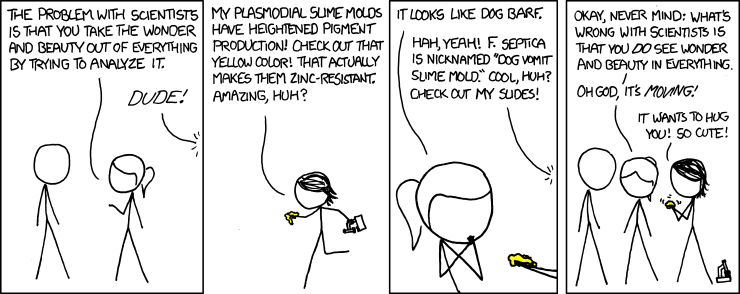
Some say science destroys wonder. I say it increaces it by many orders of magnitude. It magnifies everything, exploding our perspectives to previously unknown scales-- while at the same time massively increacing the detail and fineness of everything. We can now not only wonder at the beauty of the human form, but also know the trillions of cells living therein, with their own amazing architecture; also the ecological supports to our lives on the larger scale. We can now look at threads running everywhere, even to the stars, and temporally through natural history. An excellent book that reflects this is Annie Dillards Pilgrim At Tinker Creek, a favorite book of mine. It's deeply poetic, full of awe at the world around us, but based in science, in fact. It's close to what Richard Dawkins wanted when he wrote Unweaving the Rainbow, his answer to Keat's accusation that science destroys wonder.  

The microscope and the telescope have done more for the cause of wonder than any theology in history, for those who are paying any attention and sensitive to their implications. 

What I like most about science is that it is empirical. It looks first, then thinks. It doesn't read the dogma, then go looking for evidence to support it-- not in it's pure form. Instead it is simply open to the real. In this way science is very, dare I say it, spiritual. In a Zen way, at least. It encounters the world with attention and concentration, to see what is really there, what is actually happening. This is the prefect starting point for accurate knowledge.

Temples of the new age
The problem is that, in the end, science tears the world to pieces, so they can reassemble them; like a kid trying to fix the lamp he broke playing football in the house, to try and pass it off to us as truth, the glue running down the side, tape hanging off, and half the pieces missing.

What I mean is, science leaves us with only a model, a framework of ideas. I'm not saying there's no place for analysis, study, investigation; truly I'm all for it. But paying too much attention to mental models, be they religious or scientific, keeps us seperated from the real. They are sketches, rough estimates. They are useful, especially science which I admire in principle, but it's best not to be too attached to it.

Example: take a hundred data points and throw them on a graph; science will draw a line through them to show their average, and that average is what he holds on to. But that's not real. The reality is the hundred seperate points. The Law, the theory, the description, comes after, and is only a rough approximation of those points. There's no Law of Gravity, there's just things moving in space. We later came along and described the happenings, which, while seemingly consistent, do not actually obey our law. That is a Judeo-Christian notion with the Judeo-Christian removed; that is, the idea of laws of nature is a historical holdover from when it was thought science was discovering the laws of God. We're not discovering anything; we're just describing.

Science is provisional. Science admits this, many scientists do not; there is a reason that a scientist is far more likely to be an atheist or agnostic. Science has become their faith, though they'll call if hard truth, ignoring the many assumptions and fudge factors (such "constants" in their equations). Certainly most media reports treat science as holy dogma, absolute truth handed down by the men in white robes lab coats.

Finally, a quote: "The larger the island of knowledge, the longer the shoreline of mystery" --Mary B. Yates. Kinda sums it up, eh?

Saturday, April 9, 2011

Pax Americana?

Today I was thinking about war and the USA. When, I wondered, was the last year of peace we've had? I knew we've been fighting in Afghanistan since 2001, and then of course we've been in Iraq since 1990, with our No Fly Zones and near-daily sorties. I knew we'd had things like Panama and Grenada in the '80s, but didn't know when they happened.

From 1776 to 2011, that's 235 years of existence as a country. My question was what years have gone by without a military action. It's a bit muddy and uncertain, but it looks like, all told, we have had just 39 years of peace, counting occupations, by using a combination of this list and this list:

1796-7
1811
1820-21
1826
1827-31
1833-4
1843-5
1859
1880-89
1891-92
1894-7
1935-40

We haven't had a year of peace since 1940! Many of these wars, incidents, conflicts and occupations I'd never heard of. All the things in the Carribean and Central American banana republics are not taught in school. I admit, I'm counting the entire Cold War as a war. But if you only count actual military actions like Grenada and Panama, and proxy wars like Korea, Vietnam, we still haven't had a year without US military action since 1988, just before Panama... though even that is pretty debatable as being a "peace" year.

But breaking down the Cold War into actual military actions, of troops-on-the-ground, gets muddy. How do you define when we got involved in the Vietnam war? We had "advisors" there since 1955... but what's an advisor? The date on the list says the war started (for America, that is) in 1959. And while we aren't really occupying South Korea, we have troops there, and technically the war never ended. Of course I didn't count CIA missions, which opens up a whole 'nother can of worms.

I didn't count the many, many instances of troops (usually marines) being sent to this or that country to protect American lives and interests while said country is in a rebellion or whatever, nor did I count "displays of force" which struck me as naval exercises. They're both kinda borderline, so I opted to only include times when the troops were really used for war. If I had counted them, hardly a year passed where it didn't happen somewhere.

Most of the wars and actions that I did counnt were to support American business: anti-pirate actions, support for banana/fruit companies, and so on. Oil, of course. This isn't to say none of our actions were justified. The raids on the African coast against the slavers, after a law banning slave trading was passed, sounds alright to me; but still, many seem greed-influenced. That, or genocidal. We were fighting Native Americans for the entire first half our existence.

Many questions arise: Has there been a president who hasn't ordered troops somewhere? Can a country that is so devoid of peace really understand or support democracy? Why have we been so militant from the beginning? Is there hope for us to become a peaceful, truly prosperous country, without the use of force to ensure said prosperity? Can we ever leave this sick sort of economic terrorism behind?

Wednesday, April 6, 2011

Aliens


I believe in aliens.

I don't figure they've visited us. No human can keep a secret, not really, and certainly not one that big, and certainly not a group of people. Someone's gonna leak it. Anyways, you don't travel the light years of space to sneak around anally probing rednecks and hillbillies. I think it's more likely to be top secret military jets and spy craft, or natural phenomena.

The universe is... unutterably, unfathomably, ineffably huge. The number of stars in our galaxy alone staggers the mind, but there are as many galaxies in the universe as stars in our galaxy. Many of those stars have planets. How can we be the only planet with life on it? Any life, intelligent or not.

But here's the thing. What I just said may not be true. The things we know, are not actually things we know. People used to know that the sky was a hard firmament upon which moved the sun and stars, the Earth in the center. People used to know the Earth was flat. People used to know that flies came from spoiled meat. Science changes often. Sometimes radically, major paradigm shifts. Science is relative, not absolute, and could be a laughable myth that will some day be the butt of a future society's jokes.

Conditions conducive to life are pretty narrow and specific. I'll admit we only have Earth life to study, and maybe it could take other forms. But we don't know that. Maybe the universe is not actually so ineffably big, maybe we have it wrong. Or, maybe it is big, but the dice were thrown and somehow only came up sevens here. Good ol' Earth. Possible.

So, belief or not, the belief is empty. Doesn't matter. We know very few things, really, one of which being that we are alive. We don't know about the stars or even what live is. Only that we are alive. We will probably never know of any other life. We could truly be the miracle of the universe. I guess I'm saying, let's take some care of it.

No, say not "it." Say rather, "us." We are one Life, after all.

Monday, April 4, 2011

Anger


Lately, I've seen in a few places where people have said anger is an unhealthy or negative emotion. I care to disagree.

Anger is, like every human emotion, healthy. But I do make a distinction. For me, there are two forms of anger. The first I call righteous anger. This is when someone has done an injustice upon you; and I'm using "you" in its broadest sense. It can apply to nations. Say what you want about nationalism, the anger felt by us Americans after 9-11 was normal and healthy. It'd be inhuman to not feel angry, and I doubt even Jesus, the Buddha, or Lao Tzu would be so heartless. Anger is the fire that drives action towards justice. Very useful.

Then there is when things don't go your way, when people don't do what you want them to or don't live up to your expectations. This is ego-anger. The anger of the little king or queen we all feel ourselves to be not having the world bow down to their whims. This some might call unhealthy, and maybe it is (but I think it's really the ego that's unhealthy).

In fact, I'm kind of tired of people denigrating sadness too. It's normal to feel that way at times. I heard a while back they were adding grief to the DSM IV, the Diagnostic and Statistical Manual of mental disorders, the Holy Bible of psychiatry. I was majoring in psychology before I quit school, and hearing shit like that makes me glad I got out of the field. As if there's a time limit on what constitutes healthy grieving a dead child, and after that you're sick. Sadness in it's basic sense is normal too. People aren't cheery all the damn time, and telling them their sick for being down in the dumps is itself sick and wrong.

The real issue is what we do with these emotions. Bottling it up, supressing it, this is not healthy; expressing the emotion is obviously better. Yet what's unhealthy about anger is usually the way it is expressed. The expression is the release, the way through it; ignoring it isn't going to work, nor is drugging it away. The nuance is this: you have every right to be angry, even to be hateful; you do not have a right to hit your spouse or kick your dog, and you do not have the right to strap on dynamite and blow up a bus.

It gets tricky, though. How do you safely express your anger when your boss does something stupid that is going to cost you hours of tedium? Do you bury the feeling and keep your job, or tell him what you really think? Part of the solution might be to express, somehow, the emotion in the very moment it rises. Let it rush in, and out, like a passing storm. Or maybe expression in the exact moment isn't necessary; but get it out soon. I find anger and exercise go together great: do some push ups, or run a mile or two. Anger is energy. Hold it too long and it turns to hate.

As for sadness, crying is fine, or listening to sad music, writing a poem or journal, or whatever works for you. I think Freud called this sublimation, the turning a "negative" emotion into some kind of positive. I guess depression is sort of the negetive side of sadness, that of dwelling too long on it, from not expressing it and letting it go. Like hate, it is a trap. We have the right to feel these ways, but they aren't good for us and are the sign of neglected emotions.

I do know one thing. Psychology/psychiatry should be focusing not on pathologizing these natural emotions, but on helping us deal with them in productive ways.

Saturday, April 2, 2011

Looking Back, Looking Ahead

One of my supervisors at work asked me the other day if, five years ago, I ever would have dreamed I'd be living in Texas. I thought a minute, and said, "a thousand times, no." We both laughed.

Not that it's so bad here, really. All I mean is that five years ago I never would have dreamed what directions my life would take. Back in 2006, I was living a hopeless life. Stagnant. College dropout, just working at a dead end job which wasn't terrible, but wasn't great by any means. No goals. I had an online journal back in my late teens early 20s, which I'll never post here, but I look at it sometimes, and try to remember what it was like then. I always find it amazing how depressed I was.

That spring, I embarked on a cross-country bicycle trip, my first hope of breaking out of my doldrums, with no plan but to make for the coast. On the ninth morning of the trip, I was creamed by an 83 year old lady driving a Buick in New Ulm, Minnesota, breaking my bike and very nearly me. I wore no helmet, but was lucky; I survived with only some bad contusions and road rash, but had to limp on back home via America's favorite traveling option: a Greyhound bus. Truth is I wasn't enjoying the trip that much anyways. I was trying, and naturally failing, to run from my demons.

After that little changed for a while. I got a second job to fill my hours up, moved out of my parents' house. Tried returning to college, lasted about two weeks. Finally in the winter of 07 I finally decided to hike the Appalachian Trail, which in 2008 would prove to be the catalyst to finally change my life, to teach me what happiness was and to rekindle my spirit. Since then I've been travelling a lot, working seasonally, three times in jobs involving hiking or trails.

I look back at myself, and at myself now. When I was 17 I would have laughed if you said 10 years from now I'd be some kind of hippie-ish*, hiker-trash guy, living in Texas of all places, hiking these long distance trails, working occasionally, and, the kicker, writing a spirituality-laced blog. I was a pure, strict athiest back then, looking towards graduation and college, assuming I'd have a career someday, a stable, normal life. No one would have said I had it in me for living this way. While I've always loved the outdoors, I was the shy kid who didn't go out much, never the risk taker, the adventurer, and certainly don't conform to the "adventure sports guy" persona. I'm not even very athletic, never was the "physical" type. I'm not the type at all to be living this way.

Yet here I am about to go hike the Pacific Crest Trail. And I don't know where I'm going after that. It's a little scary. I find it amazing that a reserved and cautious person like me is at the same time living this totally unsecure life. Very curious.

But it all just goes to show that you never know where life will take you, what it will make of you. Look back 5 or 10 years in your own life, and ask yourself if the path you've since taken was at all obvious back then. It probably wasn't. The raw material of us, our deep-seated loves and likes, those few core personality traits, can find very unforseen expressions as life plays out; the interplay of variables shuffles your life in a new and unexpected arrangement.

Whatever there is to be said of life, at least we can say it's very interesting.

(*I am NOT a hippie.)