Saturday, November 19, 2011

Scarcity, Abundance, and Food


Well, I just finished reading the Grapes of Wrath. That book always hits me so hard, no matter how many time I read it, infuriating me, tearing at my heart. The Joads may be characters in a book, but they stand for a reality, archetypes, so to speak.

Got me thinking, as you'd expect, about the Depression, the banks, debt, and our economic system. Seems the depression's travails were largely brought about by overproduction, as well as the environmental catastrophe of the Dust Bowl, and rampant speculation. It really boggles the mind to consider that in a time of overproduction, people were starving. And it's because we have an economy based on scarcity. We had so much food back then, so much fruit in the vinyards and orchards, too many cattle and pigs, that prices fell so much that they couldn't sell it. It cost more to pick the fruit then you could get for it, cost more to raise the beef than you could sell it for. So they let the fruit rot on the vine, or piled it in heaps and poured gasoline on it so it would be inedible; they slaughtered 6 million pigs and wasted them.

This, to stabilize prices. We are so insane in our abstraction that we forget reality. Money is a symbol for wealth. Who the fuck cares about dollars? The point is the food you can get with it. And we are so insane as to let the big owners to let people starve rather than forego their symbolic wealth. A moral people would have distributed the food, to save those starving masses. Only, then the system of scarcity (that is, scarcity for the masses, not the owners) would fall: the masses would get used to having enough to eat, they might get cocky, and surely won't go back to buying it, will they?

Starvation in a time of plenty. It is literally a mark of craziness on our society. And it goes back thousands of years, since the first guy had a silo and kept everyone's grain in it. He sure had 'em by the short and curlies then. Like when there was a famine and all the Hebrews went to Egypt to buy food, often indenturing themselves for it. It took a Moses and ten plagues to liberate them. Ever stop to think what plagues might be coming our way? Climate change is a giant monkey wrench coming down the line, and the roiling and growing poverty is going to work great changes on our society. Given that the Depression was a man created thing, and moreso a bank-and-owner created thing, I have to wonder who's orchestrating our Great Recession now, and what tricks they're using. I'm not educated or informed enough to know, but I do know the boom and bust cycle is part of our planned economy, to a much greater extent than it is a natural thing.

How few  and consolidated ownership is getting. Monsanto and Conagra control vast swaths of the food production. Five corporations own almost all of the major media sources, so even truth in news and information, food for the mind, is scarce (thank God for the internet! For now, at least). What happened to abundance? I once read this comic book series called Testament. It's a weird story mixing a fascistic near-future with biblical narrative and pagan gods of long ago, the storylines mixing and eventually merging. Anyways, at the end the human protagonists figure out a way to screw the meddling gods that live beyond the panels; the people exit the worldview of scarcity in favor of one of abundance. This is what we need to be doing.

I recently read a book called the Voice of the Planet, a compelling if strange book, where an environmentalist professor is contacted via computer by the planet itself, and is taught many lessons about the wrong path we're going down as a species, and some things that need correcting. Has some pretty amazing sequences in it, though it's a bit tedious getting to the point. Anyways, it makes the point, when talking about famine in Bangladesh, that most people there work land owned by absentee owners, who deal in money, not crops. Ownership is concentrated in relatively few hands, and thus are grown fewer and less nutritional or non-food crops (like cotton) for export to the global market. Sound familiar? This is as true for Bangladesh as it was for America in the 30s and today, for food production as well as everything else.

Beyond the giant ownership problem, which cannot be overstated, is the way we think about food. Firstly that we call it a commodity, rather than the foundation of life. That says a lot about us, and relates to the aforementioned poverty and famine. Second, we eat very little of what the Earth has to offer. Who would think to eat an insect? Ants are supposed to be delicious roasted, and most insects are edible and nutritious. In the Grapes of Wrath, the family is half-starved, but when they run over a snake, no one stops to pick it up, even though that's good meat. You can go out and eat cattail roots, very high in starch, as are day-lily tubers, right there in your own garden. Pine sap can be chewed like gum and has some sugars, acorns can be eaten if blanched of the tannins, dandelions are extremely high in vitamins and minerals and medicinal to boot-- there's food everywhere!

Yet we limit ourselves to a few key crops (wheat, corn, soy, rice, the few popular vegetables and fruits) and a few animals (cow, pig, chicken, a few fish); and being limited, these are all the more at the mercy of market fluctuations. Native cultures don't do this, not the hunter gatherers. Even though today the few remaining hunter gatherers often live in more barren areas, like the Bushmen in the Kalahari, since the good land was long ago stolen by agriculturalists, they still have a hugely more diverse diet than us, even with our supermarkets and global exchange. If one food gets scarce, they have many others. Native Americans, even the agricultural tribes, even those that developed civilization, the Moundbuilders, especially the Mississippian culture at Cahokia, even they maintained, if only as a back-up should the crops fail, a diet founded in the diversity of the natural world. They could always melt back into the forests and prairies, and often did. Diversity was their way, they didn't put all their eggs in one basket.
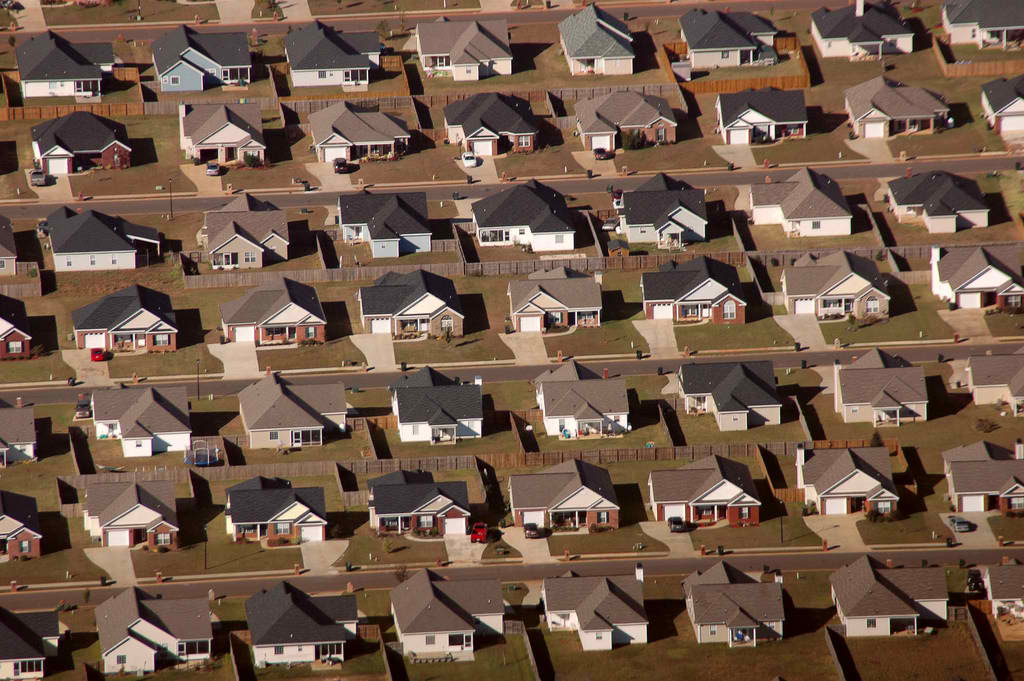
Homes for people, but what about
the rest of the biosphere?
How does this apply to us? Well, I forget the statistic, but something like between 70% and 90% of our processed food contains corn in some form, it was something staggeringly high like that. Meanwhile, the dwindling numbers of homeowners grow wasteful gardens of ornamentals, rather than food, thereby ceding power they might realistically and easily keep. The sprawling development here in Florida is displacing the crackers, the traditional cattlemen this state once was filled with. All across the Midwest, in California's and Pennsylvania's valleys, and in the Southeast, like around Atlanta, we put the new suburbs and strip malls on excellent farmland, erasing productive land from use, and then grow lawns or asphalt on it. We're losing our topsoil because we care about profits, not fertility; because we live in a mindset of scarcity (not enough dollars!) rather than one of abundance. We need more CVS stores, more Walmarts, more 2000 or 3000 sqft single-family dwellings! Even though a 12x16 cabin used to do for a family of 8.

Even without submitting to eating beetles, we could do better. As Aldo Leopold wrote, "Nothing could be more salutory at this stage than a little healthy contempt for a plethora of material things." The simple life, to be brief. That is, to step back from the relentless rat race (it takes a rat to win a rat race) and reevaluate. I'm not talking about simplicity as scarcity. I mean it as clarity. If people had done that in the 30's, those cattle wouldn't have been wasted, the fruits wouldn't have had to rot while thousands starved. Possession is nine-tenths of ownership-- squatter's rights. We might have took charge of that model of scarcity that exploits the many for the comfortable few, and realized that this world is seething with food and the stuff of life, if only we could see it, and if only we could share.

And that is the hope Steinbeck gives us in Grapes of Wrath. Yes, we're left hanging, wondering about the fate of the Joads; yes, it's a sad and bleak ending, but not entirely. The people have found each other and forged a community of the road; the migrants share what they have, poor as they all are. Community over ownership. If you have a little and he has none, you get together and you both have a little. This is the power of the people, this is resilience. No one has a right to starve another, but we're right back where we were in the Depression, lesson not learned. But when the 99% finally get together to realize that they are the majority and strong when they stand together, we're unstoppable. I don't know if I'm advocating localism or socialism or communism or what; can't label it like that, and don't know what the change is going to look like. But change is in the air, and the elites are getting scared.

And they should be.

Wednesday, November 16, 2011

Talkin' Old Truck Blues

It's a strange thing. Here I just wrote about the burden of possessions, and then I go and dump over $1500 into my truck's front end. Ouch. At the same time, I'm reading Grapes of Wrath, about the Great Depression, the masses of people suffering through hard times, with Steinbeck's musings on what might be when those distressed and angry people all get together... and as I'm sitting in the mechanic's lobby, thinking not only of my times on the trails with only what was on my back, but also about the times this country and world is facing now, the Occupy protests being shut down, unemployment up and no end in sight... I'm a bit conflicted, and stirred up inside.

On the one hand, I know the pain of being stuck, the difficulty in staying ahead of bills and costs, and though I resent it at times, I know I'm not getting rid of my truck any time soon. But ah, how nice it would be to not need it, if public transit existed or could exist in these diffuse, scattered cities of single-family housing, cities with no real centers, just sprawls of development on the cheap and cheapened land. I'm as stuck as anyone else in a system that I requires I dump money into the suck-hole that is a vehicle, which I need for getting to work, where I have to work all the harder for it, and for less of a wage than I should be making. Wages always fall behind inflation; even when we get raises, we're still getting pay cuts every year.

On the other hand, I've lived the truth of simple living, I've walked that path and found it good. How we value things, and how little those things mean in the end! Yes, you need some gear to get by, be it hiking gear on a trail or the accouterments of daily life. We make so much of nothing: the owners on the one hand obsessed with owning, those without always trying to become owners themselves, and always failing and being miserable about it. Everybody always looking up, and trying to climb there, never happy where they are. I say, the less you need, the less you need to work-- and then look how much more free time you have! Time for what matters, and less stuff to worry about, and less stress about "getting ahead."

We should have let the banks fail, should have let this system crash, and from the ashes built something more sensible. So, I have an idea that it would be better to opt out. Of all of it. Let's get local currencies going, let's barter among ourselves, get black markets going, and cut the banks out of it. Why should they, or for that matter the government, profit because you and I make a private transaction of goods and services? We use the banks' money, Federal Reserve Notes, and we are taxed by the government to do it. Then the banks fuck around with interest rates and push inflation on us, constantly devaluing the money we have to use, so it gets harder and harder to live. Why do we go in for these shenanigans?

It just seems we are all working so hard to stay in the same place, though more often falling behind, and all because we can't see outside the box, can't see that this system is not set up for our benefit, can't see that there are other options, other perspectives. I'm not saying that all of our woes fall on us, the lower classes. In fact, it is my adamant belief that this system was built not by us, and that is why it fucks us every time; it is of, by, and for the rich and powerful. But I am saying that we have a responsibility and a right to do something else that is in our own interest. But first one has to see other possibilities, other ways of looking at it.

That's why this Occupy movement seems so cool to me. I like that people are talking about this stuff, in living rooms, in diners, in mechanics' lobbies, in bars. I'm disheartened a bit that the green movement seems dead, since all anyone cares about now is jobs (growth), but maybe if this system really gets the shaking up it needs, that will be part of the new order. And I know it's hard to live against the grain, to find a new way to order your life; so much easier to just go along.

But one thing is for sure, something has got to change. We're so inflexible, so unable to act responsibly in everyone's interest, that we're heading for environmental disaster. I know I've been talking economics mainly, but these two things are deeply connected. The insane lust for profits (growth) is killing our planet, but we can't stop the killing without somehow fundamentally altering our economy. I'll leave you with this: I heard the other day that there's a 1 in 10 chance now that by the end of the century, global temperatures will go up 7 degrees Celcius, effectively ending life on Earth as we know it. You like those odds?

Saturday, November 12, 2011

Back from Texas

So I just got back from Texas today, drove for 20 hours straight (or, if you don't count the hour and a half break at a friend's, it was really more like 24). It turns out, sleep deprivation can be kinda fun. Though, that last hour this morning was a little dicey. It was 8 A.M., but the last sleep I'd had was over 26 hours ago at that point, and it was only 4 hours' worth at that, so... I was definitely zoning. At one point I remember noticing the mileage number, then looked again in what felt like about two minutes... but I was fifteen miles down the road.

Turns out also that I have way too much stuff. Not that most people would agree, since it all fits in my little extended cab Ranger, and there's no furniture at all. Still, I thought I'd winnowed my possessions down before putting it all into storage, but apparently this was not the case. Perhaps it's just because I've been living without all this stuff for so many months, that it just seems so much more superfluous than ever-- I obviously don't need it. In a way, it felt like a weight on me just to go and get it all. Like, I'd missed some of it, namely my CD collection, but clearly it's not necessary to my life or even my enjoyment. Maybe someday I'll be like Diogenes, eh?

But the truth is, I have a lot of crap I don't need. Probably about a third of my stuff is books, another third is backpacking/camping gear, and the rest clothes, CDs, my bike, and a lot of miscellany. Doesn't really add up to much, but I had what we'd call on the trail a "pack explosion" when I unloaded it all here at home. A room explosion, I guess. It was immediately stressful to me, even back there in Texas as I tried to get it all in my truck's extended cab. In fact, I couldn't do it, if partly due to haste. Fortunately the forecast was good, so I just put the overflow in the bed.

Shoes I'll probably never again wear, too many shirts, some of which don't even fit me or are getting rather worn, random scavenged cookware... I also have several backpacking stoves I probably won't use again, having switched to alcohol stoves and woodburners, but I can't throw them out, they're perfectly good stoves, and kinda pricey. Too much gear altogether, but one tends to collect such things when one hikes and camps as a partial lifestyle.

I got it all organized though, and filled a garbage bag with junk, as well as collecting a pile of clothes for donation. There's still more I could get rid of, much more, though not much in terms of space-saving... but I just can't do it. Those shoes, for example. I'm not a shoe collector, at all. But since I have them, and they're still perfectly good shoes, I hate to toss them; shoes aren't exactly cheap. Of course, I wear my homemade sandals most of the time, or otherwise my work shoes, so I'm not sure what the issue is. Guess it's just hard to let go sometimes, even for me, the anti-packrat.

On a related note, I've decided I'm going to start meditating more. Which is to say, I'm going to start meditating. Kinda fell off in the practice there, but I've been meaning to get back into it. I suppose I write this just to help encourage myself, since I'm sure no one cares. I just find that I've been getting sucked into too much TV in the evenings, which could be time better spent, including sitting for a while every day.

This post it a little scattered, sorry. I still haven't slept...

Thursday, November 10, 2011

Back in Dallas

Weird. I'm in Dallas today, back to get my truck and other stuff, which I'd left here for my hike and then afterwards when I flew direct to Florida after my dad's accident. Finally time to go back for it. And as if in proof of my previous post about the energy of a place, my left eyelid is twitching again.

It was doing this all the time last winter and spring before I left for the Pacific Crest Trail, but had stopped just a day or two into the hike, never to return. And now it's back. At first I thought it might be the caffeine: I've been off the juice for almost a week now, but stopped in to my favorite Dallas area coffeehouse for old times sake and to kill some time. Halfway into my cup of coffee, it started up. But caffeine has never affected me that way, even after a break. It's very strange, I think this place makes me jumpy or something.

And there is a different air about this city, I just can't explain it. More energetic and dynamic than retirement-ville in SW Florida, but there's also a sort of undertone of negativity, something I was feeling last winter, when I felt rather depressed and down and out, poor. Like there's some big money-focus here (though not as bad as in downtown Houston, let me tell you).

I'm really fascinated by this. I'm sure some of it is climate induced: Detroit always had a bit of a depressed feel, and it's cloudy and grey so damn often it's easy to see why, plus the 5 months of winter cold. Not to mention the depressed economy, of course. There's probably all kinds of things that go into a particular feel of a place: local economic priorities (tourism in Florida, manufacturing or the lack of it in Detroit), weather and climate, lattitude, topography, history, the cultural and racial mix, size of the town, water (lake, river) or lack of it...

I wonder what others have to say about this, about where they live in comparison to other places. Have you felt this effect?

Tuesday, November 8, 2011

Life and Death

Life is good

It seems, sometimes, that there much more death out there than there is than life. Most creatures, from trees to frogs, from beetles to mice, produce enormous quantities of offspring, but most die or are killed and eaten long before they mature to adulthood. All those dead sea turtles, all the seeds fallen on hard ground, the million sperm that die to make one human. How dismal, how wasteful.

But, consider a truth. Life and death are perfectly equal: every living thing dies, while that which is not alive cannot die. Nothing is added, but nothing is lost. Balance and harmony. 

This pic is here because,
well, it just cracks me up.
Then again, death is momentary, but life is prolonged. It endures, if only for a little while. A tadpole dies in an instant, but may have lived for three whole days. Who knows how long a seed may last before it is no longer dormant but truly dead. And, all that dies, every last bit, becomes food for other life.

So. There is far more life than there can ever be death.

Further, if the vast majority of organisms die before reaching maturity, then adulthood is the exception. Most living things that enter and exist in this world are, as it were, children.

So why so serious?

Sunday, November 6, 2011

Entrainment

This post is third in a series, go here for the first post

I wrote once about a weird fantasy I have, of going out into the desert to meditate in solitude, to see what I'd find without distraction. Trey from The Rambling Taoists made the intelligent comment that I probably wouldn't find anything out there that I couldn't find in my own living room. I agree with that in principle, but there are two problems, or issues, to consider.

The first is the distractions. In my house, there's the TV with a couple hundred channels, there are movies on tape and DVD, books to read, I can jump on the internet, I can play with my dog, or get on the phone and call someone up, and nearby are restaurants, coffee shops, movie theaters, stores, and so on, a million different things to do should I get bored. So the level of discipline must be far higher in my house than in the desert. To get to the desert level of distraction, I'd have to become a recluse living in a room with nothing in it, like monks have always done. I currently have a hard time getting myself to meditate for 20 minutes a day.

Of course, because meditation is boring to the ego, I'd find distractions in the desert same as I do now: I can watch the ants roving over the rock and sand, can throw stones at chosen targets, stare at mountain ranges in the distance and wonder what's there, concoct all sorts of stories and fantasies involving my surroundings, or maybe totally disconnected from where I am. But of course, it would be easier to be reminded what I'm intending to do, by virtue of the fact that I've come all the way out here into these stark surroundings to do it, not to mention that those distractions and amusements themselves become boring after a while. So, while discipline would still be called for out there, it clearly would be of a less intense nature. This is one reason I believe wise men often went out into Nature, or otherwise the monestary.

The other issue is entrainment. Entrainment is what it sounds like: getting into a groove with what surrounds you. It was discovered in 1665 by Christiaan Huygen when he noticed that one of his pendulum clocks ran a minute slower than another. He placed them side by side, and found that, after a while, they now kept the same time; in fact, they ended up working out a sort of compromise, running at the same time, but 30 seconds slower than his pocket watch, which had before run in harmony with the faster pendulum clock.

This happens biologically too. I remember seeing a documentary when I was a kid which showed two heart cells in a petri dish. Each beat its own rhythm, but they slowly neared one another and finally touched. When that happened, almost immediately, they adjusted to one another and beat in one rhythm. Same thing is going on at a larger scale with circadian rhythms, and with women who live in close association, the way their menstrual cycles tend to coincide (just imagine the PMS that goes on in a sorority house. Yikes!). Or think about the way you entrain socially; if you hang out with someone a long time, you start to talk alike, picking up each other's phrases, expressions, even cadence. To say nothing of their memes.

This is what I was talking about in my posts (first, second) about the echoes of the mind. There is a very noticable shift in one's mindset when one goes out to Nature, be it the woods, the mountains, the sea, or the desert. This isn't anything mysterious or unknown, this is the major draw towards the outdoors and especially the back country. People go fishing not just to catch fish, perhaps not even primarily to catch fish; but because it is inherently relaxing. People camp not to sleep uncomfortably on the cold, hard ground, but because there is a rhythm out there that they want to entrain with, at least (usually) on a subconscious level. People just know they feel more relaxed out there, so they go, not really thinking much about why. And of course, that's fine, it works the same.

So even if I'm a recluse in a bare house, with no mass media devices, no books, no phones, no other person around, I believe I'll still be caught up in the rhythm of the city. It's not about interaction as much as it is proximity. The clocks in the experiment never touch or interact directly, but the effect is there. Likewise, if you travel much and are sensitive and paying attention, when you arrive in a new city you notice that it often "feels" markedly different from others.

This is probably even more true with international travel, but as someone who has mainly traveled in the US, I can say that Dallas feels very different from Detroit, and Logan UT differs greatly from Wichita KS, and even from St George, UT. Even the West Coast cities of San Francisco and Portland feel quite different from one another. Mountain towns feel different from seaside towns, and desert towns from farm towns from forest towns. This effect is being deadened somewhat by the spread of national and transnational corporations, the McDonaldization of the world. Still, each place has its own energy, and this can be felt right away. It is all around you, and staying in your house won't escape you from that energy.

So heading out to the "desert" or Nature is partly about leaving distraction behind. But another, bigger part of it is about entraining to a larger, older, more natural rhythm or energy. Where the big energy is the rise and fall of the sun, the breath of the wind, the deep vibration of the landscape in which you find yourself, be it desert or forest, by the sea or in the mountains. This is taking my point about letting the echoes fade to another level, something deeper than a mere shift in conscious thought.

The process starts quickly. I've found on past camping trips that as soon as I get out of the car, take a deep breath of the forest air, I'm already "unwinding," which is a rather telling term. I am loosening the mind from the forms and content of the city, finding myself immediately speaking quieter. Given more time, this can get really deep. On long treks I've taken, such as on the Pacific Crest Trail and especially the Appalachian Trail, I get almost spacy. Staring at the trees was a common pasttime for many on the AT, and when we'd finally get an exposed ledge or open summit, I for one could stare for hours if allowed (sadly, on thru-hikes you have to make miles). That was part of why I loved the PCT so much-- it's vastly more open for long views. There's a quietness of mind, an openness that isn't quite emptiness. I think this is entrainment. I'm becoming a part of the greater whole.

Wednesday, November 2, 2011

Philosophy

The longer you think about things, the less and less everything seems to make sense. Nothing makes sense anymore. Is there a meaning to life? What caused the Big Bang? Where did consciousness come from? Is there a physical world or is it all mere perception, all in the mind? Most of the "big questions" are unanswerable. You read through all the various philosophies, science, religions-- and there are so many-- you become enthusiastic time after time, only to find that in each one exists some fatal flaw, some unproven assumption, some fudge factor constant in the equation, some ungodly leap of faith. Did it all start from an uncaused Cause, or is it an infinite regress? Both are unfathomable, one of them is right. You have to choose, but you cannot choose. You are afloat in an endless sea of mystery, there's nowhere to stand, it's all floating away from you, the flat, empty horizon receding in every direction.
And there's no going back, no forgetting, no turning your back to the Question and quietly going about your day, back to the formula, marriage, children, work, placid retirement and grandchildren, the whole world in its proper place. You're circling a black hole, a swirling vortex from which you cannot excape. You think you must be going insane, you begin to understand madness. You are afraid on an atavistic level.

You would latch onto anything, believe anything; you would spend years in study in universities, monestaries, libraries. You would lay on any bed of nails, fast for weeks, measure whole continents with the length of your body on your road to the Holy Place; you woud meditate until your legs rotted where you sat, hide in caves in the desert, sit in trees, become an activist, go door to door, rave from streetcorners, believe in any damn thing-- if only it would fill the cracks, if only it would last. But always it falls apart under scrutiny. Your cognitive house is built not on rock, not on sand, even--but on nothing at all, you are way over the edge of the world, fallen over into the oblivion of pure agnosticism. You have decided you exist, but you are trapped on that tiny rock of truth, able to trust neither the senses nor the faculty of reason.

Mostly you get on okay, you act the part well enough, but the terror seeps in sometimes, like light through the cracks in your current system; but too uncomfortable, you are soon on to the next book, the next theory, the next really interesting idea. Confusion cannot reign, it just can't; but in the end it must, and so you run, run, like the mouse from the white wings of the owl who would tear you from your life and turn you into pure flight.